
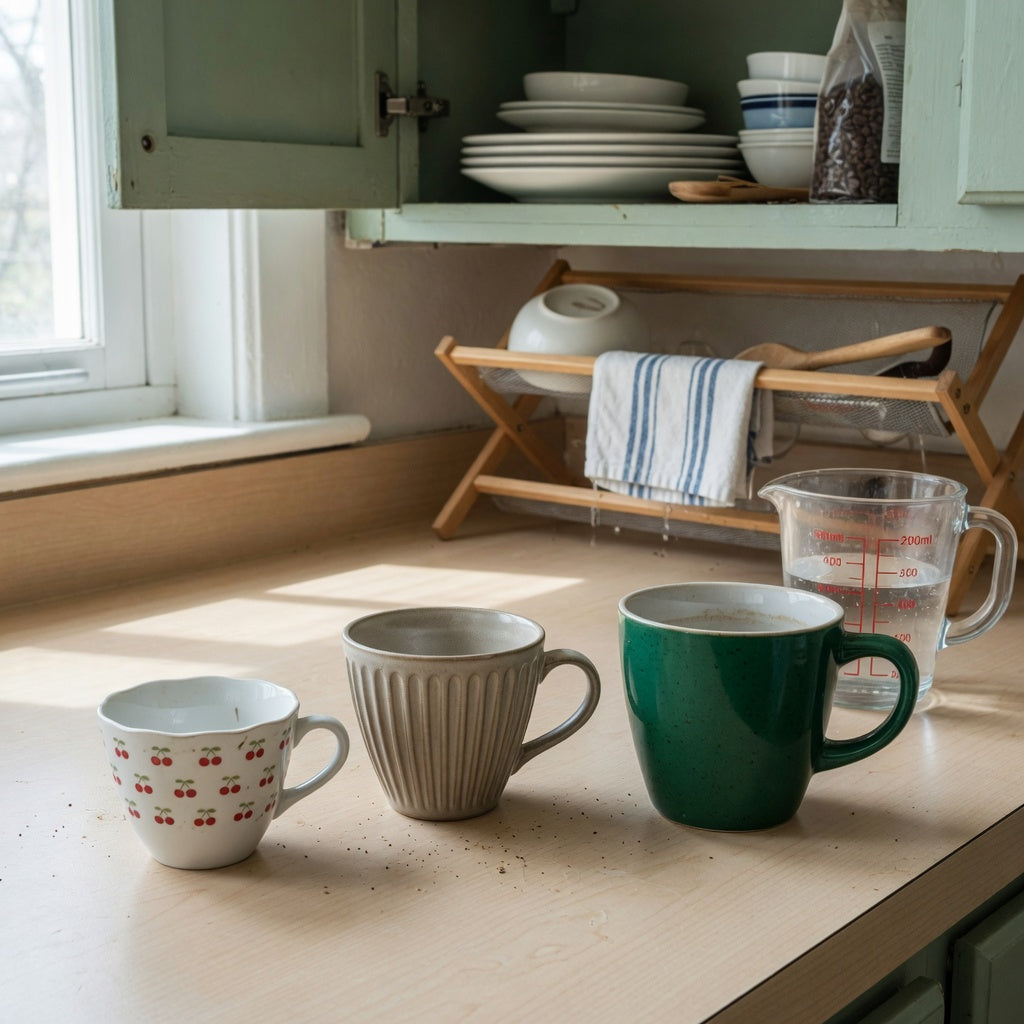
Lungo Coffee Cup Everyday Mug Rotation Product Shortlist Guide
Reading time: about 10 minutes
One cup is still on the office desk, another is beside the sink, and the clean mug in the cabinet holds much more than you want for the next pour. That ordinary rotation problem is what this lungo coffee cup everyday mug rotation product shortlist guide is designed to solve. In our store, the useful question is rarely which cup is best in isolation. It is which listed capacity works with the amount you actually pour, the headroom you prefer, and the places the cup occupies between uses.
We are keeping this comparison intentionally narrow. The verified catalog facts are the Retro at 170 ml, the Pleated at 200 ml, and the Emerald at 270 ml. We do not infer material, exterior dimensions, stackability, equipment fit, dishwasher compatibility, or a universal lungo serving volume from those figures. For the same measured pour, a higher listed capacity provides more numerical capacity margin, but actual space between the liquid and rim also depends on the cup's internal shape and your fill level.
How does the lungo coffee cup everyday mug rotation product shortlist guide narrow the choice?
Start with your own pour rather than a drink-size rule found elsewhere. Measure one typical prepared serving in milliliters, including any water or milk you normally add. Subtract that amount from the listed cup capacity. The result is your numerical capacity margin, which is a useful comparison point but not a measurement of physical rim clearance.
- Measure a normal complete pour with a kitchen measuring jug. Do not change your routine just to make a particular cup work.
- Repeat the measurement on a second day if your weekday and weekend servings differ.
- Decide how much capacity margin you want when carrying the cup from the kitchen to a desk or table.
- Check the cup's current exterior measurements against the shelf, counter, and drying area where it will actually sit.
| Option | Verified capacity | Position in this shortlist | Primary reason to consider it |
|---|---|---|---|
| Retro | 170 ml | Lowest listed capacity | Your measured pour stays comfortably below 170 ml and you prefer less unused capacity. |
| Pleated | 200 ml | Middle listed capacity | You need more margin than the Retro provides without moving straight to 270 ml. |
| Emerald | 270 ml | Highest listed capacity | You want the greatest capacity margin in this three-product group. |
The gaps are concrete: the Pleated adds 30 ml over the Retro, the Emerald adds 70 ml over the Pleated, and the Emerald adds 100 ml over the Retro. Those differences matter only in relation to your measured serving. Listed capacity should not be treated as a recommended fill line or an equipment-fit promise.
Is the Retro 170 ml the right first check for a crowded rotation?
If your normal serving stays below 170 ml with enough margin for the way you carry and drink it, the Retro 170 ml coffee and tea cup is the lowest-capacity option on this shortlist. It is the first product we show shoppers who say excess cup volume bothers them more than having limited room for additions.
- Choose it: Your complete measured pour fits without approaching the listed capacity, and you deliberately want the lowest-capacity choice of the three.
- Choose it: Different cups in your rotation have defined jobs, and this one will handle a modest kitchen or mid-morning serving.
- Skip it: Water, milk, or another regular addition pushes your serving close to 170 ml.
- Skip it: You carry coffee through a hallway or up stairs and prefer a larger numerical margin above the amount poured.
A 170 ml capacity does not prove that the Retro has the smallest exterior footprint, the lowest weight, the quickest drying time, or the best stackability. Capacity and outside dimensions are separate variables. For a crowded cabinet, treat the Retro as the first candidate to measure, not as a guaranteed fit.
Does the Pleated 200 ml suit a routine that changes by day?
The Pleated 200 ml coffee and tea cup occupies the arithmetic middle of this group. Its listed capacity is 30 ml above the Retro and 70 ml below the Emerald. That makes it a practical candidate when a 170 ml cup leaves less margin than you want, while 270 ml would leave more unused capacity than your routine calls for.
- Choose it: Your weekday serving and weekend serving vary, but both fit below 200 ml with your preferred margin.
- Choose it: The cup often moves from a kitchen counter to an office desk, and you want more capacity margin than the Retro can offer for the same pour.
- Skip it: You already know the lowest listed capacity is your priority.
- Skip it: Your complete serving regularly needs more room than 200 ml provides.
We often use the Pleated as the comparison point, not an automatic default. A middle capacity does not guarantee middle exterior dimensions, weight, or shelf use. It simply gives you a clear 30 ml step up from the Retro, making the effect of added capacity easier to judge against your own measured pour.
When does the Emerald 270 ml earn a place in the rotation?
The Emerald 270 ml coffee and tea mug has the highest verified capacity in this shortlist. For an identical measured serving, it leaves the greatest amount of unused listed capacity: 100 ml more total capacity than the Retro and 70 ml more than the Pleated.
- Choose it: Your prepared drink, including regular additions, needs more capacity than the two smaller options provide.
- Choose it: One cup stays at your desk for a longer session, and greater capacity margin matters more than choosing the lowest-volume vessel.
- Skip it: Your usual serving is modest and a large amount of unused capacity makes the cup feel mismatched to the routine.
- Skip it: Your shelf has strict height, width, or depth limits and you have not verified the mug's current exterior dimensions.
The Emerald is not automatically the better choice because it holds more. If your measured serving is above 270 ml, or none of these three clears your storage checks, compare other shapes and capacities in our unique coffee mugs collection rather than forcing this shortlist to cover a use it was not built for.
Does pour frequency change cup size or the number of cups?
Frequency often changes how many cups a rotation needs more than it changes the right capacity. A smaller listed capacity does not establish that a cup washes or dries faster. From what we see in our store, availability problems usually come from location: one cup remains at a desk, one waits to be washed, and another is needed in the kitchen.
- One serving in one location: Choose strictly by measured pour and desired capacity margin.
- Separate morning and afternoon servings: Decide whether one cup can realistically return to the clean shelf between them.
- Home and office use: Two cups may be more practical than carrying one back and forth, but test the capacity before buying a duplicate.
- Coffee and tea in the same rotation: Measure each prepared serving and shortlist against the larger one if a single cup must cover both.
A frequent-pour routine does not automatically favor the Retro, and a long desk session does not automatically require the Emerald. The serving amount still controls capacity choice. Frequency tells you how many clean cups need to be available and where they must be stored.
What should you measure on the shelf, desk, and drying rack?
Milliliters describe volume, not cabinet fit. Before placing an order, follow the path the cup will take from storage to pour station, drinking spot, sink, and back again. Our team uses this route-based check because it exposes constraints that are easy to miss while viewing a product on a screen.
- Shelf height: Measure from the shelf surface to the underside of the shelf above, including any front lip.
- Usable depth: Check that the cabinet door can close without contacting a handle or rim.
- Maximum width: Compare the widest point, including the handle, if that measurement is published on the current product page.
- Drying area: Note whether the cup will sit on a mat, over a rack slot, or beside other daily items.
- Dishwasher clearance: Check rack and spray-arm clearance only after current care instructions explicitly confirm dishwasher use.
The verified source facts for this shortlist do not establish material or care instructions. We therefore do not label these products as ceramic, microwave-safe, or dishwasher-safe here. Read the live product listing and the instructions supplied with the cup before its first wash. Appearance alone is not a reliable basis for assuming material or care compatibility.
For strict storage limits, use exterior measurements rather than capacity as the deciding test. If a current listing does not provide the dimension you need, do not infer it from the 170 ml, 200 ml, or 270 ml figure. That restraint is especially useful in shallow cabinets, tightly spaced office cupboards, and drying racks already shared with plates and glasses.
How do you test one cup before building a matching set?
A one-week trial gives you better information than ordering several pieces based on capacity alone. We recommend tracking ordinary use rather than creating an ideal routine for the test. Leave the cup on the desk when that is what normally happens. Let it compete for shelf and drying space with the items already in your kitchen.
- At unboxing, confirm the product name and listed capacity against the order.
- Place the cup on a flat counter and inspect the rim, handle attachment, and base for visible transit damage or unexpected rocking.
- Follow the current care directions before first use instead of assuming a wash method.
- Measure your complete serving on several typical days and note how much numerical capacity margin remains.
- Record where the cup spends most of its time: cabinet, counter, desk, sink, or drying area.
- Buy matching multiples only after the capacity and storage path work without special handling.
This inspection is not a prediction of long-term durability. It is a practical way to catch a visible delivery issue and confirm that the cup suits the routine you already have. For a gift, the same check is useful at unboxing because the recipient's shelf dimensions and preferred serving may differ from yours.
Frequently asked questions
Which capacity is the safest starting point for an everyday mug rotation?
There is no universally safest size. A useful lungo coffee cup everyday mug rotation product shortlist guide starts with your measured serving, then compares the remaining capacity margin across 170 ml, 200 ml, and 270 ml. The Pleated is the numerical middle, but it is only the right starting point if your pour fits below 200 ml with the margin you want.
Does 170 ml mean the Retro cup will use less cabinet space?
Not necessarily. Listed capacity does not establish exterior height, base diameter, maximum width, or handle clearance. Check current product dimensions against your shelf rather than treating the lowest-capacity option as a guaranteed compact fit.
How much more listed capacity does the Emerald have?
The Emerald at 270 ml has 100 ml more listed capacity than the Retro at 170 ml and 70 ml more than the Pleated at 200 ml. For the same measured pour, that creates more numerical capacity margin. Actual physical headroom at the rim still depends on internal shape and fill level.
Can I assume these cups fit my coffee equipment or dishwasher?
No. Capacity alone cannot confirm clearance under coffee equipment, and this comparison does not provide a dishwasher-fit or dishwasher-safety guarantee. Verify current care instructions and compare the cup's published exterior dimensions with your equipment or rack before relying on either fit.
Should I buy several cups in the same size at once?
Test one first if you are uncertain about capacity, shelf clearance, or desk use. Buying multiples can solve availability problems only after the cup itself fits the routine. Otherwise, it repeats the same mismatch across more cabinet space.
Your next step: measure one normal prepared serving, write down your shelf height and usable depth, choose the capacity margin you prefer, and verify current material and care details on the product page. Then compare the three linked options with the broader unique mug collection and shortlist only the cups that pass every check.
More from our blog
Read more
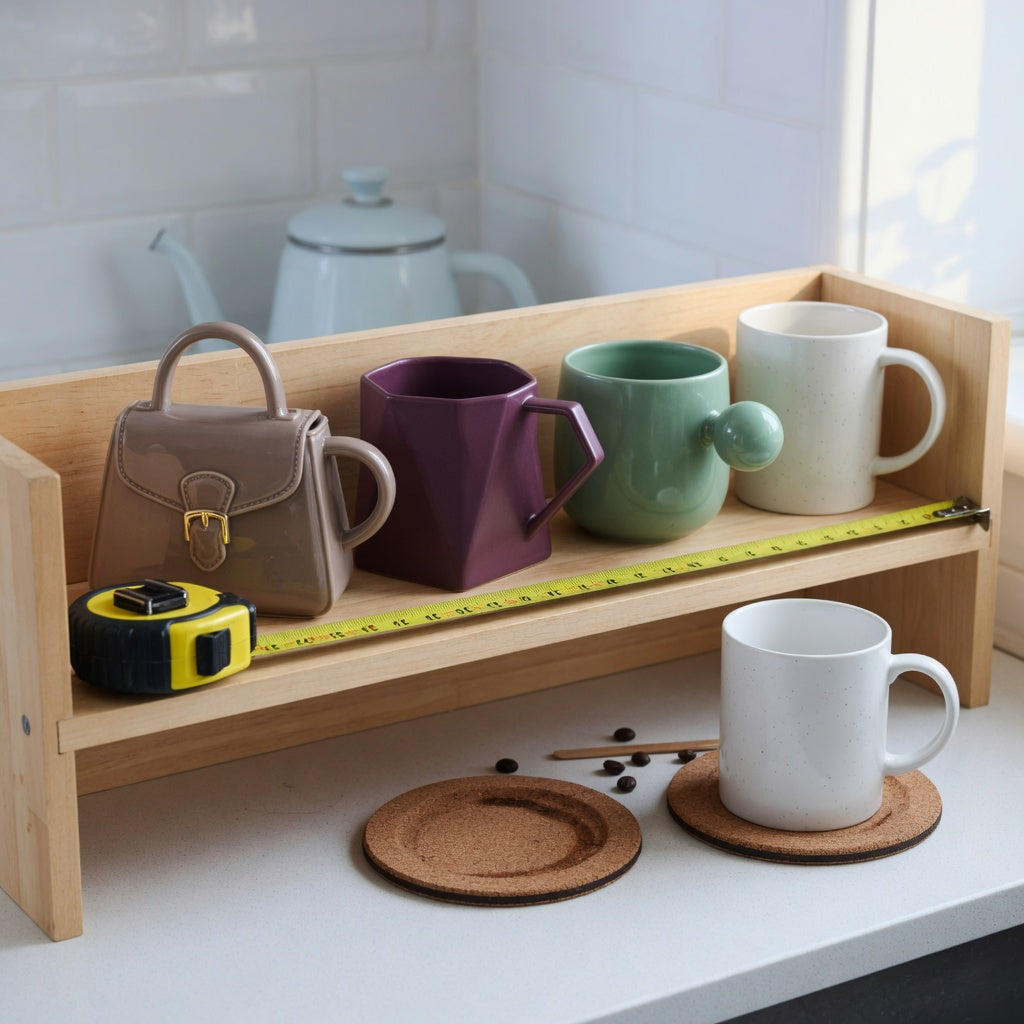
Coffee Mugs Unique Shape: Everyday Rotation Purchase Checklist
Measure cabinet and desk space, match each shape to its likely frequency of use, and verify capacity and care before buying. We compare handbag, rhombus, and ball-handled mugs by practical rotation...
Read more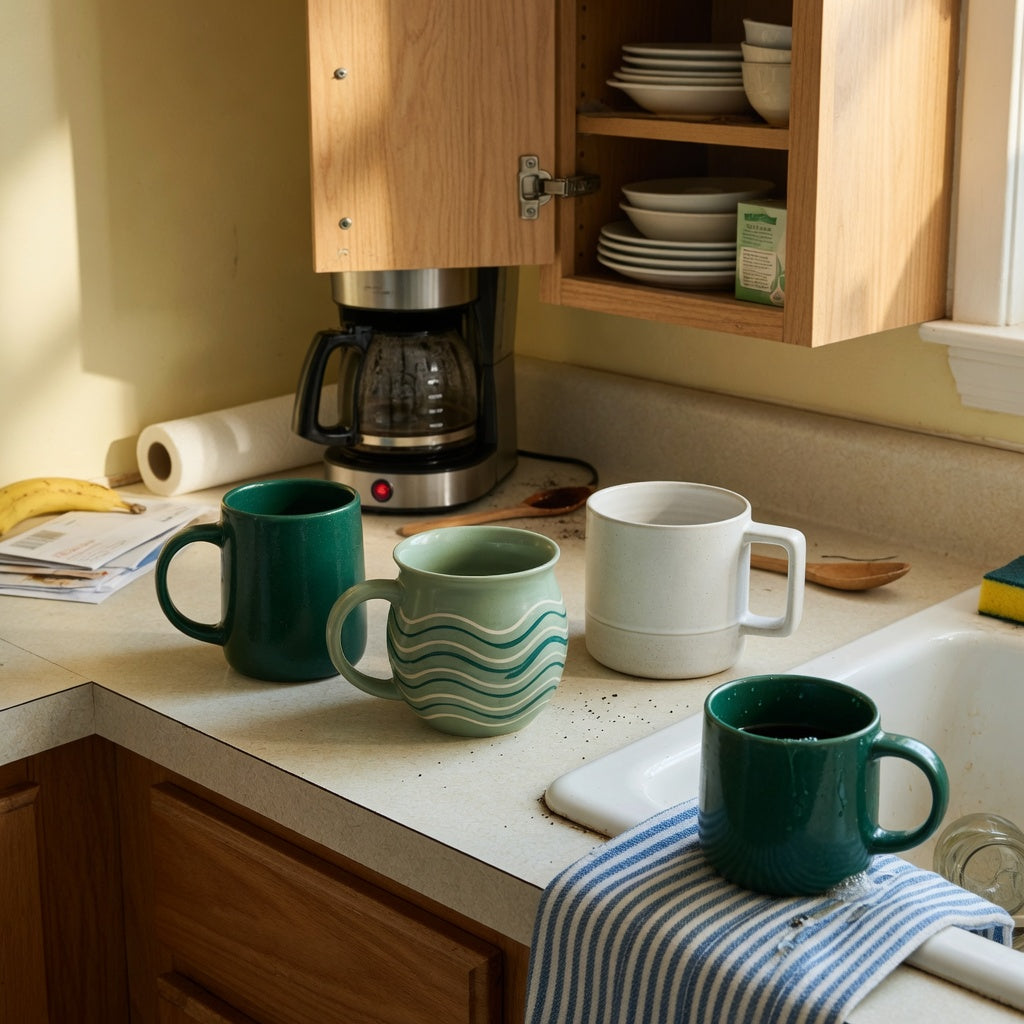
Green Ceramic Coffee Mugs Everyday Mug Rotation Product Shortlist Guide
Build a three-mug shortlist around wash frequency, cabinet clearance, and the role each design will play. This guide gives clear reasons to choose, verify, or skip Emerald, Green Waves, and Round o...
Read more
Leave a comment
This site is protected by hCaptcha and the hCaptcha Privacy Policy and Terms of Service apply.