
Green Ceramic Coffee Mugs Everyday Mug Rotation Product Shortlist Guide
Reading time: about 10 minutes
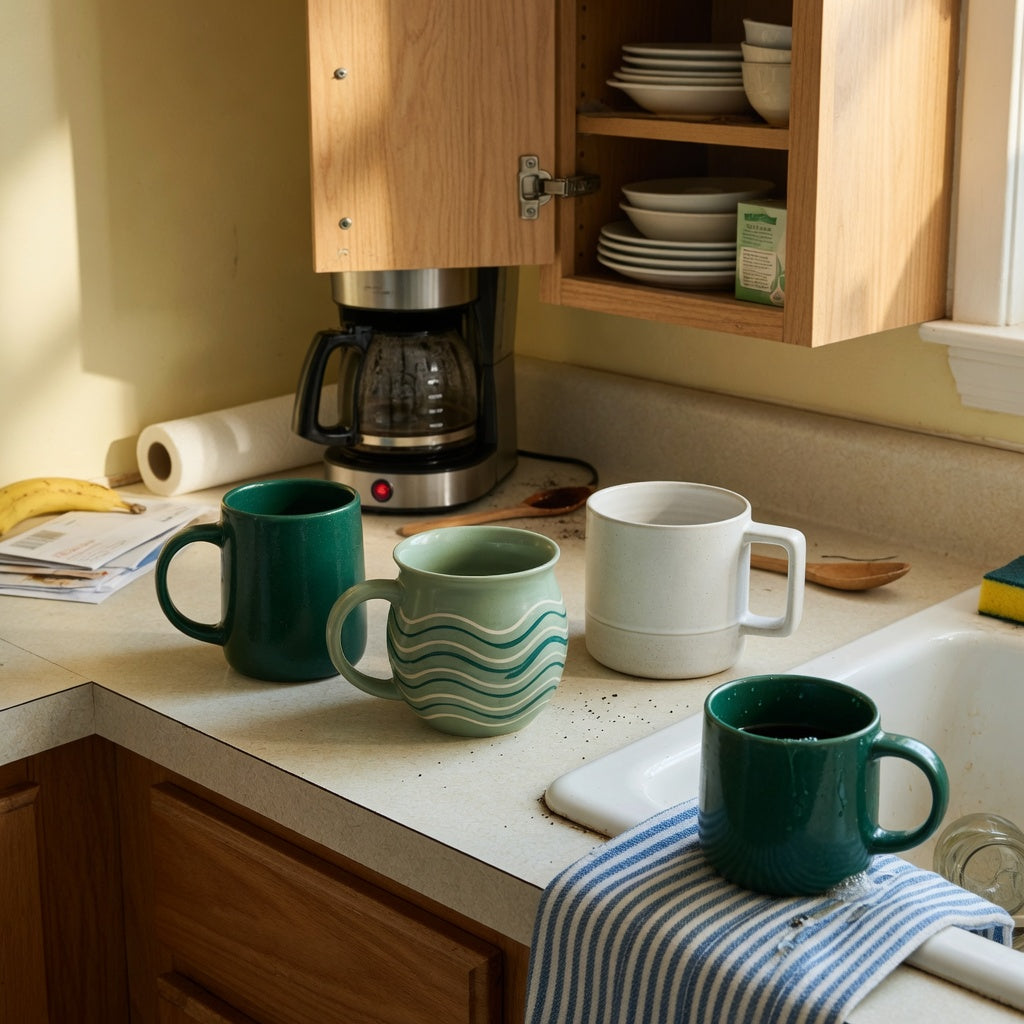
The mug beside the coffee maker is clean at breakfast, in the sink by noon, and back on the drying rack that evening. The decorative green mug behind it may not move all week. This green ceramic coffee mugs everyday mug rotation product shortlist guide starts with that familiar shelf pattern: wash frequency, storage fit, and visual preference decide which mug gets used, not color alone.
In our store, we separate what a product page actually shows from general ceramic handling advice. For the three linked options, we use the design distinctions named by each listing. We do not assume an unlisted capacity, dimension, appliance-safe claim, stacking behavior, or performance advantage. That restraint matters when cabinet clearance or one care instruction can change the buying decision.
Green ceramic coffee mugs everyday mug rotation product shortlist guide: which design earns shelf space?
An everyday rotation has two jobs: keep a suitable mug available and make the next choice easy. Before comparing designs, write down the practical limits that every candidate must meet.
- Wash interval: Count how many fresh mugs your household uses before the next hand wash or dishwasher cycle.
- Clear shelf space: Measure the usable height, depth, and width rather than relying on the cabinet's outside dimensions.
- Required drink volume: Check the live listing for capacity if you need room for milk, tea infusers, or ice.
- Visual role: Decide whether the mug should blend into a set, stand out on a shared shelf, or feel distinctive enough for a gift.
Use this green ceramic coffee mugs everyday mug rotation product shortlist guide as a filter, not as a claim that one design is universally better. A mug should remain on the list only if its current product details support your routine.
How many mugs does your wash schedule actually require?
Count fresh mugs used between cleaning cycles, then add one backup only if storage allows. Someone who uses one mug each morning and washes it nightly has a different requirement from two people who each start a fresh cup before the dishwasher runs every second evening.
- One daily drink, nightly washing: One active mug and one backup may cover the routine without crowding the shelf.
- Several drinks between wash cycles: Count each fresh mug you normally use. A shortlist of three designs may still require repeat pieces or a wider set.
- One office mug washed by hand: Quantity matters less than desk footprint, easy identification, and a shape you are comfortable handling.
- Occasional guest or gift mug: Appearance can carry more weight, but the mug still needs a defined storage place between uses.
Frequency alone does not prove durability. A mug used twice a day simply receives more lifting, washing, and shelf contact than a weekend mug. We do not label one of these options a daily workhorse unless the live listing provides the care details needed to support that use.
Which cabinet and desk measurements can eliminate a mug?
Measure a mug's entire storage path, not just the empty shelf. A piece can clear the cabinet opening but still catch on a shelf lip, collide with the mug beside it, or leave too little room to grip the handle.
- Clear height: Measure from the shelf surface to the underside of the shelf above. Include a coaster or liner if the mug will sit on one.
- Maximum width: Use the distance from the outside edge of the handle to the opposite side of the body, not body diameter alone.
- Usable depth: Check that the mug can sit fully on the shelf without its handle blocking the door or neighboring pieces.
- Lift clearance: Leave enough space for fingers to raise the mug without scraping its rim against the shelf above.
Do not assume that a rounded profile is compact, stable, or stackable. Those are separate characteristics. For a desk rotation, repeat the exercise with the coaster, keyboard, notebook, and charging cables in their normal positions. A mug that fits an empty desk may feel intrusive once the work surface is in use.
Three product scenarios with clear reasons to choose or skip
These recommendations start with a reader situation, connect it to a visible product distinction, and identify the detail that could remove the mug from the shortlist.
| Reader situation | Starting option | Reason to choose | Reason to skip or verify |
|---|---|---|---|
| You want a recognizable green mug without selecting a pattern-led design. | Emerald Coffee Tea Mug | The emerald color is the defining cue, making this the color-first option. | Skip if you want a visible motif. Verify capacity, dimensions, and care on the live page. |
| You want a more decorative mug for an open shelf or a visually specific gift. | Green Waves Coffee Tea Mug | The wave design gives the mug a clear identity within a mixed rotation. | Skip if your existing set is deliberately plain or you want identical-looking pieces. |
| You are choosing primarily by silhouette rather than color treatment or pattern. | Round Coffee Tea Mug | The rounded form is the central design distinction named by the listing. | Verify maximum width and stacking behavior if cabinet space is strict. |
Emerald Coffee Tea Mug for a color-first daily slot
Choose the Emerald option if the mug needs to be easy to recognize in a shared kitchen or office cabinet and green is the main design requirement. It is also the most direct starting point if nearby dishes already carry patterns. Skip it if you want surface decoration to be part of the purchase, and do not infer handle comfort, capacity, or dishwasher suitability from the product name.
Green Waves Coffee Tea Mug for pattern-led shelves and gifts
Choose Green Waves when a visible motif will help the mug feel intentional on an open shelf or during a gift unboxing. The design can also distinguish one person's mug in a mixed household collection. Skip it if the recipient prefers plain tableware or if the wave treatment competes with an existing patterned set.
Round Coffee Tea Mug for shoppers choosing by shape
Choose the Round option if a softer silhouette is the feature drawing you to the mug. That makes it a useful contrast piece in a rotation dominated by straighter shapes. Skip it when efficient stacking or a strict cabinet footprint is mandatory unless the current measurements and product details confirm the fit; the word round does not establish either point.
Which details should you verify on each live product page?
Open all three listings side by side and record only what is currently stated or clearly shown. Product names support a style comparison, but they do not support assumptions about technical specifications.
| Detail | How to use it |
|---|---|
| Ceramic type and finish | Do not substitute terms such as stoneware, porcelain, matte glaze, or reactive glaze unless the listing uses them. |
| Capacity | Compare the listed volume with the mug you already use, especially if you add milk, ice, or a tea infuser. |
| Overall dimensions | Check height and maximum width, including the handle, against your recorded shelf limits. |
| Care wording | Follow the listing's exact dishwasher and microwave guidance. Ceramic material alone does not establish appliance safety. |
| Quantity included | Confirm whether the listing is for one mug or another stated quantity before calculating the cost and size of a rotation. |
A product photo can answer a style question. It cannot, by itself, confirm capacity, appliance compatibility, cabinet fit, or comfortable grip.
If a required detail is absent, treat it as unknown rather than filling the gap with a category assumption. That is particularly important for compact cabinets, large iced drinks, and households that rely on machine washing.
How should a frequently used ceramic mug be checked and cared for?
When we handle ceramic mugs, we pay attention to the points that receive repeated contact: the drinking rim, the handle attachments, the base, and the surface that touches the shelf. These checks apply to ceramic mugs generally and are not claims about a defect or feature of any linked product.
- Check the base on a flat counter: Look for pronounced rocking before putting the mug into regular use.
- Inspect contact points: Check the rim for chips, the handle joins for visible lines or movement, and the foot for sharp areas that could mark a shelf.
- Use the stated care method: Wash according to the current product instructions. Do not assume dishwasher or microwave compatibility from appearance.
- Avoid sudden temperature changes: Do not move a chilled ceramic mug directly to very hot liquid or place a hot mug into cold water.
- Prevent hard contact during washing: If machine washing is permitted, position the mug so its rim and handle cannot knock against heavier tableware. Use a nonabrasive sponge for hand washing.
Remove a mug from use if the handle becomes loose, a crack appears to pass through the body, or a chip affects the drinking rim. Cosmetic variation and structural damage are not the same thing, so contact our store with a clear photo if you are uncertain about what you see.
When is a different mug style the more practical purchase?
Green ceramic suits many kitchen and desk routines, but it should not override a functional requirement. Start elsewhere if your use case depends on a feature these listings do not explicitly provide.
- Long commutes: A lidded, insulated travel vessel is a better category than a standard ceramic coffee or tea mug.
- Large iced drinks: Prioritize verified capacity, opening width, and room for ice before color.
- Very compact storage: Look for a mug or set that explicitly provides suitable dimensions or stacking information.
- Frequent drops or rough handling: Ceramic is breakable. Another material may be more appropriate for that environment.
If Emerald, Green Waves, and Round all fail a must-have check, do not force one into the rotation simply because the color is right. Compare other silhouettes in our unique coffee mugs collection, then apply the same frequency, measurement, and care filters.
Frequently asked questions
How do I shortlist green ceramic coffee mugs for an everyday rotation?
Use this green ceramic coffee mugs everyday mug rotation product shortlist guide by starting with wash frequency and measured storage limits. Eliminate any mug whose current listing does not confirm a required capacity, dimension, or care instruction. Compare visual design only after those practical checks are complete.
Are the Emerald, Green Waves, and Round mugs dishwasher safe?
Do not assume dishwasher safety from the ceramic category or from this article. Follow the exact care wording on each live product page. If machine-washing guidance is not provided, contact our store before making it a requirement of your purchase.
Which green ceramic mug is best for a small cabinet?
No design is automatically the most compact based on its name. Compare each listing's current height and maximum width, including the handle, with your measured shelf clearance. Do not treat a rounded shape as proof of a smaller footprint or better stacking.
Which option is the most practical gift?
Start with the recipient's visible preferences: Emerald for a color-led choice, Green Waves for a pattern-led choice, or Round for a shape-led choice. If you do not know their cabinet space or cleaning routine, verify the listed dimensions and care requirements before ordering.
How many mugs belong in an everyday rotation?
Count the fresh mugs used between normal wash cycles, then add one backup if space allows. This produces a more useful number than a fixed rule because a single daily coffee drinker and a two-person household have different cleaning rhythms.
Next step: Measure clear shelf height and maximum usable width, write down your wash interval, and open the three product pages side by side. Remove any option that leaves a must-have detail unanswered. The mug left on the shortlist should fit the shelf, the cleaning routine, and the visual role you actually need.
More from our blog
Read more
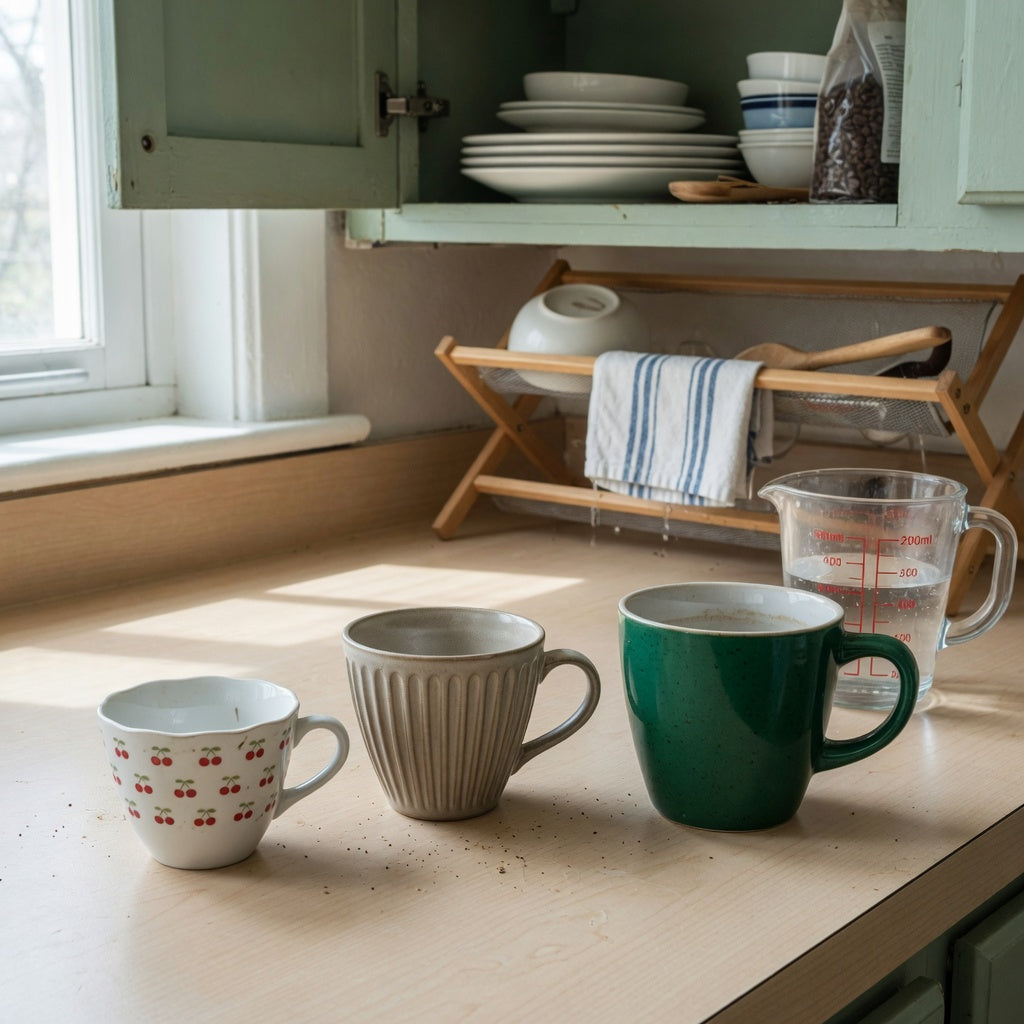
Lungo Coffee Cup Everyday Mug Rotation Product Shortlist Guide
Compare the Retro 170 ml, Pleated 200 ml, and Emerald 270 ml through the realities of daily rotation: measured pour size, capacity margin, shelf clearance, desk use, and care checks. Each option in...
Read more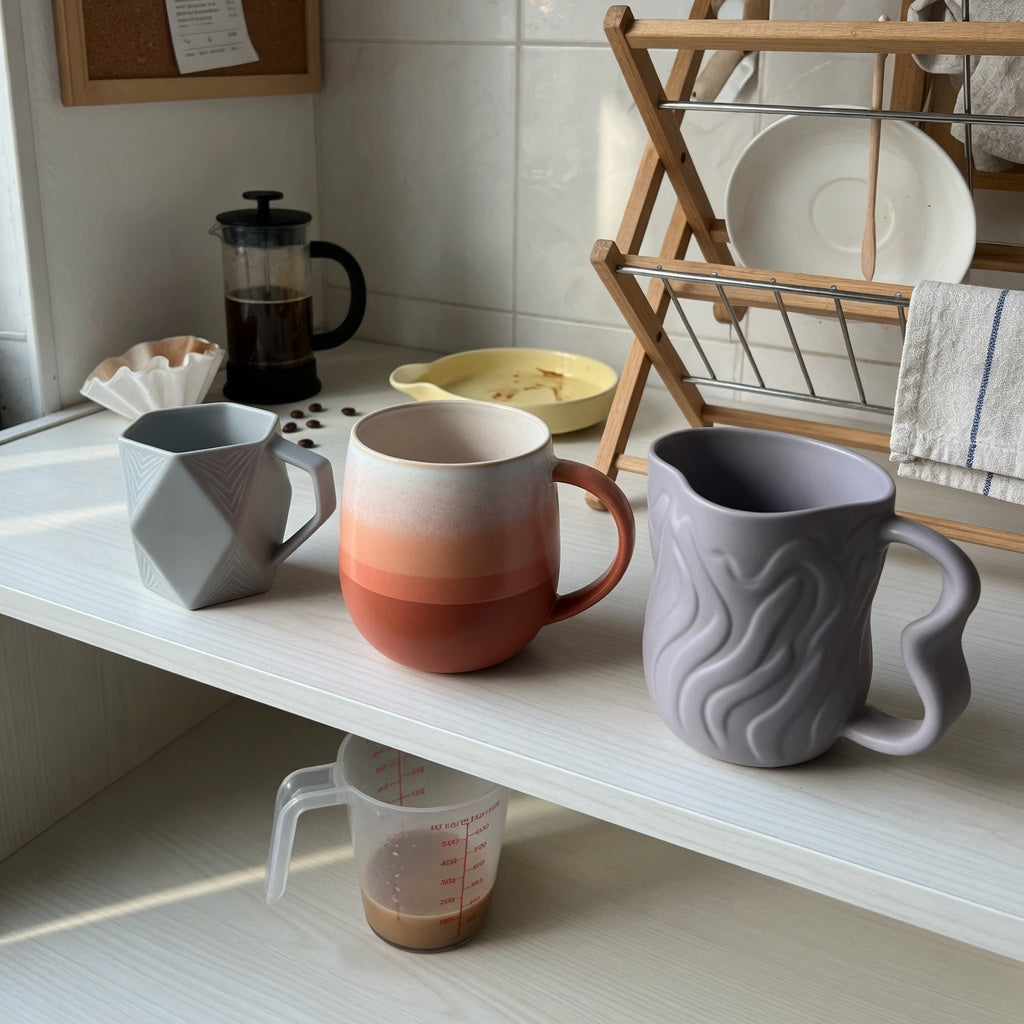
Abstract Coffee Mug Everyday Mug Rotation Product Shortlist Guide
Compare Rhombus, Gradient, and The Flow by verified capacity, visual form, storage fit, and drink routine. Each recommendation includes a reason to choose it, a reason to skip it, and a practical n...
Read more
Leave a comment
This site is protected by hCaptcha and the hCaptcha Privacy Policy and Terms of Service apply.