



Loose Leaf Tea Mug Vs Tea Ball: Room, Mesh, and Fit
Reading time: about 13 minutes
The usual complaint arrives like this: a hinged ball that will not close flush, leaves mashed into the mesh, and a mug that still tastes like faintly tinted water. Someone asking us about a loose leaf tea mug vs tea ball setup is not shopping for a prettier object. They want to know whether the wet leaf had room to open, whether the fine bits stayed out of the cup, and whether the steep can be stopped before it turns harsh.
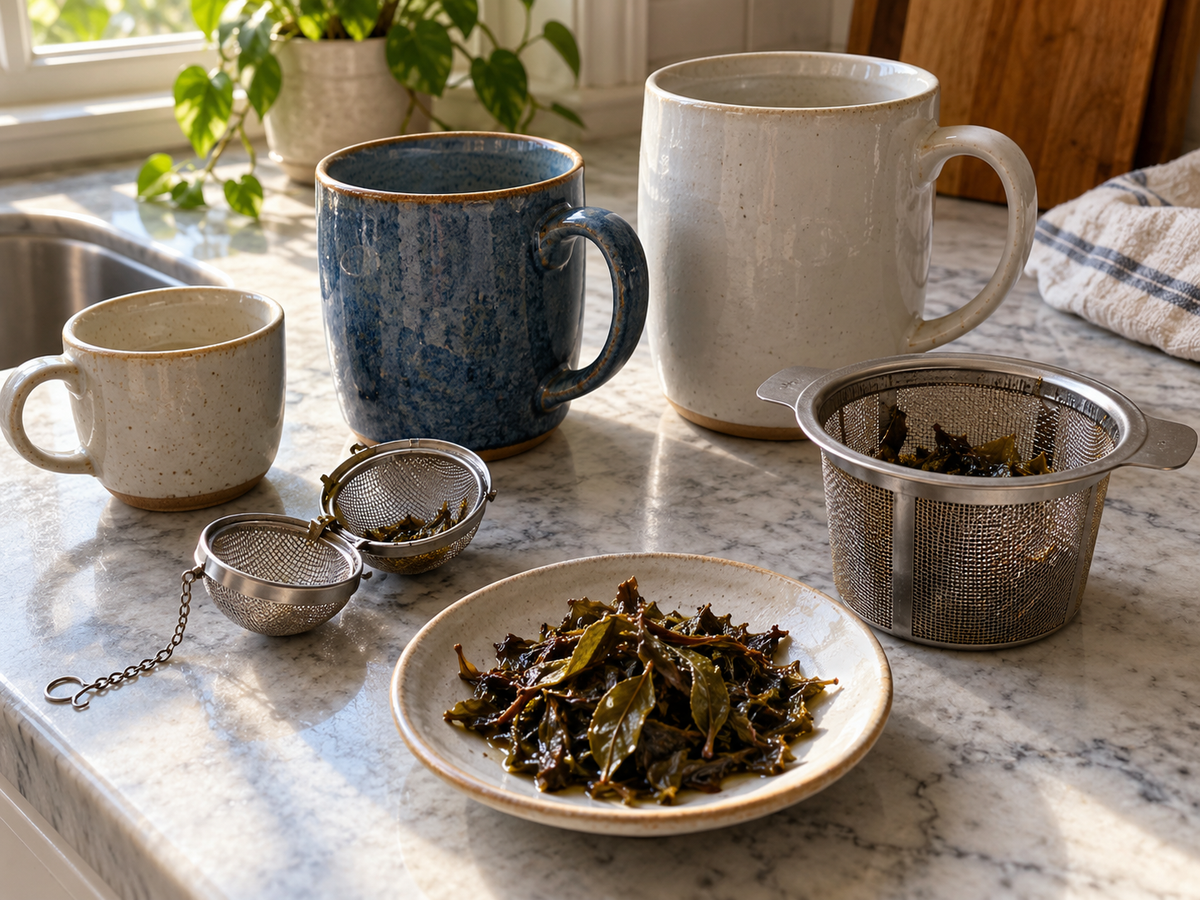
In our store we sell the cup, not a brewing kit. The three mugs below are drinkware only. They do not include a basket, a tea ball, a filter, or any other accessory the listing does not name. You bring the holder. The mug decides how much water is left once that holder is in the drink, and whether the rim will take it without tipping.
Why a shut tea ball leaves the cup thin
A tea ball is a small chamber, usually a hinged sphere or egg on a chain or a short handle. Shoppers often mean something else by a loose-leaf mug: a cup with a deeper basket hanging in the water, sometimes under a lid that can also catch drips. The printed shape matters less than three conditions: how full the chamber is, how tall the packed leaf bed gets, and whether water can move through it.
A 2024 review in Trends in Food Science & Technology describes more efficient brewing when tea has space to swell, for example by reducing single-particle size and the height of the tea bed. Citing Yadav and colleagues (2017), it notes that a greater tea-bed height raises pressure among particles, reduces swelling, and lowers the release rate of constituents. Temperature, time, and the water-to-tea ratio change the liquor as well, because they affect how polyphenols, caffeine, and theanine leach and convert.
The 2017 study in the Journal of Food Science and Technology used tea granules in bags, not a retail ball. A heavier load slowed infusion, and percent fill plus tea-bed height affected infusion kinetics the most. Loose tea swelled and infused faster, and further, than tea held in bags. A double-chamber bag did more of both than a single-chamber bag. A 2002 model in Food and Bioproducts Processing adds the flow: without stirring, solute buildup in a packed bed drives natural convection, and that recirculation largely controls infusion rate. Stirring forces more flow, spreads dissolved material more evenly, and speeds the brew.
Those papers are not a head-to-head of a shop basket and a shop ball on the same teas. ISO 3103:2019 is a laboratory method for preparing a liquor so tasters can compare samples. It is not a buying guide. We will not invent a score. Filling a ball to the hinge makes a tall, tight bed, and that is the condition the granule work associates with slower infusion.
Where a loose leaf tea mug vs tea ball choice shows up in the cup
Treat the tools as different jobs. A basket is a single-cup chamber you lift out. A ball is a small holder you can drop into a cup you did not choose. Fit, mesh, and how full the chamber is matter more than the shape name.
| What you are judging | Deeper basket in a mug | Tea ball |
|---|---|---|
| Leaf bed | Wider and shorter if you do not overfill it, so wet leaf can open. | Small sphere. Easy to pack into a tall, tight mass, especially with rolled or fluffy leaf. |
| Water movement | More leaf surface sits in the mug. A gentle swirl moves liquid through a looser bed. | Fine if the ball is only partly filled and you stir. Weak if the mesh is a plug of leaf. |
| Stopping the steep | Lift the basket. A drip-tray lid can park it. A sealed travel lid is a different tool, and it is not assumed here. | Lift by chain or handle. A short chain often leaves the ball dripping on a saucer. |
| Fine particles | Depends on hole size. A coarse basket still sheds rooibos and spice dust. | Seam gaps and coarse mesh are the usual leaks, not the metal itself. |
| Where it fails | Too wide for the rim, or so tall the leaf sits above the water. | Bulky whole leaf, fiddly to empty, and it steals volume in a small mug. |
Ceramic, stainless mesh, and fabric waste more debate than they deserve. Hole size, seam gaps, and how tightly the leaf is held explain more of the cup than the material name. A tight fabric weave can hold herb dust a coarse ball dumps into the drink. A ceramic insert with wide slits can look calm on a desk and still pass broken leaf. Match the mesh to the smallest piece you drink, not to a photo of perfect whole-leaf black tea.
No public hole-size standard we can cite maps openings onto rooibos, fannings, or chai spice. Brew a small test, look at the bottom of the cup, then decide whether you need a finer basket.
Which teas still work in a ball, and which leave grit
We do not tell every buyer to retire the ball. Broken black tea and small herb pieces are the case where a partly filled ball is often enough. The leaf is already small, so room to unfurl matters less than with rolled oolong or fluffy white tea. Leave the ball well short of full. The granule studies used bags, not your exact ball, but percent fill and bed height were what slowed the brew.
Whole-leaf, rolled, and bulky teas are where the ball disappoints. The dry dose looks modest. Once the leaves swell against the mesh, water barely moves, and the cup tastes weak. A deeper basket, only partly filled, is the usual fix. A larger dose forced into the same sphere is not.
- Broken black tea and small herb bits: a tea ball can be fine if you fill it loosely and lift it when the cup tastes right.
- Rolled oolong and large whole leaf: give them a wider chamber. A ball is the tool most likely to taste thin here.
- Rooibos, honeybush, and chai with spice dust: expansion is not the complaint. Escape is. Floating needles and silt usually mean holes or a seam gap, in a ball or a basket.
- Blends with powdered spice: expect some silt. Mesh that holds whole leaf will not hold powder. That dust comes from the ingredient, not from a defective mug.
If the ball leaks along the seam, a finer mesh will not fix a hinge that does not meet. Hold it to the light before you blame the tea. Pieces smaller than the holes come through any infuser. People switching from tea bags notice that silt for the first time, because the paper was filtering. The honest upgrade is a finer basket in the mug, not another ball of the same gauge.
Does 250 ml, 390 ml, or 400 ml leave water under the infuser?
Listed capacity is the fact we can use. One mug also carries a listed diameter. We are not reading filters, lids, or dishwasher safety off a photograph.
The Ball Handle mug is listed at 250 ml, with a listed diameter of 11.2 cm. That listing is the mug itself. It does not include a tea ball. At 250 ml the drink is already modest. A ball inside it displaces water you were counting on, and a deep basket can take a large share of the volume before the cup feels like enough. Treat 11.2 cm as the listed diameter, then check the visible opening. A diameter on a page and the gap a basket must pass are not automatically the same measurement. If the basket, arms included, is close to that figure, do not assume it drops in and sits level.
The Round mug at 390 ml is the middle capacity. More water sits around a partly filled ball, and a separate basket has a better chance of staying under the waterline. We are not stating an opening width for it. Verify the rim on the current listing before you order a wide basket.
The Spittoon mug at 400 ml is the largest of the three. Bulky herbal leaf and a single longer steep are where the extra water helps. Capacity still does not say whether a basket's arms will rest on the rim. Confirm the visible opening on the listing.
None of the three include an infuser. A lookalike photo with a basket in the frame is not evidence for these pages. If the accessory is not listed, it is not in the box. Other shapes live in our unique coffee and tea mugs collection. Compare them as cups first: how much you finish, whether the handle suits your hand, and how much counter the base takes. Then match an infuser you already own, or one you will buy on its own.
Before you pair any of them with a holder you already own, run this fit check:
- Outer width of the basket or ball versus the mug opening. For the Ball Handle mug, start from the listed 11.2 cm diameter, then confirm the visible rim.
- Basket depth versus the waterline. Leaf sitting above the water does not brew.
- Chain or handle length, so the ball can come out without a drip trail across the desk.
- A place for the wet holder. Confirm any lid on the current listing. Do not assume a drip tray or a travel seal is in the box.
- Cleanup at the sink. Hinges trap wet leaf. An open basket rinses faster between meetings. Neither point tells you the mug is dishwasher-safe. That stays a listing question.
Desk steep, or a ball that lives in a drawer?
In our experience the desk failure is timing. A call runs long, the leaf stays in hot water, and the cup goes harsh. You want a holder you can lift in one motion and set down without soaking a keyboard. A roomy basket with somewhere to rest it wins that scene. A short chain often parks the ball on a napkin.
Capacity still decides the sitting. 250 ml is a short cup you will refill. 390 ml and 400 ml are closer to one pour, which matters if you do not want a second kettle trip while the first holder is still dripping.
A bag or a drawer is where the ball earns its keep. It is small, easy to replace when the hinge fails, and it works in a cup you do not own. That is a poor reason to brew rolled oolong with it at the kitchen table every morning. If the limit is a suitcase, use the ball and keep the fill loose. If the limit is taste at your own desk, choose cup capacity and a separate basket that fits.
An open basket also dumps faster between short resteeps. Emptying a hot hinged sphere is fiddly, and the leaf was already cramped. Steep temperatures belong on the packet for the tea you drink. Published work shows that temperature, time, and ratio change extraction. It does not show that a metal ball tastes different from the mug once leaf room and mesh are equal. Take the holder out when the cup is right. Leaving it in so the leaf keeps working is how a decent tea turns harsh.
What to buy when you want the cup, not a gadget set
Keep the ball if the leaf is small or already broken, you will only partly fill it, it has to live in a drawer or a bag, and a little sediment does not bother you. It is the wrong tool for large rolled leaf, for a hinge that will not close, and for a 250 ml mug where the ball itself takes a noticeable share of the volume.
Choose a separate basket, then a mug with enough water under it, if whole leaf is the daily drink and the brew happens at a desk. Do not buy one of our mugs expecting the basket to arrive with it.
- Small cup, modest steep, and a ball you already trust for broken tea: start with the 250 ml Ball Handle mug and measure your holder against the listed 11.2 cm diameter, then the visible rim.
- More water around the leaves, still one person: look at the 390 ml Round mug and the 400 ml Spittoon mug, then verify each opening on the current listing before you commit to a wide basket.
- You mostly want a cup you will actually reach for: use the unique mug collection as drinkware, then add the infuser that matches the tea.
Before checkout, use this list:
- Name the smallest particle you drink: whole leaf, broken black, rooibos, or spice dust.
- Decide whether today's problem is weak taste (room and fill) or grit (mesh and seams).
- Pick 250 ml, 390 ml, or 400 ml for the drink you want left after the holder is in the cup.
- Use 11.2 cm only as the Ball Handle mug's listed diameter, not as a universal rim size.
- Read the listing as drinkware only, then buy the ball or basket separately if you do not already own one.
If two shapes are still tied, compare them as cups: how they sit in the hand, how much counter they take, and how much you actually finish. Then match the infuser. The steep gets better when the leaf bed stays loose and the mesh matches the tea. The mug's job is to hold that water steadily. It is not a filter.
Frequently asked questions
Is a loose leaf tea mug vs tea ball decision mostly about taste or convenience?
Both, and they fail in different ways. A ball is the portable holder, and it tastes weak when you pack it full of leaf that needs to swell. A deeper basket usually gives a looser bed and an easier lift-out at a desk, but only if it fits the mug and the holes suit the tea. Our mugs are the cup in that setup. They are not sold as an all-in-one infuser.
Why is loose leaf leaking through my mesh tea ball?
Usually the holes are larger than the smallest piece in the blend, or the hinge does not meet at the seam. A finer mesh will not close a gap you can see when you hold the ball to the light. Rooibos, honeybush, fannings, and spice dust show this first. If you are coming from tea bags, some sediment is normal until the filter is finer than the paper was.
Can I use a tea ball for rolled oolong or other large-leaf teas?
You can, and many people do, but it is the case where the ball most often tastes thin. Rolled and bulky leaves need room to open. Fill the ball only partway, stir, and take it out on time. If the cup is still weak, move that tea to a wider basket rather than forcing a larger dose into the same sphere. There is no standards-body figure for how far a typical oolong expands, so we are not going to invent one.
Do these CoffeifyMug listings include a brew basket or filter?
No. The Ball Handle, Round, and Spittoon mugs linked here are drinkware only. Listed capacities are 250 ml, 390 ml, and 400 ml, and the Ball Handle mug also has a listed 11.2 cm diameter. They do not include unlisted brewing accessories or filters. Buy a basket or ball separately, and confirm rim fit on the current listing. If a lid matters, verify that the listing actually includes one.
How full should I pack a tea ball for one mug?
Leave room. Studies of tea held in bags found that a higher percent fill and a taller leaf bed slowed infusion, and that loose leaf infused more readily than tightly held leaf. Keep the ball clearly under-full, use fresh water, and follow the time and temperature on the packet. Pull the ball when the cup tastes right instead of leaving it in for the rest of the morning.
More from our blog
Ready to pick your mug? Two ways to save on today's order:
Ordering 1–3 mugs? Get an extra 10% off your 1st order with code 10_OFF Apply 10% Off & Shop Wooden-Handle Mugs →
Gifting 4+ mugs? Buy 3, Get the 4th Free applies automatically at checkout (no code needed; offers do not stack) · Free standard shipping (Nov pre-Christmas delivery: 15–20 calendar days US) · Free replacement if chipped in transit.
Popular mug buying guides: Wooden-Handle Tea Infuser Mugs Compared · Christmas & Secret Santa Mugs 2026 · Espresso & Cortado Cups Guide · Cup & Saucer Gift Sets · All 25 Mugs Spec Table · Mug Size Guide · Shipping & Promo FAQ
FIRST ORDER 10% OFF (CODE: 10_OFF) · OR BUY 3, GET THE 4TH FREE


Read more
Ceramic Mug Gift for Home Coffee: What Buyers Should Compare
A ceramic mug gift for home coffee has to earn a spot by the kettle, not just look good in a box. We walk through usable fill, glaze questions, handle comfort, and care labels so the mug gets used.
Read more
Best Hot Cocoa Mug Size: Packets, Brim, and Toppings
The best hot cocoa mug size is the brim that still looks right after a 6 to 8 fl oz packet and room for toppings. Here is how our 400 ml and 480 ml listings compare before you buy.
Read more
Leave a comment
This site is protected by hCaptcha and the hCaptcha Privacy Policy and Terms of Service apply.