



Ceramic Mug Gift for Home Coffee: What Buyers Should Compare
Reading time: about 13 minutes
A gift mug that never leaves the cabinet is an expensive coaster. We see it after birthdays and office exchanges: someone chose the design that photographed well, the recipient brews drip coffee at the kitchen counter, and within a week the new cup sits behind the plain one that actually fits their hand. A ceramic mug gift for home coffee has to live in that routine. Hot liquid. A real wash. A handle that does not pinch. A glaze meant for drinking. Looks matter. They just do not matter first.
Is a ceramic mug gift for home coffee the right format?
Home coffee means the cup stays on a table, a nightstand, or a desk. It does not mean a car cup holder or a lid that has to stay shut in a bag. An open ceramic mug lets the drink smell like coffee, and it can go back in the microwave only when that exact piece is labeled for it. It will not hold heat through a long commute, and it will not bounce off a sidewalk the way a steel bottle might.
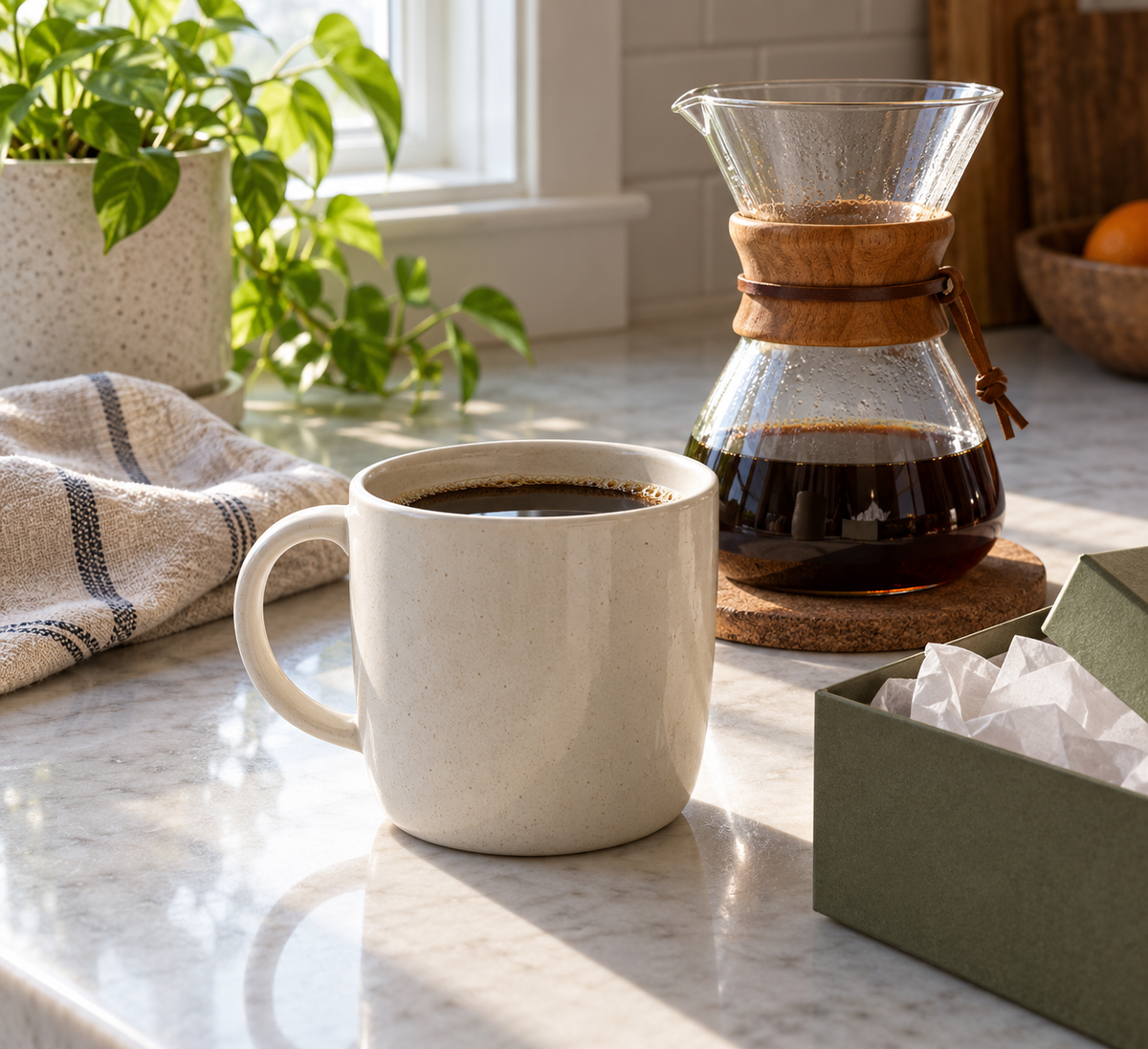
In our store, the Morning & Night Large Ceramic Coffee Mug is the listing we point to for that at-home pattern. The catalog title calls it a large ceramic coffee mug, and the name points to morning and night rather than a sealed cup for the train. Treat large as a label, not a measured promise. Open the current page and confirm capacity, material, and care before you decide it matches their carafe. To compare shape and finish around the same use, start with the unique coffee mugs we stock.
If they mostly leave the house with coffee, an open mug is the wrong lead gift. Buy the format they will carry, not the format that looks more gifty in a box. For someone who stays home but switches between a morning brew and an evening cup of tea, the checks in our ceramic mug notes for coffee and tea drinkers sit beside this choice.
What usable fill matches drip coffee, milk drinks, or a short cup?
There is no official best gift size, and we will not invent one. For lead testing, FDA groups cups and mugs as small hollowware commonly used for coffee or tea served above room temperature. The agency notes that these pieces are normally about 8 fluid ounces (about 240 milliliters) and usually have a handle. That figure describes the testing category. It is not a recommendation for how much your recipient pours.
Listed capacity is often brim-full: liquid to the lip, with no room to walk from the machine to the table. Usable fill sits lower. Match the mug to the drink they actually make.
- Black drip or pour-over at the counter: enough volume for a real serving, with space under the rim so the first steps do not slosh.
- Milk drinks: more headroom, and a rim that feels smooth rather than sharp on the lip.
- A short espresso or a small afternoon coffee: a large format can feel like a bowl. Skip it if they already complain about oversized cafe cups.
- The same mug later for tea: look for an interior you can see and rinse. A rough glaze holds color. A smooth food surface does not.
- A shallow cabinet or a crowded mug tree: compare height and handle swing to the shelf, not to a styled photo.
If the product page never states ounces or milliliters, do not guess from the thumbnail. We would rather you pause on the Morning & Night listing and read the current specs than assume the word large equals their usual pour.
Which pieces are made for daily hot drinks, and which only look like mugs?
Stoneware and porcelain sold for everyday table use are a different purchase from decorative pottery, antiques, and handmade ware you cannot trace. Clay words on a tag are clues, not safety certificates. What matters is whether the piece was made and sold as something you drink from, by a maker you can identify, with a glaze fired for food contact.
FDA consumer guidance treats commercial factory pottery made for everyday use as much less likely to have lead problems than a specific list of problem types: handmade ware that looks crude or irregular, antiques, damaged or worn pieces, flea-market finds, unknown makers, and brightly decorated orange, red, or yellow ware. A potter you can ask about the food surface, the firing, and how to wash the piece can still be a better gift than another slogan mug for someone who already owns a dozen cups. A stall piece with no maker is not that gift.
If the base is marked Not for Food Use, believe it. Under the FDA ornamental-ware rule, ceramic that looks suitable for food is treated as foodware unless it carries a conspicuous temporary warning that it is not for food use, plus a permanent statement on the base, or unless a hole is bored through the potential food-contact surface. A cup-shaped decor object is not a coffee mug.
Buyers also ask us about pinholes, crazing, and a sandy lip. Those flaws are not, by themselves, a leach test. Damaged or worn ceramic still belongs on the careful list, and a gritty rim is simply unpleasant every morning. We do not gift a chipped lip. Chips stain, and they change how the mug feels on the mouth. For a closer look at mugs people reach for on a weekday, see what we compare in a morning coffee ceramic mug.
How should you read lead, cadmium, and lead-free on a gift listing?
You cannot see lead in a glaze or in painted decoration. California public-health guidance says acidic drinks, including coffee and tea, can draw lead out faster than non-acid drinks when lead is present, and that heat from cooking or microwaving can speed that release. Running a lead-containing dish through the dishwasher can wear the glaze and make later leaching more likely. Washing, boiling, or other household tricks do not remove lead. Plain white commercial dishes are described as a place where lead is rarely found. That is a lower-risk appearance, not a promise you can skip reading.
For lead, the FDA action level on cups and mugs is 0.5 micrograms per milliliter of leaching solution in any one of six units tested. That is stricter than the guideline for other small hollowware, at 2.0 micrograms per milliliter, and stricter than flatware, at 3.0 micrograms per milliliter averaged over six units. A correct firing locks lead into the glaze. A poor firing can let it migrate into food or drink. The agency has also found traditional pottery labeled lead free that still released lead. A line of marketing copy is not the same document as a leach result.
Cadmium is a separate limit. FDA ceramicware levels are 0.5 micrograms per milliliter for flatware, as an average of six units, and for small hollowware in any one of six units, plus 0.25 micrograms per milliliter for large hollowware in any one of six units. The cadmium guide does not add a special cups-and-mugs category. Acid foods can extract cadmium, and continued food use is tied to the risk of chronic cadmium poisoning. Sampling attention falls on cups, mugs, pitchers, heavily decorated items, and ware used for liquids, especially acidic liquids. Red, orange, or yellow glaze or decoration is often a reason for a closer look, not an automatic failure and not a color to ignore.
California Proposition 65 uses another scale entirely. For lead, the state Maximum Allowable Dose Level is 0.5 micrograms per day for reproductive toxicity, and the oral No Significant Risk Level is 15 micrograms per day for cancer. Those are daily exposure safe-harbor levels, not ceramic leach concentrations in micrograms per milliliter. A mug can sit inside an FDA action level and still raise a warning question under Proposition 65, because the arithmetic is not the same. Do not treat lead-free, FDA compliant, and no Prop 65 warning as three ways of saying one thing.
A home swab kit can indicate leachable lead. If it reads positive, do not cook, serve, or store food or drinks in that piece. A swab is not a full leach panel, and it does not answer cadmium. Households with infants or young children should be stricter about unknown glaze. FDA connects childhood lead poisoning with learning problems, delayed development, and lower IQ scores, and notes that infants, young children, and a developing fetus can be affected by ongoing exposure that may not cause obvious symptoms. In our experience, the ordinary commercial mug with a named maker beats a charming mystery cup in that kitchen.
Are dishwasher-safe, microwave-safe, and food-safe the same claim?
No. We split them every time we talk through an order. A listing that blends them is how people end up hand-washing a mug they thought was dishwasher-safe, or heating a metallic rim.
| Question | What a yes should mean | What it does not prove |
|---|---|---|
| Food-contact surface | Sold for drinking, with no Not for Food Use mark, from a maker you can identify | That it can go in the dishwasher or the microwave |
| Dishwasher | This exact listing says the glaze and decoration tolerate detergent and heat | That metallic luster will survive, or that the glaze is lead-free |
| Microwave | Labeled for microwave use, with no metallic paint or trim | That a one-minute water test measured lead or cadmium |
USDA microwave guidance is the practical rule we point buyers to: use only cookware made for microwave use. Glass, ceramic, and plastics that are safe are usually labeled that way. China with metallic paint or trim is not. If a piece has no label, heat the empty utensil for one minute beside, but not touching, one cup of water. Warmth in the ceramic means it is taking on microwave energy because of metal in the body or glaze, so it does not belong in the microwave. Keep that test in its lane. It looks for heating. It does not clear a glaze for lead.
Gold, silver, platinum, and luster are the details that most often break the habit of treating every ceramic cup as microwave-safe. In our shop conversations, that trim is also the usual reason a mug becomes hand-wash only. If the current Morning & Night page does not explicitly allow the dishwasher or the microwave, do not fill in the blank from the word ceramic. Tell the recipient the truth, or choose a listing that states the care they already use. Someone who reheats a half cup every morning will resent a hand-wash-only gift they were not warned about.
Will the handle, weight, and rim earn a spot by the kettle?
Gift buyers judge a rectangle on a screen. The recipient judges the handle at full weight. A tight opening pinches larger fingers. A huge opening forces a cramped grip. Look at both joins, top and bottom, and skip hairline cracks in the gallery photos. Empty weight plus a full pour is what they carry from the kitchen to a desk. A very heavy mug gets abandoned. A paper-thin lip chips on the faucet.
Interior color is a cleaning choice. Dark glaze hides tea tannin. A light interior shows when the mug is actually clean, which some people prefer. Neither one tells you the glaze chemistry.
Shoppers sometimes say coffee tastes cleaner in ceramic than in steel, plastic, or a paper cup. Treat that as preference. We have no flavor trial to quote, and a ceramic mug will not rescue burnt coffee or a dirty carafe. What a sound ceramic surface does well is stay out of the way when the cup is washed. What it does poorly is travel, long heat retention, and any job that needs a lid.
Skip this style of gift when they want leakproof commuting, when you cannot confirm a drinking surface, when metallic decoration fights their dishwasher-and-microwave habit, when the shelf cannot take the height, or when they only drink a short espresso and will hate a large mug. It fits when they already brew at home and you can match care to how they wash up. People who own a lot of mugs rarely need another joke slogan. A daily cup they like the feel of gets used. Beans are optional, and fresh beans they pick locally beat a bundle that mostly adds packing weight. The mug still has to work on its own. If you are still sorting a statement piece from a daily drinker, our unique ceramic mug gift notes for coffee lovers cover that split.
What to verify on the listing before you wrap it
Use this in order. If a line is missing, the gift is not ready.
- Confirm they drink at home in an open cup. If not, change the format.
- Read usable size on the current page. Match it to drip, milk drinks, or a short cup, and leave room below the rim.
- Confirm it is sold for food or drink, not as decor, and that you know who made it.
- Separate three claims: drinking surface, dishwasher, microwave. Metallic trim means follow the stricter instruction.
- Check handle opening, full weight, rim feel, and cabinet height.
- Pack it as breakable. A ceramic gift that arrives cracked is not a charming story.
When those answers line up, order from the listing you actually verified. Use the Morning & Night Large Ceramic Coffee Mug if its current specs fit their pour and their wash habit. If the shelf, the drink size, or the care label points somewhere else, choose another shape in the unique coffee mugs collection.
Frequently asked questions
What size ceramic mug gift for home coffee should I buy if the page only shows a photo?
Do not guess ounces from a photo. The FDA note that cups and mugs are normally about 8 fl oz is a testing category, not an ideal gift size. Read the current listing for milliliters or ounces, then compare that brim-full number with the drink they pour at home and with the space they need under the rim. If the page never states capacity, pick a mug that does.
Does ceramic automatically mean dishwasher-safe and microwave-safe?
No. Food-contact, dishwasher safety, and microwave safety are separate claims, and they can differ on one mug. Gold, silver, or luster is a reason to keep the mug out of the microwave and to follow the maker wash instructions. USDA also says china with metallic paint or trim is not microwave-safe. A one-minute water test only checks whether the piece heats because of metal. It does not test for lead.
How do I tell whether a handmade mug is safe for hot coffee?
Ask who made it, whether the drinking surface is intended for food, and how it was fired and glazed. Be wary of crude-looking handmade ware, antiques, damaged pieces, unknown flea-market pottery, and bright orange, red, or yellow decoration. A lead-free label on traditional pottery has not always matched leach results. If a home swab indicates leachable lead, do not drink from that mug.
Is a large ceramic mug a bad gift for someone who already owns a lot of cups?
It is a weak gift if it only repeats a slogan they will not use, or if a large format fights a small espresso habit and a small cabinet. It is a fair gift when the handle, weight, and care instructions match a daily home brew. Coffee beans help only when they are fresh and chosen for that person. The mug still has to stand on its own the next morning.
Should I worry about Proposition 65 if a mug meets an FDA lead level?
They are not the same measurement. The FDA cup-and-mug lead action level is 0.5 micrograms per milliliter of leaching solution. California Proposition 65 lead safe harbors are daily exposure figures: 0.5 micrograms per day for reproductive toxicity and 15 micrograms per day for cancer. One result does not automatically answer the other, so read the listing instead of merging the labels.
Ready to pick your mug? Two ways to save on today's order:
Ordering 1–3 mugs? Get an extra 10% off your 1st order with code 10_OFF Apply 10% Off & Shop Wooden-Handle Mugs →
Gifting 4+ mugs? Buy 3, Get the 4th Free applies automatically at checkout (no code needed; offers do not stack) · Free standard shipping (Nov pre-Christmas delivery: 15–20 calendar days US) · Free replacement if chipped in transit.
Popular mug buying guides: Wooden-Handle Tea Infuser Mugs Compared · Christmas & Secret Santa Mugs 2026 · Espresso & Cortado Cups Guide · Cup & Saucer Gift Sets · All 25 Mugs Spec Table · Mug Size Guide · Shipping & Promo FAQ
FIRST ORDER 10% OFF (CODE: 10_OFF) · OR BUY 3, GET THE 4TH FREE


Read more
Mountain Sea mug wooden handle gift: what buyers compare
Our Mountain Sea II page lists a 450 ml ceramic mug with a wooden handle detail for desks, kitchens, and gifts. Check care wording, heat limits, and box contents before you buy a Mountain Sea mug w...
Read more
Loose Leaf Tea Mug Vs Tea Ball: Room, Mesh, and Fit
A packed tea ball tastes thin when the leaf bed is too tall, and a wider basket only helps if the mesh matches the tea. Our 250 ml, 390 ml, and 400 ml mugs are drinkware only, so size the cup to th...
Read more
Leave a comment
This site is protected by hCaptcha and the hCaptcha Privacy Policy and Terms of Service apply.