
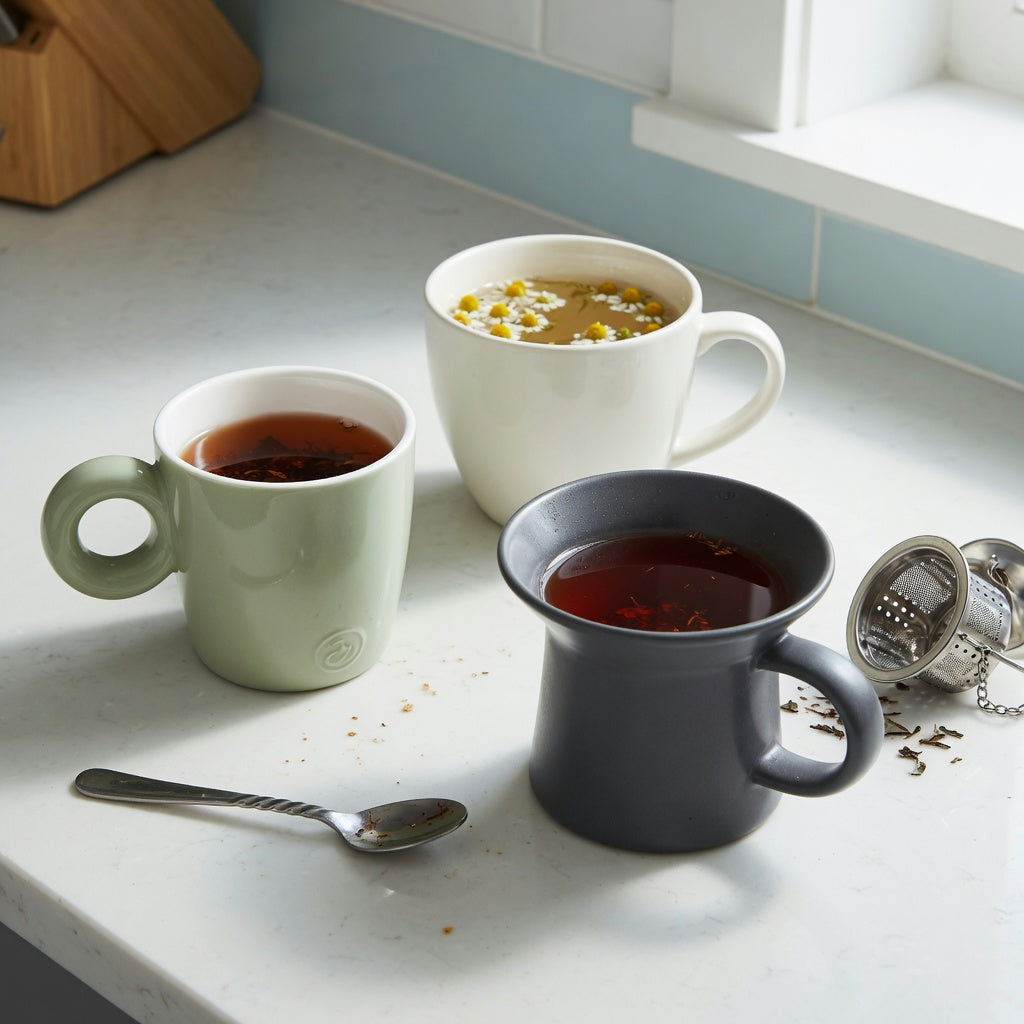
Loose Leaf Tea Mug Gift Choice Practical Purchase Checklist
Reading time: about 12 minutes
A birthday message arrives with one vague instruction: buy a mug for someone who drinks loose leaf tea. You know the recipient's habit, but not the serving size, the infuser they own, or the amount of room beside their kettle or keyboard. That is where this loose leaf tea mug gift choice practical purchase checklist helps: it turns a familiar routine into a few product checks you can verify before ordering.
At CoffeifyMug, our team handles this drinkware category and compares pieces in the situations that matter after the gift is opened: a first pour at a kitchen counter, a mug parked on an office desk, and the care questions that surface after a dishwasher cycle. We use practical handling experience to frame the choice, while keeping every product claim tied to details we can confirm.
The three linked products are drinkware only. They do not include a filter, infuser, strainer, or other brewing accessory in the verified offer. The confirmed comparison facts are the listed capacity for all three mugs and a listed 11.2 cm diameter for the Ball Handle; material, care, full footprint, and gift presentation should be checked on the live product page rather than assumed.
What does the recipient's tea routine look like when the mug is in use?
A buyer often knows that someone likes loose leaf tea without knowing how that tea is prepared. The most useful clue is not the blend name. It is what happens between the kettle and the first sip.
- One measured cup: The recipient fills a small basket, pours once, and drinks at a desk or beside the kettle. The smallest listed capacity is the logical first comparison.
- A longer morning session: The recipient pours more water or returns to the same leaves for another steep. A larger listed capacity may better match the routine, provided the existing brewing tool fits.
- An established infuser: The recipient already owns a mesh ball, basket, or strainer. The visible opening and usable depth matter more than the mug name.
- A fixed kitchen ritual: The mug stays on one counter or shelf. Actual footprint, handle clearance, and storage space should be verified from the product page instead of guessed from capacity.
For a discreet gift investigation, ask a friend to photograph the recipient's current mug beside a teaspoon or ask which size they use at work. A short clue such as fills halfway, fills to the top, or carries it from kettle to desk is more useful than a general statement that they drink tea. If nobody can provide a measurement, choose the option whose listed capacity and visible profile best match the strongest clue you do have.
How should a gift buyer read the 250 ml, 390 ml, and 400 ml listings?
Capacity is the cleanest common comparison because it is stated for all three options. Treat it as a listed maximum or comparison figure, not as a recommended fill line. Loose leaves, an infuser, and practical headspace all affect how much finished tea the recipient will pour, so a 390 ml mug will not necessarily hold 390 ml of liquid during everyday use.
| Product style | Listed capacity | Diameter or opening evidence | Useful gift cue |
|---|---|---|---|
| Ball Handle | 250 ml | 11.2 cm listed diameter | Start here for a smaller measured serving; verify the full footprint |
| Round | 390 ml | No numeric opening size is confirmed in this comparison; use the visible opening on the product page | More listed room for a larger pour or repeat steep |
| Spittoon | 400 ml | No numeric opening size is confirmed in this comparison; use the visible opening on the product page | Largest listed capacity; let the profile and routine decide |
The 250 ml Ball Handle coffee tea mug is the first page to inspect for a recipient who normally makes a smaller serving. Its listed 11.2 cm diameter gives you one concrete measurement to compare with a shelf or desk, but it is not a substitute for checking the full product dimensions or handle clearance.
The 390 ml Round coffee tea mug gives 140 ml more listed capacity than the Ball Handle. That makes it a reasonable comparison for someone who pours a larger solo serving or likes room for a second steep. The 400 ml Spittoon coffee tea mug is only 10 ml above the Round, so capacity alone should not decide between those two. Compare the visible opening, profile, and handle in the product images, then match them to the recipient's habits.
Will the handle and visible opening suit a desk, counter, or existing infuser?
Gift success often turns on how a mug is used, not how it looks in a thumbnail. A recipient who carries tea from the kettle to an office desk may care about handle clearance and grip. Someone who leaves the mug beside a teapot may care more about the opening and how easily an infuser can be placed or removed.
- Check the brewing tool: Compare the outside width and depth of the recipient's mesh ball or basket with the opening shown on the relevant product page. A basket can span the rim and still sit awkwardly, so capacity does not prove compatibility.
- Check the handle visually: The Ball Handle name signals a different handle treatment from the Round and Spittoon options. Use the product photographs to judge clearance and grip rather than promising a particular hand feel.
- Check the surface: Measure the open space beside the keyboard, kettle, or sink. A listed diameter is useful, but it does not tell you every dimension of the mug or how much room the handle needs.
- Check the cleaning route: A visible opening can make access easier for a hand or brush, but only the stated care guidance tells you how the mug should be cleaned.
For the Ball Handle, keep the listed 11.2 cm diameter in the comparison, while checking what dimension the product page labels and how it relates to the full footprint. For the Round and Spittoon, the verified facts supplied here do not provide a numeric opening diameter. Compare only the visible opening and any measurements explicitly shown on their pages. That boundary is especially useful when a gift buyer is tempted to promise that an existing infuser will fit.
Which material and care details should you verify before gifting?
A glossy product photograph cannot confirm material, finish, dishwasher use, or microwave use. The supplied catalog facts for these three mugs establish their capacities and the Ball Handle's listed diameter, but they do not establish whether a particular piece is ceramic, stoneware, porcelain, glass, dishwasher-safe, or microwave-safe. If one of those details is non-negotiable for the recipient, verify it on the live product page before ordering.
- Material and finish: Use the exact material wording provided by the seller. Do not label a mug ceramic or porcelain based on its appearance alone.
- Dishwasher guidance: Look for an explicit care instruction. A dishwasher cycle is a real-world use question, not a durability test to run on a gift after it arrives.
- Microwave guidance: Confirm this separately if the recipient reheats tea. Dishwasher and microwave suitability are different claims.
- Arrival condition: During unboxing, check the rim for a chip, the handle-to-body junction for a hairline crack or rough break, and the foot ring or base for rocking on a flat counter.
- Quantity and measurements: Confirm what the current product page says about the number of pieces and the dimensions. Do not infer a pair, gift set, or special presentation from a single product photograph.
In our store, we separate a product fact from a sensible precaution. We can compare the listed 250 ml, 390 ml, and 400 ml capacities directly. We cannot turn an unlisted care instruction into a promise, and we would rather tell a gift buyer to verify it than have the recipient discover a limitation during the first cleanup.
Which mug fits a compact desk, a long home brew, or a casual kitchen?
Use the recipient's situation as the starting point, then give that situation a product-specific next step. The matches below are decision aids, not universal rankings.
- One measured cup at a compact desk: Start with the Ball Handle mug if the recipient normally makes a smaller serving and you want the smallest listed capacity. The 250 ml listing and 11.2 cm listed diameter give you concrete numbers to compare with the available space. Open the product page and verify the full footprint and handle clearance before ordering.
- A home-office drinker who pours more: Review the Round 390 ml mug if the recipient refills from the same kettle, prefers more liquid in one serving, or regularly re-steeps. It offers 140 ml more listed capacity than the Ball Handle. Confirm that the visible opening works with the brewing tool they already use.
- The largest listed serving with a distinctive profile: Inspect the Spittoon 400 ml mug if the recipient likes a fuller listed capacity and the product's visible shape suits their kitchen. Because it is only 10 ml larger than the Round, choose it for profile and routine rather than expecting a meaningful volume jump.
- Unusual drinkware is the clue, but the routine is unknown: Browse the unique coffee mugs collection to compare the available silhouettes, then return to the individual product pages for capacity, opening, dimensions, and care information. Collection browsing can narrow the style choice, but it cannot replace checking the facts for the exact mug.
If the gift is for a household with two tea drinkers, confirm the quantity shown on the product page before planning a matching pair. Capacity describes one vessel; it does not turn a single mug into a set.
When does a travel mug, teapot, or simpler mug suit the recipient better?
Sometimes the most useful gift decision is to leave this category. These mugs are a poor default when the recipient's main requirement is a feature that is not confirmed in the listing.
- Backpack commuting: Choose a vessel with an explicitly confirmed lid, leak resistance, and insulation if tea must travel through a bag. The verified mug facts here do not establish those transport features.
- An all-in-one brewing setup: Choose a mug or brewer that specifically includes a filter or infuser if the recipient has no brewing tool. The three linked CoffeifyMug products are drinkware only, so do not present one as a complete loose-leaf brewing kit.
- Tea for several people: A teapot or serving vessel is a better fit than choosing a larger individual mug. The 400 ml listing describes one mug's capacity, not a multi-cup system.
- Bagged tea only: A simpler everyday mug may be more useful if the recipient never handles loose leaves. The opening comparison matters less when no separate brewing tool is involved.
- A strict material or care requirement: Pause until the product page explicitly confirms it. A gift should not depend on a guess about dishwasher, microwave, finish, or thermal-shock tolerance.
- A required set, gift box, or personalization: Verify those exact inclusions separately. This article makes no claim about gift packaging or personalization, and a product image is not evidence of either.
Choosing a different style is not a failure of the gift search. It is the right result when transport, brewing accessories, multi-cup service, or care instructions matter more than the mug's listed capacity.
Loose leaf tea mug gift choice practical purchase checklist for the final five minutes
Run through these points while the product page is open. Stop at the first unanswered requirement instead of filling the gap with an assumption.
- Write down one routine clue: one smaller cup, a larger home pour, repeat steeping, desk use, or stationary kitchen use.
- Choose the capacity range: compare 250 ml, 390 ml, and 400 ml as listed figures, remembering to leave practical headspace.
- Compare the opening: use the recipient's existing mesh ball, basket, or strainer as the reference. Use the Ball Handle's listed 11.2 cm diameter only in the context supplied on its page, and do not invent numeric opening sizes for the other two.
- Check the handle and footprint: compare the product photos and listed measurements with the desk, shelf, or counter where the mug will live.
- Account for the separate brewing tool: these products are drinkware only. Decide whether the recipient already owns a filter or infuser, or plan that purchase separately.
- Verify material and care: read the current listing for material, dishwasher, microwave, and any temperature guidance that the recipient needs.
- Confirm the offer: check quantity, dimensions, and exactly what is included before treating the item as a finished gift.
- Make the product-page decision: choose Ball Handle for the smaller listed serving, Round for more listed room, or Spittoon for the largest listed capacity when its visible profile fits the recipient.
If two options still seem close, focus on the non-negotiable clue. Round and Spittoon differ by only 10 ml, so their visible opening and profile deserve more weight than the number alone. A clear routine match is more useful than a broad claim that one style suits everyone.
Frequently asked questions
Which loose leaf tea mug size is safest for an office gift?
There is no universal safest size. Our loose leaf tea mug gift choice practical purchase checklist starts with the person's usual pour: 250 ml for a smaller serving, 390 ml for more room, or 400 ml when the largest listed capacity and profile fit. Check the available surface and the recipient's brewing tool before ordering.
Do these loose leaf tea mugs include an infuser or filter?
No filter, infuser, or strainer is included in the verified offer for these linked products. They are drinkware only, so confirm that the recipient already owns a compatible brewing tool or plan that item separately. Do not describe the mug as an all-in-one brewing system.
Is the 400 ml Spittoon meaningfully larger than the 390 ml Round?
The listed difference is 10 ml, which is small in everyday use. Compare the visible opening, handle, and profile on the two product pages, then choose the style that matches the recipient's routine. Capacity alone is unlikely to settle this particular pair.
Can I assume these mugs are dishwasher-safe or microwave-safe?
No. The verified facts used for this comparison do not establish dishwasher or microwave safety. Read the current care instructions on the product page or obtain confirmation before gifting, and do not use a dishwasher cycle as a test.
What should I buy if the recipient carries tea in a backpack?
A travel mug with an explicitly confirmed lid, leak resistance, and insulation is a better starting point. The products in this comparison are drinkware only, and the supplied facts do not confirm those transport features. Choose a listing that states the required feature instead of assuming a regular mug will manage a commute.
Take one concrete clue about the recipient, run it through the checklist, and then open the Ball Handle, Round, or Spittoon page. If the style is still the unknown, compare the wider range in the unique coffee mugs collection, then return to the exact product listing to confirm capacity, visible opening, care, and included items.
More from our blog
Read more
Flat White Cup Gift Choice Practical Purchase Checklist
Match a recipient's real drink routine to confirmed 200 ml, 250 ml and 270 ml cup capacities. This checklist covers headroom, product-page checks, care questions, unboxing inspection and reasons to...
Read more
Herbal Tea Mug Weekend Coffee Practical Purchase Checklist | 400-480 ml
Compare The Flow (400 ml), Morning and Night (440 ml), and The Rock (480 ml) for slower weekend tea and coffee routines. This checklist separates measurable capacity from handle comfort and flags m...
Read more
Leave a comment
This site is protected by hCaptcha and the hCaptcha Privacy Policy and Terms of Service apply.