



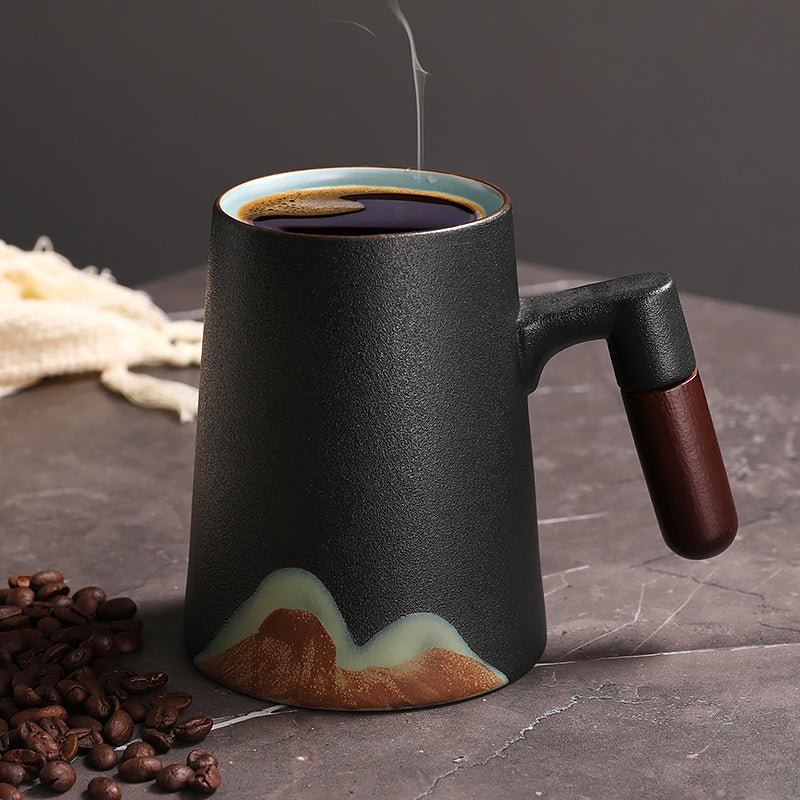
Latte Mugs Tall Storage Fit Guide: Shelf and Handle Needs
Reading time: about 10 minutes
A customer sent us a photo last month of a mug sitting at a ninety-degree angle in her cabinet. It fit — barely. She had to store it handle-sideways, and the door only latched with a press. The mug held exactly the latte she wanted. It was still the wrong mug for that shelf.
That is the problem this latte mugs tall storage fit guide is built to solve. A listed capacity tells you how much a vessel is stated to hold. It tells you almost nothing about the height, the width across the handle, or the base diameter that decide whether the thing goes back without a fight. Those are three separate numbers, and most listings give you one.
We handle these mugs daily in our store, so we hear the real version of the question: not "how many ounces" but "will it fit under my machine" and "will it fit in my cupboard." Here is how we walk a shopper through it, using the three capacities we can state plainly — The Flow at 400 ml, Morning and Night at 440 ml, and The Rock at 480 ml.
Latte mugs tall storage fit guide: which capacity do you shortlist?
Start with drink volume, then move to fit. Our three current options sit in a narrow band, 400 ml to 480 ml, so the volume decision is simpler than shoppers expect. Convert with the NIST approximate factor of 29.57 milliliters per U.S. fluid ounce, then subtract what you actually pour.
| Mug | Listed capacity | Approx. U.S. fl oz | Arithmetic headroom after a 12 fl oz pour | What the listing still needs to state |
|---|---|---|---|---|
| The Flow | 400 ml | about 13.5 | about 1.5 fl oz | Exterior height and width across the handle |
| Morning and Night | 440 ml | about 14.9 | about 2.9 fl oz | Widest body point and handle projection |
| The Rock | 480 ml | about 16.2 | about 4.2 fl oz | Shelf height and full handle-to-body width |
Read that fourth column as arithmetic, not a promise. We cannot confirm whether these listed figures are brim-full measurements or a working fill line, so treat any headroom number as an estimate until the specification says otherwise.
One more framing point. A regulatory definition is not a sizing target. The FDA ceramic guidance describes a typical cup or mug as holding about 240 ml (8 fl oz), with a handle, and describes a mug as having cylindrical sides — a description used when testing hollowware, not a rule about how big a latte mug should be. Nobody pours a 13.5 fl oz vessel to 8 fl oz and calls it done.
So: if you pour around 10 fl oz of espresso and steamed milk and your cupboard is the tightest constraint, open The Flow coffee and tea mug first, because 400 ml is the smallest stated capacity in this comparison. If you routinely pour 12 fl oz, Morning and Night at 440 ml sits squarely in the middle. If a bigger drink is the point — a 14 fl oz latte, or coffee that has to last a long morning — The Rock at 480 ml is the largest listed capacity we are comparing.
None of the three is automatically right for a shelf with 11 cm of clear height. We do not have verified exterior heights for these mugs in this guide, and capacity does not imply shape. If you want to compare silhouettes before narrowing down, the unique coffee mugs collection shows the range side by side.
What does "tall latte mug" mean in the listing you are reading?
Shoppers use the phrase for at least three different objects, and the storage math changes with each one.
- A tall everyday mug. Straight or slightly tapered sides, a handle, taller than it is wide. It stores upright and spends its shelf budget mostly in height.
- A wide café latte cup. Often shorter and bowl-like with a broad rim, designed so a milk pitcher can come close to the surface for latte art. It eats width and depth rather than height.
- The conical gift-mug shape. The kind sold in photo-print catalogs, frequently around 17 fl oz, with a narrow base flaring to a wide rim. That rim is the number that matters in a crowded row.
We can describe the silhouettes of The Flow, Morning and Night and The Rock from their current photos, and that is the honest limit of it. Use the photo to choose a shape you like, then get numbers before you commit.
Which cabinet measurements beat capacity every time?
Measure the usable opening, not the carcass. Shelf lips, hinges and door racks all steal space you assumed you had.
- Clear height. Shelf surface to the lowest obstruction above. Compare against the mug's tallest point, including a handle that rises past the rim. Leave enough to get your fingers in and lift, not a hairline.
- Usable depth. Inside back wall to the closed door. Then pick the orientation you will genuinely store it in, because a sideways handle trades width for depth.
- Width across the handle. Ask for two figures: widest body and maximum overall width including the handle. In a row, the second one decides how many mugs fit.
- Opening clearance. Hinges and shelf supports narrow the route in. A mug that fits once inside still has to get past the frame.
- Base diameter. Separate from everything above. It decides stability on a narrow shelf, a coaster, a tray and a car cup holder.
- Weight when full. A 480 ml mug carrying 480 ml of espresso and milk holds close to half a kilogram of liquid before you count the mug. On a high shelf, that is a two-hand lift.
Picture a shallow wall shelf at an office coffee station. Handle sideways, the mug clears the shelf and blocks its neighbour. Handle forward, it overhangs the front edge. Sketching both orientations against your measurements takes two minutes and settles a question ounce labels never answer.
For the same shelf logic applied to a smaller vessel, our 350 ml tall coffee mug comparison walks through how one shorter mug behaves against identical constraints.
How do straight, tapered and rounded bodies change what fits?
- Straight sides. The body takes roughly the same width at every height, so row width is predictable. The handle is usually what breaks the line.
- Tapered body. A narrow base feels compact, but the widest point higher up is what collides with a shelf support or the next mug.
- Rounded or flared body. The belly or the rim is the widest point. Two mugs standing apart at the base can touch at shoulder height.
- Outward handle. Turning it toward the cabinet wall saves width across the row and spends depth. Confirm the door still closes without pressure.
A tall, narrow silhouette is not automatically the storage-friendly choice. A shallow cabinet with generous horizontal space often stores a shorter, wider cup more easily — and that shorter cup is also the friendlier shape if latte art is your goal, because the pitcher can reach the surface. Tall vessels show off layers; they make the pour harder.
Do not plan on stacking unless the maker states that the specific mug is designed to stack. Rims, handles and finished surfaces make improvised piles unstable, and contact between stacked bodies is how chips and surface wear start.
Will the mug clear your espresso spout and your cup holder?
Machine clearance is model-specific, so measure your own setup: drip tray to the lowest point the mug must pass, usually the group head or spout housing. Then compare that against the mug's verified exterior height. A 480 ml mug is not guaranteed to be taller than a 400 ml one — capacity is volume, not stature.
Check side clearance too. A handle can foul the machine body or a neighbouring cup even when the rim slides under the spout cleanly. If your machine lets you reposition the drip tray or spout, measure the configuration you will actually use each morning, not the factory one.
If the current listing does not state a height, ask us before ordering rather than guessing from a photo. The workaround is pulling the shot into a small espresso cup and transferring it. It works, and it adds a vessel to wash every single morning, which is a real cost at 6:40 a.m.
Cup holders are the forgotten constraint. They care about base diameter, not capacity. A flared mug that sits beautifully on a counter can wedge in a console holder or tip in a shallow one.
What should you confirm about care and food contact before you gift it?
Capacity and care are unrelated facts about the same object. One does not vouch for the other, and neither does a colour that matches someone's kitchen.
On microwaving: the USDA advises using only containers manufactured for microwave use, notes that microwave-safe glass and ceramic is usually labelled as such, and lists china with metallic paint or trim as unsafe. If a mug arrives with no microwave claim, do not assume. The USDA's own field check: heat the unlabelled piece for one minute beside a cup of water — if it comes out warm or hot, it is not microwave safe.
On dishwashing, treat it as product-specific. Rely only on a dishwasher claim the maker states for that exact item, and re-read it if a design or print changes.
On ceramics from unknown sources — flea markets, antiques, handmade pieces with worn or damaged glaze — the FDA advises extra caution, because some glazes can release lead and washing or boiling will not remove it. For leachable lead in cups and mugs, the FDA's action level is 0.5 micrograms per millilitre of leaching solution across the units tested. Factory-made commercial drinkware is far less likely to be a problem than an unmarked import, and a "not for food use" marking means exactly that.
For gifting, put the care note in the box and check the recipient's cabinet height and machine clearance first. A mug that forces a shelf reorganisation is a worse gift than one that slots into space already there. If you would rather start from volume than from shape, our coffee mug size guide is the page we send people who ask what their cupboard actually holds.
Frequently asked questions
Does a 480 ml latte mug take up more shelf space than a 400 ml one?
Not necessarily. The Rock is listed at 480 ml and The Flow at 400 ml, but capacity says nothing about exterior height, base diameter or how far the handle projects. Compare those three figures on the current listings before you decide one is the tighter fit.
How much clearance should I leave above a tall mug on a shelf?
There is no universal number, because it depends on your grip and the shelf above. Leave enough to lift the mug out without scraping the rim or catching a raised handle, and account for shelf lips and hinges. A mug you already remove comfortably is the best available reference.
Can this latte mugs tall storage fit guide tell me if a mug fits my espresso machine?
Only partly. Machine clearance is model-specific, so measure from the drip tray to the lowest obstruction and compare it with the mug's verified exterior height. If that height is missing from the listing, ask us for it rather than estimating from a photo.
Is the listed capacity the same as a comfortable serving size?
Do not assume so. A stated capacity may be measured to the brim, and steamed milk plus foam needs headroom so the mug stays carryable from machine to desk. Subtract your usual pour and judge whether what is left feels like enough.
Will a tall mug fit a car cup holder?
Cup holders grip the base, so base diameter decides it — not height and not ounces. A flared mug with a narrow base can sit loose and tip; a wide base can refuse to seat at all. Measure the holder and the base before you plan on commuting with it.
Next step: write down four numbers before you order — your cabinet's clear height, usable depth, the width you can give one mug including its handle, and the clearance from your drip tray to the spout. Then match them against the current listings for The Flow, Morning and Night and The Rock, and ask us for any figure that is missing. Two minutes with a tape measure beats a return.
More from our blog
Ready to pick your mug? Two ways to save on today's order:
Ordering 1–3 mugs? Get an extra 10% off your 1st order with code 10_OFF Apply 10% Off & Shop Wooden-Handle Mugs →
Gifting 4+ mugs? Buy 3, Get the 4th Free applies automatically at checkout (no code needed; offers do not stack) · Free standard shipping (Nov pre-Christmas delivery: 15–20 calendar days US) · Free replacement if chipped in transit.
Popular mug buying guides: Ceramic Tea Cups & Infuser Mugs · Ceramic Mugs with Lids Compared · Wooden-Handle Tea Infuser Mugs Compared · Christmas & Secret Santa Mugs 2026 · Espresso & Cortado Cups Guide · Cup & Saucer Gift Sets · All 25 Mugs Spec Table · Mug Size Guide · Shipping & Promo FAQ
FIRST ORDER 10% OFF (CODE: 10_OFF) · OR BUY 3, GET THE 4TH FREE


Read more
Wide Based Coffee Mugs Size Decision Guide: 250 vs 400 vs 480 ml
A practical look at when a 250 ml, 400 ml or 480 ml wide based ceramic mug is the better buy — desk footprint checks, fill-level stability, handle clearance, and the glaze questions worth asking be...
Read more
15 Oz Ceramic Coffee Mugs Storage Fit Guide: Shapes and Shelf Needs
Shelf space, not capacity, is what gets large mugs returned. We compare three current shapes by footprint and handle projection, map them to our 400 ml, 440 ml, and 480 ml mugs, and give you the th...
Read more
Leave a comment
This site is protected by hCaptcha and the hCaptcha Privacy Policy and Terms of Service apply.