



Latte Mug vs Coffee Mug: What Fits Your Daily Pour?
Reading time: about 8 minutes
There's a mug on our packing table with a dried foam ring halfway down the inside wall. A customer bought it for her morning latte, poured roughly 300 ml of steamed milk into a narrow 350 ml coffee mug, and the foam broke before she reached her desk. Nothing was wrong with the mug. The drink and the vessel were simply mismatched.
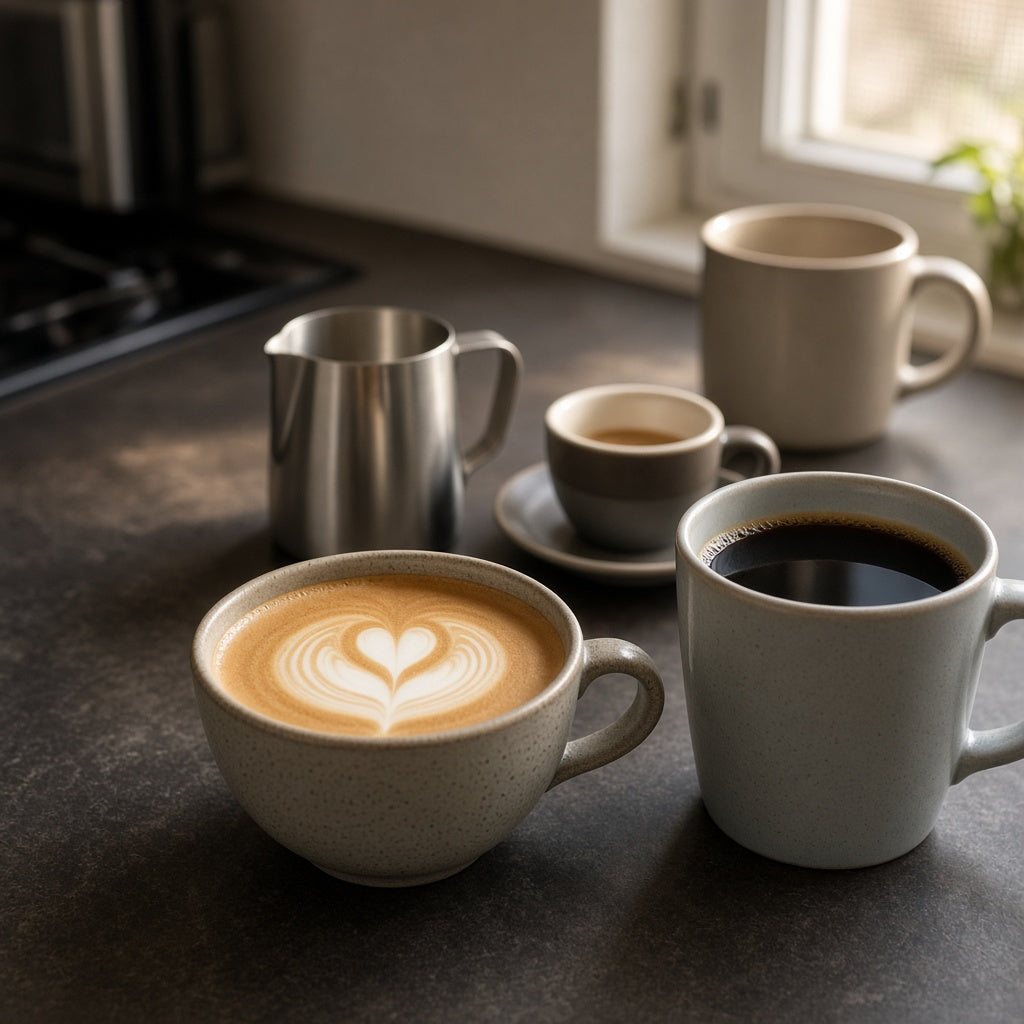
The latte mug vs coffee mug question sounds like hair-splitting until you've watched that happen a few hundred times. Here's the version we give customers across the counter, minus the sales voice: no standards body defines either term, and retail capacities sold as 12 oz, 16 oz, or 350 ml are listing specs rather than rules. What you can compare honestly is usable volume, rim width, bowl depth, handle clearance, and how a given shape handles heat. All five matter, so we'll take them against the three mugs on our own shelf.
Why does a latte need more room than drip coffee?
Start with what goes into the cup. Drip coffee is almost entirely water — it fills a mug to whatever line you choose and drinks the same from first sip to last. A latte is assembled: a small volume of espresso, then a much larger volume of steamed milk, then a thin cap of microfoam. Published manufacturer cup guides typically place a home coffee mug near 350 ml, a cappuccino cup near 180 ml, and latte service either in a glass around 220 ml or in a bowl-like mug larger than a cappuccino cup. The latte earns that extra room because more milk is the defining difference between it and a cappuccino.
That one fact settles most of the latte mug vs coffee mug argument before shape even enters it. If your usual drink is black coffee or coffee with a splash, a standard mug is the correct tool and nothing fancier will improve it. If milk is most of the drink, volume becomes a hard constraint rather than a style preference.
How much room does your drink need, and which of our mugs covers it?
Here is what we can state flatly, because these are the listed capacities on our own product pages: The Flow holds 400 ml, Morning and Night holds 440 ml, and The Rock holds 480 ml. All three sit in everyday-mug territory — big enough for a home latte, equally usable for drip coffee or tea. Rim width, profile, and wall thickness vary by design, so read those off the current listing rather than assuming they match across the range.
Matched to situations we actually hear about:
- Weekday drip, weekend latte, same desk. The Flow at 400 ml is our practical floor for a full milk drink with foam headroom, and it stays comfortable for black coffee on a Tuesday.
- One big morning pour, tea in the afternoon. Morning and Night at 440 ml gives a longer drink room without pushing into pitcher-sized territory, and the extra capacity earns its keep when the same mug has to hold a large tea.
- Extra shot, longer drink, slow sipper. The Rock at 480 ml is the generous option. Remember a full 480 ml mug is noticeably heavier in hand than a half-filled 350 ml one, so check the handle before you commit.
None of those three carry a bowl-shaped silhouette, so if a wide rim for latte art is the whole reason you're shopping, say so and look further. If you want one mug that handles several drinks competently, our unique coffee mugs collection is where we'd start you.
Latte mug vs coffee mug: where rim width and bowl depth split the two
Capacity tells you whether the drink fits. Shape tells you what happens after the pour. Three silhouettes keep showing up in this category:
- Wide, bowl-style latte mugs. A broad rim gives foam somewhere to spread and a milk pitcher somewhere to draw. The trade-off is real: a very wide surface thins foam quickly, and the pour has to stay centered or the design drifts to one edge.
- Taller, straighter coffee mugs. A narrower opening concentrates aroma and limits exposed surface, which suits drip coffee and keeps a modest milk cap from breaking apart. You give up canvas if latte art is the point.
- Handleless cafe au lait bowls. A related French serving tradition rather than a latte mug with the handle removed. Lovely for a slow weekend drink, awkward at a keyboard, and it wants a pre-warmed vessel because both hands are occupied.
You'll find plenty of home baristas describing a pour that suddenly worked after a cup swap. That's anecdote, not measurement — but it points at something true. An overly wide bowl spreads foam thin; an overly narrow one leaves nowhere to pour. The usable middle sits short of a shallow saucer and short of a tall tumbler. We get into the geometry in our latte art mug buying guide.
Handle clearance and the weight of a full mug
Handles are the most under-specified part of any mug listing and the most common source of returns in our experience. On a 400 ml mug holding black coffee, almost any handle works. Fill that same mug with a dense milk drink and the center of gravity shifts forward.
Two things are worth checking before ordering. First, clearance: you want room for at least two fingers to pass through the opening comfortably, not a decorative loop. Second, balance: a small handle mounted high on a heavy, full vessel tips more in the hand than a larger one set lower. If you grip mugs by the rim instead of the handle — plenty of people do — rim thickness and a rounded lip matter more than the handle does.
Does a wide bowl keep a latte hot, or cool it faster?
We won't pretend this is settled. We could not find independent, measured comparisons of heat loss in a wide latte bowl versus a taller coffee mug, and buyer articles repeating "wide mugs go cold faster" are not data. Two things are safer to reason from. A large, cold-walled cup pulls heat out of a small volume of espresso quickly, so pre-warming matters. And a wider liquid surface exposes more area, which usually means faster cooling — a sensible expectation, not a documented result.
Practical translation: if you drink a latte over twenty minutes, pour into a pre-warmed mug and accept that shape is a secondary factor to starting temperature. If you finish in five, stop optimizing and pick the shape you enjoy holding.
What should you confirm on the listing before you order?
Microwave, dishwasher, and oven compatibility are listing-level facts, not properties of ceramic as a material. Check the care icons on the exact product page — ours included — instead of assuming every ceramic mug behaves the same. A glaze that tolerates a dishwasher cycle on one mug tells you nothing about another.
Glaze safety deserves the same discipline. The FDA Food Code requires ceramic, china, and crystal ware that contacts food, including decorative hand-painted pieces, to be lead-free or within category lead limits, and it lists a maximum of 0.5 mg/L lead for coffee mugs in the beverage mugs, cups, and pitchers category. The FDA also warns that lead in traditional or improperly glazed pottery may not be fully bound and can migrate into food. "Lead-free" is a product-specific claim. Verify it on the listing in front of you, not on a category page.
Four checks before you add to cart
- Name your drink and its volume. Espresso plus milk plus foam, then headroom. If your total brushes the stated capacity, size up.
- Decide whether the rim is a feature or a risk. Wide for foam and art; narrower for aroma and a smaller exposed surface.
- Picture the full mug in your hand. Two-finger handle clearance, and a handle set low enough to balance a heavier pour.
- Read the product page, not the label. Stated capacity, care icons, and any food-contact or lead statement live on the listing.
If you want a second data point on volume before deciding, our breakdown of average coffee mug sizes covers how much a "standard" mug actually holds.
Frequently asked questions
Is the latte mug vs coffee mug difference only about size?
No. Size decides whether the drink fits, but rim width and bowl depth decide how the foam behaves. A tall 400 ml mug and a wide 400 ml bowl hold the same volume and pour completely differently — one concentrates the surface, the other gives art room to spread.
What size latte mug should I buy for a double-shot latte?
Treat 400 ml as a practical floor for a full milk drink once you allow foam headroom, which is where The Flow sits in our range. If you regularly add a third shot or drink slowly over a long morning, the 480 ml Rock gives more margin.
Can I use a regular coffee mug for a latte?
Yes, as long as the capacity covers espresso, milk, and foam without forcing you to short the milk. What you trade is foam surface and pour space; what you gain is a mug that also handles drip coffee and tea without a second purchase.
Can I put a ceramic latte mug in the dishwasher or microwave?
Only if that specific listing says so. Care compatibility varies between glazes and bodies even within one brand, so check the product page for the mug you're buying rather than general ceramic guidance, and treat any unlisted capability as unconfirmed.
Does a wide latte bowl make latte art easier?
Easier than a narrow tumbler, yes — up to a point. A very wide bowl spreads foam thin and lets the design drift off-center. The sweet spot is a rim wide enough to pour into without the surface going shallow.
Start with the drink you make most mornings, work out its volume with headroom, then decide whether rim width is a feature you'll use or a liability you'll notice. With those two answers in hand, browse the unique coffee mugs collection and check each listing's capacity and care icons against your notes — it takes about two minutes and saves a return.
More from our blog
Ready to pick your mug? Two ways to save on today's order:
Ordering 1–3 mugs? Get an extra 10% off your 1st order with code 10_OFF Apply 10% Off & Shop Wooden-Handle Mugs →
Gifting 4+ mugs? Buy 3, Get the 4th Free applies automatically at checkout (no code needed; offers do not stack) · Free standard shipping (Nov pre-Christmas delivery: 15–20 calendar days US) · Free replacement if chipped in transit.
Popular mug buying guides: Wooden-Handle Tea Infuser Mugs Compared · Christmas & Secret Santa Mugs 2026 · Espresso & Cortado Cups Guide · Cup & Saucer Gift Sets · All 25 Mugs Spec Table · Mug Size Guide · Shipping & Promo FAQ
FIRST ORDER 10% OFF (CODE: 10_OFF) · OR BUY 3, GET THE 4TH FREE


Read more
Everyday vs Gift Planet Mug: Capacity, Care, and Gift Cues
We sell and ship these mugs, so this is the comparison we keep repeating to buyers: what actually separates a daily-use planet mug from a gift-and-display piece, which details to verify on the list...
Read more
Best Ceramic Tea Mugs with Infuser and Lid (2026 Buyer's Comparison)
Compare 8 in-stock ceramic tea infuser mugs with fitted lids and removable strainers (270–450 ml). Free standard shipping, 30-day returns, Buy 3 Get 1 Free.
Read more
Leave a comment
This site is protected by hCaptcha and the hCaptcha Privacy Policy and Terms of Service apply.