
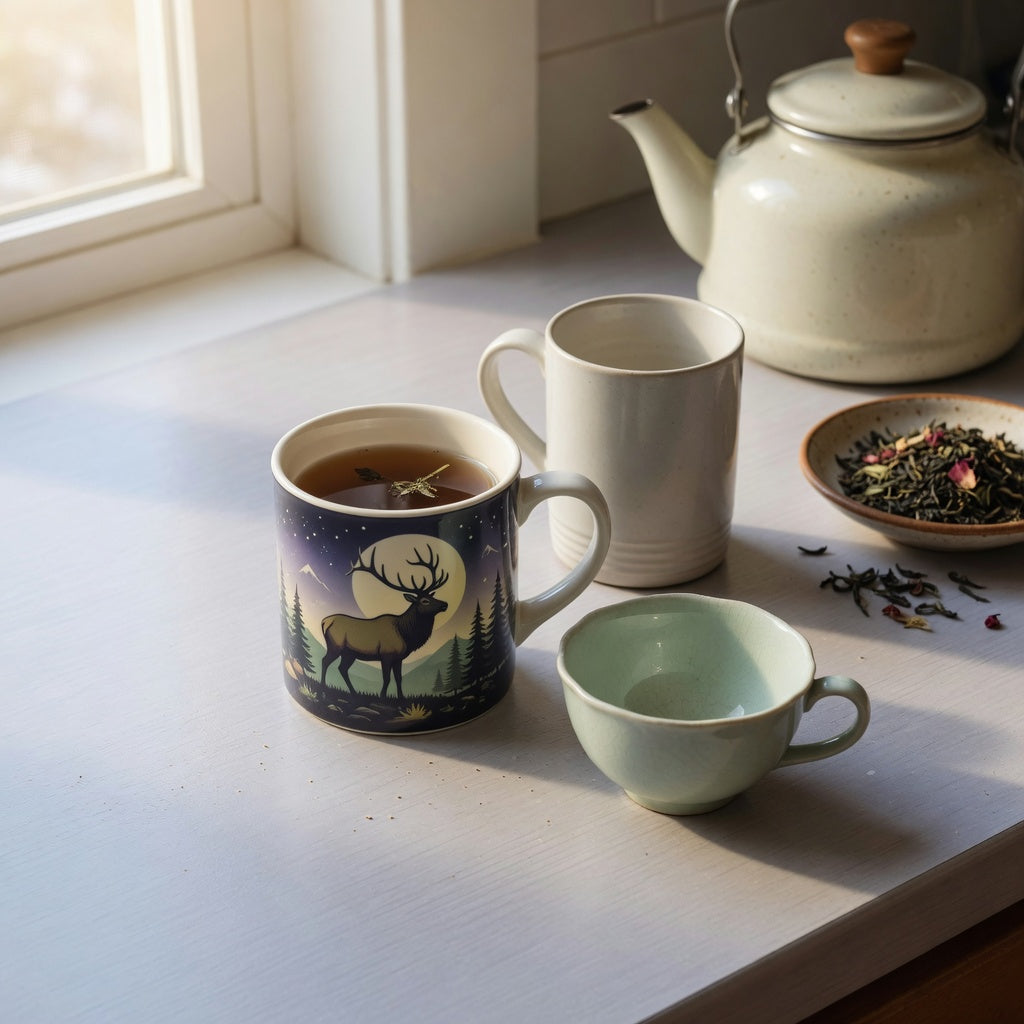
Elk and Moon coffee mug vs tea mug: size and heat
Reading time: about 12 minutes
A customer email this week asked which box to pull: the elk coffee mug, or a smaller elk tea mug. The search Elk and Moon coffee mug vs tea mug sounds like two engineered vessels with different walls, rims, and ounce marks. It is not. In our store that scene is a single Elk and Moon coffee tea mug. If you already like the artwork and you are still comparing shapes, the unique coffee mugs collection is the wider shelf. What changes the purchase is how a coffee-style mug and a tea-style cup behave once they are full, and whether this one listing should do one job or both.
We see the stall at the packing table more than we debate the moon. People already want the elk. They hesitate because yesterday's coffee might ghost into this morning's tea, because a tall cup can still be scalding at the second sip, or because a gift is going to someone who only drinks a small green tea. Those checks belong on the counter before the mug goes in a box.
Is the Elk and Moon coffee mug vs tea mug actually two products?
We have not found a manufacturer spec sheet that splits an Elk and Moon line into a coffee model and a tea model. On the wider market, elk-and-moon wildlife art shows up on ordinary drinkware labeled as a coffee mug, a tea mug, or both. That wording is a sales label. It is not a standard for rim width, wall thickness, or how fast the drink cools.
Read our listing as one everyday mug, then decide the drink. The animal on the outside does not tell you the pour. An open mug will not replace a leak-resistant commute cup unless the current listing shows a lid and a seal. Do not infer a lid, an infuser basket, or a double wall from the elk. If those parts are absent, this is the wrong tool for a drive to work, and it is the wrong tool for loose leaf you want held off the last swallow.
What cup and mug mean before you pick a tea pour
U.S. FDA guidance on pottery describes cups and mugs as small ceramic hollowware commonly used for coffee or tea served above room temperature. They normally, but not exclusively, hold about 240 mL (8 fl oz), and they normally have a handle. In that guidance, a cup usually has a base and curved sides. A mug has cylindrical sides. That note sorts a regulatory category. It does not tell you the body, the glaze, or the capacity of our listing.
It is also not a brewing recipe. Nothing in it requires a flared rim for tea or a thick wall for coffee. A cylindrical mug can hold tea. A curved cup can hold coffee. Neither word promises an infuser, insulation, or a surface that will never stain.
In our experience, shoppers say tea mug when they want something smaller and lighter, sometimes with a more open lip, and coffee mug when they want the taller cylinder beside the drip machine. Those are cupboard habits. We looked for a required rim width, height, or wall thickness that separates the two drinks and did not find one from a standards body. Retailer guides contradict each other, so we will not crown a single silhouette.
Plenty of Western tea drinking happens in that large coffee cylinder. A tea mug in a U.S. kitchen can look oversized next to a traditional teacup, and that is habit, not a rule the elk settles. Read the shape on the listing instead of arguing with the search phrase.
Which pour size fits milk, loose leaf, or a short tea?
Capacity is the decision that changes minds at our bench. People ask about roughly 8 oz, 12 oz, and 16 oz because those sizes are already in the cupboard. None of those numbers is assigned to the Elk and Moon listing in this article. Ounce marks, variants, and materials live on the current product page. A product photo is not a measuring cup. If the page is silent, do not guess.
How we talk it through when someone is judging a full mug on the counter:
- Straight coffee, or one tea you finish while it still tastes fresh. A smaller vessel, near that typical 8 fl oz cup, leaves less liquid to abandon during a meeting. Full, it also weighs less between the kettle and a desk.
- Coffee with milk, oat drink, or a second splash. You need empty space above the coffee. A larger cylinder gives you that room, then sits heavy in the hand. Read the stated capacity and picture the mug full, not the empty hero shot.
- Loose-leaf tea. Dry leaves expand to about four to five times their size and need room for water to circulate, a point chemist Michelle Francl makes for anyone stuffing a mug to the rim. Headspace matters more than the animal on the outside.
- Guest tastings or a small green tea. A big everyday mug is the wrong tool. A modest pour lets the liquor cool into a range you can smell. Keep the elk mug for the person who wants one generous favorite cup.
If you brew with a lid or an infuser, those parts have to be written on the current page. A blog post will not add them, and a similar wildlife mug on another site cannot fill the blank.
Wide rim, tall wall, or a thick base
Rim talk gets confident online and fuzzy beside a real kettle. Here is the limit: we are not publishing a cooling curve for thick versus thin walls, or for wide versus narrow openings. No standards body we found sets those measurements separately for coffee and tea. Treat the points below as shopper heuristics, not a spec for this design.
- Wider opening. More surface meets the air. Aroma is easier to smell, and the drink often leaves the scalding range sooner. The downside is a cup you meant to nurse through a long call going flat.
- Taller, narrower body. Less surface, so heat hangs on longer. Harder to get your nose over the liquor. A small base can feel tippy beside a keyboard and a stack of mail.
- Thick wall and heavy base. Kinder on the fingers, and slower to pass heat through the side. A cold thick mug also steals heat from the first pour, so prewarming matters more, not less.
- Thin wall. Livelier for tasting, and easier to chip when a spoon hits the rim in the dishwasher. Only relevant if the listing describes a thin body. Do not assume that from an illustration.
Francl's prewarm step is the habit we repeat. Warm the cup before you brew. Her water guidance is drink-specific. Black tea wants water at the boiling point, 212°F (100°C). Green and white tea want water nearer 175°F (80°C). Those are brewing temperatures. They are not the heat you should still be gulping ten minutes later.
A cold mug from a winter cupboard is what people feel and then blame on the tea. Splash hot water in, swirl, dump, then pour. We will not quote a degree drop. It depends on mug mass and how cold the shelf was. The habit costs nothing, and it works on any open cup.
Brewing heat versus the sip you should take
Keep two columns. Brewing heat extracts the drink. Drinking heat is what touches your mouth.
In 2016 an IARC working group classified drinking very hot beverages, meaning beverages consumed above 65°C (149°F), as probably carcinogenic to humans (Group 2A) for cancer of the esophagus. The same work classified coffee itself as Group 3: not classifiable as to carcinogenicity. The temperature finding is about the liquid you swallow. It is not about artwork, glaze color, or which side the handle is on.
Match the kettle to the tea, then let the cup come down before you drink. A mug that holds coffee at a scalding temperature for a full hour is not a feature we would praise. It delays the moment the cup is pleasant to hold and to sip.
Mug warmers are a separate desk gadget. Some morning drinkers like them. They do not fix a vessel that is simply too big, and they can pin a drink in a too-hot range if you never let it settle. The same checks apply in December as on a Tuesday in March. The season on a design changes. An open cup still loses heat from the surface.
One mug for coffee and tea, or two cups?
Most households do not need a matched pair. They need an honest read on residue. Coffee oils and tea tannins cling where a glaze is crazed, scratched, or chipped at the rim. A smooth intact surface usually rinses between a rare switch. A rim chip is where stains start, and it is when we would retire a mug from daily drinking even if the scene is still sharp.
We cannot call this design stain-proof, lead-free, microwave-safe, or dishwasher-safe. Those claims are not established in this article. FDA compliance guidance for pottery sets an extractable-lead action level for cups and mugs of 0.5 micrograms per mL of leaching solution, for any one of six units, using specified methods that include ASTM C738. That is a category benchmark. It is not a leach-test certificate for our SKU. If the product page says lead-safe, or names an appliance, read it there. Silence means not stated, not yes.
Share one mug when you mostly drink a single beverage, you rinse between an occasional switch, and you want the elk scene as the cup by the kettle. If that is you, open the elk-and-moon listing and read the care lines before you make it the only cup on the counter. Keep two vessels when you swing from a dark roast to a pale tea and you can taste the carryover, or when two people in the house are particular. A plain second cup fixes flavor transfer better than ordering the same scene twice.
Porcelain, glazed stoneware, bone china, and glass change how other drinkware washes and chips. Thin porcelain feels lively and chips at the rim. Heavier stoneware takes a knock and holds more heat in the wall. Bone china is the light, strong body of a lot of traditional tea service. Glass shows liquor color and shows stains the same day. None of that transfers onto this listing because another elk mug used that clay. Verify the body on the current page before you wash it like thin porcelain or like heavy stoneware.
| Situation | Lean coffee-mug style | Lean tea-cup style |
|---|---|---|
| Drink | Drip coffee, often with milk | Straight tea, especially a smaller pour |
| Size cue | Room above the coffee for milk | Near an 8 fl oz pour, plus leaf swell |
| Rim | Open enough to sip without a drip down your shirt | Open enough to smell, not so wide the tea goes flat |
| Heat habit | Prewarm, then let it leave the scalding range | Match water to the tea, then the same cool-down |
| Cupboard | Rinse if tea is next | Own cup if coffee oils bother you |
That table is a counter checklist, not a spec sheet. It will not give you a diameter or a filled weight for this listing. It will show which column your morning sits in.
What to verify on the listing before checkout
In our experience, the too-big notes and the hand-wash complaints come from skipped lines on the product page, not from the elk. Before you buy:
- Open the current Elk and Moon listing and copy only what the page states: capacity, material, variants, and care. Ignore ounce guesses from similar wildlife mugs elsewhere.
- Match that capacity to milk room, loose-leaf swell, or a short tasting pour. If capacity is missing, ask us or skip the guess.
- Picture the handle in your grip and the mug in the dishwasher rack you actually own. A cylinder that will not fit becomes a hand-wash chore by Thursday.
- If microwave or dishwasher use is non-negotiable, the listing has to say so. A blank line is not permission.
- Choose one shared cup or two cups from the staining and carryover you already notice at home.
- For a gift unboxing, match the drink that person makes. A huge coffee cylinder is a weak surprise for someone who only drinks a small cup of green tea.
- If the scene is right and the shape is wrong, go back through other unique coffee mugs and pick artwork on a size you already trust.
Look elsewhere if you need a lidded commute cup, a built-in infuser, or a lead-leach report for this exact product, unless the listing or paperwork we have published actually shows them. Also skip any open mug sold on the promise of staying above a comfortable sipping temperature. That is not a job we want this cup to do.
If the stated details match the pour you already make, add the mug. If you are still split between a smaller curved cup and a taller daily mug, trust the drink in your hand this week, not the search phrase that brought you here.
Frequently asked questions
Is the Elk and Moon coffee mug vs tea mug a comparison of two products?
No. The phrase reads like two products, and we are not selling a separate coffee model and a separate tea model. There is one coffee-and-tea mug listing with the elk-and-moon scene. You still decide whether that shape fits coffee, tea, or both by reading capacity and material on the current page, not by trusting the search wording.
Can one everyday mug handle both coffee and tea?
For a lot of kitchens, yes, if the surface is intact and you rinse between drinks. It is a poor plan if you taste coffee oils in a delicate tea, or if the rim is chipped and holding stain. A second plain cup fixes carryover more reliably than buying the same scene twice.
What size should I verify for tea instead of a large milky coffee?
Read the capacity stated on the listing. Do not assume 12 oz or 16 oz from the photo. A smaller pour, around the 8 fl oz size FDA guidance calls typical but not exclusive for cups and mugs, suits a straight tea you want to finish while it still tastes fresh. Leave room for milk, and extra headspace if you brew loose leaf that expands about four to five times.
Does a wide rim cool tea faster than a tall coffee mug?
A wider opening usually puts more liquid surface in the air, so aroma is easier to smell and cooling is often quicker. A taller, narrower mug often holds heat longer and is harder to smell across. We are not publishing a lab curve for this design, and we have not found a standard that sets the rim for you. Confirm the actual shape on the listing, then pick the habit you want.
Does the elk artwork make the mug lead-safe or dishwasher-safe?
No. Artwork does not answer safety or appliance questions. FDA guidance describes an extractable-lead action level of 0.5 micrograms per mL for cups and mugs, and that benchmark is not a test result for this product. Read microwave, dishwasher, and any safety language on the current listing, and treat a missing line as unstated.
More from our blog
Read more
Mountain Sea II Mug Gift Checklist: What to Compare
A practical mountain sea ii mug gift checklist for the ceramic wooden-handle mug: confirm the live 450 ml listing, hand-wash habits, finger room, and whether a lid or cup holder is required before ...
Read more
Filled Christmas Mug Gift Ideas: What Buyers Should Compare
Compare what actually belongs in a Christmas mug you fill yourself: recipient, dry cocoa or tea, wrap, allergens, and heat care. The mug is only the vessel; the extras are yours to choose and check.
Read more
Leave a comment
This site is protected by hCaptcha and the hCaptcha Privacy Policy and Terms of Service apply.