




Large Round Coffee Mugs Morning Routine Practical Purchase Checklist
Reading time: about 11 minutes
At 6:40 on a Tuesday, the coffee is ready and the mug is not. The carafe spout catches the rim before the stream clears it, or the mug is too tall to slide under the brew basket, or it needs two hands while you are also holding a lunch bag and keys. That is the moment a large round coffee mug either earns its counter space or gets pushed to the back of the cabinet. This large round coffee mugs morning routine practical purchase checklist starts at that counter, not at the product photo.
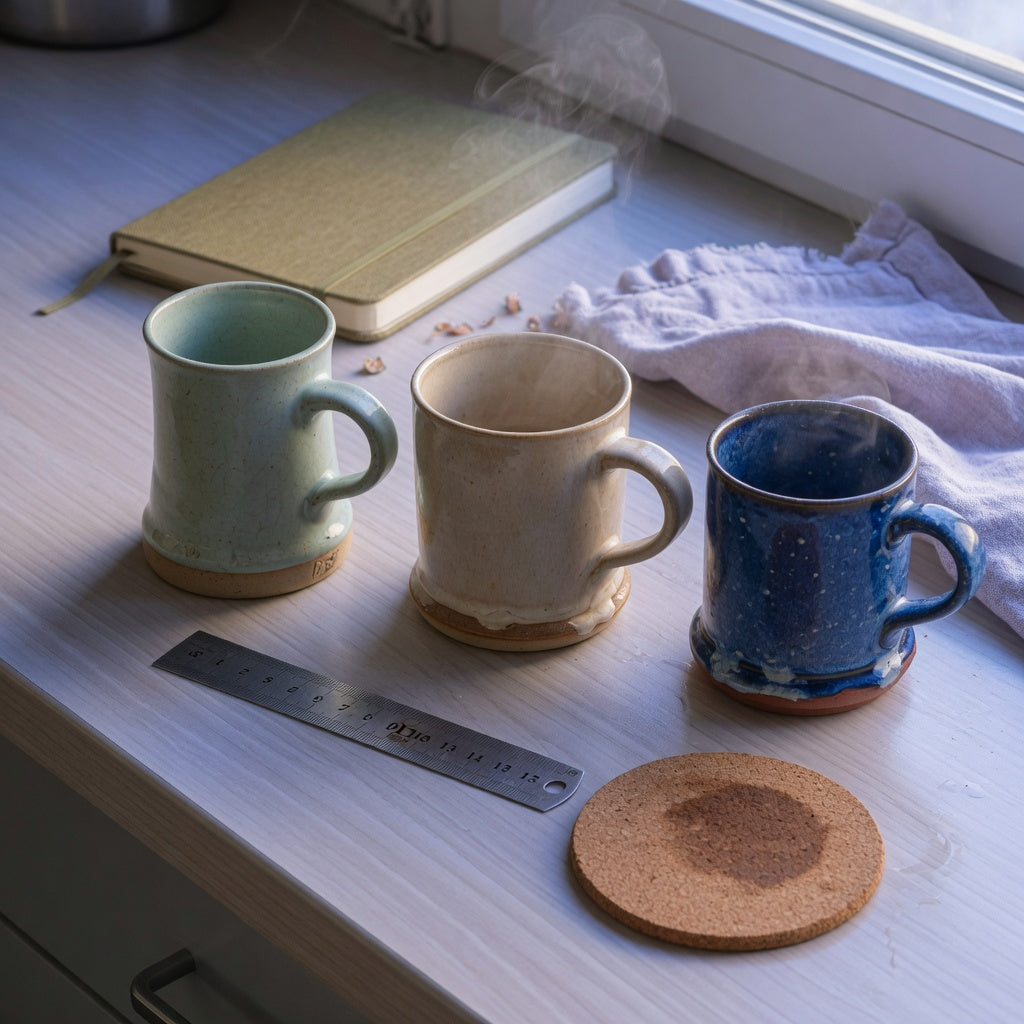
We pack and ship these mugs every week, and the questions that come back to us are rarely about color. They are about volume, clearance, handle room, and whether the glaze is suitable for hot liquid. What follows is the walkthrough we would give you across the counter, built around the three rounded silhouettes in our store and the measurements you can take at home in five minutes.
How much coffee do you actually pour before 8 a.m.?
Start with what you drink, not with what the listing says. The FDA describes cups and mugs as small hollowware that normally, but not exclusively, holds about 240 ml, which is roughly 8 fl oz. In our store, buyers asking for a large round mug usually want more headroom than that, especially if milk or cream goes in first.
Two conversions keep comparisons honest, and NIST Handbook 44 defines both: 1 US fluid ounce equals 29.57353 ml, and a measuring cup is exactly 8 fl oz. Run those numbers on the three round mugs we carry:
- The Flow - 400 ml, about 13.5 fl oz
- Morning and Night - 440 ml, about 14.9 fl oz
- The Rock - 480 ml, about 16.2 fl oz
Then subtract. Nobody fills to the brim on a workday. You leave a centimeter or two of headspace so a splash of cream, a spoon, or a walking stride does not end up down your shirt. A 480 ml mug poured to a comfortable line still delivers roughly 14 to 15 fl oz of actual coffee. If your current 12 oz mug runs dry before your second meeting, the 440 or 480 ml body is your range. If 12 oz is usually too much, 400 ml is plenty.
Which measurements belong in a large round coffee mugs morning routine practical purchase checklist?
Round mugs trade height for width. At the same capacity, a rounded body tends to sit lower and wider than a tall cylinder, which helps with spout clearance and hurts with shelf height and car cup holders. Measure these five things before you commit, in this order:
- Spout-to-counter clearance. With the brew basket in place, measure from the counter up to the spout, then add the mug's height plus an inch of pouring gap.
- Cabinet shelf height. Use interior shelf spacing, not the exterior. A mug that fits under the brewer may not fit on the shelf above it.
- Desk footprint. A wide base is stable but greedy. On a crowded desk it crowds a keyboard and a mouse pad.
- Cup holder diameter. Measure the holder, not the mug. A wide round base is the most common reason a mug rides home in someone's hands instead of the console.
- Stackability. If you store mugs two high, check whether the handle and base let them nest without wobbling.
If a single-serve brewer or a shallow drip spout is your setup, compare the mug's overall height and top width against the gap you just measured. Where a listing does not state a dimension you need, ask us before ordering. We would rather answer a measurement question than process a return.
Does the handle leave room for your fingers when the mug is full?
The handle is where large round mugs quietly fail. A generous opening lets three or four fingers through. A tight one forces a pinch grip, and a pinch grip on a full mug is how people end up with coffee on their wrist. The test is not how the handle looks on an empty mug. It is whether your knuckles clear the body when the mug is full and tilted toward your mouth.
- Slide your fingers through the opening and check knuckle room against the body.
- Hold the mug with water at your usual pour volume, not empty.
- Carry it the distance you actually walk - kitchen to desk, sink to sofa, counter to stairs.
Weight follows volume. A larger fill is heavier at the end of an extended arm, and that is physics, not a defect. If you carry coffee from kitchen to office, upstairs, or across a workshop, a smaller listed capacity with a broad handle usually beats a bigger body with a narrow one. The Flow's 400 ml listed capacity is the smallest of our three, so it is the first one to compare if one-handed carrying matters more than refill size.
Will a wide rim take a pour-over dripper or spill when you tilt it?
Two shape questions come up constantly with round mugs. The first is pour-over fit. A V60-style cone needs a rim wide enough to seat without tipping, and a very wide mouth can leave a dripper straddling the rim instead of resting flat on it. AeroPress users hit the opposite problem: a bellied body is fine, but a narrow foot under pressure feels tippy.
The second is drinking angle. A round belly holds volume low and wide, so tilting it far enough to reach the last few ounces moves the whole mass of liquid forward at once. Black coffee drinkers who finish in one long tilt often prefer a straighter wall. Sippers - latte, tea, someone who sets the mug down between every mouthful - rarely notice the difference. A wide base usually feels stable on the counter; a strongly bellied body changes where the weight sits in your hand.
Does a wide-open round mug hold heat long enough for your morning?
Honestly, less well than a narrow one. Surface area drives heat loss, and a broad round mouth exposes more liquid to room air than a tall narrow mug at the same volume. Thick walls add thermal mass that slows the first drop, which is why a heavy mug feels warm in your hand while the coffee inside is still cooling from the top down.
The fix costs nothing: swirl hot tap water in the mug for twenty seconds and tip it out before you pour. You are preheating the body so it stops stealing heat from the coffee. Beyond that, a large round mug is built for drinking, not for holding. If your coffee routinely sits for forty-five minutes during calls, a lidded travel mug is the better tool, and that is a different category with its own trade-offs in weight, cleaning, and lid seals.
What should you verify about glaze, lead, and cadmium before daily use?
Cups and mugs are not the same risk profile as a serving platter. The FDA treats them as small hollowware, applies a lead action level of 0.5 ug/ml of leaching solution under Compliance Policy Guide 545.450, and applies that guideline to any one of six units tested. Cadmium has its own limits under CPG 545.400 - 0.5 ug/ml for small hollowware and 0.25 ug/ml for large hollowware - and the FDA has stated that extractable cadmium from ceramicware could cause chronic cadmium poisoning with continued food use.
Here is the part shoppers rarely hear: the FDA has reported imported traditional pottery labeled Lead Free that nevertheless contained extractable lead, in some cases above those action levels. A printed Lead Free badge is marketing copy until it is tied to a named leach test. A published pilot study in Food Safety and Risk also reported that lead from ceramic mugs can leach into coffee and tea, and that measured concentrations depended on the individual cup. Heavily decorated yellow, orange, and red glazes are the ones most worth asking about in cadmium terms.
If a piece is decorative-only, US rules require a conspicuous not-for-food-use warning, or a hole through the potential food-contact surface, when 21 CFR 109.16 applies. Also look at the trim: metallic rims, gold luster, and exposed enamel bands are the details that take a mug out of microwave use regardless of what the body is made of. If you want to know which food-contact testing applies to a specific mug in our store, ask us directly and we will tell you what the maker provides rather than what the box promises.
Which of our three round mugs fits your morning volume?
Work backwards from the checks above rather than from the product photo. The capacities below are the listed capacities. Dimensions, handle opening, and care markings still need to be confirmed on each current listing.
| Mug | Listed capacity | The morning it suits |
|---|---|---|
| The Flow | 400 ml (about 13.5 fl oz) | You want the smallest listed capacity of the three and usually stop at one mug. Best starting point if you drink 10 to 12 oz and want less volume to manage while carrying. Verify height and rim width before ordering. |
| Morning and Night | 440 ml (about 14.9 fl oz) | You switch between coffee and tea and want a little more headroom than The Flow without going to the largest body. A middle option for a one-mug morning with milk. Verify handle opening and base width on the listing. |
| The Rock | 480 ml (about 16.2 fl oz) | You finish a mug fast, refill, or drink slowly at a desk and want the largest listed capacity of the three. Measure brewer clearance and cabinet height first, because the biggest listed volume is the one most likely to surprise you. |
None of the three is right if you need a sealed lid for a commute, or if your cabinet is tight - round bodies consume shelf height. If you want to compare silhouettes side by side, browse the full unique coffee mugs collection before you decide.
How do you care for a large round mug without cracking it?
Thick ceramic handles daily use well and thermal shock badly. The failure we hear about most is a mug going from a hot dishwasher rack into cold rinse water, or boiling liquid poured into a mug that just came out of a cold cabinet. Cracks often start at handle joints and thick sections, where expansion is uneven.
- Warm the mug with hot tap water before pouring anything near boiling.
- Let it cool before washing, and skip the ice-water rinse on a hot mug.
- Check the base for the maker's dishwasher and microwave marks - that stamp is the only claim worth trusting.
- Look at the foot: a recessed or ridged base contacts a mug warmer differently than a flat one, and a foot ring can hold the mug off the plate entirely.
Do not assume dishwasher or microwave compatibility because a mug looks sturdy. The maker's mark or the listing is the claim to trust, and metallic trim changes the microwave answer even when the body is fine.
The six checks to run before you add to cart
If you are standing in the kitchen with a tape measure right now, run these six checks in order and stop when one fails:
- Measure spout-to-counter clearance with the brew basket loaded.
- Confirm the volume you actually drink, then add 2 fl oz for milk and headspace.
- Slide four fingers through a handle opening roughly the same size as your current mug's.
- Check interior cabinet shelf height against the mug's height plus a finger's width.
- Match the rim width against any dripper or cone you plan to use.
- Look for a food-contact statement you can trace to a test, and a base mark for dishwasher and microwave use.
Anything you cannot answer from the listing is a question worth sending us before checkout. Start with the three product pages above, compare the listed capacities, and measure the tightest spot in your morning - usually the space under the brewer.
Frequently asked questions
How many fluid ounces is a 400, 440, or 480 ml mug?
Using the NIST conversion of 29.57353 ml per US fluid ounce, 400 ml is about 13.5 fl oz, 440 ml is about 14.9 fl oz, and 480 ml is about 16.2 fl oz. Those are brim-full figures. A realistic pour line with room for cream lands closer to 12, 13.5, and 15 fl oz.
Will a wide round mug fit under my single-serve brewer?
Usually the issue is height, not width. Measure from the counter to the spout with the basket in place, then add the mug's height plus an inch. If the listing does not publish a height you can compare, ask before ordering - that is exactly the kind of question we answer daily.
Do large round mugs make coffee go cold faster?
A wider mouth does lose heat faster than a narrow one at the same volume, even with thick walls that slow the first drop. Preheating the mug with hot tap water offsets most of it for a normal drinking window. If your coffee sits for an hour, use a lidded vessel instead.
Is a lead-free label enough on a coffee mug?
Not on its own. The FDA has reported imported pottery labeled Lead Free that still contained extractable lead above the 0.5 ug/ml action level in CPG 545.450. Ask which leach test backs the claim, and check cadmium separately if the glaze is yellow, orange, or red.
What should I measure first when buying a large round mug for my morning routine?
For this large round coffee mugs morning routine practical purchase checklist, start with spout-to-counter clearance and the volume you actually drink. Those two numbers eliminate more wrong choices than color, shape, or handle style. Send us both if you want help comparing The Flow, Morning and Night, and The Rock before checkout.
More from our blog
Ready to pick your mug? Two ways to save on today's order:
Ordering 1–3 mugs? Get an extra 10% off your 1st order with code 10_OFF Apply 10% Off & Shop Wooden-Handle Mugs →
Gifting 4+ mugs? Buy 3, Get the 4th Free applies automatically at checkout (no code needed; offers do not stack) · Free standard shipping (Nov pre-Christmas delivery: 15–20 calendar days US) · Free replacement if chipped in transit.
Popular mug buying guides: Ceramic Mugs with Lids Compared · Wooden-Handle Tea Infuser Mugs Compared · Christmas & Secret Santa Mugs 2026 · Espresso & Cortado Cups Guide · Cup & Saucer Gift Sets · All 25 Mugs Spec Table · Mug Size Guide · Shipping & Promo FAQ
FIRST ORDER 10% OFF (CODE: 10_OFF) · OR BUY 3, GET THE 4TH FREE


Read more
Wide Based Coffee Mugs Morning Routine Practical Purchase Checklist
A six-check buying sequence for wide based mugs built around when you actually drink, how much you pour, and how often you refill — plus the base, handle, cup holder, and glaze questions to settle ...
Read more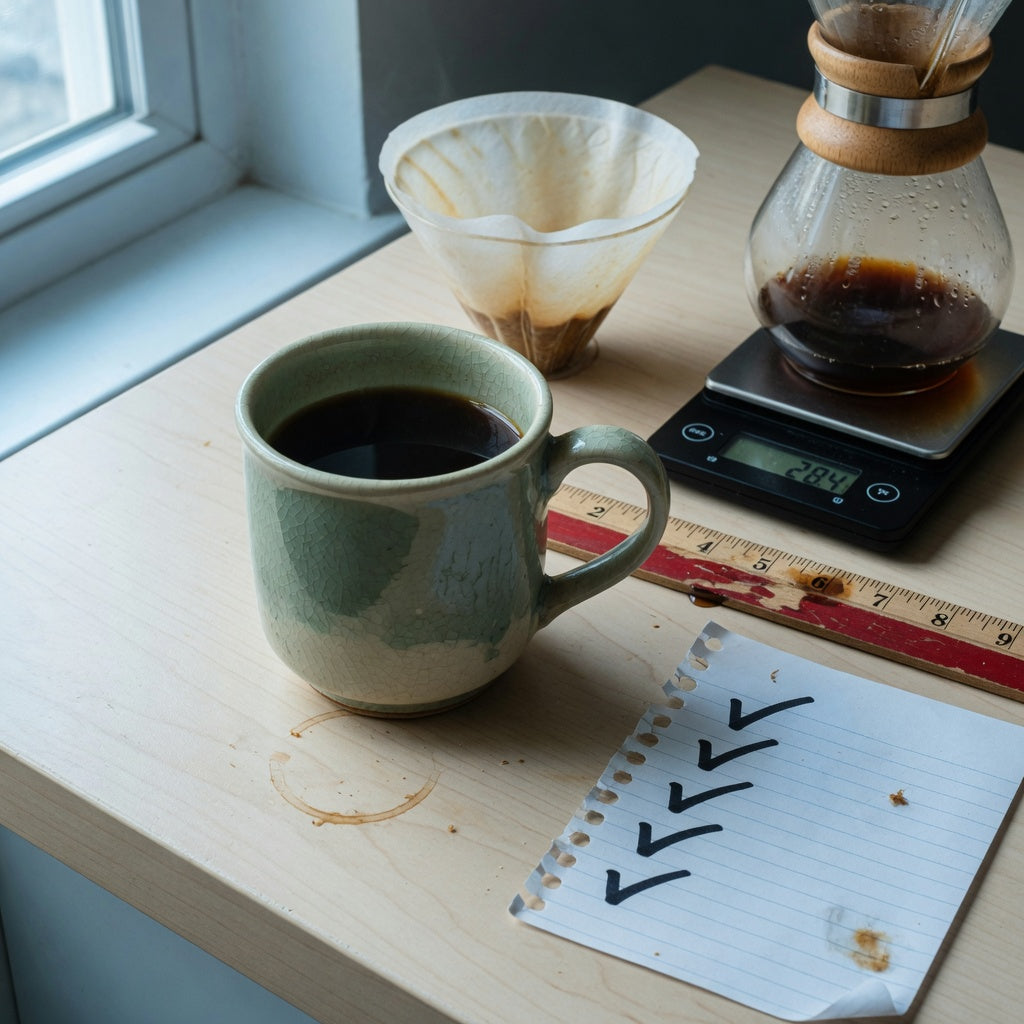
15 Oz Ceramic Coffee Mugs Morning Routine Practical Purchase Checklist
A 15 oz ceramic mug is roughly 444 ml at the brim — which is not the same as your coffee. Use this morning-routine checklist to match usable pour, handle clearance, full-mug weight, care claims, an...
Read more
Leave a comment
This site is protected by hCaptcha and the hCaptcha Privacy Policy and Terms of Service apply.