
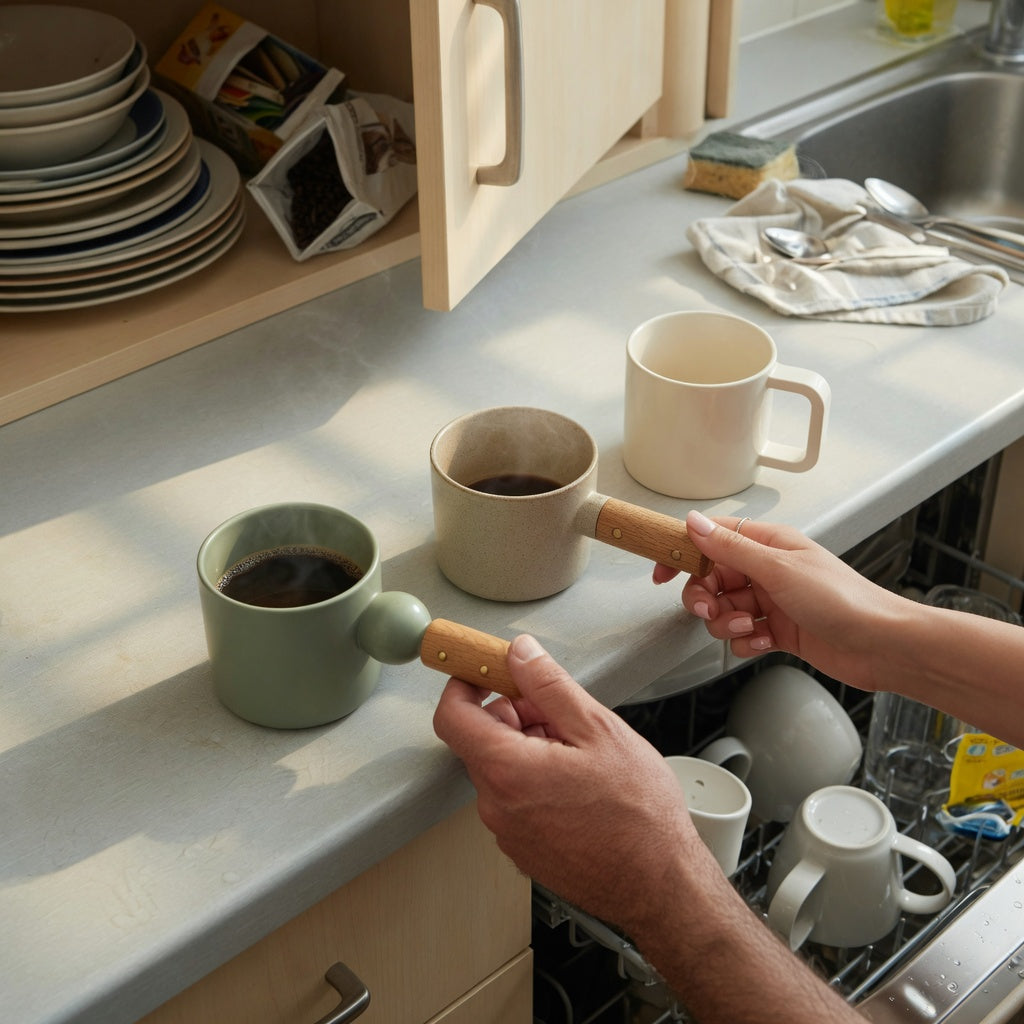
Large-Handle Ceramic Coffee Mugs: Shared Household Buying Checklist
Reading time: about 10 minutes
A shared kitchen exposes mug problems quickly. One person hooks two fingers through the handle, another wants room for a full four-finger grip, and someone else leaves the mug beside a laptop until the drink cools. Our ceramic coffee mugs with large handles shared household practical purchase checklist starts with those differences, then checks cupboard space, drink habits, cleaning routines, and the facts confirmed on each product page.
In our store, we pay close attention to the parts shoppers cannot evaluate from a styled kitchen photo alone: the usable opening inside the handle, knuckle clearance from the mug wall, the two handle-to-body joins, the foot ring, and the mug's total width once the handle is included. A handle can look generous from the outside yet still pinch at its narrowest point. A visually striking grip can also take up more shelf space or feel less balanced after the mug is filled.
Ceramic coffee mugs with large handles shared household practical purchase checklist
Run these checks for every regular user, not just the person placing the order. Keep general preferences separate from product facts that still need to be verified on the linked page.
- List each person's normal grip. Record whether they use two fingers, four fingers, a palm-supported hold, or both hands. A larger opening does not help if the handle shape conflicts with the preferred grip.
- Measure a mug that already works. Note the internal handle height and width at the narrowest points, the gap between the handle and mug wall, and the total width from the outer body to the far edge of the handle.
- Identify a mug that gets avoided. Write down the specific reason: cramped fingers, excessive empty weight, a hot-feeling grip, poor balance, an uncomfortable rim, or a handle that catches neighboring items.
- Compare normal drinks. Check the capacity listed on the product page against each person's usual coffee or tea pour. Ice occupies part of the vessel, so an iced-drink user may need different usable volume from a short-coffee drinker.
- Measure the real storage route. Include shelf height, cabinet depth, door clearance, and the side-to-side space needed to lift the mug without striking another handle.
- Confirm the care routine. Read the product page for dishwasher and microwave guidance. Do not assume that every ceramic mug has identical care requirements, especially when another material is attached to the handle.
- Check finish and stability after delivery. Inspect the rim, base, interior, and both handle joins before use. A mug should sit steadily, and a crack at a structural join is a reason to stop and contact the seller.
- Verify quantity instead of reading it from the photo. Styled images may show more than one object. Confirm what the product page says is included rather than assuming the mugs are sold as a set.
This process often leads a shared household to choose different mugs for different people. That is a practical result. Matching pieces are less useful if one handle suits everyone in theory but only one person in daily use.
Handle opening, knuckle clearance, and balance for different hands
The word large does not describe one standard measurement. Two handles can have similar outside dimensions while providing very different usable space because of thick ceramic, a sculpted grip, or a narrow attachment point. Measure the opening where fingers actually pass through, not just the widest part shown in a photograph.
Knuckle clearance matters during a full pour. If the opening sits close to the mug wall, larger fingers may touch the warm ceramic even though the handle looks broad. A handle that projects farther from the body creates more clearance, but it also moves the hand farther from the mug's center of mass. That leverage can make a filled mug feel heavier or less controlled for someone with limited grip strength.
Large handles are therefore not automatically the right answer for every user. Someone who supports the mug body with a second hand may prefer a compact handle and lighter overall form. Smaller hands can also find a thick ball or oversized loop harder to control. For a household that includes children, frequent guests, or people who prefer delicate two-finger grips, keeping at least one smaller-handled alternative is sensible.
How much cabinet and dishwasher space does the handle consume?
Measure the full footprint, not just the ceramic body. On a crowded shelf, the handle determines how closely mugs can sit and whether the cabinet door closes. A simple paper template made to the product page's listed width and depth can reveal conflicts before checkout. Place it beside the mugs you already own and leave enough room to lift one item without dragging another by its handle.
Stacking should never be assumed. Sculpted handles and wide loops can prevent nesting, and forcing mugs together can put pressure on the rim or handle joins. Large-handle designs are not a strong fit for very shallow cabinets, tightly packed open shelving, or a household that depends on vertical stacks to save space.
Dishwasher fit is a separate measurement. Check rack-prong spacing, clearance below the upper rack, and whether the handle could interfere with another item or the spray arm. Dishwasher suitability itself remains product-specific. If the page does not state a cleaning method clearly, treat that point as unconfirmed rather than inferring it from the ceramic body.
Coffee, tea, and iced drinks create different purchase priorities
A long morning coffee, a modest tea serving, and an iced drink do not use the same mug in the same way. Compare the listed capacity with the amount each person actually pours. An oversized vessel may feel unnecessary to a tea drinker, while a smaller mug can require repeated refills for someone who carries coffee from the kitchen to a home office.
Also check height if anyone fills the mug beneath a coffee machine. The relevant number is the available clearance between the drip tray and dispenser, not the cabinet measurement. At a desk, compare the base with the person's coaster and consider how far the handle projects toward a mouse, notebook, or charging cable.
Iced drinks introduce condensation and ice displacement. A user may value a secure, easy-to-wipe grip more than heat clearance, while a hot-drink user may prioritize keeping fingers away from the mug wall. Shared households do not need to force these preferences into one compromise piece. Choosing individual mugs by role is often more practical than trying to make every item identical.
Ceramic bodies, wooden handles, and product-specific care
General category guidance: A ceramic body alone does not confirm dishwasher or microwave suitability. Glazes, decorative finishes, adhesives, and attached materials can change the manufacturer's instructions. A wooden handle makes the mug a mixed-material object, so its exact cleaning and reheating guidance should be checked on the product page before purchase.
Wood can be affected by prolonged soaking, detergent, and repeated high-heat cycles, but the appropriate routine depends on how the handle is constructed and finished. Follow the instructions supplied for the specific mug. If everyone in the household expects to place every cup in the same dishwasher load or use it for microwave reheating, an option with uncertain mixed-material care is not a good fit until those points are confirmed.
For any ceramic mug, inspect these areas after unboxing and during use:
- Handle joins: Look closely where the handle meets the body. Do not keep using a mug if a structural crack develops there.
- Drinking rim: Check for chips, sharp areas, or rough exposed material before the first pour.
- Interior glaze: Contact the seller if the food-contact surface has unexpected cracks, rough patches, or damage.
- Foot ring: Set the empty mug on a flat counter and check for rocking before filling it with a hot drink.
Avoid abrupt temperature changes unless the product instructions explicitly permit them. Moving a very cold ceramic mug directly to very hot liquid can stress the material. This is general care guidance, not a claim about the specifications of any individual CoffeifyMug product.
Which CoffeifyMug product page fits each household scenario?
Product-page comparison: The names, photographs, listed materials, dimensions, capacity, and care details on each page should decide the final purchase. The scenarios below identify which page to inspect first; they do not claim that the products share identical specifications or are sold together.
| Household situation | Page to open first | Why it belongs on the shortlist | Details to verify |
|---|---|---|---|
| A regular user prefers a pronounced, sculptural grip instead of a conventional loop. | Ball Handled Coffee Tea Mug | The product is presented with a ball-style handle, making its grip geometry the main comparison point. | Usable finger space, total width, capacity, weight, care instructions, and quantity included. |
| The household specifically wants a wood accent and is prepared to follow material-specific care. | Mountain Sea II Coffee Tea Mug with Wooden Handle | The product title identifies a wooden handle, which directly affects the material and care decision. | Handle construction, cleaning guidance, microwave guidance, dimensions, capacity, and quantity included. |
| A shopper wants to compare another coffee-and-tea mug profile against the ball and wooden-handle designs. | The Flow Coffee Tea Mug | Its product page provides a distinct design to compare visually with the other handle approaches. | Handle opening, mug width, material listing, capacity, care instructions, and quantity included. |
If none of those pages resolves the hardest grip, storage, or care requirement in your household, browse the unique coffee mugs collection. Start with the person who has the least flexible requirements, then compare options for everyone else. This keeps the purchase focused on daily use instead of visual matching.
A five-minute counter test before checkout
Use one favorite mug and one avoided mug as physical references. This turns vague preferences into measurements that can be checked against product-page details.
- Fill the favorite mug to the person's normal level and note how many fingers enter the handle.
- Measure its internal handle opening, knuckle clearance, overall height, and total width including the handle.
- Place it in the usual cabinet and dishwasher position to identify the actual space available.
- Repeat the grip test with the avoided mug and record precisely what feels wrong.
- Mark every candidate fact as confirmed, unsuitable, or unknown. Ask about unknown care or dimension details before ordering.
The best first purchase is the individual mug that clears every non-negotiable requirement for the hardest-to-fit user. Confirm what is included on the page rather than assuming multiple mugs arrive because several appear in a photograph.
Frequently asked questions
What should a shared-household large-handle mug checklist include?
The ceramic coffee mugs with large handles shared household practical purchase checklist should cover grip style, internal handle measurements, total mug width, capacity, storage clearance, and confirmed care instructions. It should also record which details remain unknown on the product page and the quantity actually included.
Does a larger handle always make a ceramic mug easier to hold?
No. The usable opening, handle thickness, knuckle clearance, filled weight, and balance matter more than the outside size alone. A handle that projects far from the mug may provide more room but can make a full mug feel less controlled for some users.
Can a ceramic mug with a wooden handle go in the dishwasher or microwave?
Do not assume it can. A wooden handle creates a mixed-material construction, and cleaning or reheating suitability depends on the product's specific design and instructions. Check the linked product page and ask the seller if either point is unclear.
Should everyone in a shared household use the same mug style?
Only if the same handle, capacity, weight, and care routine genuinely suit every regular user. Different hand sizes and drink habits often make individually selected mugs more useful than matching pieces. Confirm each product's quantity because this checklist does not assume the mugs are sold as sets.
How can I tell if a large-handled mug will fit my cabinet?
Use the product page's total dimensions to make a paper template, including the full handle projection. Test it at the intended shelf position, check that the door closes, and leave room to remove the mug without striking neighboring handles.
Put the household's favorite mug on the counter, record its handle opening and full footprint, then open the product page that best matches the hardest-to-fit user. If the listed facts leave a non-negotiable question unanswered, continue through the unique coffee mugs collection until grip, storage, capacity, care, and quantity are all confirmed.
More from our blog
Read more

Black tea mug compact kitchen product shortlist guide: 3 options
Compare the Round 390 ml, Gradient 400 ml, and Flow 400 ml without guessing at unlisted dimensions. This shortlist connects capacity, visible handle shape, cabinet checks, and daily storage routine...
Read more
Unique Coffee Mugs for Gifts Compact Kitchen Product Shortlist Guide
A compact kitchen turns a decorative mug into a storage decision. Compare the Handbag, Rhombus, and Crane Coffee Tea Mugs by recipient style, space constraints, care questions, and clear reasons to...
Read more
Leave a comment
This site is protected by hCaptcha and the hCaptcha Privacy Policy and Terms of Service apply.