



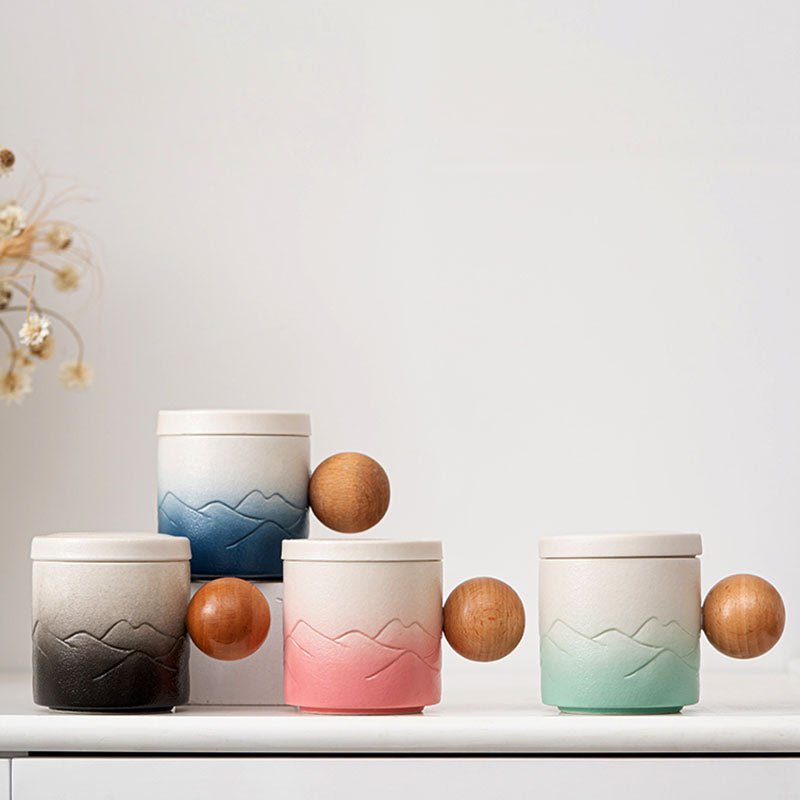
How to Size Ball Handled Mug for Daily Use: Ounces, Grip, Weight
Reading time: about 9 minutes
A customer at our packing table last month held up two mugs and asked which one was smaller. Both were listed at 12 ounces. One she could lift with three fingers wrapped cleanly around the ball; the other pushed her knuckles against the mug wall before the first sip. Same capacity on paper, completely different mug in the hand. Learning how to size ball handled mug for daily use starts exactly there, with your own hand and your real pour, not with the number printed on the label.
What follows is the walkthrough we use with customers who email us after a mug arrives and does not quite fit their morning. There is no universal right answer here, only measurements you can take at home and then match to the current listing.
Measure the pour first, not the mug
Fill the mug you reach for every morning to the level you actually fill it, not to the brim, then pour that into a liquid measuring cup and write the number down. Most people guess 12 ounces and find their honest pour is closer to 9 or 10.
Two details skew that number more than buyers expect:
- Listed capacity usually runs to the rim. Leave room for milk, a tea bag, or that last inch of coffee nobody drinks, and a mug sold as 12 oz gives you closer to 10 or 11 oz of usable liquid.
- The refill counts. If you always pour a second cup, your real number is the total, not the first pour. It is the reason the same person often wants a large mug at the desk and a small one at the kitchen table.
What ounce range covers one person's daily serving?
There is no published sizing standard for ball handled mugs. We have looked, and most available guidance is generic mug advice rather than anything specific to a knob-style grip. What we can offer is the band that fits most of the buyers we talk to. Treat it as a starting range, then confirm the real number on the listing.
| Capacity | Who it suits | Trade-off |
|---|---|---|
| 8-10 oz | Tea drinkers, single small coffees, espresso-based drinks | More refills; lightest to carry and easiest to grip |
| 11-14 oz | The everyday coffee or tea serving for one person | Best all-round balance of volume, weight, and hand fit |
| 15-16 oz | Desk days, long meetings, iced drinks with plenty of ice | Noticeably heavier when full; the liquid cools before you finish |
| 18 oz and up | All-morning sippers and big-volume drinkers | Needs a large hand; a ball concentrates a lot of weight on a small contact area |
Iced coffee breaks the table. Ice takes up real volume, so a 12 oz pour over ice wants a mug closer to 16 oz, otherwise you drink a strong first half and a watery second. A wide infuser basket creates the same problem for tea drinkers, eating space at the top of the mug where you expected liquid to fit.
Whatever band you land in, confirm capacity and dimensions on the product page rather than the lifestyle photo. Our Ball Handle Ceramic Coffee Tea Mug listing carries those lines, and on a ball handled mug the capacity and the handle geometry have to work together before anything else matters. If you would rather compare body shapes and handle styles at similar volumes first, the unique coffee mugs collection is a faster scan than opening ten tabs.
The ball handle is the sizing variable buyers forget
On a loop-handled mug, the handle mostly acts as a hinge. On a ball handled mug, the rounded knob is the entire grip. Your fingers close around it, and the gap between that ball and the mug wall decides whether the mug feels secure or cramped by the second cup.
Three measurements matter, and you can take all of them with a ruler and your own hand:
- Clearance between the ball and the body. Hold your hand flat and measure across your three middle fingers. That is roughly the opening you want. Less than that and you will grip with two fingers and a pinch, which is fine for one cup and tiring by the fourth.
- Ball diameter. A larger ball spreads pressure across more of your fingers, which helps over a long morning. Too large, though, and it pushes your hand away from the mug's centre of gravity, so the mug feels heavier than it actually is.
- Knuckle room at the top. Your index finger rests on or just under the ball. A tight gap there shows up on the third cup, not the first.
Glaze is part of the fit too. In our experience, a high-gloss ball is slicker in a wet hand than a matte or lightly textured one, and that changes how tightly you end up gripping. Try holding the mug with damp hands after washing up. You will learn more in five seconds than from any product photo.
Full weight versus empty weight: the balance question
Capacity tells you volume. It does not tell you what the mug weighs at 7 a.m. with a full pour and a phone in your other hand.
Do the rough sum. A 12 fl oz pour adds roughly 12 ounces of liquid before the mug itself is counted, so a thick-walled ceramic body can push the whole thing past a pound. Once is fine. Four times a day, with a handle that forces an awkward grip, it is not.
Two things are worth checking before you size up:
- Wall thickness and rim. Thick walls hold heat longer but add weight; a thin, tapered rim drinks better and cools faster. Neither is wrong, but know which one you are buying.
- Base width. A wider foot resists tipping on soft surfaces like a couch cushion or a car seat, but it also demands more shelf height in the cupboard.
Where the mug lives decides the size as much as your pour does
A mug that is perfect at the kitchen table can be wrong at a desk. We ask customers where the mug will spend most of its life, because the answer reshapes the recommendation more than the ounce count does.
- Office desk: a wider base and slightly larger capacity, since every refill costs you a walk down the corridor. A 14-16 oz mug with generous handle clearance earns its weight here.
- Couch or reading chair: smaller and lighter wins. A full 16 oz mug balanced on an armrest is a spill waiting for a chapter break.
- Tight cupboards: measure the shelf gap before ordering. A tall body plus a ball knob that protrudes sideways can stop a shelf from sliding shut.
- Dishwasher: tall mugs may not clear the upper rack, and ball handles can hook on the tines. Read the care note on the listing rather than assuming, and expect repeat detergent cycles to dull a glossy glaze over the years.
- Car cupholder: a protruding ball generally will not drop into a cupholder. If commuting is part of daily use, this is probably the wrong style for you.
Where a ball handled mug is the wrong pick
Honest trade-offs, because a mug that fights your routine ends up at the back of the shelf:
- Travel and commuting. The ball protrudes. It is a desk and kitchen mug, not a travel mug.
- Limited grip strength. If hooking your fingers through a full loop is easier, buy that instead. A ball handle asks for a closed grip, and a heavy one asks for a strong one.
- Stacking and crowded cupboards. Ball knobs get in the way when mugs nest and can chip against their neighbours.
- Very large capacities. A 20 oz body on a small ball concentrates a lot of weight on a small contact area. If you drink that much, a large loop handle or a handled tumbler usually feels steadier.
How to size ball handled mug for daily use, step by step
- Measure your real pour in a liquid measuring cup, including the refill you pretend you will not have.
- Add 1-2 ounces of headroom for milk, ice, or a tea bag.
- Measure across your three middle fingers; that is your minimum handle clearance.
- Read capacity, dimensions, and the care note on the listing, not the lifestyle photo.
- Estimate the full weight: pour volume plus the mug itself.
- Confirm it fits where it lives, whether that is a shelf, a desk, a dishwasher rack, or a cupholder.
Mapped to our store: a one-cup coffee drinker with average hands should start with the ball handled coffee and tea mug, then compare its listed capacity against the number you measured. That order matters, because no photograph tells you the ounce count. A two-refill desk drinker should size up and accept the extra weight. Buying as a gift? Measure the recipient's current mug while they are out of the room; it is the only sizing data that is ever reliable. And if you are still torn between neighbouring sizes, browse the full collection to see how other shapes and handle styles sit at similar volumes before you commit.
Frequently asked questions
Is a 12 oz ball handled mug big enough for daily coffee?
For most single-cup coffee drinkers, yes, provided your measured pour is around 10 oz or less. If you routinely go back for a second cup, a 14-15 oz mug saves trips. Check the listed capacity rather than the product name, since usable volume always sits below the rim.
How do I know if the ball handle will fit my hand?
Measure across your three middle fingers and compare that to the gap between the ball and the mug body. If the gap is smaller, you will be gripping with two fingers. When you can hold the mug in person, try it with a wet hand, because glaze grip changes noticeably once water or dish soap is involved.
How to size ball handled mug for daily use if I mostly drink tea?
Tea drinkers usually land smaller, around 8-10 oz, because a smaller volume stays hot to the last sip and leaves room for an infuser basket without crowding the rim. An open, wide rim also lets you lift the bag out without fishing for the string.
Are ball handled ceramic mugs dishwasher safe?
Read the care note on the specific listing, because that is the only answer that applies to your mug. As a category, glazed ceramic generally tolerates dishwasher cycles, but repeated heat and detergent can dull a glaze over the years, and a protruding ball knob can knock against rack tines. Hand washing the handle keeps the finish crisp for longer.
Should I size up or down if I am between two capacities?
Size down if you carry the mug around, have smaller hands, or drink in short sittings. Size up if it stays parked on a desk and you dislike refilling. Handle clearance and full weight matter more than the ounce difference between two neighbouring sizes.
More from our blog
Ready to pick your mug? Two ways to save on today's order:
Ordering 1–3 mugs? Get an extra 10% off your 1st order with code 10_OFF Apply 10% Off & Shop Wooden-Handle Mugs →
Gifting 4+ mugs? Buy 3, Get the 4th Free applies automatically at checkout (no code needed; offers do not stack) · Free standard shipping (Nov pre-Christmas delivery: 15–20 calendar days US) · Free replacement if chipped in transit.
Popular mug buying guides: Ceramic Tea Cups & Infuser Mugs · Ceramic Mugs with Lids Compared · Wooden-Handle Tea Infuser Mugs Compared · Christmas & Secret Santa Mugs 2026 · Espresso & Cortado Cups Guide · Cup & Saucer Gift Sets · All 25 Mugs Spec Table · Mug Size Guide · Shipping & Promo FAQ
FIRST ORDER 10% OFF (CODE: 10_OFF) · OR BUY 3, GET THE 4TH FREE


Read more
Best small emerald ceramic coffee mug for beginners: buying checks
A small mug can be easier to use, but capacity, rim shape, handle clearance, glaze variation, and care instructions matter more than color alone. Use this practical checklist before ordering the Em...
Read more
Pleated Coffee Cup Size Guide: What 200 ml Holds in Practice
A practical pleated coffee cup size guide from our store: how the 200 ml Pleated Ceramic Coffee Cup pours in real use, which drinks fit comfortably, and the saucer, stacking, and care checks worth ...
Read more
Leave a comment
This site is protected by hCaptcha and the hCaptcha Privacy Policy and Terms of Service apply.