
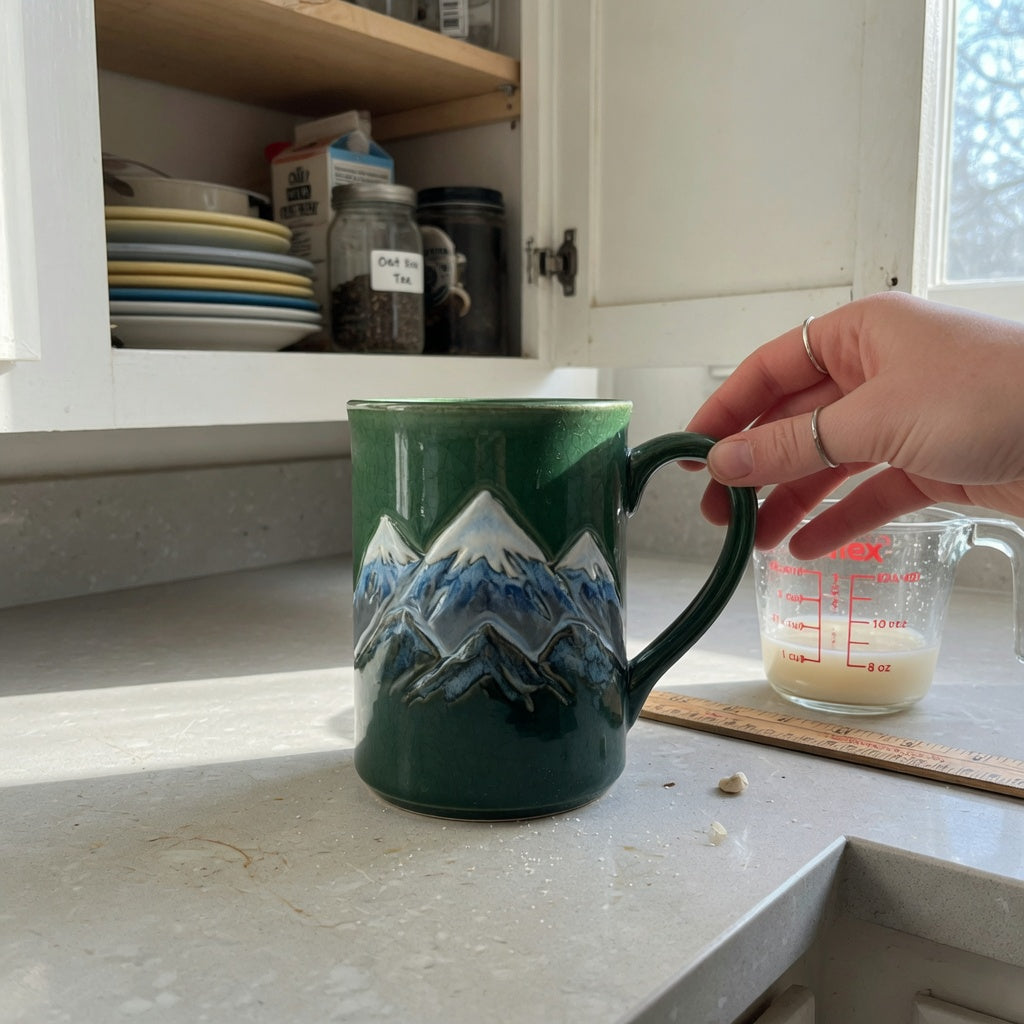
How to Choose Tall Ceramic Coffee Tea Mug: Size, Shape, Fit
Reading time: about 10 minutes
A tall mug can look balanced in a product photo, then arrive too high for the cabinet, too heavy once filled, or too cramped around the handle. We see those mismatches when shoppers choose the artwork before checking the mug against their actual drink and kitchen. That is the practical problem behind how to choose tall ceramic coffee tea mug: the right piece must fit your pour, hand, shelf, and cleaning routine.
For a concrete comparison, open the Mountain Tall Coffee Tea Mug and our unique coffee mugs collection in separate tabs. Treat the product page as a candidate, then verify every current capacity, dimension, material, and care detail that matters to you. A name or styled image cannot settle those points.
Pour volume first: how to choose tall ceramic coffee tea mug capacity
Start with the finished drink, not a capacity label. Pour your normal coffee or tea into a measuring cup after adding the milk, foam, lemon, or ice you actually use. Then find out whether a listed capacity is measured to the brim or represents a practical fill level. Those are different buying measurements.
- Measure the normal serving. Record the amount you drink rather than the largest serving you might make once a month.
- Add working headroom. One or two fluid ounces is a useful starting allowance for carrying and stirring, but it is not a universal rule.
- Account for additions. Milk tea, latte foam, an infuser, and ice all need space beyond the base pour.
- Check the exterior height separately. Two mugs can hold the same amount while fitting a shelf or dishwasher very differently.
A small black coffee in an oversized tall mug leaves a long empty interior and may feel awkward to sip. A milk-heavy coffee or tea benefits from extra room because you can stir without pushing liquid over the rim. If your finished drink measures 11 oz, an 11 oz brimful mug is likely too tight; shortlist something with usable room above that measurement. This measured-pour test is the part of how to choose tall ceramic coffee tea mug options that no styled photograph can do for you.
Tall and narrow or wide: which shape suits your drink?
Height alone does not keep coffee warm. The opening and wall construction matter. A Consumer Reports heat-retention overview explains that glass and ceramic vessels matched for size, weight, and shape perform similarly, while a narrower vessel reduces evaporative cooling. It also notes that thicker ceramic absorbs more heat from the initial pour, then retains heat better after the mug and drink approach equilibrium.
| Daily pattern | Useful starting shape | Trade-off to check |
|---|---|---|
| Slow desk coffee or tea | Taller body with a narrower opening | Can reduce exposed liquid surface, but a narrow base may feel top-heavy |
| Latte or milk tea | Tall body with measured headroom | Confirm that your spoon reaches the bottom comfortably |
| Loose-leaf tea with an infuser | Opening wide enough for easy removal | A very narrow mouth can make a basket infuser awkward to lift |
| Aroma-focused coffee and maximum stability | Wider, lower mug | Uses more desk space and exposes more liquid to air |
There is no standardized heat result that applies to every tall ceramic mug. Compare similar capacities and wall construction, then focus on mouth diameter. An open ceramic mug also will not perform like a sealed, insulated travel vessel.
Will the handle, rim, and foot still work when the mug is full?
Handle comfort is personal, so a universal three-finger or four-finger rule is not reliable. In our store, we recommend measuring a mug you already enjoy: note the interior handle height, interior width, and the narrowest gap between your knuckles and the mug body. Compare those numbers with the listing or ask the seller for them.
- Grip at full load. A tall mug combines ceramic weight with a larger column of liquid. If hand fatigue matters, ask for the empty product weight and test a similarly filled mug at home.
- Inspect both handle joins. After unboxing, look where the handle meets the body for a visible hairline crack, gap, or rough edge.
- Check the sipping rim. A rounded rim often feels forgiving for daily use; a thinner rim can feel precise but gives less material around an impact-prone edge.
- Test the foot. Place the empty mug on a flat counter and press lightly around the rim. Rocking can signal an uneven foot ring, which matters more on a tall body.
For the first handling check, fill the mug halfway with cool water, lift it in your normal grip, and then fill it to your intended level. This reveals balance without starting with a hot drink. Also run a finger carefully around the rim and foot ring for sharp chips before the first use.
Stoneware, porcelain, and wall thickness in daily use
Ceramic is an umbrella category, not a complete specification. Porcelain is a denser, less porous type of ceramic, but the body name alone does not tell you the finished wall thickness, empty weight, handle balance, or care instructions. Stoneware should not automatically be treated as heavy, and porcelain should not automatically be treated as fragile; judge the finished mug.
- Thicker walls: they take more heat from the first pour and add weight, but can retain heat better after warming through.
- Thinner walls: they reduce empty weight and can feel more refined at the lip, but edge protection depends on the finished design.
- Exterior comfort: ceramic generally heats more slowly on the outside than comparable glass or metal, though the handle still needs to carry most of the load comfortably.
No ceramic body is drop-proof. For a busy sink, shared office dishwasher, or gift recipient with limited grip strength, weight and rim construction may matter more than the material name.
Food-safe glaze: which listing details deserve trust?
Glaze safety cannot be judged from color, gloss, or price. The U.S. FDA states that it may take enforcement action when a cup or mug exceeds 0.5 micrograms/mL of leachable lead in any one of six units tested under ASTM C738 or an equivalent method. The FDA guidance for pottery and ceramic drinkware treats cups and mugs as small hollowware used for beverages such as coffee and tea.
Before buying, look for information that addresses the finished drinking surface:
- A statement that the mug is intended for food or beverage contact, including the interior and rim.
- Clear material identification rather than only a decorative style name.
- Microwave and dishwasher directions tied to the finished product, glaze, and decoration.
- A seller who can explain what testing or compliance supports a safety claim if you ask.
A bare lead-free phrase is less informative than product-specific food-contact information. We will not infer a certification that a listing does not state. If the interior glaze or intended use is unclear, leave that question unresolved rather than filling the gap with an assumption.
Cabinet, dishwasher, and microwave: measure all three
Tall mugs often fail the storage test by a small margin. There is no single cabinet or dishwasher clearance that applies to every home, so take the measurements where the mug will actually live.
- Cabinet: measure the clear vertical opening, then allow enough room to tilt and retrieve the mug by its handle. Shelf height alone may not capture a low door frame.
- Dishwasher: measure from the rack surface to the obstruction above. Check whether the handle can sit between tines without forcing the mug to lean or interfere with moving parts.
- Microwave: confirm both interior height and turntable rotation, then use the mug there only if its current care instructions say it is microwave-safe. Do not assume all ceramic finishes or metallic decorations are suitable.
- Brewing station: if coffee pours directly from a machine, measure from the drip tray to the spout. A mug that fits the shelf can still be too tall for the brewer.
After the first wash and periodically after dishwasher cycles, inspect the rim, interior, handle joins, and foot ring. Stop using a piece with a sharp lip chip or a structural crack, and ask the maker about unexplained glaze changes. A mug that only fits the bottom rack is not necessarily defective; it may simply be a poor match for your routine.
Desk coffee, milk tea, or a gift: match the mug to the situation
| Reader situation | Why a tall mug may fit | Relevant next step |
|---|---|---|
| Slow coffee or tea at a desk | A narrower opening can reduce evaporative cooling and a modest base can use less desk area | Compare the Mountain tall mug listing, then verify its current base, handle, capacity, and care details |
| Milk tea or a latte at home | Extra vertical room can provide headspace for milk or foam | Measure the completed drink and confirm that your spoon or frothing routine works with the interior depth |
| A gift for someone who likes distinctive drinkware | A tall silhouette has visual presence when the recipient has suitable storage and grip | Use the current mug collection to compare available styles instead of guessing one shape will suit everyone |
| Tight shelves, a light grip, or commuting | A tall open ceramic mug is usually the weaker category choice | Choose a shorter or lighter mug, or a transport vessel explicitly designed with a secure lid |
For gift orders, capacity is not enough. Think about the recipient opening the box, washing the mug, lifting it full, and finding a shelf for it. If you do not know those constraints, a moderate, easier-to-store shape is the safer selection.
Seven yes-or-no checks before the mug reaches your cart
- Does the usable capacity exceed your measured finished pour?
- Is there enough headroom to carry and stir the drink?
- Will the exterior height clear the cabinet, dishwasher, microwave, and brewer?
- Can your normal grip clear the body and support the full mug?
- Does the base look proportionate to the height for your desk or table?
- Does the listing address food contact and your intended cleaning method?
- Is an open, breakable ceramic mug suitable for where you plan to use it?
A no on capacity, grip, storage, or food-contact information is a reason to pause. A tall ceramic mug is a strong candidate for an unhurried desk drink, milk tea, or a visually distinctive kitchen mug. It is not the right tool for leak-resistant commuting, tiny espresso servings, low shelves, or someone who needs the lightest possible cup.
Frequently asked questions
How to choose tall ceramic coffee tea mug capacity if my tea and coffee pours differ?
Measure both completed drinks and use the larger regular serving as your baseline. Add enough headroom for carrying and stirring; one or two fluid ounces is a practical starting point rather than a fixed standard. Do not size the mug around an occasional oversized drink if that would make every daily serving feel half-empty.
Does a tall, narrow ceramic mug keep coffee hotter than a wide mug?
It can, if the capacities and wall construction are comparable, because a narrower opening exposes less liquid to air and reduces evaporative cooling. The advantage comes from the opening, not height by itself. A ceramic mug remains an open vessel and will not replace an insulated container.
How many fingers should fit inside a tall ceramic mug handle?
There is no universal answer because grip style and hand size differ. Measure the interior opening and knuckle clearance on your favorite mug, then compare those dimensions. The handle should let you support the full mug without pressing your knuckles against the warm body.
How can I tell if the glaze and care claims are adequate?
Look for product-specific food-contact language covering the interior and rim, plus separate microwave and dishwasher instructions. If those details are absent, ask the seller what supports the claims. Do not treat the word ceramic or a glossy finish as proof of safety or appliance compatibility.
Should I buy a tall ceramic mug if I have low shelves or commute?
Probably not unless your measurements confirm the shelf fit and the mug will remain at your destination. An open ceramic mug is a poor substitute for a leak-resistant travel vessel, and a tall body can be inconvenient in a compact cabinet. Measure the height and handle opening of your current mug, then compare those numbers with the Mountain product listing and the broader collection before ordering.
More from our blog
Read more
Pleated Ceramic Coffee Mug: Compare Size, Care, and Use
A practical guide for shoppers comparing a pleated ceramic coffee mug with a smooth round mug. Check usable capacity, rim and foot stability, groove cleaning, glaze and heat-care guidance, and the ...
Read more
Gift Ideas Landscape Coffee Mug: Compare Size, Print, and Care
Compare scenic mug formats, 11 oz versus 15 oz capacity, print placement, care claims, ceramic safety, and recipient routines. Includes clear cases where a travel mug is the better gift.
Read more
Leave a comment
This site is protected by hCaptcha and the hCaptcha Privacy Policy and Terms of Service apply.