
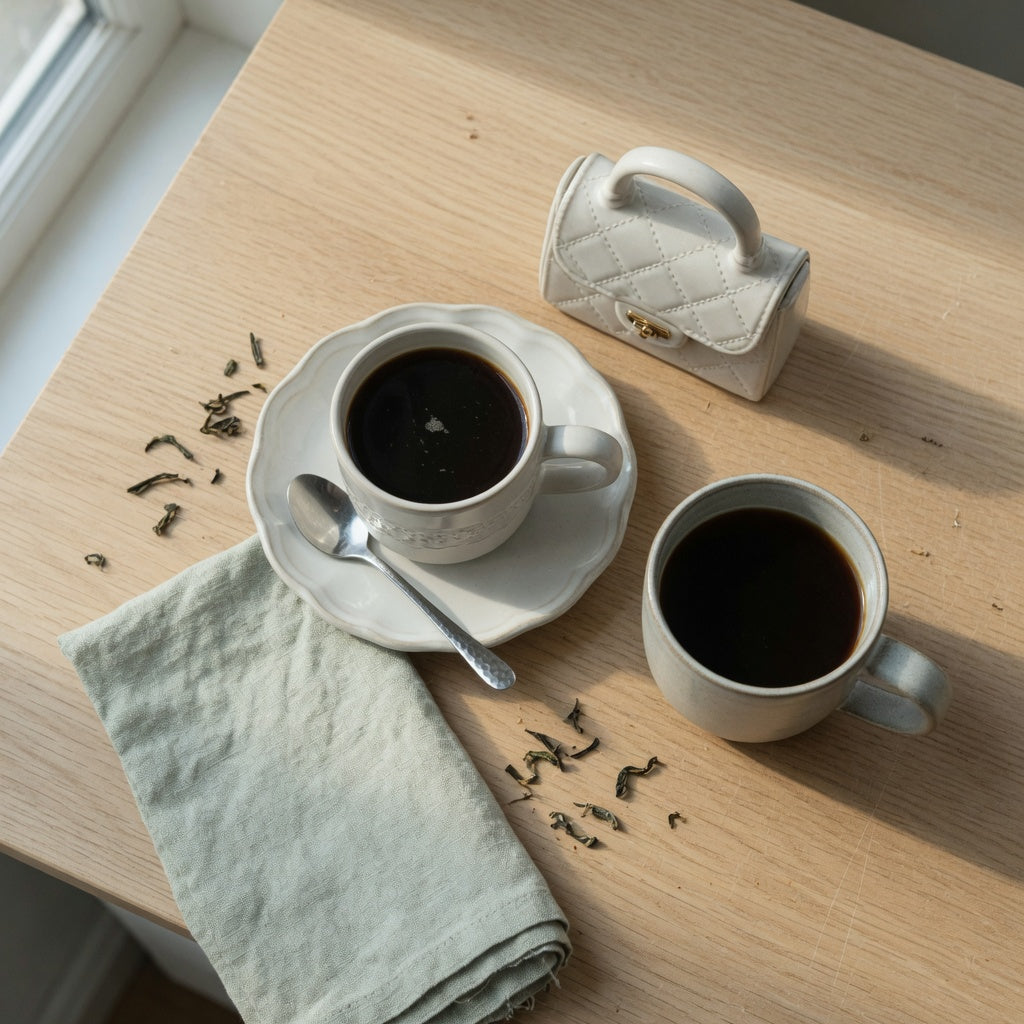
Handbag Tea Cup vs Coffee Mug Size: What Actually Fits
Reading time: about 9 minutes
A shopper opened one of our handbag mug boxes last month, filled it to the brim at the kitchen sink, and asked whether we had shipped the wrong size. It held exactly what the listing said. It just did not hold what she expected — a full travel-tumbler's worth of coffee. In our store, we field some version of this question most weeks, and the answer almost always starts with the same point: the gap between the printed ounce number and the pour you actually get is the entire story behind handbag tea cup vs coffee mug size.
Let's separate the three comparisons shoppers keep blending together: a novelty purse-shaped cup versus a plain kitchen mug, a traditional tea cup versus a mug, and the separate question of whether any cup actually fits inside a handbag. They are not the same decision, and they do not resolve with the same number.
Why a 10 oz handbag teacup can feel smaller than a 10 oz mug
Shape does more work than volume here. A handbag silhouette tends to be wide and low, with a body that flares from a narrow base and a lid or clasp sitting above the rim line. A standard mug is a straight cylinder. Put the same nominal capacity into both and your eye reads the low, wide one as the smaller vessel, because we judge cups by height and by the diameter of the opening we drink from.
There is a physical reason too. Rounded corners, a tapered base, and a lid that intrudes into the headspace all consume space that a straight-walled mug uses for liquid. Listings rarely separate brim capacity from a comfortable hot-drink fill that leaves room to carry the cup across a room without a wave over the edge. When a reviewer says a purse mug looks smaller than the photos, that is usually what they are describing — not a false listing, but a shape that photographs generously and pours conservatively.
Handbag tea cup vs coffee mug size: the ounce-and-milliliter trap
Before you compare any two cups, settle the units. A US fluid ounce is 29.57353 milliliters under NIST Handbook 44. Run the math and 10 US fl oz comes to 295.7353 ml — which means a listing that pairs 10 oz with 310 ml is not using the NIST factor. That is not a scandal, but it tells you the number on the box is approximate.
| Listed size | Milliliters (NIST factor) | What it feels like in practice |
|---|---|---|
| 8 US fl oz | 236.6 ml | The US customary measuring cup; a small tea or coffee cup |
| 10 US fl oz | 295.7 ml | Often listed for purse-shaped novelty cups |
| 12 US fl oz | 354.9 ml | Everyday stoneware mug territory |
| 13 US fl oz | 384.5 ml | Larger handbag mug or a generous kitchen mug |
| 16 US fl oz | 473.2 ml | Big mug or small tumbler; usually too much for tea |
Two more cups get confused with drinking vessels. NIST Handbook 130 lists 8.0 US fl oz as 236.588 ml — that is the US customary measuring cup, a recipe tool. FDA nutrition labeling uses a rounder set of household equivalents where 1 cup means 240 ml and 1 fluid ounce means 30 ml, explicitly as labeling conventions rather than vessel standards. None of these defines a tea cup, and no standards body sets a capacity that separates a tea cup from a coffee mug. Normal comes from habit.
Brim capacity vs. the pour you actually get
This is where most size disappointment is born. A cup filled to the absolute rim is untouchable, uncarryable, and impossible to stir. Real pours leave a centimeter or two of headspace, and on a wide handbag body that headspace costs more liquid than it would in a narrow mug — the surface area is bigger, so the same depth of clearance removes more ounces.
The practical test we suggest to customers: fill the cup to the level you would actually pour on a workday morning, then tip that into a measuring cup. That number, not the listing number, is your real capacity. If it lands near 8 fl oz, you are holding a tea cup that happens to be shaped like a purse, and you should plan accordingly.
Match the vessel to the drink you make, not to the label
Drink style should drive the decision, because a short espresso serving, a milk-based drink, and a tall black coffee are not interchangeable volumes. Think about what actually leaves your kitchen each morning:
- Straight espresso or a strong steeped tea: small volumes, small cups. A compact handbag cup is genuinely in its element here, and the decorative shape is a bonus rather than a compromise.
- Cappuccino or latte: the milk drink needs headroom and a wide enough opening to hold foam. A tall narrow mug can leave you with a drink that looks full but layers badly; a wide, low cup handles milk texture better.
- Drip coffee or a large mug of builder's tea: this is where a purse-shaped novelty cup usually loses. If you drink 12–14 oz in one sitting, you will refill a 10 oz cup twice.
There is also a sensory angle worth knowing. A study published in Frontiers in Psychology found that teacup width, height, rim thickness, and surface smoothness affected how participants perceived tea taste and fragrance, with cup preference mediating part of that effect. In plain terms: the vessel is part of the drink. A wide, shallow, thin-rimmed cup reads differently from a thick-walled tall mug, and neither is wrong — they are different experiences.
Handle grip, saucer balance, and cupboard clearance
Ounces get all the attention; the fit questions cause most of the returns. Our team handles these cups daily, and the same four checks come up again and again:
- Handle opening. Can you get two fingers through it comfortably, or is it decorative? A filled cup is heavier than an empty one, and a small handle turns a pleasant cup into a two-handed carry.
- Filled weight and saucer stability. A wide body sitting on a small saucer can rock. If the set includes a saucer, look for its diameter in the listing and compare it to the cup's widest point.
- Brewer clearance. Will it fit under a drip spout or an espresso machine's group head? Height matters here, and low purse shapes usually clear better than tall mugs.
- Shelf and cupboard height. A cup with a lid or clasp is taller than its body suggests, and upper shelves are unforgiving.
Our handbag coffee tea mug is the product to check if you want the purse silhouette itself. The current listing is where the seller-stated capacity and exterior dimensions live, so read those numbers against a mug you already own rather than against the product photos — photos are styled, your cupboard is not. If you want to see how the shape sits next to other novelty designs in the same range, the unique coffee mugs collection shows the full spread of silhouettes.
Metallic trim and the dishwasher: care limits worth knowing
Metallic trim is one of the most common care questions we get about decorative cup sets. Metallic films and lusters applied over glaze can dull, scratch, or lift at the rim over time, particularly with repeated hot dishwasher cycles and abrasive detergents. Microwave use is a separate risk: metallic decoration can arc.
We will not tell you a specific cup is microwave- or dishwasher-safe unless the listing for that exact item says so — care instructions vary too much between makers, and this is precisely the kind of claim that should never be borrowed from a similar-looking product. What we can say: if a cup has any metallic trim, hand-washing in warm water with a soft sponge is the conservative choice, and it keeps the finish crisp far longer. Treat the trim as the fragile part of the object, not the ceramic.
When a handbag tea cup is the wrong purchase
Being honest about this saves everyone a return label. Skip the purse-shaped cup if:
- You drink 12 oz or more of coffee in a single sitting and dislike refilling.
- You need a mug that survives a daily dishwasher cycle without a second thought.
- You want one cup that handles everything — espresso, tea, iced coffee, soup. A straight-sided mug is the generalist; a novelty shape is a specialist.
- You are buying for someone who has limited cupboard space and no interest in display pieces.
Conversely, a handbag cup earns its place when the gift is the point. Mother's Day, a bridal shower, a desk that needs one cheerful object — that is the correct use case, and the smaller pour stops mattering. If you are weighing a different decorative shape, our cappuccino cup vs coffee mug comparison walks through milk-drink trade-offs, the pleated tea cup vs coffee mug size breakdown runs the same math on another silhouette, and the broader coffee mug vs tea mug size comparison covers the everyday end of the range.
A 60-second listing checklist before you buy
Run this against any handbag tea cup listing, including ours:
- Note the capacity and the unit — ounces or milliliters, not both blended.
- Find all three exterior dimensions, plus the saucer diameter if one is included.
- Convert the capacity with the 29.57353 factor and subtract roughly 10–15% for the fill line.
- Compare that adjusted number to the mug currently on your counter.
- Check the handle opening in a photo that shows a hand holding the cup.
- Read the care instructions for microwave and dishwasher, specifically around metallic trim.
- Decide whether you are buying a daily drinker or a display piece. The answer changes which size makes sense.
If the adjusted number lands near the amount you actually pour, buy it. If it lands well under, buy it as a gift or a display cup — or step up to a larger silhouette in the collection.
Frequently asked questions
Is a 10 oz handbag tea cup too small for coffee?
It depends on your pour. Ten US fluid ounces converts to about 295.7 ml using the NIST factor, and after leaving room to carry and stir you are realistically holding closer to 8–9 oz. That is a comfortable tea or mid-size coffee for many people, but a refill situation for anyone who drinks a 12–14 oz mug in one go.
Why does my 10 oz purse mug look smaller than my 10 oz coffee mug?
Because it is wide and low rather than tall and straight, and because a tapered base and lid reduce usable interior volume. We judge cup size mostly by height and rim diameter, so an identical capacity can read as noticeably smaller in a purse shape.
Is a tea cup the same as an 8 oz measuring cup?
No. Eight US fluid ounces is 236.588 ml per NIST Handbook 130 — that figure defines a measuring cup, not a drinking vessel. FDA nutrition labeling separately treats 1 cup as 240 ml and 1 fluid ounce as 30 ml as rounded household measures. No standard sets a capacity that makes a cup a tea cup.
Can I put a gold-trim handbag mug in the microwave or dishwasher?
Only if the listing for that exact cup says so. Metallic decoration can arc in a microwave and can dull or lift in a hot dishwasher cycle, and care instructions differ between makers. Hand-washing with a soft sponge is the safe default for any cup with gold-tone trim.
How do I compare handbag tea cup vs coffee mug size at home?
Fill each vessel to the level you would actually pour, then tip that water into a measuring cup. Compare those real numbers, not the brim capacity. For a handbag tea cup vs coffee mug size decision, the lower usable fill usually settles the question faster than any listing photo.
Read more
14 Oz Ceramic Coffee Mugs Everyday Mug Rotation Product Shortlist Guide
Fourteen ounces means different things once a mug is actually full. We map our 400 ml, 440 ml, and 480 ml ceramic mugs to real rotation moments, flag which size to skip, and show what to verify on ...
Read more
14 Oz Ceramic Coffee Mugs Buying Priorities: Fit Your Routine
A 14 oz label hides the three things that decide whether a mug earns counter space: usable pour, handle clearance, and shelf, brewer, and cup-holder fit. Our guide ranks those priorities and maps o...
Read more
Leave a comment
This site is protected by hCaptcha and the hCaptcha Privacy Policy and Terms of Service apply.