

14 Oz Ceramic Coffee Mugs Buying Priorities: Fit Your Routine
Reading time: about 11 minutes
One of our regulars ordered a 440 ml mug, filled it to a sensible level, and found it would not slide under her single-serve brewer. The capacity was exactly what she wanted. The mug still went back on the shelf. We hear some version of that story most weeks at our store, and it is why 14 oz ceramic coffee mugs buying priorities should be ranked by the space the mug has to live in, not by the number printed on the listing.
Fourteen U.S. fluid ounces is roughly 414 ml — NIST lists the U.S. fluid ounce as 29.57353 ml — so a 14 oz mug is a genuinely larger everyday cup. FDA compliance guidance describes the typical cup or mug as small ceramic hollowware normally around 240 ml (8 fl oz). Nearly doubling that changes how the mug behaves in your hand, on your shelf, and in the dishwasher.
Why do 14 oz ceramic coffee mugs buying priorities start with usable fill, not the listed ounces?
Because a mug is a container with a rim, and the listed number describes the container, not your pour. Three measurement conventions show up in listings, and they are not interchangeable:
- Brim capacity — volume to the very top edge. Fill it that far and you cannot walk across a kitchen without a spill.
- Usable fill — what remains after 1–2 cm of headroom, which is the amount you actually drink and carry.
- Lid-in capacity — on lidded mugs, whether the lid displaces volume when seated. Worth asking, never worth assuming.
We publish millilitres for this exact reason. The Flow is 400 ml (~13.5 fl oz), Morning and Night is 440 ml (~14.9 fl oz), and The Rock is 480 ml (~16.2 fl oz). If you want the closest thing to a true 14 oz pour with headroom left over, the 440 ml body is where we point most shoppers first. All three sit side by side in our unique coffee mugs collection.
Which drink is going in — and when does extra capacity work against you?
Capacity only means something next to the pour. Here is how the arithmetic plays out across the drinks people actually make:
- Black drip or filter coffee, about 10–12 oz: a 400 ml mug leaves sensible headroom. A 480 ml body exposes more surface area, and more surface area sheds heat faster.
- Milk-heavy lattes and flat whites: U.S. cafe servings for these commonly land in the 14–16 oz zone, which puts 440–480 ml in the useful range.
- Tea: 400 ml gives you room to lift a bag or basket clear of the rim instead of dragging it down the inside wall.
- Iced coffee: cubes occupy volume, so a 480 ml mug holds noticeably less drink than the number suggests. Budget roughly a third of the body for ice.
The trade-off worth stating plainly: a big body with a small pour is a bad pairing. Eight ounces of coffee in a 480 ml mug tastes lukewarm by mid-morning, and you will blame the mug instead of the ratio. In our experience, most people who say their coffee goes cold too fast are pouring small into large.
What the product photos cannot tell you about handle, wall, and base
Styled photography shows glaze and mood. It cannot show whether a full mug feels secure in your hand. Four specs decide that, and most listings omit them:
- Handle opening height and width. A narrow slot and an open loop wrap very differently, especially once the mug is heavy. If you cannot picture two fingers of clearance above your knuckles, ask the seller for the measurement before ordering.
- Wall thickness. Thick walls hold heat longer and add weight; thinner walls drink lighter in the hand but cool faster. Neither is automatically better.
- Foot diameter. The base must sit inside your brewer tray, your coaster, and your car's cup holder. A wide foot is the usual reason a mug rides at an angle on a passenger seat.
- Rim profile. A thin rounded rim and a thick rolled rim deliver liquid differently, which matters if you drink from the same spot every morning.
Do the weight maths too. 440 ml of coffee weighs about 440 g before any ceramic is added, so a full mug is roughly half a kilogram hanging off one hand at counter height. That is a bigger deal than a 20 ml capacity difference between two mugs. We go deeper on grip geometry in our guide to what to check on a handled mug before ordering.
Will it clear your cabinet shelf, your brewer, and your cup holder?
Measure these four things in your own kitchen before a glaze finish wins you over:
- Shelf gap. Measure the clear space between shelves, not the shelf depth. Plenty of mugs fit the footprint and still foul the shelf above.
- Brewer clearance. Single-serve machines have a fixed chute height, and a tall body plus a drip tray is the most common mismatch we hear about.
- Cup holder diameter. Handled mugs generally will not sit in a car holder. If commuting matters, a tapered travel mug is the honest answer, not a handled ceramic one.
- Stackability. Nesting saves cabinet space only when handles offset cleanly and glazes do not grind against each other. Two mugs stacked badly cost more space than one stored upright.
If you are choosing between sizes rather than materials, our breakdown of 12 oz ceramic mugs covers the step down and when the smaller body is the smarter buy.
Ceramic, porcelain, stoneware, double-wall, or ceramic-lined steel — which are you actually buying?
All five phrases appear in mug listings. They behave very differently once filled:
- Porcelain — denser and often thinner-walled, so it usually feels lighter for the volume. Chips read more clearly on a thin rim.
- Stoneware — heavier and typically thicker, with better heat retention. The same capacity feels considerably heavier in the hand.
- Double-wall ceramic — an internal air gap slows heat loss, but constructions vary widely. Judge it on the maker's microwave and dishwasher statements for that piece, not on the category name.
- Ceramic-lined steel — a steel body with a ceramic interior layer. Travel-friendly, but it is not a ceramic mug. Ask whether the interior is a true ceramic layer or a ceramic-reinforced coating, because durability differs.
What a 14 oz ceramic mug is not good for: keeping coffee hot for two hours, surviving a drop onto tile, or replacing a sealed travel mug in a bag. If hold time is the priority, an insulated lidded mug wins. Ceramic wins on how the coffee tastes and how the rim meets your mouth. Our comparison of ceramic mugs for coffee and tea drinkers walks through that split.
Do “lead free” and “food safe” mean the same thing on a glazed mug?
No, and the gap matters more than the label suggests. FDA guidance sets an action level of 0.5 micrograms of lead per millilitre of leaching solution for cups and mugs, judged on any one of six units and tested using methods such as ASTM C738. Cadmium carries a separate action level of 0.5 micrograms per millilitre for small hollowware. These are leach limits, not ingredient bans — a glaze can contain lead and still pass, which is why a listing's wording is a starting point rather than proof.
Two distinctions deserve to travel with you into any store:
- Lead-free versus lead-safe. California's health department defines lead-free as containing no lead, and lead-safe as possibly containing some lead that does not leach above Proposition 65 levels. Tableware above those levels can still be sold in California with a written warning.
- Decorative ware. Under 21 CFR 109.16, ceramicware that looks food-appropriate is treated as food-use unless it carries a required “Not for Food Use” warning or is physically disabled for food contact, such as a hole bored through the surface. Some mugs sold as decor were never drinkware.
FDA has also documented imported pottery labelled “Lead Free” that still released extractable lead above its action levels, so the phrase alone proves nothing. What you can do: look for a stated test method or a clear brand statement about glaze testing, favour undecorated interiors, and treat bright colour or on-glaze decoration at the lip with more caution than a plain interior. California's guidance notes that lead is rarely found in plain white dishes, that damaged or chalky glaze is a higher concern, and that acidic drinks — coffee among them — increase the chance of leaching. We are not claiming every ceramic mug leaches. Most well-made ones do not. But if you are buying an unmarked handmade mug from a marketplace listing, ask what testing backs the claim.
Microwave and dishwasher claims apply per piece, not per collection
A care line printed on a category page does not automatically cover every item in that category. On an otherwise microwave-safe ceramic body, a gold or metallic handle, a rim band, or an overglaze decal can make that specific mug unsafe to microwave — and the same trim can degrade in a dishwasher while the plain version of the same shape survives years of cycles.
For unmarked imports, California's health department advises against microwaving or dishwashing items that contain or might contain lead, because heat and detergent can damage the glaze and make later leaching more likely. With a documented, tested glaze that is a non-issue. Without documentation, hand washing is the conservative call — and it is also the habit that keeps a gloss glaze looking new. Whatever you buy, read the care statement on that exact product page rather than the collection page.
Which of our three capacities fits which routine?
Here is how we map our listed capacities to the situations shoppers describe most often. Capacity is what we can confirm here; for exterior dimensions, material wording, and care instructions on any single mug, read that product's own listing — and if a number you need is missing, message us and our team will measure the unit in the warehouse rather than guess.
| Mug | Stated capacity | Fits well when | Skip it if |
|---|---|---|---|
| The Flow | 400 ml (~13.5 fl oz) | You pour 10–12 oz of drip coffee, drink large mugs of tea, or carry a mug one-handed to a desk | You routinely pour 16 oz, or you want ice plus a full drink |
| Morning and Night | 440 ml (~14.9 fl oz) | You want the closest match to a true 14 oz pour — lattes, cocoa, a long first cup | You need the smallest body in a tight cupboard, or you want the lightest full mug |
| The Rock | 480 ml (~16.2 fl oz) | You drink iced coffee, sip slowly at a desk, or make big weekend pours | You usually pour 8 oz, or you carry a full mug up and down stairs |
Frequently asked questions
Does a 14 oz mug actually hold 14 oz of coffee?
Often not. Many listings measure to the brim, and leaving the 1–2 cm of headroom you need to walk with a mug removes a meaningful amount. Treat 14 oz as the container's volume, then ask whether the seller means brim or usable fill.
Is a 440 ml mug the same as a 14 oz mug?
Close. 440 ml converts to roughly 14.9 fl oz, so it sits slightly above the 14 oz mark. That is usually the sweet spot, because the extra volume becomes headroom instead of a spill waiting to happen.
Can I microwave a ceramic mug with a gold handle or metallic rim?
Not safely. Metallic trim, rim bands, and some overglaze decals can arc or heat unevenly even when the ceramic body itself is rated microwave-safe. Check the care statement for that exact piece rather than the collection it belongs to.
How do I know whether the handle will fit my hand?
Ask for the opening height and width, or compare a listed exterior dimension against a mug you already own and like. If neither is published, that is a fair pre-purchase question — a full 440 ml mug weighs around half a kilogram, and grip matters more at that weight.
What should I ask a seller about glaze safety on an unmarked mug?
Ask what testing backs the food-contact claim, which method was used, and whether the interior or only the exterior is glazed as described. In practice, 14 oz ceramic coffee mugs buying priorities come down to usable fill, physical clearance, and glaze documentation — in that order.
The two-minute counter check before you add to cart
- Write down the pour you make most mornings, in millilitres or ounces.
- Measure your shelf gap, brewer clearance, and cup-holder width.
- Confirm whether the listed capacity is brim or usable fill.
- Find the handle opening and exterior height, or ask for them.
- Read the care statement on that exact product page — microwave, dishwasher, and any metal trim.
- Look for a glaze testing statement if the mug is handmade or imported.
Short version: capacity first, clearance second, glaze claims third. Start with the 440 ml Morning and Night mug if you are chasing a 14 oz pour, drop to the 400 ml Flow mug if your shelf is tight or your pours are smaller, and step up to the 480 ml Rock mug if ice is usually involved. Then browse the full ceramic mug lineup with your measurements in hand and compare all three capacities side by side.
Read more
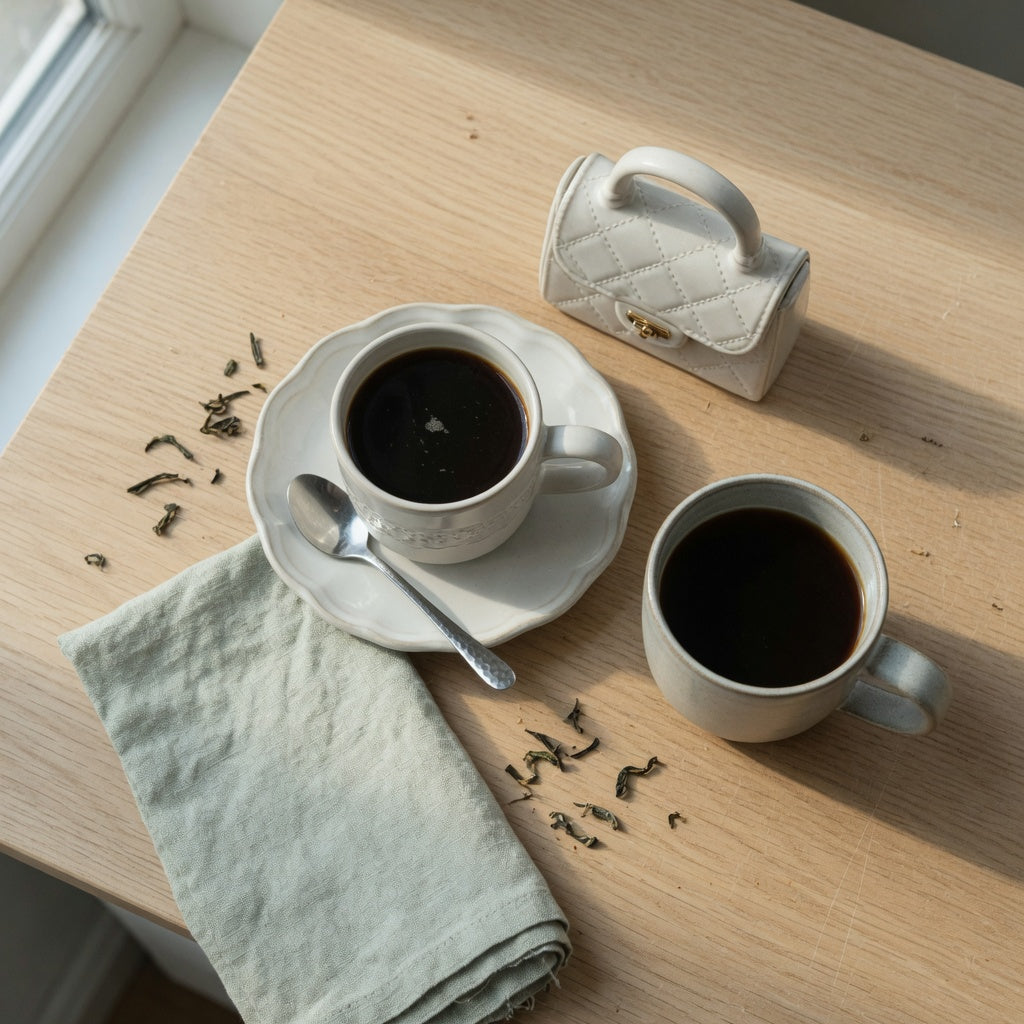
Handbag Tea Cup vs Coffee Mug Size: What Actually Fits
A purse-shaped cup and a kitchen mug can carry the same printed ounce number and still pour very differently. Here is how to compare usable fill, drink style, handle fit, and trim care before you buy.
Read more
Big Latte Mug Buying Priorities: Capacity, Shape, and Space
Sort by volume and you can still end up with the wrong mug. These are the priorities we walk shoppers through before they order — real fill versus listed capacity, shape for milk versus ice, handle...
Read more
Leave a comment
This site is protected by hCaptcha and the hCaptcha Privacy Policy and Terms of Service apply.