
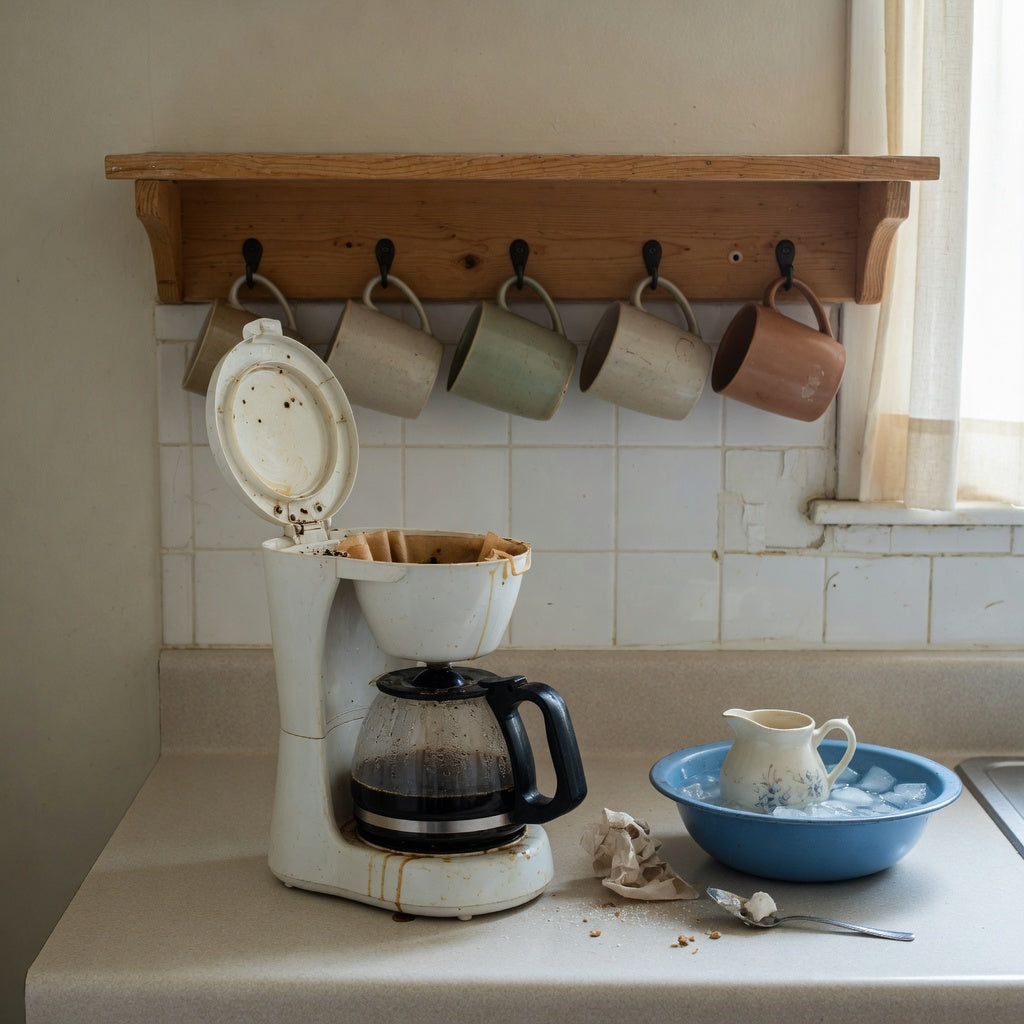
Guest Coffee Cup Shelf Setup: Reach, Hooks, and Mounts
Reading time: about 14 minutes
The third cabinet is usually where a guest gives up and lifts the chipped souvenir instead. A guest coffee cup shelf setup only earns its wall space when that person can see a clean cup, take it, and move to the brewer without asking where anything lives. In our store, the stations people actually use have the everyday cups on the hooks. The pretty failures are the empty rack, with the real mugs still in a cupboard, and the full rack of fragile pieces nobody will touch.
Buyers comparing these stations are setting up a self-serve coffee or tea corner. The decisions that change the purchase are wall versus counter, hook versus cubby, reach height, and whether the fasteners go into studs, into hardware rated by its maker, or onto adhesive never meant for a loaded row of mugs. No standards body sets a required hook gap, shelf depth, or mounting height for coffee mugs. Measure your own cups. A weight figure on a lifestyle page is an estimate until the hardware package prints a rating.
Where should a guest coffee cup shelf setup sit so guests can serve themselves?
Put the cups at the start of the line, not as decoration above the toaster. The order that keeps a weekend kitchen moving is simple:
- Clean cups, where a hand can reach them without crossing the hot machine.
- Brewer or kettle next, with the lid and steam vent clear of the shelf above.
- Milk and sweeteners after that, so nobody sets a full mug down to go hunting.
- A spoon rest, then a tray or bin for used cups and trash.
Reverse that path and guests park a full mug on the stone edge, walk back for a cup, and chip a rim on the return. We see that nick on the foot and the lip more often than a dramatic break. Open storage gets bumped. Cabinet cups do not.
Hand height beats eye-level styling. A standing adult can use hooks a little above the counter. A seated guest, a shorter visitor, or anyone who should not lean across a hot machine needs the cups lower and closer to the front edge. Six mugs a person can pinch beat eighteen hung so high that someone drags a chair over. The U.S. Consumer Product Safety Commission advises households to keep heavier items on lower shelves and to avoid storing appealing objects where children may climb. Its mandatory tip-over standard from the STURDY Act covers clothing storage such as dressers and armoires, not mug shelves. The climbing point still applies. A bright row of cups is an invitation if a child can use a drawer as a step. If those cups live on a bookcase, anchor that furniture the way CPSC advises for bookcases and dressers.
Washable mugs suit the shelf when people drink in the kitchen or at a nearby table and you have a return spot for dirty cups. Disposable cups are the better call when drinks travel through a crowded room. Paper will not satisfy someone who came for a proper pour. Ceramic will not forgive a hallway full of coats and suitcases. If you are buying the everyday set as a host gift, start in our coffee mugs for gifts and confirm size on each current listing. A matched photo is not a fit check.
Fixed hooks, cubbies, pegboard, or a counter tree?
These are the setups buyers actually bring home. Each one solves a different room, and each one fails in a specific way.
| Setup | Choose it when | Skip it when |
|---|---|---|
| Wall rack with fixed hooks | Handles are similar and you can hit studs or use rated hardware | Handles are wide, square, or too small to seat |
| Shelf with hooks underneath | You also need a surface for filters, pods, or a small kettle | The shelf is hollow or particle board and the hooks are wood screws |
| Cubby or open shelf, cups standing | You would rather not hang awkward handles | The board above is too close for your tallest piece |
| Pegboard | The mug mix changes and you want to move the hooks | Hooks are so short that cups walk off when a door slams |
| Under-cabinet rail | The counter is full and the doors clear the handles | A door or a range hood swings into the cups |
| Freestanding mug tree | You cannot drill, and the tree sits against a backsplash, not in a walkway | One side gets emptied and the base rocks on a slick counter |
Fixed hooks look tidy until two wide bodies share a gap and clank every time someone takes tea. Sliding hooks or a pegboard fix that only if the hook is long enough, with an upward lip, that the handle cannot walk off. We do not have a lab number for the right gap. Hang your two widest mugs, leave daylight between the bodies, then mark the holes.
A hook-only rack is a poor home for cups you are unwilling to have touched. Open cubbies hide less dust than a closed cabinet and show every water spot. That is acceptable if someone wipes rims the morning guests arrive. It is a bad system if the shelf is a display and the drinkable cups live somewhere else. An unglazed foot ring on open wood is another quiet problem: set down damp, it can scratch the shelf and leave a brown ring.
What height, handle depth, and brewer clearance should you measure first?
Measure in this order, with the cups you will actually leave out, not with a stock photo:
- Wall width between cabinet ends, window trim, and the outlet the brewer already uses.
- Height from the counter to the underside of the upper cabinet, including door swing.
- Tallest cup from foot to rim, plus a little clearance if it will stand in a cubby.
- Handle projection: how far the handle sticks past the body, because that is what hits the next mug and the backsplash.
- Counter depth that must stay clear so nobody pours over a knife block.
Shelf depth sold for decor is not a mug standard. A very shallow ledge lets a cup walk off when someone bumps the counter. A very deep one pushes handles past where a seated guest can pinch them. Clearance above the coffee maker is separate from how even the row looks. The lid, the steam, and the way a guest leans in to fill a cup all need room the styling shot hides.
Tall bay versus a tight cabinet opening
If the bay has open height above the brewer and you want a taller drinking cup in that spot, open our landscape tall coffee and tea mug and read the listed height against the space you just measured. The name is not a clearance guarantee. For a tighter bay, or a row where one cup has to share hooks with wider mugs, open the pleated coffee and tea cup and compare the published height, handle depth, and capacity with the cubby or hook you already marked. If those figures are missing from the listing, leave them unconfirmed. Do not drill from a guess.
A standing cup needs foot-to-rim height plus room for fingers so the rim does not scrape the board above. A hanging cup needs a handle opening that seats without forcing the join. We will not tell you a specific cup passes either test until the current page prints the size. A low cubby is the wrong place for a profile taller than the opening. A wide, shallow hook is the wrong place for a tiny handle loop. Those are fit problems, not style problems.
Will studs, a French cleat, or adhesive hold a full guest row?
A loaded row is heavier than the empty rack suggests, and the load gets worse when someone leans on the shelf while reaching. Screws into studs are the mount we trust first. Studs often repeat across a wall, but you still have to find the wood in this one. A second screw that only bites drywall is not a backup plan.
With one stud and a long rack, the honest options are a wider cleat that reaches two studs, or drywall anchors whose manufacturer states a load you can set beside a full shelf. Keyhole slots make a shelf easy to lift off for painting. A French cleat spreads weight along a board and is easier to level, but it still has to be fastened into structure, not into paint. If the rating on the package is vague, do not hang guest mugs from it.
Rentals, hollow shelves, and screws that are too short
Adhesive strips are reasonable only inside the strip maker's stated weight and only on the surfaces that maker lists. In our experience they are a short-term option for a renter hanging a very light rail, not for a shelf you intend to load with guest mugs. Soft drywall, textured paint, and a film of kitchen grease are common reasons a strip lets go. When it fails, the whole row comes down at once.
Hollow doors and particle-board shelves, including many flat-pack units, are a bad place for screw-in mug hooks. The screw catches a thin skin, the core crushes, and within a week the hook rotates and drops a cup. If the only shelf you own is hollow, use a freestanding tree or a rack on the wall.
Screws packed with a rack are often too short to reach a stud through the bracket, the drywall, and a tile backsplash. Check length before you commit to the holes. Retighten the hooks after the first week of lifting. Repeated use can back a bolt out even when day one felt solid. Above a sink, pick a finish that will not rust and stain the cups it touches. Bare steel in the splash zone is a poor guest-shelf choice.
Which cups belong at hand height, and which pottery should stay off?
Everyday guest cups are the ones you will let get chipped, washed often, and handled by someone who does not know the collection. Keep those at the front, at a height a guest can reach without a step. Move thin porcelain, antiques, and anything with a hairline crack higher, behind a door, or off the station. A crack at the handle join fails in a person's hand, not while the mug is sitting still. Open storage adds its own wear: feet chip when cups are set down hard, and rims nick when two handles swing together.
For anything that is not ordinary commercial tableware, we follow FDA guidance on traditional pottery. Lead in the glaze or decoration of some pieces can move into a drink if the pottery was not fired properly. Higher-concern pieces include handmade or irregular ware, antiques, damaged or worn pieces, flea-market or street-vendor pottery of unknown origin, and ware brightly decorated in orange, red, or yellow. That color note is a reason to be more cautious, not a verdict by itself. Commercial everyday tableware is much less likely to have this problem. Washing or boiling does not remove lead. A piece marked not for food use, including the words Not for Food Use—May Poison Food, should not cook, serve, or store drinks. If a home lead test shows leachable lead, keep that cup off the guest shelf.
Bare metal hooks can leave a gray rub on a soft glaze. A coated hook avoids some of that metal-on-glaze contact. We are not aware of a standard test that ranks coatings for mug handles, so treat a coating as a preference, not a certified shield. Leave a little slack. A hook is not a clamp.
Wash the cups you expect people to use before guests arrive, and look at rims and feet. If you want a collectible row on display, give visitors a separate, obvious set. Mixing the two is how a favorite mug leaves in a napkin. A small card for regular versus decaf, and for dairy versus a plant milk, stops guessing. That is a hosting habit. It is not a hospitality code, and home coffee shelves do not have one we can cite.
A product name does not finish this check. The cups linked above are candidates for the everyday row only after the current page shows they are sold for drinks and the printed size fits the hook or cubby. They are not a stand-in for an heirloom wall, and they are a poor reason to skip the tape measure.
How long can cream sit beside the cups, and when does a tree tip?
The shelf can hold cups all day. It should not hold perishable cream all day. USDA's two-hour guidance is the limit we follow and the one we tell hosts to use.
Perishable food left out can let bacteria such as Staphylococcus aureus, Salmonella Enteritidis, Escherichia coli O157:H7, and Campylobacter reach unsafe levels. Growth is fastest between 40°F and 140°F, the Danger Zone, and numbers can double in as little as 20 minutes. Do not leave perishable food unrefrigerated more than 2 hours, or more than 1 hour if the room is above 90°F.
A ceramic pitcher does not pause that clock. Put the creamer back in the fridge, or set it in ice and still watch the time. Shelf-stable pods, tea bags, and sealed sweeteners can stay out. Keep them on a small tray so they do not slide into the hooks. Give guests a clear spot for dirty cups, or wet mugs go straight back onto the clean row.
A mug tree needs the same caution as any tall, narrow stand. Clothing-storage tip-over rules do not cover it, and that absence is not a safety rating. Set the tree back from the counter edge, keep heavier cups on lower hooks, and do not park it where someone will brush past with a suitcase or a toddler. If the base rocks when you lift one mug, it is the wrong tool for this station. Wide mugs also crowd a tree faster than a wall rack, because the hooks radiate instead of sitting in one line.
Frequently asked questions
What should I measure first for a guest coffee cup shelf setup?
Start with the widest mug you will actually leave out, including the handle, and the open wall or cabinet bay where the rack has to live. Then check reach height for the shortest guest you host and the clearance above the brewer, including the lid. Hook spacing and shelf depth only make sense after those three numbers are on paper.
Can adhesive strips hold a loaded mug shelf in a rental?
Only if the strip's own instructions list a weight and a surface that match a very light load. A full guest row is usually past what those strips are sold to carry, and kitchen paint plus steam makes a sudden failure more likely. If you cannot drill, use a freestanding tree placed where it cannot be knocked, or get permission before you anchor into the wall.
Are wall hooks better than cubbies for mixed mug sizes?
Hooks win when handles are similar and you can move the gaps so wide mugs do not hit. Cubbies win when handles are tiny, square, or too thick to seat on a peg. Many kitchens need both: a few hooks for daily cups and one standing shelf for the pieces that will not hang.
Should guests who are walking around get washable mugs or disposable cups?
Use washable cups when people stay near the kitchen and you have a return spot. Use disposable cups when drinks will travel through a crowded room. A shelf stocked only with heirlooms does neither job. It looks generous and still sends people hunting for something they are allowed to use.
How do I offer a cup without putting collectible mugs in reach?
Keep only the everyday set at hand height. Move antiques, cracked pieces, and unmarked decorative pottery somewhere enclosed. Confirm on each product page that the cup is sold for drinks, and do not plan the layout around a listing that omits height, handle depth, or capacity.
A counter check before you buy the rack or the cups
Run through this with the cups on the counter, not from a product photo:
- Capacity for the guests you actually host, not for a display photo.
- Hooks or pegs that can move, or cubbies tall enough for the pieces you measured.
- Screws long enough to reach structure, or anchors with a printed rating you can compare with a full shelf.
- A finish that will not rust above a sink, and hooks that will not grind the glaze.
- A renter plan that does not pretend strips replace studs.
- No not-for-food-use pieces, no cracked handles, and no creamer left out past the two-hour mark.
- Height, handle, and capacity confirmed on the current page before you hang any cup from the gift collection.
If the wall will not take the load, stop at a counter tree or a tray and keep the same left-to-right path. If it will, mount into structure, put the plain daily cups where a guest can grab them, and leave the fragile row out of reach. That is the station people use without a tour of your cabinets.
More from our blog
Read more
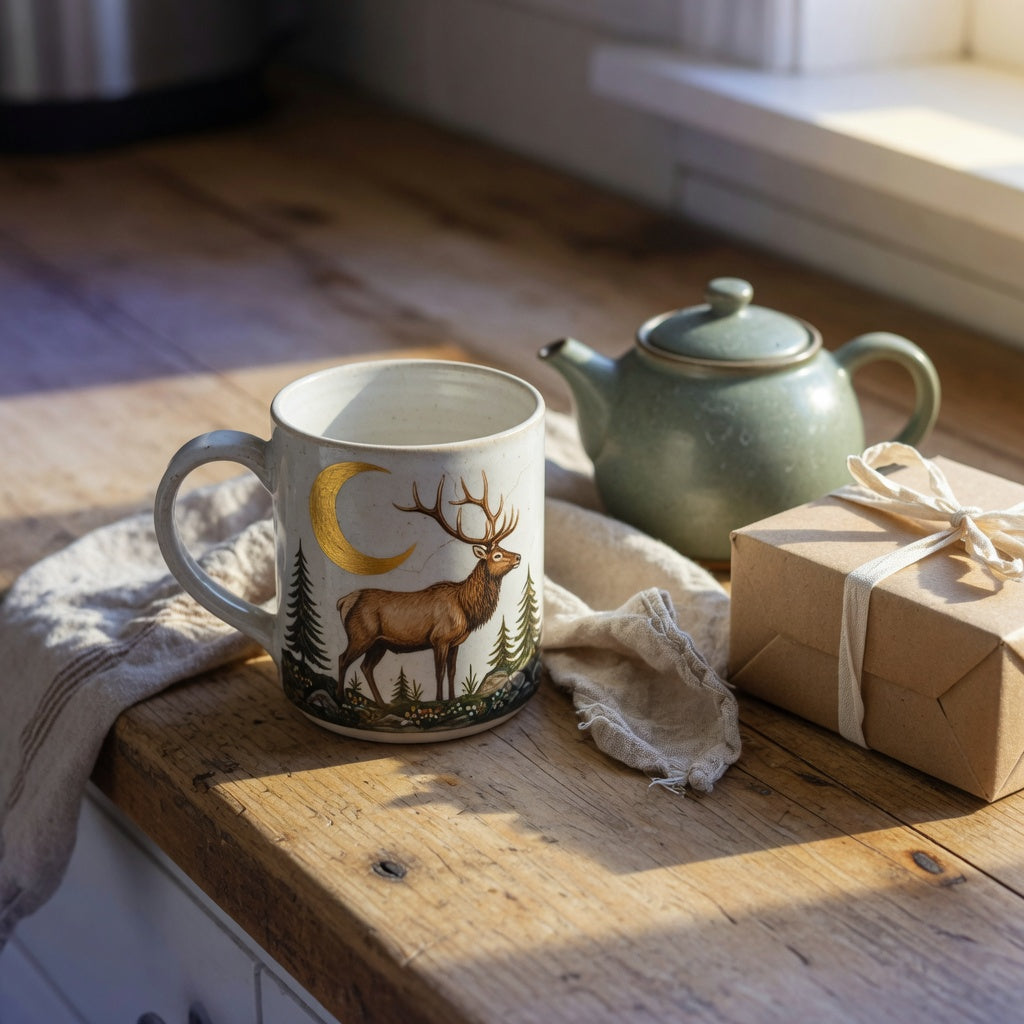
Elk Coffee and Tea Mug Gift: Size, Care, and Fit
Capacity, glaze safety, and whether the elk suits a hunter or a wildlife watcher decide if the cup stays by the kettle. These are the checks we use before an elk coffee and tea mug gift is packed.
Read more
Best Coffee Tray for Entryway Gift Ideas Mugs Compared
A tray that carries two hot mugs, sits on a narrow console, and still reads as a housewarming gift is a compromise. We compare footprint, lip height, material wear, and food-contact labeling before...
Read more
Leave a comment
This site is protected by hCaptcha and the hCaptcha Privacy Policy and Terms of Service apply.