
Great Mountain Coffee Mug Checklist: 10 Things to Compare First
Reading time: about 10 minutes
Two questions reach our inbox before anyone mentions the artwork: "how many ounces does it actually hold?" and "is it dishwasher safe?" Both are the right questions, and no product photo settles either. This Great Mountain coffee mug checklist is the same one we talk through with customers at our counter, ordered the way a real buying decision happens — capacity first, material and glaze next, handle and care last.
We'll use the Great Mountain Ceramic Coffee Mug as the reference point. Our catalog gives us one solid spec — the word ceramic in the listing title. Everything else (exact ounce capacity, microwave and dishwasher markings, care instructions) lives on the current product listing and its care card, because glaze finishes and specs can shift between production runs.
Our counter rule: if a spec isn't printed on the listing, ask before checkout — never find out after the first dishwasher run.
How many ounces do you actually drink? Matching mug size to your pour
Here's the mismatch that trips up most first-time buyers: a standard brewed "cup" of coffee is around 6 ounces — the serving brewing guides like the National Coffee Association's are built around — while most mugs sold as coffee mugs hold 10 to 16. A 12-ounce mug isn't "one cup." It's roughly two brew cups before you add milk. Match the number to the drink:
- Drip or pour-over: 12–15 oz covers a generous pour without a second trip to the machine.
- Latte or café au lait: 12–16 oz, ideally with a wider opening so milk drinks have room.
- Cappuccino or flat white: 8 oz or less, honestly — a 15 oz mug turns a cappuccino into warm milk.
- Tea: 10–12 oz, since loose leaves re-steep and you'll be topping up anyway.
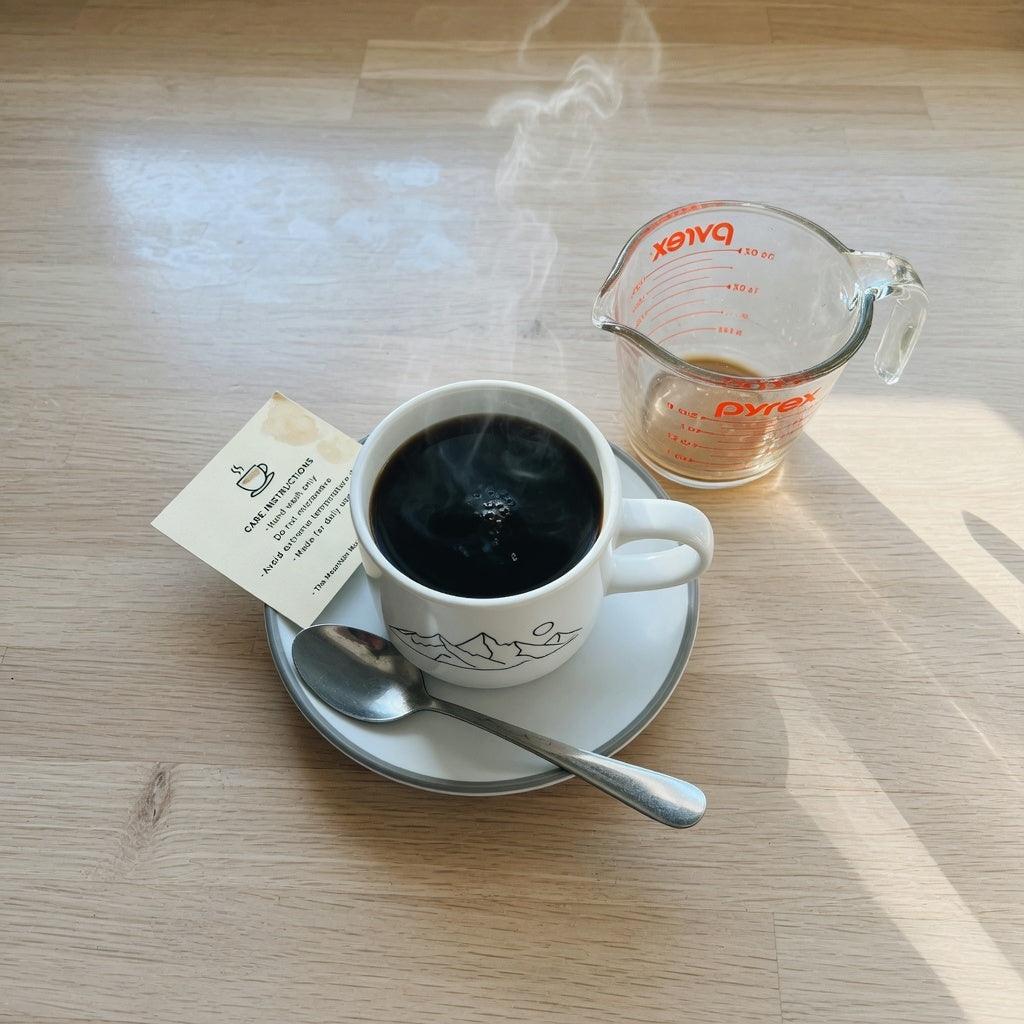
One verification habit we teach every customer: when the mug arrives, fill it with a liquid measuring cup. Photos and fill lines exaggerate, and thick ceramic walls or a flared rim can eat an ounce or two of real capacity. There's a trade-off to name here too. Oversized mugs go lukewarm before you finish them; small ones mean constant refills. Neither is wrong — just decide which annoyance you'd rather live with.
Ceramic, stoneware, glass, enamel, or steel: what the material changes
Material decides heat behavior, care rules, and how the mug eventually fails. Ceramic — what the Great Mountain mug is listed as — is the everyday sweet spot: it warms evenly, feels substantial in hand, and carries detailed glaze work. How the common options compare:
| Material | Heat retention | Microwave | Dishwasher | How it fails |
|---|---|---|---|---|
| Ceramic / stoneware | Good, especially thick-walled | Only if marked | Only if marked | Chips, thermal shock, dulled decorated glazes |
| Porcelain | Lighter feel, cools faster | Usually yes | Usually yes | Thin rims chip easily |
| Borosilicate glass | Fair | Yes | Yes | Shows every stain and drip |
| Insulated stainless | Best by far | Never | Often top rack only | Traps coffee odors; no microwave, ever |
| Enamelware | Poor to fair | Follow the label | Hand wash preferred | Chips expose steel that can rust |
The trade-offs cut the other way too. Ceramic is the wrong pick for a campsite, a truck cab, or a tile floor — one drop on the handle ends it, which is why enamel or stainless suits that life better. And if a single cup has to survive until 10:30 at your desk, no ceramic keeps up with an insulated tumbler. To see how this style sits next to wood-handled and novelty designs, our unique coffee mugs collection lays the options out side by side.
Is the glaze food-safe? The check most mug reviews skip
Glaze safety matters more for coffee than for almost any other drink, because coffee is served hot and acidic — the combination that pulls the most from a glaze containing lead or cadmium. For a new mug from a shop like ours, the fix is simple: buy where the glaze is described as food-safe, read the listing and care card for any California Prop 65 warning, and ask the seller if the listing is silent.
The rules tighten for vintage, thrifted, or handmade ceramics. Regulators including the FDA advise retiring cracked or chipped dishware from food use when lead in glaze is a concern, since damage exposes more surface to your drink. Before using a secondhand ceramic mug, search the CPSC recall database for the maker if you can identify it. We're not saying decorative mugs are unsafe — we're saying the proof should come from the seller, not the pattern.
Microwave and dishwasher markings: what the symbols on the bottom mean
Flip any mug over. Wavy lines usually mean microwave-safe; a dish-with-water graphic usually means dishwasher-safe. No markings? Treat hand washing as the default until the seller says otherwise. Three situations deserve extra caution:
- Metallic paint or a gold rim: not microwave-safe, full stop — sparking is a real risk.
- Hand-painted or decorated glazes: repeated dishwasher cycles can dull the finish over time, so hand washing protects the design.
- Wooden handles: no microwave and no dishwasher. Wood swells, and the joint eventually fails — we cover that style separately in our wooden-handle mug buying checklist.
One microwave habit most guides skip: the FDA warns that water can superheat in a smooth ceramic cup — it looks still, then erupts when disturbed. If you're heating plain water, put a wooden stir stick in the cup first, and never run an empty mug. And if your household runs the dishwasher twice a day, let that decide the purchase: prioritize a mug whose listing explicitly states dishwasher safe, or accept that you're hand washing.
Will the handle fit your hand? Span, weight, and desk space
Handles are where mug regret happens most often, in our experience. Three things matter. First, handle span: two fingers should slide through without knuckles touching ceramic — a cramped loop turns every sip into a pinch, and bigger hands need bigger loops. Second, weight when full: water runs about an ounce per fluid ounce, so 15 ounces of coffee is nearly a pound before you count the mug itself. Third, rim height relative to the handle — a deep body with a low-mounted handle forces a harder tilt to drain the last inch.
If arthritis or a weaker grip is part of the picture, favor a wide, straight-sided body with a chunky handle over a dainty loop, and lean toward smaller capacities so the full weight stays manageable. Desk reality counts too: a broad-footprint mug wants a real coaster and actual surface, not the corner of a laptop stand. And a ceramic mug — any ceramic mug — is a kitchen and desk mug, not a commute mug. That's what tumblers are for.
Heat retention: why a 30-second preheat beats a pricier mug
The Specialty Coffee Association's standard brewing window is 195–205°F, and every degree the mug steals on contact is a degree your coffee doesn't keep. Ceramic walls start the morning cold, so preheat: fill the mug with hot tap water or a splash of kettle water while the coffee brews, then dump it. That half minute buys more drinking time than most premium upgrades.
Thick stoneware holds temperature longer than thin porcelain but takes longer to warm — both behaviors are fine once you know which one you bought. Be honest with yourself about the rest: if your mornings routinely end with half a cup gone cold, you want insulated stainless, and that's a different aisle. We compare ceramic against the other materials for serious drinkers in our Great Mountain mug guide for coffee lovers.
Care and retirement: stains, thermal shock, and the chipped-rim rule
Most ceramic mugs die from care mistakes, not defects. The routine we recommend:
- Let the mug reach room temperature before washing — freezer-cold to boiling-hot is thermal shock, and it can craze glaze in one bad cycle.
- Lift coffee stains with a baking-soda paste (roughly three parts soda to one part water) and a soft sponge. No steel wool; it scratches the glaze and gives the next stain a place to anchor.
- Hand wash anything decorated or unmarked, and keep metallic rims out of both the dishwasher and the microwave.
- Rinse daily even between uses — dried coffee oils turn bitter and taint the next pour.
Retire the mug when the rim chips (the unglazed body beneath traps residue and can flake into your mouth), when fine cracks spread across the interior, or when a smell survives a baking-soda scrub. A chipped mug can live on as a pencil cup. It shouldn't keep serving coffee.
Running the Great Mountain coffee mug checklist as a gift buyer
Gifting changes three lines on the checklist, because you're guessing at someone else's pour size, dishwasher habits, and hand size. Narrow the risk:
- Pick a middle capacity in 12-ounce territory — it works for drip drinkers and latte drinkers alike.
- Favor simple care instructions that survive a busy household.
- Lean classic over novelty. A mug named for mountains reads as thoughtful for hikers and cabin people while staying neutral enough for an office desk.
One step gift buyers skip: open the box before wrapping it. Inspect the glaze and rim on arrival, since finishes can vary between production runs — far easier to sort out before the birthday than after. Our gift buyer's checklist for the Great Mountain mug goes deeper, including pairing ideas like a bag of beans or a tin of tea to make the box feel finished.
Frequently asked questions
How do I confirm the Great Mountain mug's capacity before buying?
Capacity is the first box on any Great Mountain coffee mug checklist, and the answer lives on the current product listing — check the stated ounce size there, and ask the seller if it isn't shown. When the mug arrives, fill it with a liquid measuring cup to see true capacity. A "cup" of brewed coffee is around 6 oz, so a 12 oz mug is closer to two cups than one.
Is the Great Mountain mug dishwasher and microwave safe?
Only the current listing and its care card can answer that — check for the wavy-line and dish symbols on the product page and on the mug's base once it arrives. If the listing is silent, ask the seller before checkout. When markings are missing entirely, hand washing and microwave avoidance are the safe defaults for decorated ceramic.
What's the best coffee mug material for keeping coffee hot?
Insulated stainless steel wins on duration — it's the only option that keeps coffee drinkable well past the hour mark. Ceramic is the better daily-drinker: preheat it with hot water before pouring and it holds brew temperature respectably through the first stretch of your morning. Thin porcelain cools fastest of the standard materials.
Should I worry about lead in a ceramic mug?
Buy new from a retailer that describes its glaze as food-safe and discloses any Prop 65 warning, and the concern is largely handled. Be more careful with vintage, thrifted, or damaged ceramics: hot, acidic coffee is the worst-case liquid for a questionable glaze, so check CPSC recalls and retire any chipped or crazed vintage mug from food use.
What size mug makes a good gift?
A middle capacity in the 12-ounce range is the safest choice — it suits drip coffee, lattes, and tea without assuming the recipient's habits. Save the extremes, like giant 20 oz mugs or tiny espresso cups, for people whose drinking style you already know. Whatever you pick, confirm the care instructions are simple enough for a busy household.
The Great Mountain coffee mug checklist, one last pass before checkout
Copy this list into your notes and run it against any mug, ours included:
- Stated capacity, matched to your actual drink
- Material and wall thickness
- Glaze food-safety statement, plus any Prop 65 flags
- Microwave marking — or the honest absence of one
- Dishwasher marking
- Handle span against your hand
- Weight when full
- Preheat plan for heat retention
- Your personal retire-it rule for chips and cracks
- A readable care card before you gift it
Start with the Great Mountain Ceramic Coffee Mug listing to confirm the details only the listing can settle, or browse the unique coffee mugs collection to run this same checklist across styles. Ten minutes of comparing beats a mug that ends up living in the back of the cabinet.
Read more
Rhombus Mug Gift: What Buyers Should Compare Before Buying
A rhombus mug gift only lands well when the style matches the person: faceted body, diamond-pattern print, or geometry novelty. Our team compares grip, capacity, glaze care, personalization limits,...
Read more
Best Wooden Handle Coffee Mugs Buying Checklist: What to Compare
The eight-point checklist our team runs before stocking any wooden handle coffee mug: glaze and food-contact safety, wood species, finish, handle attachment, capacity, heat behavior, and the care r...
Read more
Leave a comment
This site is protected by hCaptcha and the hCaptcha Privacy Policy and Terms of Service apply.