
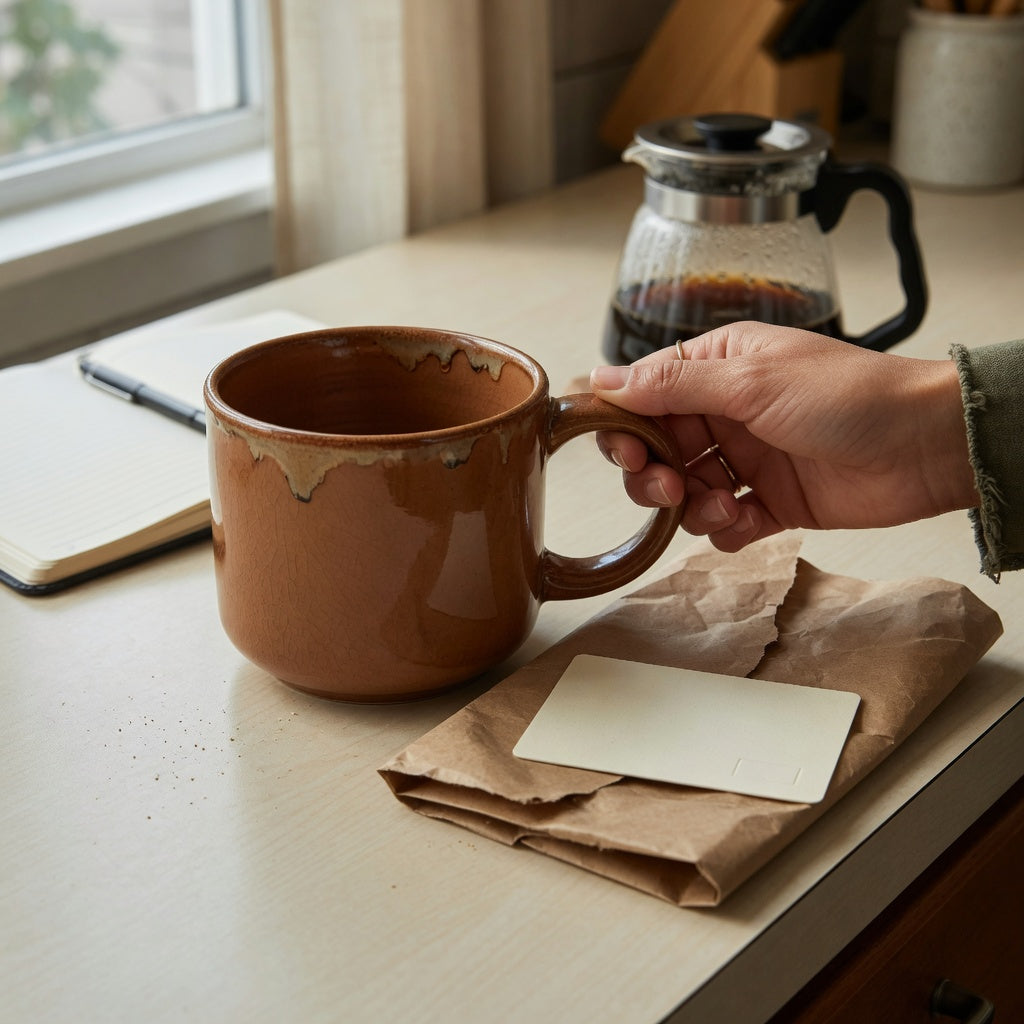
Gift Large Ceramic Coffee Mug: Size, Handle and Safety Checks
Reading time: about 11 minutes
Wrapping paper is still on the table when a large mug gets its first real test: the recipient fills it, hooks a few fingers through the handle, and carries it from the kitchen to a desk. Searching for a gift large ceramic coffee mug should account for that short trip, because a piece that looks impressive online can feel awkward when full, crowd the knuckles, or sit too tall for the dishwasher.
In our store, we compare the drinking routine before the decoration. Start with the recipient’s usual pour, then verify stated capacity, empty weight, overall dimensions, handle clearance, food-use information, and care instructions. Use The Flow Large Ceramic Coffee Mug as one product-specific starting point, and keep our collection of unique coffee mugs open for a style comparison. The live product listing—not a category label or lifestyle photo—should remain the source of truth for current specifications.
Will a gift large ceramic coffee mug replace a daily cup?
Our most useful gift test is replacement, not novelty. Picture an ordinary Tuesday morning. If the recipient would choose this mug over the cup already beside the kettle, it has a job. If it is only amusing during the unboxing, it will probably become cabinet inventory.
A large ceramic mug is more likely to fit the recipient’s routine if they:
- Refill a smaller mug while the first drink is still warm.
- Keep a favorite cup at an office desk, reading chair, or tea station.
- Prefer distinctive glaze, shape, and hand-feel over a stock joke print.
- Have enough cabinet and dishwasher space for a wider or taller vessel.
- Drink coffee, tea, cocoa, or iced drinks in servings that need real headroom.
Skip an oversized mug for someone who uses a sealed travel tumbler all day, drinks only small espresso-based servings, has limited shelf space, or finds heavy drinkware tiring. Ceramic is breakable and open-topped. It is not designed for a backpack, moving car, or crowded cup holder, so a smaller ceramic cup or insulated travel vessel may be the more considerate gift.
Is 15, 20, or 24 ounces actually the right size?
Retail labels such as large, extra-large, and jumbo are not standardized capacity classes. Across the category, shoppers commonly encounter those labels on mugs marketed from roughly 15 to 30 ounces. Read the stated capacity instead of judging scale from a close-cropped photo.
| Listed capacity | Routine it may suit | Trade-off to check |
|---|---|---|
| 15–18 oz | A longer hot drink with room for milk or cream | May not feel dramatically oversized; verify whether capacity is measured to the brim |
| 20–24 oz | Fewer refills or extra room for foam, milk, or ice | Filled weight, handle comfort, and cabinet clearance become more important |
| 25–30 oz | A recipient who specifically asks for a jumbo mug | Can be cumbersome to lift, store, wash, and finish before the drink cools |
Filled weight is easy to underestimate. Twenty U.S. fluid ounces of a water-like drink weighs roughly 1.3 pounds, while 24 ounces weighs about 1.6 pounds. The ceramic body and handle add more, so an empty mug that feels substantial in a gift box can become uncomfortable during a full pour.
Also check whether the listed capacity is a brim measurement. A usable serving needs headroom for walking, stirring, milk, foam, or ice. Two mugs with the same ounce rating can behave differently: a tall cylinder may fit a narrower shelf, while a wide bowl can provide easier access for ice or a tea infuser but occupy more counter and dishwasher space.
Can the handle carry a full mug without pinching?
Capacity is what shoppers scan. Handle geometry is what the recipient notices on day two. An empty mug conceals the load that the handle must support, so we look beyond a listing that simply says it has a big handle.
- Inner opening: Look for enough height and width for the recipient’s preferred grip. A three-finger grip spreads the load better than a tight two-finger pinch for many adults, but hand size is the final standard.
- Handle stand-off: This is the distance between the loop and the mug wall. More clearance keeps knuckles from pressing against hot ceramic.
- Attachment points: Inspect the upper and lower handle joins for visible gaps or hairline cracks when the mug arrives. These high-stress areas deserve more attention than a minor glaze variation.
- Balance and base: A large bowl paired with a small foot can feel top-heavy. A stable base matters on an office desk crowded with a keyboard, notebook, and charging cable.
- Rim profile: A rounded, moderately thin drinking edge usually feels less bulky than a thick blunt lip. Side and top photos are more useful here than a straight-on hero image.
Heft is a trade-off, not proof of durability. A heavy ceramic mug can feel substantial and gift-worthy, but it may be the wrong choice for someone with reduced grip strength, wrist discomfort, or smaller hands. If a listing does not show the handle from the side or provide a hand-for-scale image, treat comfort as an unanswered question rather than assuming the word ergonomic settles it.
Do the glaze and care labels support daily coffee use?
Ceramic is a material family, not a blanket microwave, dishwasher, or food-safety guarantee. Clay body, glaze, firing, and decoration all affect use. Read each product listing separately; if microwave or dishwasher guidance is absent, the cautious choice is to hand-wash and avoid microwave use until the seller confirms.
The FDA compliance guide for ceramic cups and mugs uses 0.5 micrograms of lead per milliliter of leaching solution as the action level for cups and mugs if any one of six tested units reaches that level. This is an enforcement threshold, not a product certification that can be assigned to a specific mug without item-level evidence.
The FDA also explains that lead may be present in the glazes or decorations of some traditional pottery and can leach if the piece is not manufactured and fired properly. Acidic drinks such as coffee can enhance that leaching. Its food-use guidance for traditional pottery says ceramicware that appears suitable for food is generally treated as foodware unless it carries conspicuous labeling indicating otherwise.
Before ordering, check these points:
- Confirm that the item is sold as a drinking mug rather than decorative pottery.
- Read microwave-safe and dishwasher-safe statements separately; one does not automatically establish the other.
- Follow the listing exactly for metallic-looking decoration, luster, or applied designs rather than experimenting in a microwave.
- If independent lead or cadmium testing is a personal requirement, rely only on a report explicitly tied to that product.
- Inspect the interior glaze, rim, and handle joins for chips, deep pits, or cracks as soon as the mug arrives.
We will not claim that a mug has third-party testing unless the current listing publishes that evidence. A food-use statement can help a buyer, but a generic badge or attractive glaze is not a substitute for a product-specific report.
Will an oversized ceramic mug fit the shelf, dishwasher, and desk?
Buyers often compare ounces and forget the mug’s outer envelope. Before sending one as a gift, measure or estimate the recipient’s setup using four dimensions:
- Overall height: Will it fit below a cabinet shelf or coffee-machine spout?
- Maximum outside width: Measure from the outer handle edge to the opposite side of the bowl, not just the rim diameter.
- Base diameter: Will it sit fully on the recipient’s coaster, desk, or warming plate?
- Appliance clearance: Can a dishwasher rack hold it without the handle striking a plate, and can a microwave turntable rotate without the handle hitting a wall?
Shape also affects daily use. A wide, open bowl exposes more drink surface than a narrow form and may cool differently, but we would not promise specific heat retention without product-level testing. Thick ceramic still is not a thermos. A recipient who needs a leakproof commute mug should receive a sealed travel vessel instead of an open oversized ceramic mug.
Which shopper should start with The Flow, and who should keep comparing?
The Flow is our product-specific starting point for this search, but our recommendation is conditional: its live listing must match the recipient’s required capacity, dimensions, and care routine. We do not fill missing specifications with assumptions.
| Recipient situation | Why the category fits—or misses | Practical next step |
|---|---|---|
| Home or office drinker who wants fewer refills and prefers open ceramic | A large ceramic mug is relevant if its filled weight and handle suit the recipient | Review the current The Flow mug listing for exact details |
| Style-conscious recipient who already owns several basic mugs | Distinctive shape and glaze matter more than simply adding capacity | Compare our unique ceramic mug styles |
| Tea or iced-coffee drinker | Usable headroom and opening width may matter more than the word large | Compare the listed capacity with the vessel shape and normal serving |
| Recipient with grip limitations or a crowded cabinet | A jumbo mug may create more burden than convenience | Choose a smaller, lighter option and verify dimensions before ordering |
| Commuter who drinks while driving or walking | Open ceramic does not seal and may not fit a cup holder | Choose an insulated, lidded travel mug instead |
If a critical value such as capacity, outer dimensions, or care guidance is missing, contact the store or continue comparing. The product name and photographs should help narrow the choice, not replace the details that determine fit.
What should you inspect at unboxing and after routine washing?
A gift-day inspection takes only a few minutes and catches problems before hot coffee is involved. This is the same practical sequence we use when assessing how a ceramic mug will behave in an actual kitchen.
- Match the care information: Confirm that the live listing, packaging, and any base markings do not contradict one another.
- Check the footing: Set the empty mug on a flat counter and look for excessive rocking. A small exterior foot ring can be normal; instability that makes the mug easy to tip is different.
- Inspect contact points: Run a finger carefully around the rim, handle joins, and interior to find rough chips or cracks.
- Test the real grip: Fill it with room-temperature water to a comfortable drinking level, then lift and pour it over a sink. This reveals balance and usable capacity without risking a hot spill.
- Avoid thermal shock: Do not move a refrigerator-cold mug directly to boiling liquid or place very hot ceramic on a cold, wet surface.
- Load it with space: If the listing permits dishwasher use, position the mug so the handle cannot knock against plates or rack hardware.
- Recheck the glaze: Watch for new chips, rough areas, staining, or fine networks of glaze lines after repeated use.
Those fine glaze lines are called crazing. If they develop on the interior, become stained, or feel rough, pause daily use and ask the seller or manufacturer for guidance. An unglazed ring on the exterior base can be part of normal ceramic finishing, while a chip where lips or liquid make contact deserves prompt attention.
Frequently asked questions
Is a gift large ceramic coffee mug a good choice for someone who already owns mugs?
It can be if it replaces a daily cup rather than adding another generic design. Prioritize a distinctive shape, comfortable handle, and capacity that solves a real refill problem. Skip it if the recipient lacks storage space or uses sealed tumblers exclusively.
What capacity counts as a large ceramic coffee mug?
There is no universal retail definition. Mugs marketed as large or oversized often fall around 15–30 ounces, so read the exact capacity and determine whether it is measured to the brim. Match that number to the recipient’s normal drink instead of choosing the largest option automatically.
How can I tell if a ceramic mug is intended for food use?
Buy a mug that the seller clearly presents as drinkware and check for any decorative-only warning. Review the product-specific food-use and care information, and ask for evidence if independent testing is essential to your decision. Do not treat appearance alone as proof.
Are all large ceramic mugs microwave and dishwasher safe?
No. Microwave and dishwasher suitability depend on the ceramic body, glaze, decoration, and manufacturing process, and they should be stated separately. If the listing is silent, hand-wash the mug and keep it out of the microwave until the seller confirms the correct care.
Is a 20 oz ceramic coffee mug too heavy to give as a gift?
It depends on the recipient and the mug’s empty weight. Twenty fluid ounces of a water-like drink adds roughly 1.3 pounds before counting the ceramic, so handle comfort matters. For someone with grip or wrist limitations, a smaller and lighter mug is usually the better choice.
Your next step: Open The Flow product page and the unique coffee mug collection side by side. Compare six fields: stated capacity, empty weight if provided, outer dimensions, handle views, food-use and care wording, and fit for the recipient’s shelf and routine. If two essential details remain unknown, keep comparing instead of guessing.
More from our blog
Read more
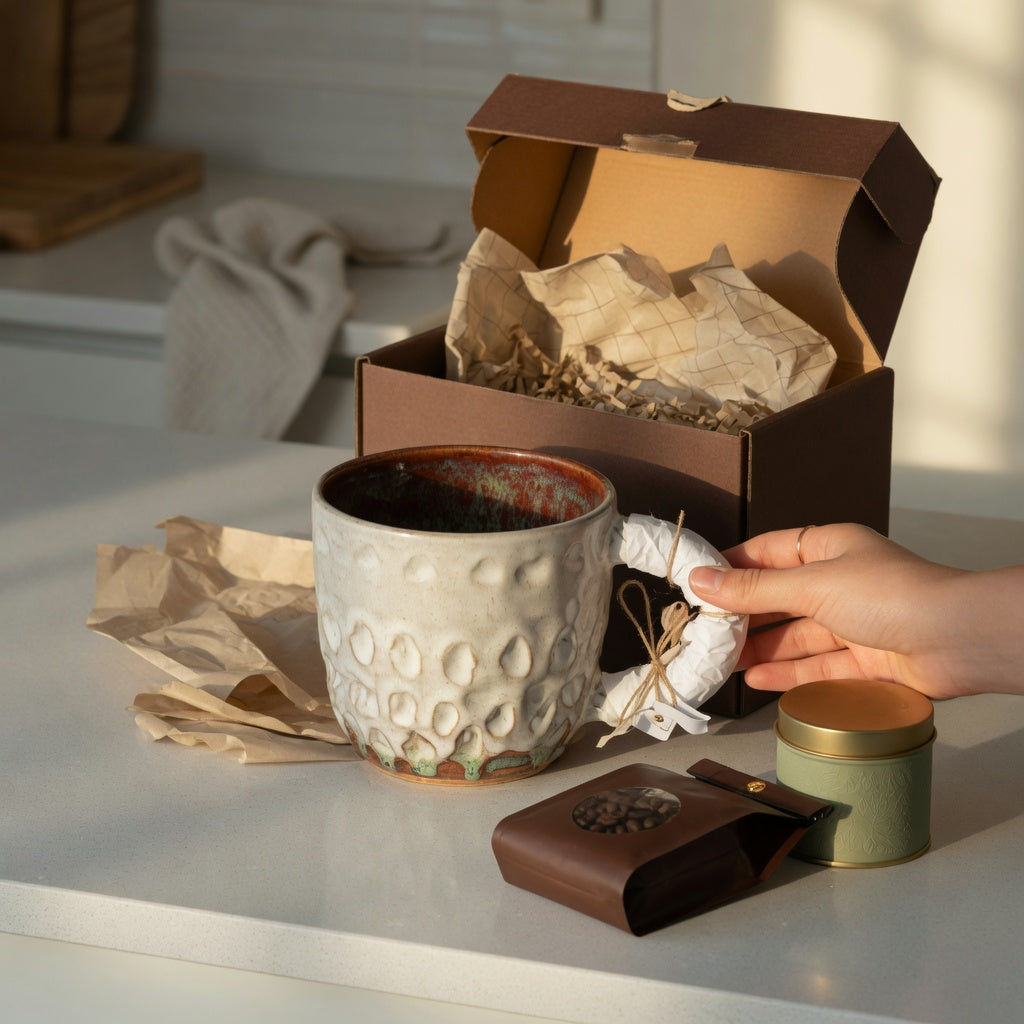
Unique big mug for gifting: Size, grip, care, and style
Compare usable capacity, handle clearance, dimensions, ceramic finishes, care instructions, and packing. We also explain who should skip an oversized mug and how to match the gift to the drinker.
Read more
Gift Ceramic Mug Ball Handle: Compare Grip, Care, and Fit
Ball handles make memorable gifts, but their grip, full-cup balance, construction, care, and packaging vary. Compare the details that decide whether the mug becomes a daily favorite or a shelf piece.
Read more
Leave a comment
This site is protected by hCaptcha and the hCaptcha Privacy Policy and Terms of Service apply.