
Unique big mug for gifting: Size, grip, care, and style
Reading time: about 10 minutes
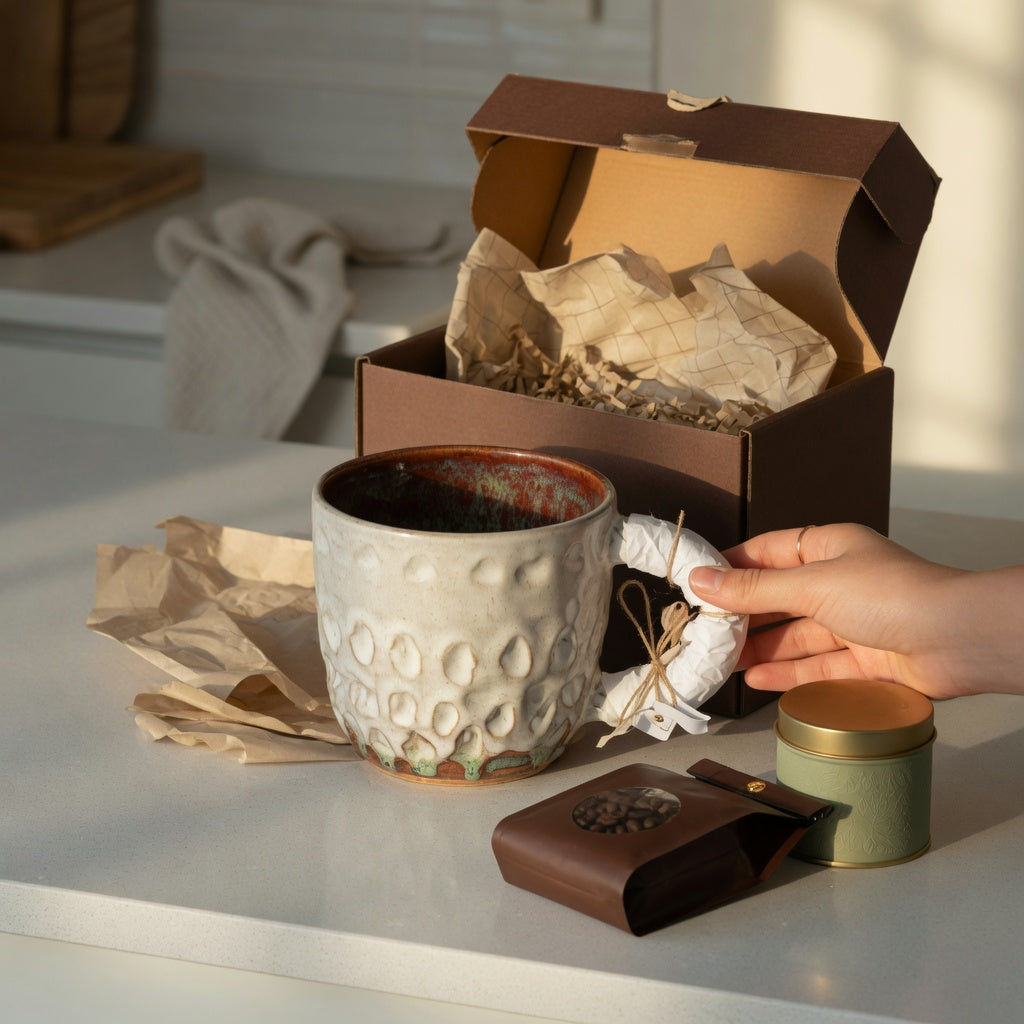
The gift box opens, the mug looks impressively oversized, and the recipient immediately slides a hand through the handle. That first grip often decides whether a unique big mug for gifting becomes the cup beside the kettle or a cabinet ornament. In our store, we see shape and color earn attention, but capacity, filled balance, shelf fit, and care instructions determine whether the gift is used.
Big is not automatically better. A generous mug suits someone who settles at a desk with one long coffee or a large serving of tea; it frustrates a short-coffee drinker, a commuter, or anyone with tight cabinets. The useful comparison begins with routine, not with the largest ounce number on the page.
How much mug does the recipient actually want?
There is no universal cutoff for an oversized mug. In current retail language, the label commonly appears on mugs in roughly the 15–25 oz range, but sellers use it inconsistently. Treat capacity as an initial filter rather than proof that the mug will feel comfortable or suitably large.
| Shopping range | How it tends to feel | Best recipient fit |
|---|---|---|
| 12–14 oz | Roomy rather than giant | Moderate pours and smaller cabinets |
| 15–16 oz | Noticeably generous | Daily desk, kitchen, or reading-chair use |
| 17–20 oz | Clearly oversized | Long coffee or tea sessions; check filled heft |
| 21–25 oz | Statement size | A known giant-mug fan with enough shelf space |
Check whether the stated capacity is measured to the brim. A mug needs headroom to carry hot coffee safely, hold milk or foam, and leave space for a tea bag or infuser. A nominal 20 oz capacity may provide a smaller comfortable pour if 20 oz fills it to the lip.
A large mug makes sense for someone who dislikes refills or drinks tea over a long sitting. It is less useful for espresso, small pour-over servings, or anyone who prefers a fresh, hot refill rather than one large drink that gradually cools.
Which measurements prevent cabinet and brewer problems?
Ounces describe volume, not fit. Before ordering, look for a dimension diagram or measurements that cover the whole mug rather than relying on a styled photograph.
- Overall height: Check clearance under a coffee-machine spout, between cabinet shelves, and in the upper dishwasher rack.
- Rim and base diameter: A broad base can feel steadier on a desk, while a wide rim takes more shelf space and exposes more drink surface.
- Total span: Measure from the outside edge of the handle to the opposite side of the mug. This affects cabinet placement and gift-box size.
- Handle opening: Internal height and width matter more than the handle's outside dimensions. They reveal how many fingers fit without pressing knuckles against the mug wall.
- Empty weight: The drink adds substantial weight before the ceramic itself is counted. A heavy empty mug may become tiring when full.
A broad, low mug can feel stable but occupy more counter and shelf space. A tall, narrow mug uses a smaller footprint, yet it may not clear a single-serve brewer or allow a hand to reach the bottom during washing. In our experience, these practical fit issues cause more disappointment than a slightly different glaze color.
What makes a unique big mug for gifting feel genuinely chosen?
A gift feels personal when its identity survives without a generic slogan. Our collection of unique coffee mugs is a useful place to compare different visual directions, but the right direction depends on the recipient rather than on which design looks boldest in a product photo.
- Distinctive form: An unusual body or handle can become a conversation piece, but sculptural details should not interfere with sipping, gripping, or cleaning.
- Glaze and surface: Reactive or artisan-style finishes can make each piece look less uniform. The trade-off is that color flow and pattern may vary from the listing image.
- Personalization: A name, date, or specific inside reference feels intentional. It also leaves little room for spelling mistakes or future regifting.
- Graphic or novelty design: This works when it matches the recipient's humor or interests. Check the care instructions because some surface decorations need gentler washing than the mug body.
Small visual choices also affect daily use. A light interior helps a tea drinker judge brew color, while a dark interior can make that harder. Texture around the body adds character, but the rim should remain comfortable against the lips. We prefer personality in the places that do not compromise the contact points: the body, exterior finish, and overall silhouette.
Can the handle manage a full oversized pour?
A handle that feels adequate on an empty mug can become awkward after filling. There is no universal comfort score, so online shoppers should combine handle-opening measurements with clear front and side photographs.
- Look for enough internal clearance for the recipient's normal two-, three-, or four-finger grip.
- Check the gap between the handle and mug wall. Knuckles should not be forced against a hot body.
- Consider balance. A large body with a small handle can pull forward instead of sitting naturally in the hand.
- Inspect the two points where the handle joins the body. Hairline cracks at these joins are a reason to contact the seller rather than wrap the mug.
If the recipient avoids heavy dishes, has limited grip strength, or already holds a standard mug with two hands, choose a smaller or lighter design. An impressive 25 oz mug is not a thoughtful gift if lifting it feels like a task.
Which ceramic material and care label suit their routine?
Ceramic is an umbrella category that includes stoneware, porcelain, and earthenware. Any of them can make a good mug, but the material name alone does not guarantee durability, low weight, food safety, or heat retention. Construction, firing, glaze, and decoration all matter.
- Food contact: The listing should clearly state that the mug is intended for beverages or food. Terms such as natural clay or handmade do not establish that on their own.
- Microwave use: Metallic luster, gold-colored trim, and other metallic decoration are reasons to stop and check. Do not microwave the mug unless the maker explicitly permits it.
- Dishwasher care: Decals, overglaze decoration, and delicate hand-applied finishes may require hand washing even if the ceramic body is durable.
- Temperature changes: Avoid moving a mug directly from a very cold environment to boiling liquid unless its care instructions allow that use. Abrupt changes can stress ceramic and glaze.
- Surface condition: Inspect for rim chips, interior cracks, glaze pinholes, and unexpected crazing. Fine crack lines may be intentional in some finishes or may indicate stress, so ask the seller if they were not disclosed.
For a concrete U.S. safety reference, the FDA Compliance Policy Guide for pottery says cups and mugs should not exceed 0.5 micrograms per milliliter of extractable lead in any one of six units tested. That is a laboratory test limit, not a visual cue or a blanket FDA approval for every ceramic mug.
Stoneware is often selected for a substantial feel, but a thick piece can be heavy. Porcelain can have a slimmer profile, yet a fine rim still needs protection from chips. If the recipient runs every dish through the dishwasher and ignores special care, favor a straightforward finish with explicit dishwasher instructions over a delicate luster or sculptural surface. Do not add a mug-cake mix unless microwave use is also confirmed.
Which recipient should get The Spittoon, and who needs another format?
For someone who uses an open mug at a kitchen counter or office desk and appreciates an unconventional product concept, review The Spittoon coffee and tea mug. Our current catalog identifies it as a big coffee mug; check the live listing for its current capacity, dimensions, material, and care information rather than inferring those specifications from the name.
- Long-sipping coffee or tea drinker: A big mug fits because the recipient values one generous serving more than repeated small pours.
- Collector of unusual household pieces: A distinctive concept can feel more personal than a generic printed blank.
- Minimalist with restrained taste: Choose a quieter shape or finish instead of assuming that the most unusual option is the safest gift.
- Car commuter: Skip an open oversized mug if the real need is a lidded, cup-holder-friendly travel vessel.
- Small cabinet or crowded dishwasher owner: Choose only after confirming the mug's full height, span, and stated care method.
A unique big mug for gifting works best when it matches the recipient's routine as closely as it matches their personality. The largest or funniest option is not automatically the one they will reach for each morning.
How do you protect the handle and complete the gift?
The protruding handle is the part most exposed to impact. At our packing bench, we protect it separately rather than assuming padding around the bowl will do the job.
- Set the mug on a flat counter and check for rocking. Inspect the rim, interior, base, and both handle joins under good light.
- Place clean tissue inside the bowl to prevent small gift items from knocking against the interior, but do not treat tissue as shipping protection.
- Wrap the handle in its own cushioning without pulling tape tight enough to put pressure on the loop.
- Use a rigid inner box and fill empty space so the mug cannot move. For shipping, place that box inside a cushioned outer carton.
- Wrap a spoon, infuser, or other hard accessory separately. Metal rattling inside the mug can chip the glaze or rim.
A sealed bag of coffee, a tea tin, cocoa, or a wrapped spoon can make the oversized scale feel intentional. Match the add-on to what the recipient actually drinks. Loose beans in the mug, an unwrapped metal infuser, or a microwave recipe paired with a mug that is not microwave-safe creates work instead of delight.
A 60-second comparison before ordering
- Does the recipient regularly drink a large serving at home or at a desk?
- Is the listed capacity measured to the brim, and is there enough usable headroom?
- Will the height, base, and handle span fit their cabinet, brewer, and dishwasher?
- Does the handle opening suit their grip, and is the empty weight provided?
- Are food-contact, microwave, and dishwasher instructions stated clearly?
- Does the shape or finish fit the recipient after any printed joke is ignored?
- Can you pack the handle securely and keep hard accessories away from the mug?
If a listing leaves several of those answers unclear, ask before ordering or select a mug with better-documented dimensions and care. A gift should not require the recipient to discover its limitations during the first dishwasher cycle.
Frequently asked questions
What size should a unique big mug for gifting be?
For many gift shoppers, 15–20 oz is roomy without reaching the most demanding statement size. Move toward 20–25 oz only if the recipient already likes giant mugs and has the grip and shelf space for one. Confirm whether the capacity is measured to the brim and check the physical dimensions.
How can I tell if an oversized mug handle will be comfortable?
Look for the handle's internal height and width, the gap between the handle and mug wall, and the mug's empty weight. Clear front and side photographs help you judge balance, but they do not replace measurements. If the recipient has limited grip strength, err toward a lighter, moderately oversized mug.
Can a large ceramic mug go in the microwave and dishwasher?
Only if the product listing or maker says it can. Metallic accents can rule out microwave use, while decals, lusters, and some hand-applied finishes may require hand washing. Follow the care statement for the specific mug rather than assuming all ceramics behave alike.
How do I wrap a large mug without breaking the handle?
Cushion the handle separately, use a rigid box, and fill all empty space so the mug cannot rattle. If you include a spoon or infuser, wrap it outside the mug or secure it so it cannot strike the ceramic.
Where should I start if I do not know the recipient's exact mug style?
Begin with two filters: the recipient's normal pour size and their willingness to hand-wash special finishes. Then compare our unique coffee mugs by shape and character, and do not order until the live listing gives you the dimensions and care details you need.
More from our blog
Read more

Gradient Ceramic Coffee Tea Mug: 7 Checks Before Buying
Compare glaze construction, food-contact safety, usable capacity, rim and handle comfort, heat behavior, and care before buying. We also flag poor-fit cases such as commuting, matched sets, and hea...
Read more
Gift Large Ceramic Coffee Mug: Size, Handle and Safety Checks
Compare capacity, filled weight, handle geometry, food-use and care information, storage fit, and gift appeal before ordering. See who should consider The Flow, who should compare other unique mugs...
Read more
Leave a comment
This site is protected by hCaptcha and the hCaptcha Privacy Policy and Terms of Service apply.