
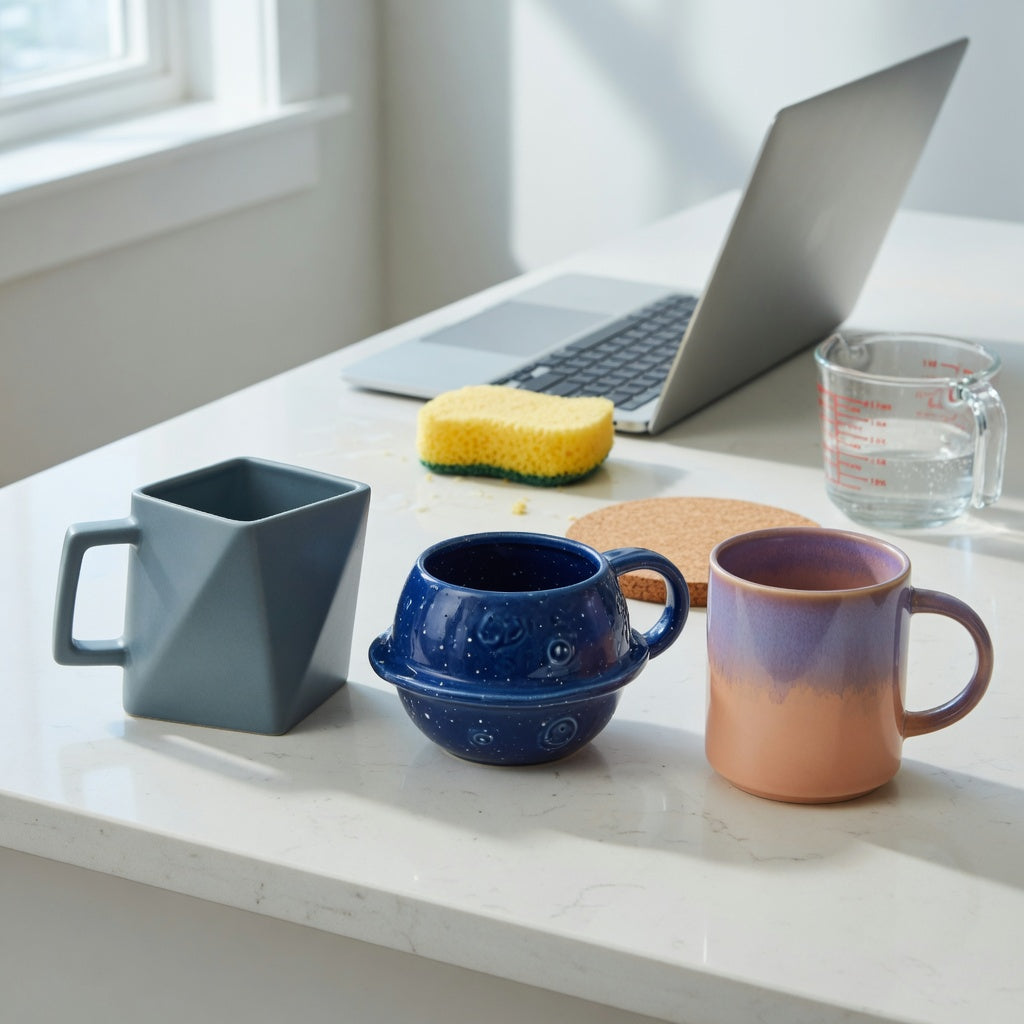
Geometric Coffee Mug First Time Buyer Product Shortlist Guide
Reading time: about 10 minutes
A mug can look broad and steady in a three-quarter product photo even when the contact point underneath it is much narrower. That difference shows up quickly beside a keyboard, on a small coaster, or under a low kitchen shelf. This geometric coffee mug first time buyer product shortlist guide starts with details a shopper can verify instead of treating the photo as a measurement.
We sell and handle this category in our store, and the useful questions tend to be practical: How much does it hold? Where does the base actually touch the counter? Will the handle clear your knuckles? What does the care label permit? The current product pages identify the compared options as ceramic, while their visible forms provide the main point of distinction. We do not infer a production method, creator, provenance, or special edition status from shape alone. If a listing omits base width, handle clearance, weight, or a care instruction, we treat that detail as unknown.
Which listed capacity, ceramic material, and dimensions should you verify?
Open each product page in a separate tab and record the following details before comparing color or styling:
- Listed capacity: Measure your normal finished drink with a kitchen measuring cup, including milk or ice. If your drink volume equals the mug's stated capacity, there may be no comfortable headspace for carrying it. If the page does not distinguish brim capacity from practical fill capacity, record that distinction as unknown.
- Material: The three compared listings identify ceramic. Ceramic can chip at the rim or handle attachment if it hits tile, stone, or another dish. The material statement alone does not establish microwave or dishwasher compatibility.
- Base contact: Look for the diameter or width of the surface that actually meets the counter, not only the mug's widest body measurement. A broad faceted body can still rest on a smaller foot ring.
- Handle clearance: Internal handle height and width affect knuckle room, while total handle projection determines how much desk or shelf space the mug occupies. Product photos rarely provide a reliable scale for either measurement.
- Overall height: Check the space below a coffee machine spout, inside a cupboard, or between open shelves. Include any lid or accessory only if the listing shows one as part of the product.
- Care language: Look for explicit microwave, dishwasher, and hand-washing instructions. Do not turn a missing care statement into an assumed feature.
Write unknown beside any detail you cannot find. An unknown does not automatically make a mug unsuitable, but it should stop the purchase if that variable is central to your setup. Someone using a fixed kitchen counter can accept more uncertainty than someone placing a full mug next to expensive office equipment.
How do base contact, handle projection, and facets affect desk fit?
Stability depends on the actual contact area, the flatness of the foot, the filled mug's balance, and the surface underneath it. A geometric name or angular exterior cannot prove that one mug is more stable than another. Exterior facets also do not confirm that the interior has matching corners, so use the listing photos to determine whether extra cleaning around internal angles is likely.
| Detail to check | Why it matters | Practical decision |
|---|---|---|
| Base contact or foot-ring width | Determines how much of the mug is supported by the desk, coaster, or warmer | Pause if the dimension is missing and tip resistance is a priority |
| Total width including handle | Affects cable snags, mouse space, and narrow shelf clearance | Compare it with the clear space beside your keyboard or kettle |
| Flatness on arrival | An uneven foot can create rocking even when the body looks broad | Test the empty mug on a clean, level, hard counter before use |
| Interior profile | Sharp internal transitions can hold milk foam or coffee residue | Choose a form your sponge or soft brush can reach |
A mug warmer adds another constraint. Its heating surface needs to support the mug's actual base, not just the widest part of the body. For a lap tray, train table, or other moving surface, a lidded travel mug is a more dependable category than an open ceramic mug selected from photographs.
Use the geometric coffee mug first time buyer product shortlist guide by daily scenario
All three options below are presented as ceramic, so material does not separate the shortlist. Your decision comes down to the current listed capacity, the visible shape, your available space, and how much uncertainty you are willing to accept.
For a stationary desk or counter: Rhombus Coffee Tea Mug
Start with the Rhombus Coffee Tea Mug if an obviously angular form is the reason you are shopping and the mug will stay in one fixed place. Its visible rhombus-like planes make geometry the clearest part of the comparison. Keep it on your shortlist only after the current capacity, base contact, overall width, and handle opening work for your desk or counter.
Skip it if verified tip resistance is non-negotiable and the listing does not provide the necessary base measurement. It is also a weaker choice for shoppers who want a smooth, rounded exterior or mugs that nest compactly. The shape looks distinctive, but appearance alone cannot guarantee stacking, grip comfort, or stability.
For open shelving or a shape-led gift: Planet Coffee Tea Mug
Consider the Planet Coffee Tea Mug if you prefer a rounded geometric profile over sharp-looking planes. That softer visible form can suit an open kitchen shelf or a gift recipient who likes unusual drinkware without wanting the most angular option. Compare its current capacity with the recipient's usual coffee or tea serving, and verify overall body width if shelf space is tight.
Skip it if your cupboard depends on stackable mugs or if you need a known handle opening for larger hands. Do not assume that a rounded body nests, grips comfortably, or has a wide contact point. Those details need measurements or direct listing language.
For a color-led kitchen setup: The Gradient Coffee Tea Mug
Choose The Gradient Coffee Tea Mug if the visible color transition matters more to you than a sharply articulated silhouette. It is the practical shortlist option for someone coordinating a mug with a coffee station, open shelf, or mixed set while still buying ceramic drinkware. Check the listed capacity against both black coffee and larger milk-based drinks if you switch between them.
Skip it if strong geometric faceting is your primary requirement, if you want a solid-color finish, or if dishwasher use is mandatory but the current care instructions do not confirm it. A gradient appearance does not by itself establish how the finish should be washed or how it will look after repeated dishwasher cycles.
This geometric coffee mug first time buyer product shortlist guide does not force a largest, most stable, or easiest-care winner because those rankings require current product-specific measurements and care statements. A missing number is a reason to pause when that number controls the mug's fit.
What should you inspect at the rim, handle joints, and foot ring?
In our experience handling mugs, a short inspection before the first hot pour catches more useful information than another pass through the lifestyle photos. Use a clean, dry, level counter rather than a towel, which can hide movement.
- Test the foot: Set the empty mug down and press lightly on opposite sides of the rim. A click or visible rocking deserves a closer look before use.
- Inspect the rim: Turn the mug under side lighting and check for chips, rough spots, or hairline cracks. The lip should feel continuous when traced gently with a fingertip.
- Check both handle attachments: Look at the upper and lower joints for separation or cracks. Do this before adding liquid, since a loaded handle carries more stress.
- Review the interior and glaze: Check for unexpected bare patches, sharp points, or deep pinholes, particularly near the lip and bottom. Compare anything unusual with the product photos and store policy before washing the mug.
- Use room-temperature water first: Fill the mug over a sink and check for seepage. Avoid making the first test a sudden move from boiling liquid to cold water.
For a gift, complete this check before wrapping while keeping the original packaging until you are satisfied. Also inspect the foot ring before placing the mug directly on a wood shelf; a rough unglazed point can mark a finished surface.
Which care routine suits ceramic facets and a gradient finish?
The care statement on the individual product page should control your routine. Ceramic material does not automatically make every finish suitable for a dishwasher, microwave, abrasive cleaner, or rapid temperature change.
- Rinse coffee, tea, and milk residue before it dries, especially if the interior has visible angles or transitions.
- Use a soft sponge or nylon brush that can reach the bottom edge without scraping the glaze.
- Avoid metal scourers and aggressive abrasive powders on visible finishes.
- Let a very hot mug cool before exposing it to cold rinse water; sudden temperature changes can stress ceramic.
- If dishwasher use is explicitly permitted, position the mug so its rim and handle cannot knock against heavy plates during the cycle.
- Dry the foot ring before returning the mug to a wood desk or shelf.
Who should skip a geometric mug for the first purchase?
A geometric ceramic mug is not the right answer for every shopper. Remove this category from your shortlist if any of these situations controls the purchase:
- You need a spill-resistant mug for commuting, a moving vehicle, or an unstable outdoor table.
- Your cupboard only works with mugs that are confirmed to stack or nest.
- You need verified microwave or dishwasher compatibility and the listing is silent.
- Your mug warmer requires a specific flat-base diameter that is not provided.
- You want a mug that can be rinsed one-handed without checking facets, handle joints, or finish care.
A simple straight-sided ceramic mug with clear dimensions, a wide-bottom mug for a fixed counter, or a lidded travel mug may suit those needs better. Distinctive shape should not outrank the basic requirements of the place where the mug will be used.
Frequently asked questions
Which geometric coffee mug should I buy first?
Use this geometric coffee mug first time buyer product shortlist guide as a filter: start with Rhombus for a visibly angular form, Planet for a rounded profile, or Gradient when color transition matters most. Keep that option only if its current listed capacity, dimensions, and care instructions match your routine.
What mug capacity should I choose for coffee with milk or ice?
Measure the finished drink rather than the coffee alone, including milk, foam, or ice displacement. Choose a listed capacity that leaves carrying headspace above your normal fill level. If the listing does not say whether capacity is measured to the brim, treat usable volume as uncertain.
Are the Rhombus, Planet, and Gradient mugs dishwasher safe?
Use the care statement on each current product page. A ceramic material listing does not, by itself, confirm dishwasher or microwave safety. If compatibility is not stated and it is a must-have, ask before ordering or choose a mug with explicit care instructions.
How can I tell if a geometric mug will be stable on my office desk?
Look for the width of the base contact or foot ring, not only the widest body dimension. Also compare total width including the handle with your available desk and coaster space. If those measurements are absent and stability is essential, do not rely on the silhouette alone.
Is a geometric ceramic mug a practical gift?
It can be if the recipient likes distinctive shapes and you know their usual drink size, storage space, and care habits. Inspect the rim, handle joints, glaze, and foot before wrapping. A simpler mug is a lower-risk gift if handle comfort, capacity, or dishwasher use is unknown.
Take five measurements to the unique mug collection
Write down five things before reopening the product tabs:
- Your normal finished drink volume.
- The maximum base diameter for your coaster or mug warmer.
- The available width including handle clearance.
- The shelf, cupboard, or brewer clearance height.
- Your non-negotiable care requirement.
Then browse our unique coffee mug collection and compare the Rhombus, Planet, and Gradient listings with those numbers beside you. Remove any option that misses a must-have or leaves a critical detail unknown. The practical first purchase is the mug whose current listing answers your real-use questions, even if that means choosing a simpler shape.
More from our blog
Read more
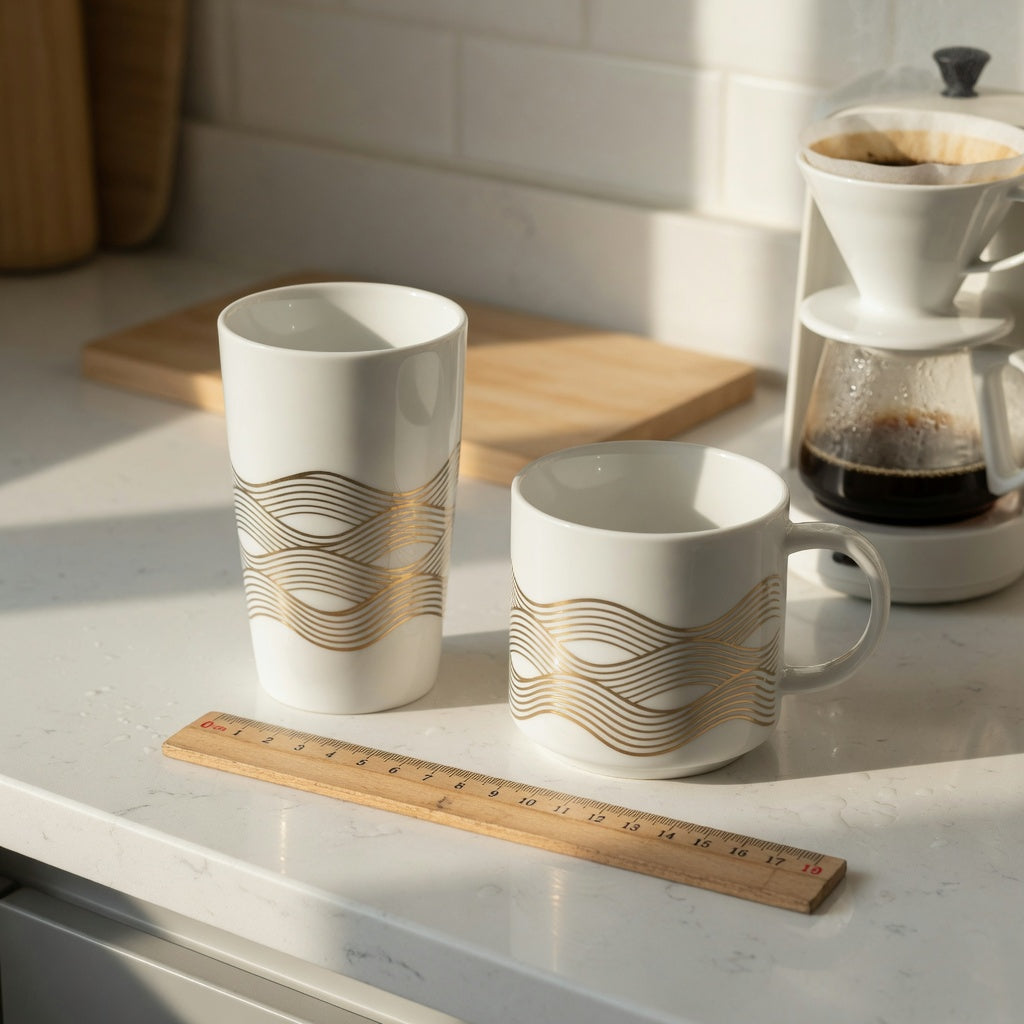
White and Gold Coffee Mug First Time Buyer Practical Purchase Checklist
Compare two current wave-style mug listings by stated capacity and visible form, then verify handle fit, storage clearance, care, material, and packaging details instead of guessing.
Read more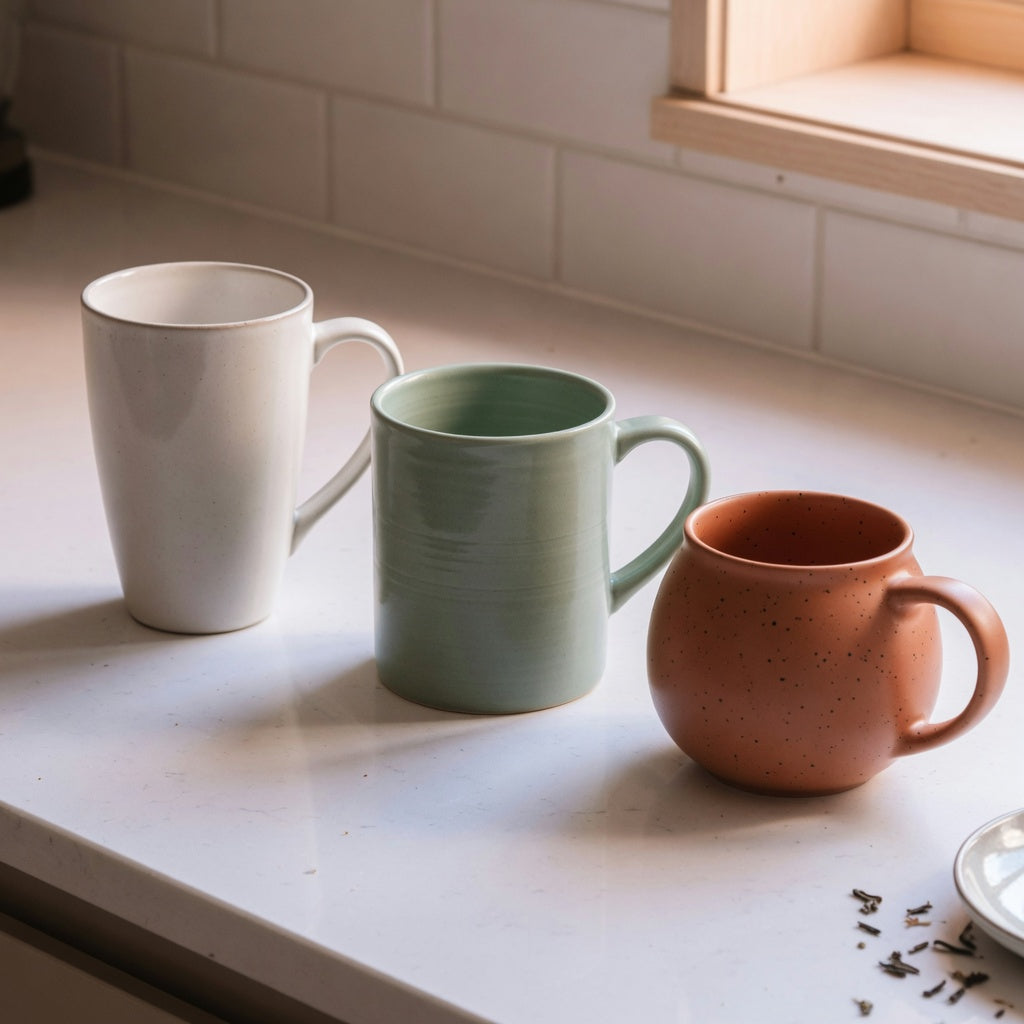
Ceramic Tea Mug First Time Buyer Product Shortlist Guide: 3 Picks
Compare three current ceramic coffee-and-tea mugs using listing-backed facts: ceramic material, 300, 350, or 400 ml capacity, visible form, and handle shape. See who should choose or skip each option.
Read more
Leave a comment
This site is protected by hCaptcha and the hCaptcha Privacy Policy and Terms of Service apply.