
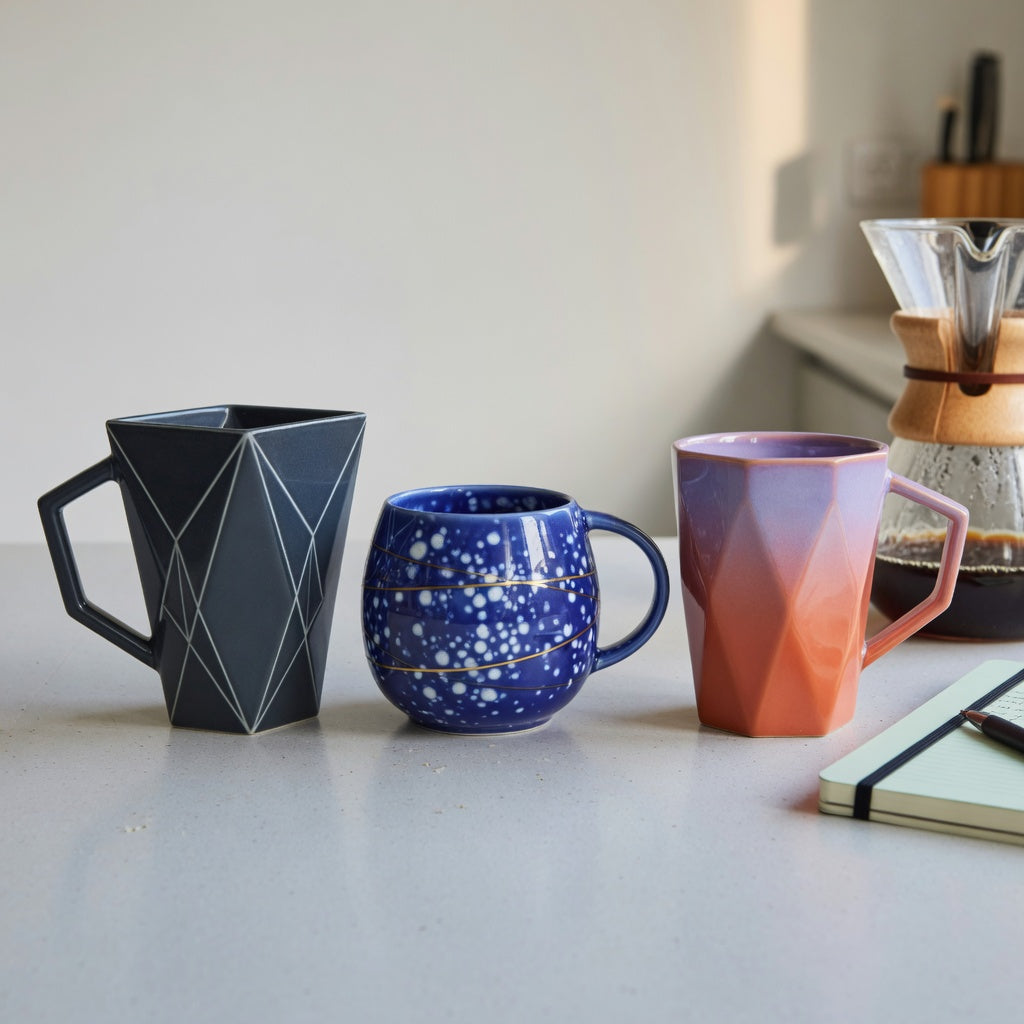
Geometric coffee mug comparison: Rhombus, Planet, or Gradient?
Reading time: about 10 minutes
A mug can be the wrong size before the first sip: too much empty room after a short pour, not enough space for milk, or a silhouette that crowds the keyboard. In our store, we line up the current Rhombus, Planet, and Gradient mugs because a geometric coffee mug comparison is most useful at that ordinary decision point. You can see the shapes, compare the listed capacities, and think about the spot where the mug will actually live.
The catalog identifies all three as glazed ceramic mugs. Their listed capacities are 350 ml for Rhombus, 400 ml for Planet, and 320 ml for Gradient. This comparison stays with material, visible form, volume, and routine fit; it does not add a designer, provenance, limited-edition story, or unlisted production detail. The choice is practical: match the mug to what you pour, where you set it, and how you store it.
How does a geometric coffee mug comparison separate the three shapes?
The names are useful shorthand, but hand feel matters. During shelf checks, packing, and customer questions, we pay attention to rim transitions, facet junctions, and the amount of visual space a mug claims beside a notebook or kettle. Those observations help with selection, but they are not a substitute for external measurements. If a shelf or desk is tight, use the dimensions shown on the individual product page where available.
| Current option | Material | Listed capacity | Visible form | Best match | Main trade-off |
|---|---|---|---|---|---|
| Rhombus | Glazed ceramic | 350 ml | Angular, faceted planes | Moderate coffee or tea servings with a pronounced geometric look | More corners and transitions to wipe around and protect in tight storage |
| Planet | Glazed ceramic | 400 ml | Rounded, planet-like geometric silhouette | A larger first cup or drinks with milk, tea additions, or ice | Largest listed volume may feel excessive for a small-pour routine |
| Gradient | Glazed ceramic | 320 ml | Faceted form with a gradient color treatment | Smaller servings, frequent refills, and a color-led geometric accent | Smallest listed volume leaves less spare room for milk, foam, or ice |
Rhombus: If defined planes are the reason you are shopping this category, start with the Rhombus coffee tea mug. Its 350 ml listing sits between the other two. The angular profile gives the strongest faceted presence; the trade-off is that the transitions deserve more attention when you clean or place mugs close together in a cabinet. The shape is a visual and handling choice, not a promise of a particular footprint or spill resistance.
Planet: If your morning drink is large or you routinely add milk, tea extras, or ice, the Planet coffee tea mug is the logical first page to open. Its 400 ml listing gives 50 ml more than Rhombus and 80 ml more than Gradient. That extra capacity is useful, but it can be more mug than a small-pour drinker wants, and volume alone does not tell you whether its outside dimensions suit your shelf.
Gradient: If you want visible facets without committing to the largest serving, review the Gradient coffee tea mug. At 320 ml, it is the smallest of the three and works well for a shopper who prefers a shorter serving or does not mind a refill. The gradient treatment adds a stronger color cue, while the lower capacity gives less room for bulky add-ins.
Does 320 ml, 350 ml, or 400 ml match your actual pour?
Capacity is the clearest numerical difference here, but listed capacity is not the same as a comfortable fill line. A mug filled to its maximum leaves little room for milk, foam, a spoon, or ice. We ask shoppers to compare the amount they actually drink and then allow for the headspace they prefer.
- Gradient, 320 ml: 30 ml below Rhombus and 80 ml below Planet; a sensible starting point for smaller portions or frequent refills.
- Rhombus, 350 ml: the middle option; useful when a standard coffee or tea serving needs some room without moving to the largest mug.
- Planet, 400 ml: 50 ml above Rhombus; best suited to a generous first cup or drinks that include several additions.
Pour your normal coffee or tea into a measuring cup once, both before and after additions if you use milk or ice. That quick check catches a common mismatch: a mug can hold the beverage on paper but feel awkwardly full in daily use. Remember that milliliters describe volume, not height, width, handle clearance, or base diameter. Confirm those external measurements on the product page if the mug has a fixed place.
Which geometric mug fits a narrow office desk or a busy kitchen counter?
On an office desk, clearance beats styling. A laptop, mouse, notebook, charging cable, and coaster create a fixed area, so measure the clear spot beside the keyboard before ordering. Rhombus is the first option to review for someone who wants a moderate 350 ml serving and a strongly angular form. Gradient makes more sense for a smaller serving that is less likely to sit full beside work papers. Planet suits a desk user who has room for a 400 ml first cup.
On a kitchen counter, the variables change. The mug may sit near a kettle, sink, drying rack, or a cupboard door, and several people may reach for it during breakfast. Planet's larger listed capacity can reduce refills for a big coffee or tea drinker. Rhombus suits someone who wants a defined faceted shape at a middle capacity, while Gradient is easier to match to a smaller breakfast-bar routine.
We do not treat one silhouette as universally more stable. A level counter, clear handle path, and enough room to set the mug down matter more than the product name. If the storage shelf is shallow, compare the listed height and width where provided instead of assuming that similar capacity means similar footprint.
What should you check during gift unboxing and after dishwasher cycles?
Glazed ceramic is well suited to everyday mug use, but a rim-to-rim knock or abrasive cleaning can still damage the surface. During a delivery or gift unboxing, our team checks the places most likely to matter in transit and repeated handling:
- Rim: check for a chip, sharp spot, or hairline crack before taking the first drink.
- Facet transitions and color areas: look for a visible open spot in the glaze, a crack, or a rough patch. A color difference alone is not enough to label structural damage; compare it with the product listing and contact the store if you are unsure.
- Base: place the empty mug on a flat counter and check that it sits level without rocking.
For routine care, use warm water, mild dish soap, and a soft non-abrasive sponge. Rinse coffee oils promptly and dry the mug before putting it into a crowded cabinet. Avoid abrasive pads around the rim and facet junctions, and do not force geometric mugs into a stack where ceramic surfaces press unevenly. Sudden temperature changes, such as moving a cold mug directly under boiling water, are also best avoided.
A dishwasher cycle is a separate question from material. The fact that a mug is ceramic does not by itself confirm microwave or dishwasher safety, so check the current care instructions on the relevant product page before using either appliance. If dishwasher use is approved, leave space between the mug and hard cookware so the rim and angular surfaces do not take a direct impact. If the listing is silent, hand washing is the conservative choice.
These mugs are not the right category for someone who needs a sealed lid, a standard car-cup-holder fit, or verified insulation for a long commute. A ceramic mug can work beautifully on a counter and be inconvenient in a backpack. That limitation belongs in the comparison.
Which capacity makes sense for coffee, tea, and iced drinks?
For a repeatable black coffee pour, Gradient and Rhombus keep the choice near a moderate serving. Gradient leaves less unused space for a smaller drink, while Rhombus gives a little more room without moving to the largest listed capacity. If you make a generous morning coffee or add a substantial amount of milk, Planet's 400 ml listing gives the most total volume.
Tea drinkers should account for additions as well as the tea itself. A tea bag or infuser, spoon, honey, and milk can make a smaller mug feel crowded. Planet is the straightforward match for a larger tea serving; Rhombus suits a moderate one; Gradient works for a shorter cup or someone who is happy to refill.
Iced coffee needs one extra calculation because ice occupies space. Planet offers the most total capacity, but that does not mean it will hold 400 ml of liquid once cubes are added. If you use large ice, inspect the opening and any listed dimensions on the product page rather than choosing by capacity alone.
Do not expect these ceramic mugs to replace a lidded insulated tumbler for outdoor carry or long heat-retention needs. Choose this set for home, office, and serving routines where an open mug is practical.
Which current shape makes the most practical gift when routine is unknown?
A recipient rarely tells you their preferred milliliter count, so use routine clues. Look at the mug already on their desk or kitchen shelf, ask what they drink, and notice whether they prefer one large morning pour or smaller refills. In our store, those details produce a more reliable gift choice than selecting by shape name alone.
- Angular-design shopper: Rhombus is the match when pronounced facets and a 350 ml serving fit the recipient.
- Generous coffee or tea drinker: Planet is the match when 400 ml and a rounded geometric silhouette suit the routine.
- Smaller-portion or color-focused shopper: Gradient is the match when 320 ml and its gradient treatment feel more appropriate.
Inspect the rim and base before wrapping, especially after delivery. Include the listed capacity in the gift note so the recipient knows what to expect. If you cannot identify the routine, send the shopper to our unique coffee mugs collection so they can compare other visible forms and choose around their own space.
What should you confirm before ordering a geometric mug?
Use this short checklist before opening a product page:
- Measure the spot: check clear width, height, and handle clearance beside the keyboard, coffee maker, or shelf.
- Measure the pour: recreate your normal coffee or tea volume and leave room for milk, foam, or ice.
- Choose the form: select Rhombus for prominent angular planes, Planet for a rounded geometric silhouette, or Gradient for faceted geometry with a gradient treatment.
- Check care: read the current appliance guidance and plan for non-abrasive cleaning and sensible storage.
- Check the limitation: if you need a lid, insulation, or car-cup-holder compatibility, compare travel drinkware instead.
That sequence turns a style preference into a concrete purchase decision. Open the product page that matches your serving and space, verify its current dimensions and care details, and use the collection link if none of the three fits cleanly.
Frequently asked questions
What should I compare in a geometric coffee mug comparison?
Start with listed capacity, glazed ceramic material, and visible shape, then check external dimensions and care instructions on the individual product page. Capacity tells you volume, not footprint or comfortable fill level. Your normal pour and storage space should decide the final option.
Which current geometric mug has the largest listed capacity?
Planet is listed at 400 ml, compared with 350 ml for Rhombus and 320 ml for Gradient. That makes Planet the strongest fit for a larger first coffee or tea serving, but it is not automatically better if you prefer smaller portions or have limited storage.
Is the 320 ml Gradient mug too small for milk coffee or iced coffee?
Not necessarily, but it leaves less spare room than the 350 ml Rhombus and 400 ml Planet. Measure your usual drink and compare it with the headspace you want if you add milk or ice. Gradient is a better fit for smaller servings or more frequent refills.
Can I put these geometric ceramic mugs in the dishwasher or microwave?
The comparison data identifies glazed ceramic, but material alone does not confirm appliance safety. Check the current care instructions on the relevant product page; until that is clear, hand washing with mild soap and a soft sponge is the conservative choice.
Are Rhombus, Planet, and Gradient suitable for commuting?
They are better considered for home, office, and serving use than for an unsealed bag or a car cup holder. This comparison does not establish a lid, insulation, or vehicle fit. Choose a lidded travel product if spill control and heat retention are requirements.
The choice is now concrete: Rhombus for the 350 ml angular middle ground, Planet for the 400 ml larger pour, or Gradient for the 320 ml smaller serving with a gradient treatment. Verify the individual listing before ordering, then browse the unique coffee mugs collection if your routine calls for another shape.
More from our blog
Read more
Ceramic Coffee Mug With Handle Capacity Guide: 350-480 ml Fit
Compare our listed 350 ml, 400 ml, and 480 ml ceramic mugs by drink volume, refill routine, visible handle form, and vessel shape. Use simple measurements for milk, ice, infusers, and headroom befo...
Read more
Tall Ceramic Coffee Mugs Daily Use Guide: Trade-Offs Before You Buy
This tall ceramic coffee mugs daily use guide uses cabinet, coffee machine, desk, gifting, iced-drink, and care scenarios to compare the Landscape, White Golden Waves, and Mountain mugs without inv...
Read more
Leave a comment
This site is protected by hCaptcha and the hCaptcha Privacy Policy and Terms of Service apply.