



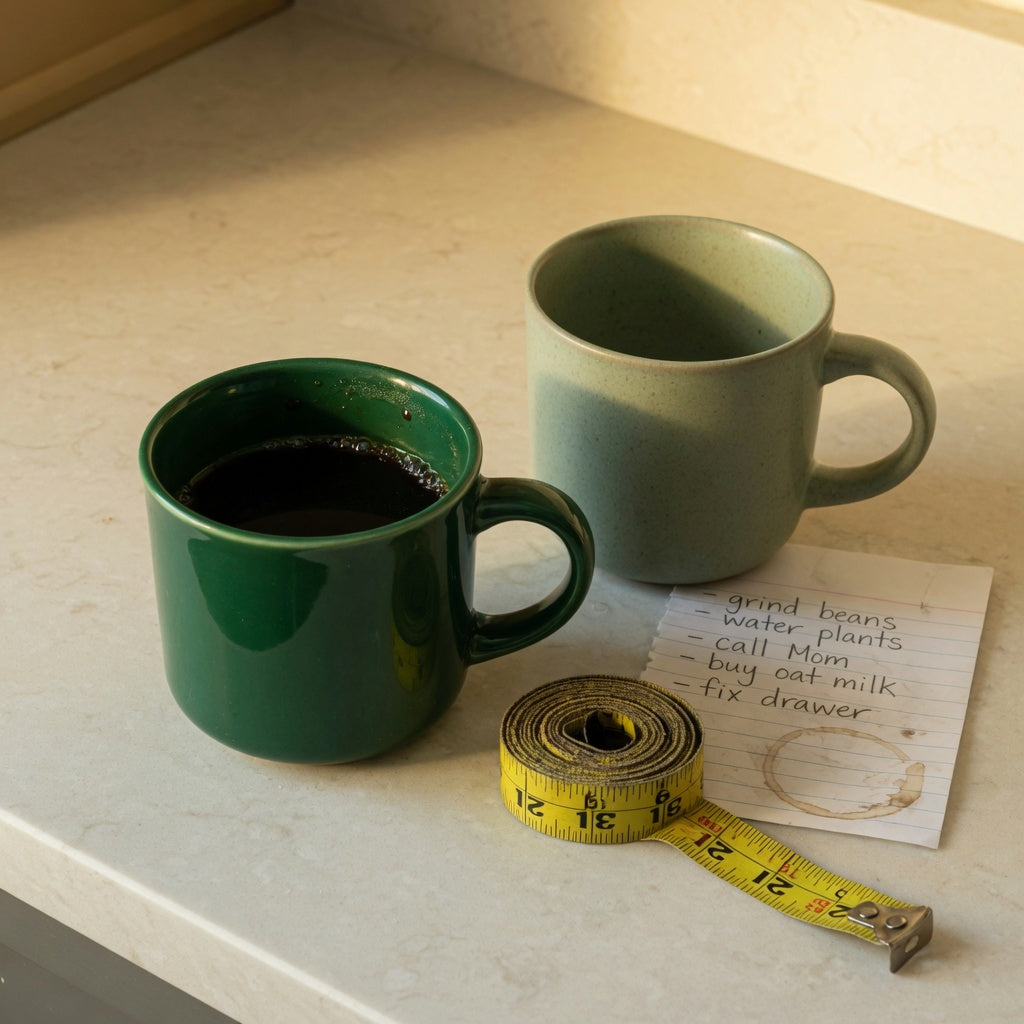
Emerald Ceramic Coffee Mug Buying Checklist: What Buyers Should Compare
Reading time: about 15 minutes
Gift boxes come back to our packing bench for a boring reason. The green looked right on a phone, then looked olive under warm kitchen bulbs, and the listing never said whether the mug could survive the dishwasher. Color closed the sale. The weekday routine undid it.
An emerald ceramic coffee mug buying checklist is how we separate those two jobs before checkout. The glaze gets the click. Capacity, the interior surface, printed care rules, and the handle decide whether the mug stays next to the kettle.
What should an emerald ceramic coffee mug buying checklist confirm before the photo wins?
In our store the live listing is the spec sheet, not the lifestyle crop. The catalog title we point shoppers to is the Emerald Small Ceramic Coffee Mug. That title calls the piece a small ceramic coffee mug. It does not lock in today's ounce rating, wall thickness, glaze batch, or appliance wording. Those lines can change. A photo of coffee in a green cup is not a capacity claim, a leach test, or permission to use the microwave.
If a field is blank, leave it blank in your notes. Silence is a gap, not a quiet yes.
Work the page in this order:
- Confirm the body is ceramic. Some products sold under an emerald color name are enamel on steel, and they do not follow ceramic care rules.
- Confirm the interior is meant to hold food and drink, not a decorative object that only looks like a mug.
- Use the ounces and dimensions printed on the page. Do not treat the word small, or the scale of the photo, as a fill line.
- Find written microwave and dishwasher instructions, and look for a metallic or luster rim.
- Check that the handle opening fits the hand that will lift the mug full, including a smaller grip or a sore thumb.
The catalog title already says ceramic. Still read the material line on the current page, because a color word is not a care instruction. If the silhouette is wrong once those lines are filled in, compare shapes in our unique coffee mugs and repeat the same five checks. A wider bowl or a different handle can be the better weekday cup even when green was what stopped the scroll.
This is the sheet we keep beside a screenshot when someone asks us to choose for them:
| Check | Where it has to appear | What the photo cannot prove |
|---|---|---|
| Color name | Glaze sentence plus customer photos in daylight and warm light | That emerald, sage, celadon, and matcha are one green |
| Material | Ceramic, stoneware, porcelain, or another body such as enamel on steel | That a green product shot means ceramic |
| Capacity | Listed ounces and dimensions | That small, large, or the crop is a usable fill |
| Food contact | Interior use, warnings, and any test note the seller actually links | That lead free, or a warning logo, is a leach report |
| Appliances | Microwave and dishwasher sentences, plus any metal trim | That a missing line means the mug is safe |
| Handle and wear | Opening size if printed; chips, crazing, cracks at the join | That crackle glaze is fine for daily coffee |
Emerald, sage, celadon, or matcha: which green shows up beside the kettle?
Shoppers use those words as if they were shared paint chips. They are not. In the emails we answer, emerald usually means a saturated blue-green, nearer a cut stone than a pale tea glaze. Sage sits gray-green. Celadon is the softer name people reach for. Matcha leans yellow-green. Factories do not share one formula for any of those labels. Your monitor shifts them. So does the bulb over the sink.
Handmade and small-batch glazes move again from piece to piece. The same recipe can pool darker at the foot, break lighter on a rim, and look different where the wall is thin. In our experience the mismatch shows up at unboxing, not in the cart. Daylight from a window can make a deep green look brighter. Warm bulbs pull it toward olive. A white or cream interior changes how the coffee reads even when the outside is the green you wanted.
Line these up before you commit:
- The color word in the title against any glaze sentence in the description.
- Whether the maker says the color varies, is handmade, or is a repeatable production glaze.
- Interior color, not only the outside. A green shell with a pale well is a different cup at breakfast.
- The rim. An iron-brown lip or a shiny metal band is a separate decision from an all-over green glaze.
Do not read a recipe into the word emerald. Nothing in the foodware guidance we use says a green hue predicts copper, lead, cadmium, stoneware versus porcelain, or microwave safety. A vivid green can be a stable commercial glaze. A quiet green can still be the wrong cup if it was never finished for food. Judge the page, not the hue.
If tea is part of the decision, our comparison of a green ceramic coffee mug for tea sits beside this color check. Use it as a second pass. It does not replace the listing open in front of you.
Is the drinking surface a food-contact glaze, or only a pretty exterior?
This is the check we do not skip, including on a mug we sell. Ceramic that looks like a cup is generally treated as something you might drink from. U.S. rules on ornamental ceramicware recognize that lead in glazes and decorative decals can move into food if a decorative piece is used to prepare, serve, or hold food. Ware that looks suitable for food is considered to be for food use unless it has both a required conspicuous stick-on warning and a permanent statement on the base, or a hole through the surface that would have held food. The hole is the obvious version: the object cannot work as a cup.
On lead, FDA pottery guidance (CPG Sec. 545.450) sets an action level for cups and mugs of 0.5 micrograms of lead per milliliter of leaching solution, in any one of six units, using the cited lab methods. In that guidance, cups and mugs are small ceramic hollowware commonly used for coffee or tea above room temperature. They normally, though not exclusively, hold about 8 fluid ounces (240 milliliters) and are made with a handle. That 8-ounce figure describes the category. It is not the capacity of the emerald mug in our catalog, and it is not a reason to skip the ounce line. The same body of guidance has found that some ceramic foodware releases significant lead from surfaces that can touch food, that foods can extract it, and that continued use can cause adverse effects, including chronic lead poisoning.
Cadmium is a separate metal. Imported and domestic ceramicware has been found with significant extractable cadmium. Acid foods can pull it from a contaminated glaze, and continued use could cause chronic cadmium poisoning. The cadmium action level given for ceramic small hollowware is 0.5 micrograms per milliliter in any one of six units. Small hollowware, in that guidance, means a capacity under 1.1 liters.
California public-health guidance adds the point that matters at the kettle. You cannot see lead in glaze or paint. A plain, undecorated glaze can still contain lead. Acidic drinks, including coffee and tea, leach lead from a contaminated dish faster than drinks that are not acidic.
Read listing phrases with those limits:
- Lead free is not a lab report. Ceramicware that leaches lead under the agency method should not carry that label, and some imported traditional pottery marked lead free still released lead, in some cases above the action levels. Lead compounds such as lead oxide have a long history in glaze formulas. If firing is too cool or poorly controlled, lead may not fully lock into the glaze and can move into food.
- A pattern on the outside is not a leach test of the interior you drink from. Exterior decoration can be irrelevant, or it can be why a warning exists. A thumbnail will not tell you which.
- A California Proposition 65 warning is a prompt to read the material notes and ask what was tested. It is not, by itself, an FDA leach result for the inside of the cup. We will not turn a warning logo into a simple safe or unsafe grade. A notice tied to exterior decoration is not the same document as an interior leach test.
- A home swab sold for lead paint is the wrong clearance test. EPA recognizes certain kits for lead-based paint on wood, ferrous metal, drywall, and plaster. That recognition does not cover ceramic dishware. A mark on an outside motif does not measure what leaves the interior, and a quiet swab is not an EPA clearance for the mug.
If you will drink from the cup every morning and the seller cannot say the interior is intended for food, do not buy it. Handmade pieces and uncertain imported glazes deserve more questions, because firing quality is part of whether any lead in a formula stays put. If the emerald listing does not link a leach report, ask us. Do not fill the gap from the color. A chipped, corroded, or worn interior raises the concern further. Public-health guidance treats damaged surfaces, and daily coffee or tea, as higher-concern use, not as charm.
When is a catalog-small emerald mug the wrong pour for coffee or tea?
Small is a merchandising word in a catalog title. It is not a fill line. The argument we hear most is usable capacity versus the ounce number on the page. Nominal volume is often taken near the brim. The pour you can walk from kettle to desk sits lower, or coffee sloshes onto a keyboard. We have not found an official standard that defines one mug fill line for every brand, so two cups with the same ounce claim can still drink differently. Do not borrow an ounce number from a different emerald mug on another site and paste it onto ours.
On this listing, use only the ounces and dimensions printed now. If either is missing, leave it unknown. A mug beside a laptop looks generous. The same mug beside a dinner plate looks modest.
Match the pour to the morning:
- A short black coffee or a small tea serving can suit a genuinely small cup, especially if you refill instead of nursing one huge mug through a meeting.
- A milky latte, a soup-sized serving, or a commute is a poor fit. You will be back at the kettle. An open ceramic cup will not behave like a lidded bottle in a car.
- Loose-leaf tea that needs room for leaves wants headspace. If the page does not mention an infuser or a lid, neither one is included. Do not infer them from a styled photo.
Heat holding is the other disappointment people try to solve with size. Ceramic takes heat from the drink. Unless a seller reports starting temperature, fill volume, whether a lid was on, room temperature, and elapsed time, a stays-hot claim cannot be compared across products. We do not quote a hold time for this mug. If you need coffee still hot after a long drive, a small open ceramic cup is the wrong tool. For a shelf where several green cups share a home station, the green mug shortlist for a home coffee station is a shape comparison, not a set of specs for this listing.
Microwave, dishwasher, and metallic rims: what has to be printed?
Appliance use is a printed instruction, not a feeling you get from the glaze. If the current listing never says microwave safe, do not microwave the mug. If it never says dishwasher safe, wash it by hand. Silence is not a compatibility claim, and we will not guess it from a studio photo of steam.
Metallic rims and luster bands are the usual reason a ceramic cup sparks or heats unevenly. Gold, silver, platinum, or a shiny luster line in the photos means you stop and find a sentence that covers that trim. Do not test a full cup of coffee to see what happens.
Search results also mix materials under one color word. Some products marketed as emerald mugs are enamel on steel, not ceramic. Enamel on steel does not inherit a ceramic microwave habit, and a ceramic cup does not inherit steel-enamel rules from a different listing that used the same green name. Our catalog title for this piece says ceramic. Confirm that line on the live page anyway. Care text is what you follow.
The catalog title does not describe a lid, a sleeve, or cup-holder fit. Unless the current listing states those, do not assume them. On any travel version you compare elsewhere, check the lid and sleeve materials separately from the ceramic body. A ceramic cup labeled for the microwave would not make a plastic lid or a sleeve microwave safe. This is a weak choice for a car cup holder, a sweaty iced drink on a laptop sleeve, a wooden-handle preference, or a bowl big enough for soup.
California health guidance is stricter when lead is plausible: do not heat food in a dish that contains or might contain lead, because cooking or microwaving speeds leaching. Running a lead-containing dish through the dishwasher can damage the glaze and make later leaching more likely. Settle the food-contact question before daily machine washing. Do not treat every green glaze as contaminated. Color still does not show whether lead is present.
How we split it when we pack an order or answer a care email:
- Written microwave and dishwasher guidance, no metal trim called out, interior described for food: stay inside those written limits.
- No care text: hand wash only, and no microwave, until the answer is in writing.
- Decorative-only warnings, a suspected leaded glaze, or a damaged interior: do not use it for coffee or tea.
Handle pinch, rim chips, and crazing: when do we pull a mug from daily use?
Comfort shows up on the third morning, not in the thumbnail. A tight handle opening pinches larger fingers. A wide, thin handle can bother a sore thumb when the mug is full. We will not quote a handle gap for this mug unless the listing prints dimensions, so check that line or ask. A smaller full cup is often easier to manage than a tall mug because you are lifting less liquid. That is a counter observation from packing and returns, not a measured weight for our emerald piece.
Look the mug over before the first pour, and again after a few months at the sink:
- Chips on the rim or inside the bowl. Once the food-contact surface is chipped, retire it as a drinking cup. Keeping it for pens, then pouring Saturday coffee into it, defeats the point.
- Cracks where the handle joins the body. Those let go when the mug is full, usually over a laptop or the sink.
- Crazing, the fine crackle network in the glaze. Some decorative ware sells that look on purpose. On a daily coffee mug we treat a crazed interior as a stop, especially if the clay stays damp, stains, or holds a smell after washing.
- A wall that feels harshly hot while the drink is only warm. That can be a thin spot. It is a comfort limit, not a lab result, and it is a reason to stop if it worsens.
Shoppers also ask us to rank stoneware against porcelain, or to bless a thick wall and a high fire. The official lead and cadmium pages we rely on do not rank those bodies for everyday coffee, so we do not invent a winner. Use the material name the maker prints. A body type is not a safety claim.
The piece earns a spot beside the kettle when you want a controlled pour and the care lines match how you wash and reheat. If you are giving it, the recipient inherits those limits. A metallic rim they were not warned about is a poor Monday surprise.
Frequently asked questions
What should an emerald ceramic coffee mug buying checklist include if I only have five minutes?
Confirm ceramic construction, an interior meant for food, the listed capacity and dimensions, written microwave and dishwasher instructions, and a handle you can grip when the mug is full. Then compare customer photos with the emerald, sage, celadon, or matcha shade you think you are buying. If any of those lines is missing, ask before you order. A green photo does not fill a blank field.
Does a green or emerald glaze mean the mug contains lead or cadmium?
No. Color is not evidence either way. FDA guidance deals with leachable lead and cadmium from ceramic food-contact surfaces, not with hue. Lead cannot be seen in a glaze, a lead-free sticker is not proof by itself, and a paint swab is not an EPA-recognized clearance test for ceramic mugs. Ask whether the interior is meant for food, and ask what leach testing the seller can share.
Can I microwave an emerald ceramic mug with a metallic rim, or one that never says microwave safe?
Do not. A silent listing is not an approval, and a metallic or luster rim is a reason to stop even when the body is ceramic. If lead is a real possibility, public-health guidance is to avoid heating the dish, because heat can speed leaching. Hand wash it until care instructions are in writing.
Is the listed capacity the amount I can actually drink, and is a small mug too small?
Listed ounces are often measured near the brim, not at the level you can carry without spilling. There is no single official fill line we can apply to every brand. A catalog-small cup can be right for a short coffee and a lighter lift, and wrong for one long latte, loose-leaf tea that needs headspace, or a commute. Read the ounces on the current listing rather than guessing from the word small or from a photo beside a laptop.
Should I retire a ceramic mug if the glaze crazes, chips, or stays damp?
Yes for drinking, once the food-contact surface is chipped, cracked at the handle, or crazed in a way that stains, smells, or stays wet. Decorative crackle is not a reason to keep pouring coffee. If you suspect the glaze might contain lead, skip the microwave and the dishwasher rather than testing the damage with a hot acidic drink.
Run the emerald ceramic coffee mug buying checklist against the live emerald coffee and tea mug listing and mark each table row confirmed, missing, or not for you. Missing care text means you wait, not that you assume. If the size or the handle is the problem, move through the unique coffee mugs collection and keep the same checks beside you so the next shape gets the same scrutiny.
More from our blog
Ready to pick your mug? Two ways to save on today's order:
Ordering 1–3 mugs? Get an extra 10% off your 1st order with code 10_OFF Apply 10% Off & Shop Wooden-Handle Mugs →
Gifting 4+ mugs? Buy 3, Get the 4th Free applies automatically at checkout (no code needed; offers do not stack) · Free standard shipping (Nov pre-Christmas delivery: 15–20 calendar days US) · Free replacement if chipped in transit.
Popular mug buying guides: Ceramic Tea Cups & Infuser Mugs · Ceramic Mugs with Lids Compared · Wooden-Handle Tea Infuser Mugs Compared · Christmas & Secret Santa Mugs 2026 · Espresso & Cortado Cups Guide · Cup & Saucer Gift Sets · All 25 Mugs Spec Table · Mug Size Guide · Shipping & Promo FAQ
FIRST ORDER 10% OFF (CODE: 10_OFF) · OR BUY 3, GET THE 4TH FREE


Read more
White and Golden Tall Tea Mug: What Buyers Should Compare
Gold trim on a white and golden tall tea mug does not tell you microwave or dishwasher limits. We compare body material, gold type, height, capacity, and food-use labeling before you buy.
Read more
Office Desk Landscape Coffee Mug: What Buyers Compare
A scenic mug only earns desk space if you can see the landscape from your chair and the cup will not tip into the keyboard. Compare print placement, the capacity printed on the listing, dishwasher ...
Read more
Leave a comment
This site is protected by hCaptcha and the hCaptcha Privacy Policy and Terms of Service apply.