
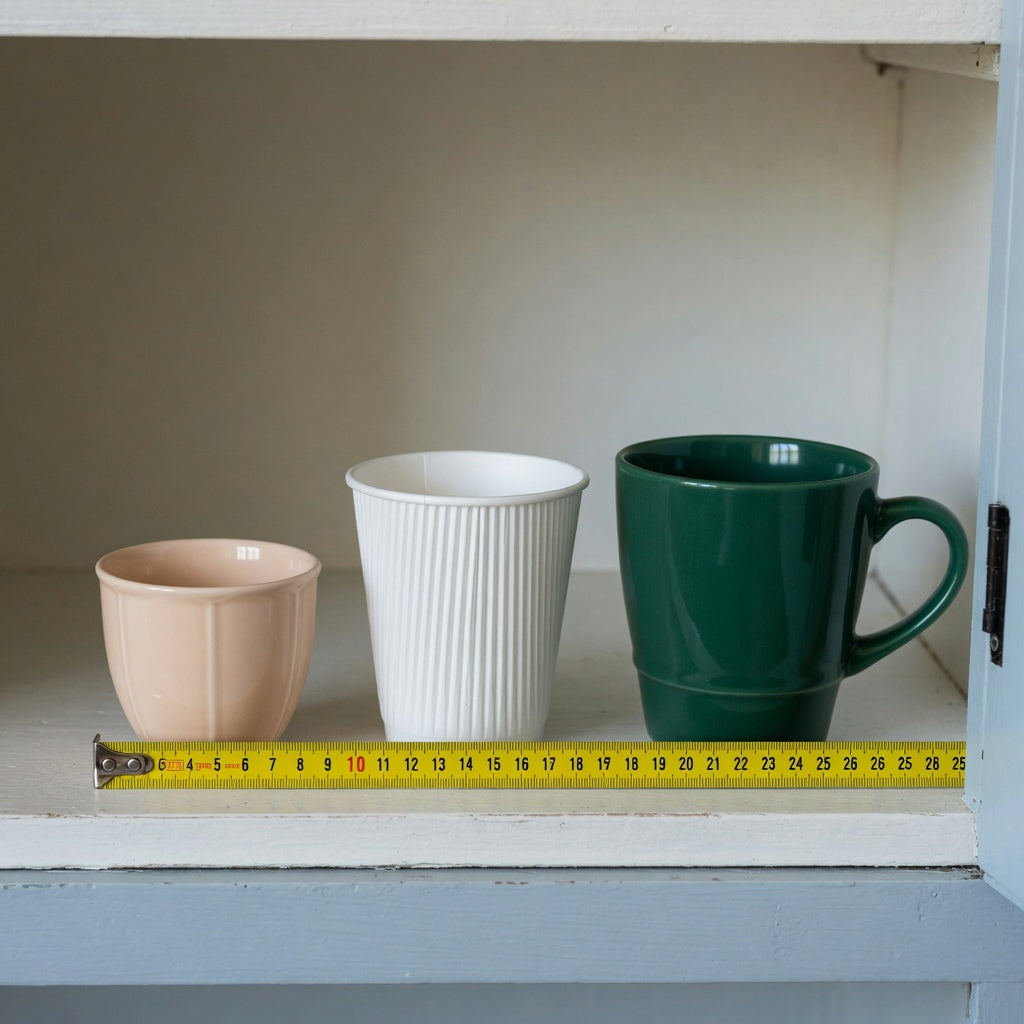
Eggnog Mug Storage Fit Guide: Shapes and Shelf Space
Reading time: about 10 minutes
The cabinet door closes most of the way, then stops against a mug handle. That is a storage problem shoppers often discover only after choosing a cup by serving capacity or front-facing appearance. Our eggnog mug storage fit guide starts with the less glamorous details that decide everyday usability: shelf depth, handle projection, clear height, neighboring dishes, and the room needed to lift a mug out without knocking its rim.
We sell and handle this category, and one lesson holds across mug styles: capacity is useful, but it is not an exterior measurement. The verified catalog facts for this comparison are the Retro at 170 ml, the Pleated at 200 ml, and the Emerald at 270 ml. Their visible forms can help you build a shortlist, but exact width, height, base diameter, and handle projection are not currently provided in the source information for this guide. We will not convert milliliters into guessed dimensions or promise that a mug fits a particular cabinet.
How to use this eggnog mug storage fit guide without guessed dimensions
Start by measuring the storage space, not by estimating the mug from a photograph. In our experience arranging drinkware, four separate clearances matter. A cup can pass one check and still fail another.
- Usable depth: Measure from the back wall to the closed-door plane, accounting for a front shelf lip, door hardware, or anything mounted inside the door.
- Clear height: Measure from the shelf surface to the shelf above. If there is a raised lip, the mug may need extra lift-out room even when its body fits underneath.
- Side-to-side allocation: Include the widest part of the body and the handle in the orientation you plan to use. Turning a handle inward may save depth while consuming more width.
- Removal path: Leave enough open space to grasp and lift the mug. A tightly packed row may fit while stationary but become awkward once the middle cup has to come out.
Those measurements describe your real limit. The product photos then help you compare visible form, while the listed capacity tells you which serving size suits your routine. If exterior dimensions are later added to a product page, compare each number with the matching cabinet measurement rather than relying on a single overall figure.
What do the 170 ml, 200 ml, and 270 ml capacities tell you?
The capacities establish a clear serving-size order. They do not establish the same order for exterior width, height, or handle reach. Wall thickness, body profile, base shape, and handle geometry can all change the space a cup occupies.
| Current option | Verified capacity | Visible form | Reader situation | Limit to remember |
|---|---|---|---|---|
| Retro | 170 ml | Compact, classic cup-like profile | A modest serving is acceptable and storage space is a priority | Lowest capacity does not prove the smallest exterior measurements |
| Pleated | 200 ml | Pleated exterior with a more detailed side profile | You want a middle serving size and have room to avoid crowding textured sides | The visible pleats do not reveal exact maximum width |
| Emerald | 270 ml | Fuller mug-style visual profile | You prefer the largest verified pour of these three and can allocate more open shelf space | Capacity alone cannot confirm its cabinet footprint |
For a small eggnog serving, the Retro 170 ml coffee tea cup is the logical first product to inspect. Its lower capacity and restrained visible form make it a sensible candidate for a crowded shelf, but the fit still needs confirmation. It is not the best choice for someone who dislikes refilling a modest cup.
The Pleated 200 ml coffee tea cup occupies the middle capacity position. We would direct a shopper here when 170 ml feels too limited but 270 ml is more than the intended serving. Its pleated exterior is part of the visual appeal, though buyers arranging a very dense row should allow for the possibility that the detailed profile will not sit as closely beside other drinkware as a plain-sided form.
The Emerald 270 ml coffee tea mug provides the largest verified capacity in this comparison. It suits a shopper who prioritizes a more generous pour and has a less constrained shelf, open display area, or dedicated mug section. We would not select it solely from a photograph for a shallow cabinet because its exact exterior dimensions remain unverified here.
Where should you measure handle projection and door clearance?
Handle projection is the distance the handle adds beyond the mug body. For storage, however, the more useful number is the mug's complete envelope in its intended orientation: the farthest point on one side to the farthest point on the other. A handle facing the cabinet door affects depth. The same handle turned sideways affects row width instead.
We check mug placement from above as well as from the front. The top view reveals problems that a product photo can hide, including a handle reaching into the neighboring slot or the door path. Check these locations before ordering:
- The shallowest area near a cabinet hinge, where hardware may reduce usable width or depth
- The door's closed position, especially if the shelf sits close to the frame
- The gap beside plates or bowls, which may lean into the mug's handle space
- The shelf edge or retaining lip that the mug must clear during removal
Do not use an arbitrary clearance rule such as a finger width. Fingers, doors, and handles differ. Record the actual usable space and compare it with confirmed product dimensions when available. A photograph can indicate whether a handle looks compact or open, but perspective and image scaling make it unsuitable for precise fit calculations.
Which mug shape suits a shallow cabinet, crowded shelf, or office cubby?
Shallow upper cabinet with a closing door
Begin with the Retro if a modest 170 ml serving works for you. It is the lowest-capacity option and has the least visually elaborate profile of the three, so it is a reasonable first candidate rather than a guaranteed fit. Measure to the closed-door plane and check the product listing for any newly available exterior specifications before purchasing.
Crowded shelf with mugs stored side by side
The 200 ml Pleated can balance serving size with a compact-cup use case, but its visible pleats deserve attention when every slot is tightly allocated. Plan around the widest point, not the narrower areas between folds. If dense packing is more important than surface detail, a plain-sided style with published measurements may suit the shelf better.
Open shelf or dedicated area for a larger pour
The Emerald 270 ml is the relevant next step when serving capacity carries more weight than maximum storage density. An open shelf removes the cabinet-door conflict, but width, height, and removal clearance still matter. The fuller visible form also makes sense where the mug is displayed rather than squeezed between stacks of dishes.
Office cubby or shared break-room shelf
Check both the cubby opening and the usable space behind it. A mug may fit inside yet catch at the narrower front frame during removal. The Retro or Pleated is the practical shortlist if a smaller serving is acceptable; the deciding factor should be confirmed exterior fit, not capacity alone.
Gift for someone whose cabinet size is unknown
No current option can guarantee fit in an unknown storage space. A 170 ml or 200 ml cup may be easier to consider than the largest-capacity option, but that remains a shortlist based on serving size and visible form. For a recipient with strict shelving, a different mug sold with complete exterior dimensions or explicit stackability information is the more dependable gift.
A five-minute shelf test for depth, width, height, and lift-out room
Use this process at the cabinet, open shelf, or office cubby where the mug will actually live:
- Empty one intended slot. Measure the usable shelf rather than the board's nominal dimensions. Hinges, frames, shelf lips, and neighboring dishes can reduce the opening.
- Record usable depth. Measure from the rear obstruction to the closed-door plane or front edge. Do not assume the door clears items that sit flush with the shelf edge.
- Record clear height. Include the space needed to lift the mug over a shelf lip. Under-cabinet fixtures and adjustable-shelf supports can also intrude into the opening.
- Allocate row width. Decide whether handles will face forward, sideways, or alternate. Use the widest total envelope for that orientation and avoid layouts where a handle presses against a neighboring rim.
- Test the removal path. Use an existing mug with genuinely comparable confirmed measurements as a physical mock-up. Similar capacity alone does not make it an accurate substitute.
- Check the current listing. Confirm any exterior dimensions, material details, care instructions, or stackability statements shown there. If a needed specification is absent, treat the fit as unresolved rather than filling the gap with an estimate.
This process also helps determine how many mugs the shelf can hold. Multiply only after accounting for handles and removal gaps; dividing total shelf width by body width alone can produce a row that looks possible on paper but cannot be used comfortably.
What trade-offs matter after the mug fits?
Storage efficiency is only one part of the decision. The Retro's 170 ml capacity can suit a small seasonal serving, tea, or another compact pour, but frequent refills may make it frustrating for someone who prefers a larger drink. The Emerald's 270 ml capacity reduces that particular compromise, while potentially asking you to reserve more space once its exterior measurements are confirmed. The Pleated 200 ml sits between them in volume and adds a visibly textured form.
None of the verified facts supplied for this comparison confirms that these mugs are designed to stack. We would plan single-level storage unless the current product listing explicitly says otherwise. Stacking mismatched profiles can place load on a rim or create handle contact, and tightly packed rigid drinkware is more likely to knock during removal. Material and care instructions are also outside the verified facts used here, so this guide does not establish dishwasher suitability or special temperature performance.
These options are not a strong match for a precision-built shelf if you need guaranteed exterior dimensions before ordering. They are also less suitable for a shopper specifically seeking a purpose-designed stacking system or a substantially larger serving than 270 ml. In those cases, choose another style with the required specifications clearly listed. Shoppers with more flexible storage can compare additional visible forms in our unique coffee mugs collection.
Frequently asked questions
Which option in this eggnog mug storage fit guide should I check first for a tight shelf?
Start with the Retro 170 ml if its modest serving size suits you. It has the lowest verified capacity and a visually restrained cup-like profile, making it a reasonable first candidate. Because exterior dimensions are not verified in this guide, it is not a guaranteed smallest-footprint option.
Does a 170 ml capacity mean the Retro has the smallest exterior dimensions?
No. Capacity measures internal volume, not overall height, body width, base diameter, or handle projection. Those external measurements must be confirmed separately before treating the Retro as the smallest physical option.
Can the Retro, Pleated, and Emerald mugs be stacked in a cabinet?
Stackability is not confirmed by the catalog facts used for this comparison. Plan to store them in a single layer unless the relevant product page explicitly states that stacking is supported. This also reduces rim and handle contact during removal.
How do I measure cabinet space for a mug handle?
Choose the direction the handle will face, then measure the complete space required from the mug body's opposite edge to the handle's farthest point. Compare that envelope with usable shelf depth or width, including door hardware and neighboring dishes. Also check that you can grasp and remove the mug through the cabinet opening.
Which current option provides the largest eggnog serving?
The Emerald has the largest verified capacity of the three at 270 ml, followed by the Pleated at 200 ml and the Retro at 170 ml. Choose it when the larger pour matters and your measured storage space is flexible enough to accommodate its confirmed exterior size.
Before choosing, record three numbers: usable shelf depth, clear height, and available row width. Then decide whether 170 ml, 200 ml, or 270 ml best matches the serving you actually pour, review the corresponding product page for current specifications, and use the unique coffee mugs collection to compare another form if the available fit information does not meet your cabinet requirements.
More from our blog
Read more
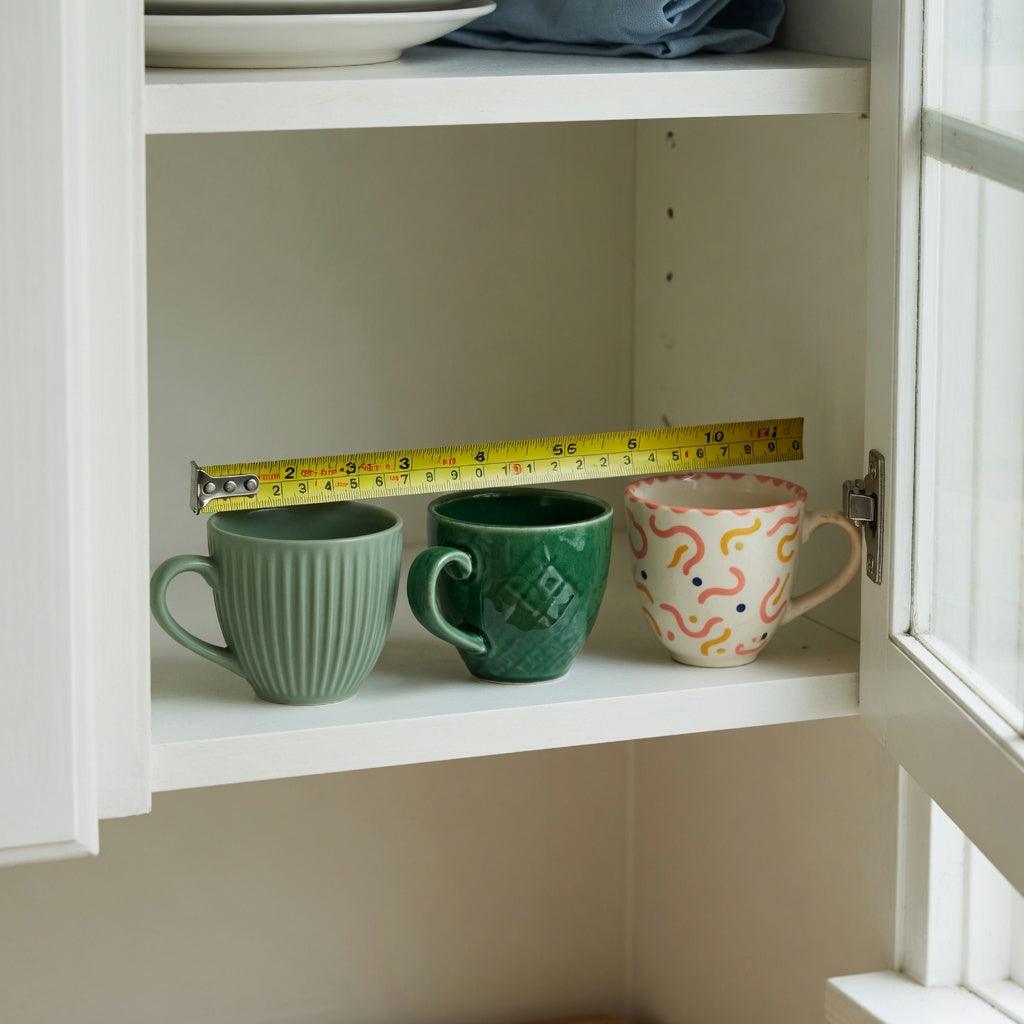
Small Ceramic Coffee Cup Storage Fit Guide: Shapes and Shelves
Compare the visible Pleated, Emerald, and Retro cup profiles against cabinet depth, handle clearance, stacking plans, and everyday lift space. Includes a practical shelf-measuring checklist.
Read more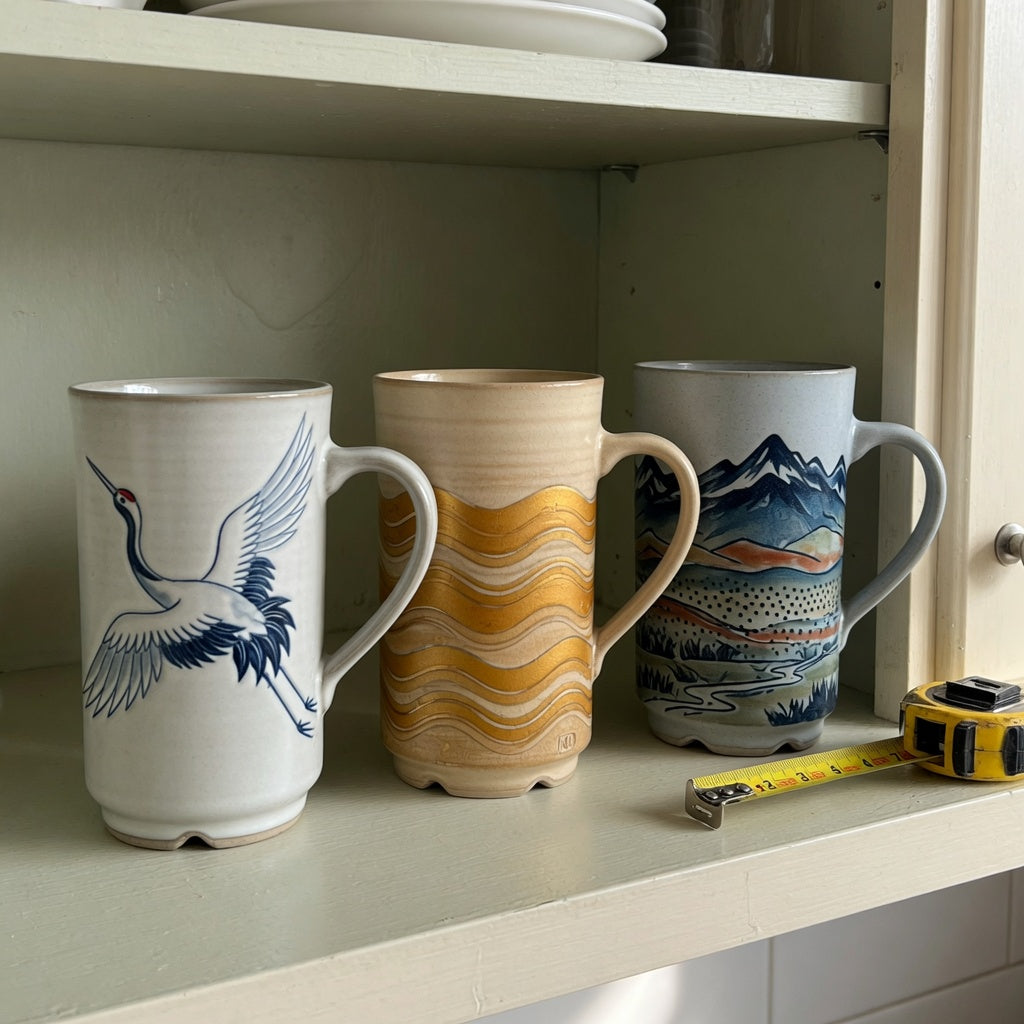
High Quality Ceramic Coffee Mugs Storage Fit Guide: Shelf Check
Compare the visible profiles of The Crane, Golden Waves Kio, and Landscape Tall, then check usable cabinet height, depth, handle clearance, and base space. This guide separates product-page evidenc...
Read more
Leave a comment
This site is protected by hCaptcha and the hCaptcha Privacy Policy and Terms of Service apply.