
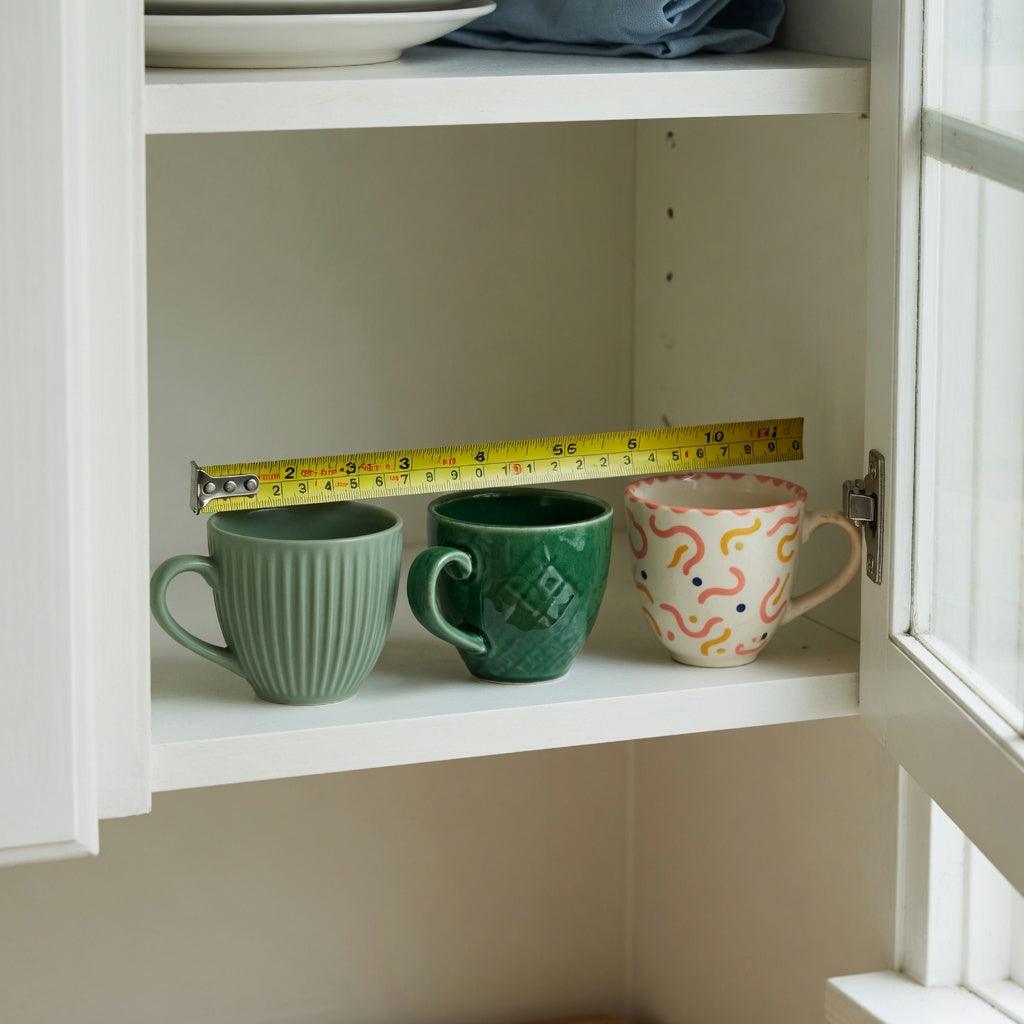
Small Ceramic Coffee Cup Storage Fit Guide: Shapes and Shelves
Reading time: about 9 minutes
A cabinet door can clear a cup body and still strike its handle. We see the same problem at coffee stations and in office cupboards: a small cup looks compact online, but its widest point sits several steps beyond the base. This small ceramic coffee cup storage fit guide helps you compare the shapes we currently sell without guessing at measurements that are not stated on their product pages.
At our packing and restocking bench, we judge a cup by its complete outside profile: body, rim, foot, and handle. Capacity describes the drink it holds, not the shelf space it occupies. We have kept the product observations below to visible form and separated them from our general ceramic storage advice.
Small ceramic coffee cup storage fit guide: which measurements decide fit?
Five measurements determine whether a cup can be stored and lifted out comfortably. Use the dimensions on the live product page when they are available, and measure the actual usable cabinet space rather than the nominal shelf size.
- Usable depth: Measure from the back panel to the inside of the closed door. Include any space lost to a face frame, hinge, or raised shelf edge.
- Total outside width: Check from the far side of the body to the outer edge of the handle. Body diameter alone does not describe the full footprint.
- Widest body point: A curved or decorative cup may be broadest above its foot, so the base is not always a reliable guide.
- Total height: Measure to the tallest point and leave room for your fingers to lift the cup instead of dragging its rim against the shelf above.
- Row width: Multiply for the number of cups you plan to store, then account for handle orientation and a little separation between ceramic surfaces.
Product photography is useful for comparing profiles, but it is not a scale drawing. If exact outside dimensions are not shown and your clearance is tight, ordering one cup first is more dependable than estimating from an image.
How do the Pleated, Emerald, and Retro profiles use shelf space?
The three current listings have visibly different exterior forms. Those differences help narrow the choice, but none proves an exact shelf footprint without measurements.
The Pleated Coffee Tea Cup has a vertically pleated exterior and a projecting handle. It suits an open shelf or coffee station where the sculpted surface can be seen and the cups do not need to press tightly together. The storage trade-off is contact: raised pleats give neighboring ceramic surfaces more points at which to rub, so we would not buy it on the assumption that it nests or packs like a plain cylinder.
The Emerald Coffee Tea Mug presents a smoother, rounded profile. That makes it the first of these three we would inspect for an orderly cabinet or office row where textured sides are less desirable. A smooth body does not automatically mean a smaller footprint, however. Its widest curve and the outer edge of its handle still control the required depth and width.
The Retro Coffee Tea Cup is the display-led option, with a more decorative vintage silhouette. It fits a buyer who wants the cup to contribute character to a visible coffee setup rather than disappear into a tightly packed cupboard. For storage, trace the whole contour with your eye and compare its broadest section and handle projection against your measurements; do not judge it from the foot alone.
| Current cup | Visible comparison point | Best storage situation | Detail to verify |
|---|---|---|---|
| Pleated Coffee Tea Cup | Vertical pleated surface | Open shelf with side clearance | Overall width and contact between pleats |
| Emerald Coffee Tea Mug | Smoother rounded body | Regular kitchen or office row | Widest curve plus handle projection |
| Retro Coffee Tea Cup | Decorative vintage contour | Visible coffee station or gift setup | Broadest contour and door clearance |
If none of those profiles matches your storage plan, compare other visible body and handle shapes in our unique coffee mug collection. Start with the outline that suits the shelf, then confirm the live listing details before ordering.
Which shape works in a kitchen cabinet, office cupboard, or gift setup?
The right recommendation changes with the room. In our experience, these are the practical matches and limitations:
- Shallow kitchen cabinet: Favor the listing with the smallest confirmed front-to-back measurement, including its handle. None of the three should be assumed to fit merely because the cup body looks short.
- Open coffee station: Consider the Pleated or Retro cup because their visible surface and contour have room to read. Choose the linked product only after confirming that the handle will not extend into a walkway or work area.
- Shared office cupboard: Check the Emerald mug first because its smoother profile is less dependent on display spacing. Leave enough room to remove one cup without knocking the mixed mugs beside it.
- Gift unboxing: One distinctive cup is easier for a recipient to place than a large unmeasured set. The Retro or Pleated style makes sense when appearance is the priority, while the broader collection is the better next step if you do not know the recipient's cabinet layout.
These small ceramic cups are not the practical choice for every situation. A true nesting set is better for an RV, compact drawer, or cupboard that must hold many pieces. A sealed travel mug is better for commuting, and a larger vessel will suit someone whose normal order is a tall iced drink.
Can glazed ceramic cups be stacked or hung without damage?
Ceramic is rigid, and glazed surfaces can become slippery while wet. During packing, the points we inspect first are the rim, foot ring, and both handle joints because those areas can take concentrated contact if cups knock together. A product photo showing one cup above another is not, by itself, confirmation that the shape was designed to stack.
- Stack only when the listing identifies the form as stackable or you can confirm that the upper cup seats without loading the lower cup's rim.
- Dry cups completely before putting one inside or above another. Wet glaze makes handling less predictable and can trap moisture between surfaces.
- Use a clean, non-slip shelf liner to reduce sliding, but do not rely on a liner to make an unstable stack safe.
- For hooks, verify both the handle opening and the route onto the hook. A tight hook that twists the handle is a poor fit even if the cup can technically hang.
Care claims must come from the individual listing. Do not infer dishwasher safety from the ceramic material or product photos. If the product page permits dishwasher cleaning, load the cup so its handle cannot strike a rack prong during the cycle, and let it dry before returning it to a crowded shelf.
How should you test cabinet fit before placing an order?
This exercise is the practical core of a small ceramic coffee cup storage fit guide. It checks both static shelf space and the movement required to use the cup every day.
- Remove nearby mugs and measure the space that will remain available after your everyday items go back.
- Measure usable depth with the door closed, accounting for hinges, the face frame, and any shelf lip.
- Measure clear height, then confirm that you can lift a cup over the lip without scraping the rim on the shelf above.
- Use listed outside dimensions, when available, to make a paper or cardboard side profile that includes the handle. Do not create a template by scaling a product photo.
- Place enough templates for the intended cup count and try handles facing forward, sideways, and alternating. Keep the arrangement that permits one-cup removal without ceramic contact.
- Check the full route from shelf to sink or approved dishwasher rack. A cup that fits the cabinet but catches on a hook, rack prong, or nearby appliance will still be frustrating.
Review the live product page immediately before buying because listing details can change. If a required measurement is unavailable and the space has little tolerance, start with one cup rather than committing the entire shelf.
Which tight-storage situations need a different cup style?
A different form is more sensible if storage efficiency outranks decorative ceramic detail:
- Choose a purpose-built stackable cup when several cups must occupy one narrow column.
- Choose a handle-free form when drawer width or front-to-back handle projection is the main constraint.
- Choose a lidded travel vessel for bags, vehicles, or desks where spill control matters.
- Choose a larger cup when the usual drink volume would require repeated refills of a small format.
That is a real trade-off. The Pleated, Emerald, and Retro options offer distinct ceramic shapes, but they are not universal space-saving tools. Use our current unique coffee mugs to compare alternatives if your shelf needs a straighter body, different handle layout, or visibly different proportion.
Frequently asked questions
How do I use a small ceramic coffee cup storage fit guide for a shallow cabinet?
Measure usable depth to the inside of the closed door, then compare that space with the cup's complete front-to-back profile, including its handle. Allow room to grasp and turn the cup. If the listing does not provide the measurement and the fit is close, do not estimate scale from the photos.
Does stated cup capacity tell me how much cabinet space it needs?
No. Capacity describes internal liquid volume, while shelf fit depends on external height, the widest body point, the foot, and handle projection. Two cups intended for similar servings can still have different outside profiles.
Can the Pleated Coffee Tea Cup be nested with other cups?
Do not assume it can. Its visible pleated surface creates raised contact points, and the listing photos should not be treated as proof of nesting compatibility. Plan for separate upright spaces unless the live product details explicitly confirm stackability.
Which current shape should I inspect first for a neat office cupboard row?
Start with the Emerald Coffee Tea Mug because its visibly smoother profile avoids the raised exterior texture of the Pleated cup. That is only a first filter, not a fit guarantee; compare the actual outside dimensions and handle clearance with your cupboard before buying.
Where should I start comparing cups for my measured shelf?
Write down usable depth, width, height, cup count, and preferred handle direction, then open the unique coffee mugs collection. Match those five points against the live listing for each shape and order only after the complete outside profile works in your space.
More from our blog
Read more
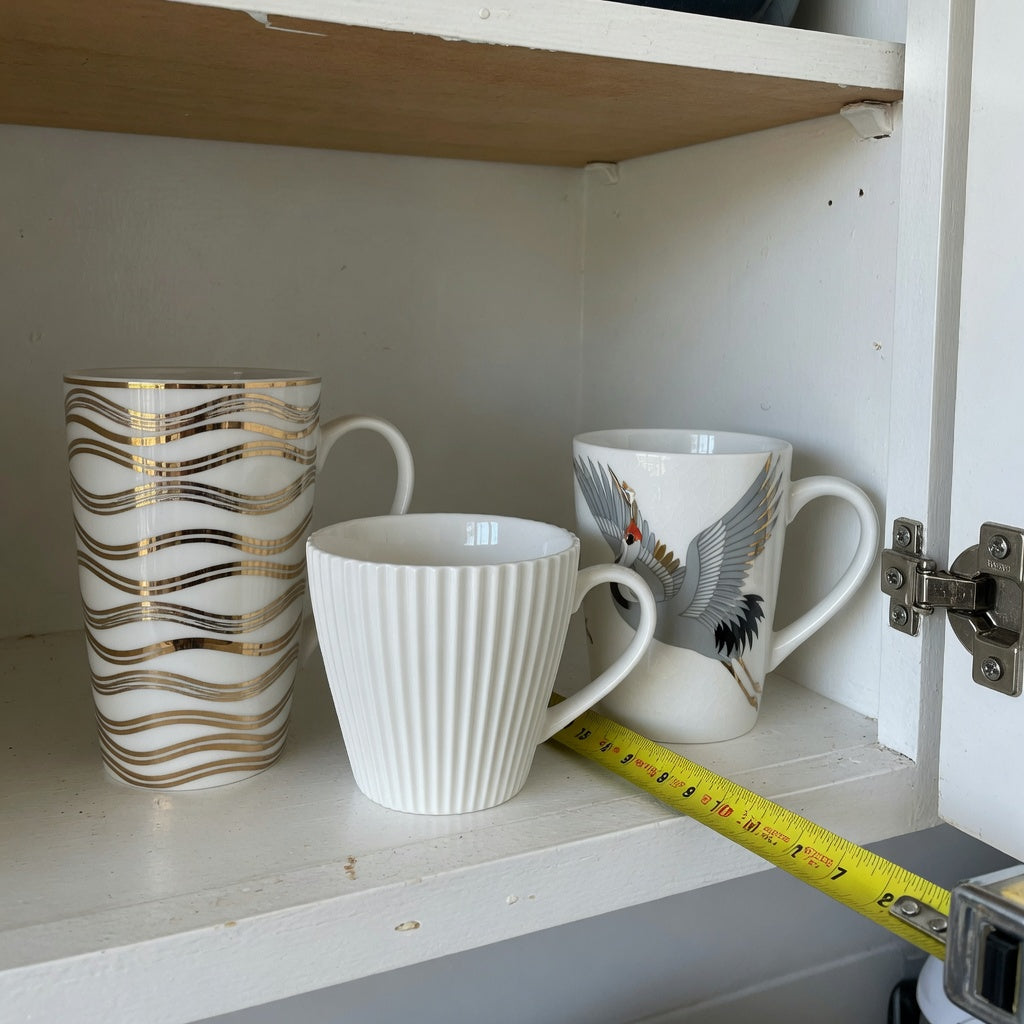
Plain White Ceramic Coffee Mugs Storage Fit Guide by Shape
Compare the visible profiles of the White Golden Waves Tall, Pleated, and Crane mugs against usable cabinet height, depth, and handle room. See what to measure, where each form makes sense, and whe...
Read more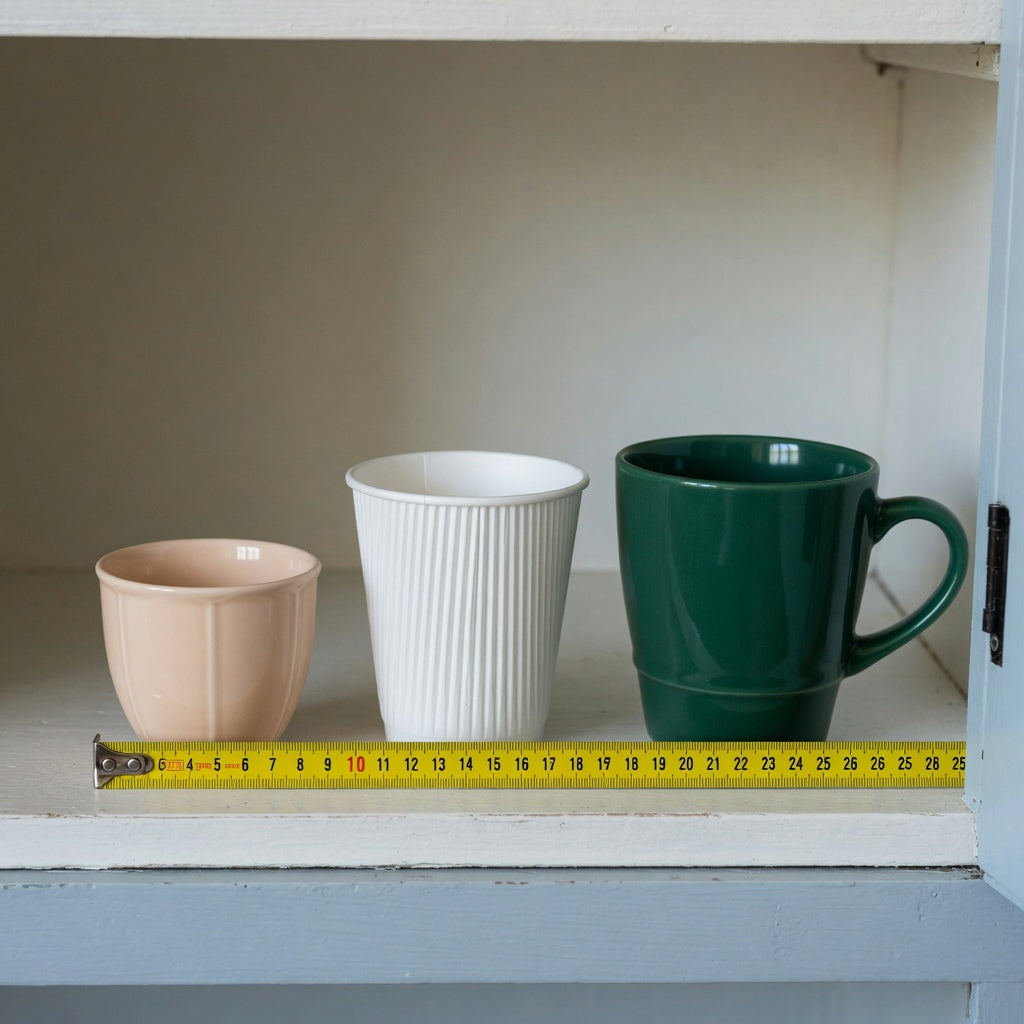
Eggnog Mug Storage Fit Guide: Shapes and Shelf Space
Compare the verified 170 ml, 200 ml, and 270 ml capacities with each mug's visible form. This guide explains how to check handle projection, cabinet depth, shelf height, and removal clearance witho...
Read more
Leave a comment
This site is protected by hCaptcha and the hCaptcha Privacy Policy and Terms of Service apply.