
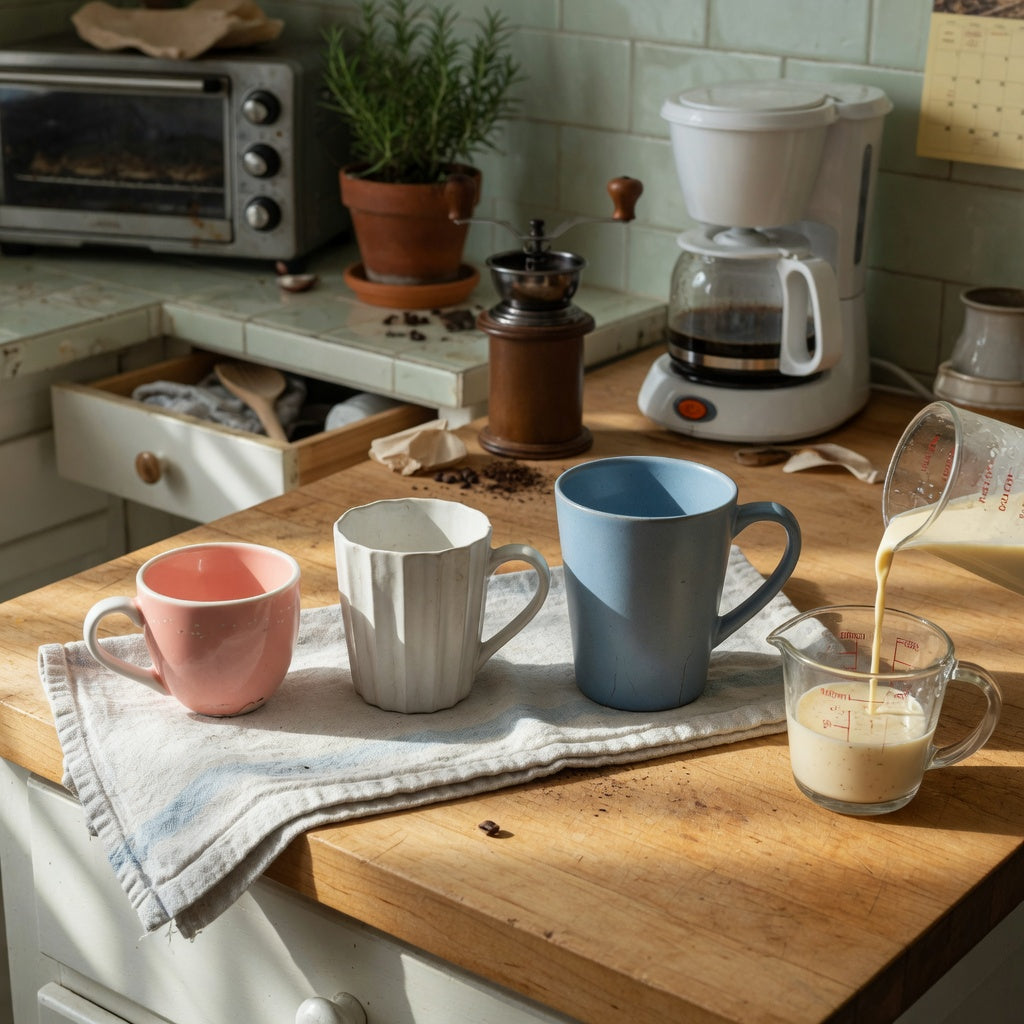
Eggnog Mug Home Coffee Station Product Shortlist Guide: 170-270 ml
Reading time: about 9 minutes
On a crowded kitchen counter, a new mug has to coexist with the brewer, grinder, bean container, spoons, and the cup already in use. The problem we see in our store is rarely a lack of appealing options. It is choosing from a product photo without first checking the usual pour. This eggnog mug home coffee station product shortlist guide reduces that decision to three verified capacities and the visible shape of each option.
Our shortlist covers the Retro at 170 ml, the Pleated at 200 ml, and the Emerald at 270 ml. Capacity does not establish exterior width, height, base diameter, handle projection, or appliance compatibility, so we do not treat it as proof that a mug will fit under a particular brewer. We also do not assume dishwasher or microwave suitability, unusual temperature performance, stackability, included accessories, or included food or drink. Those details must be confirmed on the relevant product page or care information.
Start with the pour: is 170, 200, or 270 ml closest?
Before comparing styles, measure the amount of eggnog you actually serve. We use this step with shoppers because familiar mugs are poor measuring tools: a serving that looks small in one vessel can sit close to the rim in another.
- Pour your normal serving into a measuring cup or graduated jug.
- Record the amount in milliliters before adding foam, spices, or another topping.
- Allow unfilled space for carrying, stirring, and any additions you normally use.
- Compare that practical fill amount with 170 ml, 200 ml, and 270 ml.
The gaps are meaningful. Moving from Retro to Pleated adds 30 ml. Moving from Pleated to Emerald adds 70 ml, while the difference between Retro and Emerald is 100 ml. A listed capacity is not a recommended fill line, so do not choose a 170 ml cup for a measured 170 ml serving if you expect comfortable headspace.
Eggnog mug home coffee station product shortlist guide: three scenarios
Each recommendation below maps a specific serving routine to a product. The choose-or-skip logic is based on verified capacity and visible design, not on unconfirmed performance claims.
Retro 170 ml: for a genuinely small measured serving
The Retro 170 ml coffee tea cup is the smallest-capacity option in this group. Choose it if your measured serving sits comfortably below 170 ml and you want to avoid a mug that looks underfilled during a short pour. Its visible profile has a rounded, retro-leaning character that can work beside traditional coffee accessories without turning the station into a holiday-only display.
Skip the Retro if your usual serving approaches its full listed capacity, if you need room for stirring or toppings, or if you dislike frequent refills. Also, do not assume that the smallest capacity automatically means the smallest external footprint. Confirm the product dimensions before assigning it a tight gap beside a machine or grinder.
Pleated 200 ml: for the middle step and visible texture
The Pleated 200 ml coffee tea cup adds 30 ml over the Retro. Choose it when 170 ml leaves too little headspace but a 270 ml mug would be more vessel than your routine requires. The visible pleated exterior also gives it more surface detail than a plain-sided cup, which helps it look deliberately selected on an otherwise simple station.
Skip the Pleated if you prefer a smooth exterior or want the quickest possible visual check after washing. Textured relief deserves attention because residue or water can be easier to spot in grooves than on a plain wall. That is a care preference, not a claim about dishwasher compatibility; follow the care instructions supplied for the product.
Emerald 270 ml: for the largest pour in this compact group
The Emerald 270 ml coffee tea mug is the largest-capacity option here, adding 70 ml over the Pleated. Choose it if your normal serving needs more room than a 200 ml cup provides or if you deliberately leave extra space for stirring and toppings. Its displayed silhouette has a taller-looking, clean-lined presence, so it makes a stronger visual statement than the two smaller cups.
Skip the Emerald if you normally pour well below 200 ml, since the drink may look lost in the larger vessel. It is also the wrong pick if your vertical or horizontal clearance is tight and you have not confirmed its external dimensions. A 270 ml capacity alone cannot tell you how it will sit beside or beneath an appliance.
Which capacity still makes sense after eggnog season?
A dedicated seasonal mug earns its counter space more easily if the serving size also matches your regular coffee or tea routine. The Retro is the logical candidate for smaller everyday pours. The Pleated occupies the middle position, while the Emerald gives you the most capacity of these three. We recommend choosing according to the drink you make most often, not the largest serving you might prepare once or twice.
All three are poor candidates for a large iced drink if ice cubes and toppings consume most of the available volume. They may also be unsuitable if you want a broad bowl for spooned desserts or a very wide topping layer. In either situation, a larger or differently shaped mug would serve you better.
How do you check shelf clearance without guessing at brewer compatibility?
Capacity and visible shape can create a shortlist, but only measurements can confirm physical fit. Product photography is useful for judging style. It should not be treated as evidence that a mug fits under a particular coffee maker.
- Measure the clear width, depth, and height of the place where the mug will sit.
- Include cabinet lips, shelf brackets, cords, and nearby containers in the available-space check.
- Run through your normal routine and note the room needed to open lids, refill reservoirs, or access a grinder hopper.
- Allow space for the mug handle rather than measuring only the main body.
- Compare those figures with listed product dimensions, or contact the store if a dimension you need is not shown.
We use the same process when helping someone plan a narrow kitchen counter or office coffee corner. It prevents a visually compact mug from being assigned to a space that has never been measured.
Which of the three belongs on your station?
| Option | Capacity position | Visible design cue | Choose when | Skip when |
|---|---|---|---|---|
| Retro, 170 ml | Smallest | Rounded, retro-style profile | Your measured serving fits comfortably below 170 ml | You need more headspace or fewer refills |
| Pleated, 200 ml | Middle | Visible pleated exterior | 170 ml is tight and you want more surface detail | You prefer a smooth exterior or need over 200 ml |
| Emerald, 270 ml | Largest | Taller-looking, clean-lined profile | You need the most serving room in this shortlist | Your pour is small or station clearance is unverified |
These shape notes describe visible presentation only. They are not dimensional, grip, durability, or temperature-retention claims. Use the table to narrow the options, then verify measurements and care details on the linked product page.
What should you inspect at unboxing and before washing?
Our team treats the first inspection as part of buying drinkware, especially when the mug is intended as a gift. A quick check before washing or wrapping can identify visible damage while the product and order details are still close at hand.
- Inspect the rim and body under direct light for chips or hairline cracks. Do not use damaged drinkware.
- Place the empty mug on a flat, dry counter and check whether the base sits steadily.
- Examine the handle and its attachment points, where applicable, for visible separation or damage.
- On the Pleated cup, look along the exterior grooves after washing to make sure no residue remains.
- Read the stated care instructions before using a dishwasher or microwave. Shape and capacity do not establish care compatibility.
- Wash the mug before first use according to its instructions, then dry it before returning it to a shelf or enclosed station.
These checks are simple, but they address common drinkware problems that matter more than decorative styling: rim damage, cracks, an unstable base, or a compromised handle joint.
Who should skip this compact three-mug shortlist?
- Skip all three if your normal measured serving exceeds 270 ml before adding ice or toppings.
- Choose another style if you require a lid, saucer, spoon, or other bundled item that is not explicitly listed with the product.
- Do not use this shortlist to infer fit beneath a specific brewer; verify external dimensions first.
- Choose differently if a confirmed dishwasher or microwave care instruction is a non-negotiable requirement and you cannot verify it.
- Look beyond these options if you need a matched set or a shape that performs a specific serving role not covered here.
If none of these three scenarios matches your station, browse our unique coffee mugs collection and apply the same measured-pour test to a wider selection. A different capacity or silhouette is a better decision than forcing a compact mug into the wrong routine.
Your five-point check before ordering
- Measure your usual eggnog serving in milliliters.
- Leave practical headspace instead of matching the fill to the listed maximum.
- Photograph and measure the intended station space.
- Choose the visible shape you would keep using after the holiday season.
- Verify dimensions, care instructions, and included contents on the product page before checkout.
That is the working purpose of an eggnog mug home coffee station product shortlist guide: reduce three attractive options to the one that matches a real pour, a measured space, and an honest care routine.
Frequently asked questions
What size eggnog mug is best for a home coffee station?
The best size is the smallest option that holds your measured serving with comfortable headspace. In this shortlist, Retro is 170 ml, Pleated is 200 ml, and Emerald is 270 ml. Measure the drink rather than estimating from your current mug.
Will this guide tell me which eggnog mug fits under my coffee maker?
No. This eggnog mug home coffee station product shortlist guide compares verified capacities and visible shapes, but those details cannot establish appliance compatibility. Measure the available height, width, and depth, then compare them with the product's external dimensions.
Is a 170 ml Retro cup too small for eggnog?
It is too small if your usual serving approaches 170 ml before allowing room to carry or stir it. If your measured pour sits comfortably below that amount, the Retro may prevent the underfilled look that can occur in a larger mug.
Are the Retro, Pleated, and Emerald mugs dishwasher safe?
Do not infer dishwasher suitability from the mug name, shape, or capacity. Check the current product listing and supplied care instructions before starting a dishwasher cycle. Use a different option if your required care method cannot be confirmed.
What should I do if none of these three mugs fits my setup?
Measure your normal pour and the clear station space, then compare other shapes in the CoffeifyMug unique coffee mugs collection. Apply the same checks for capacity, headspace, exterior dimensions, care, and included contents rather than forcing one of these three picks.
More from our blog
Read more
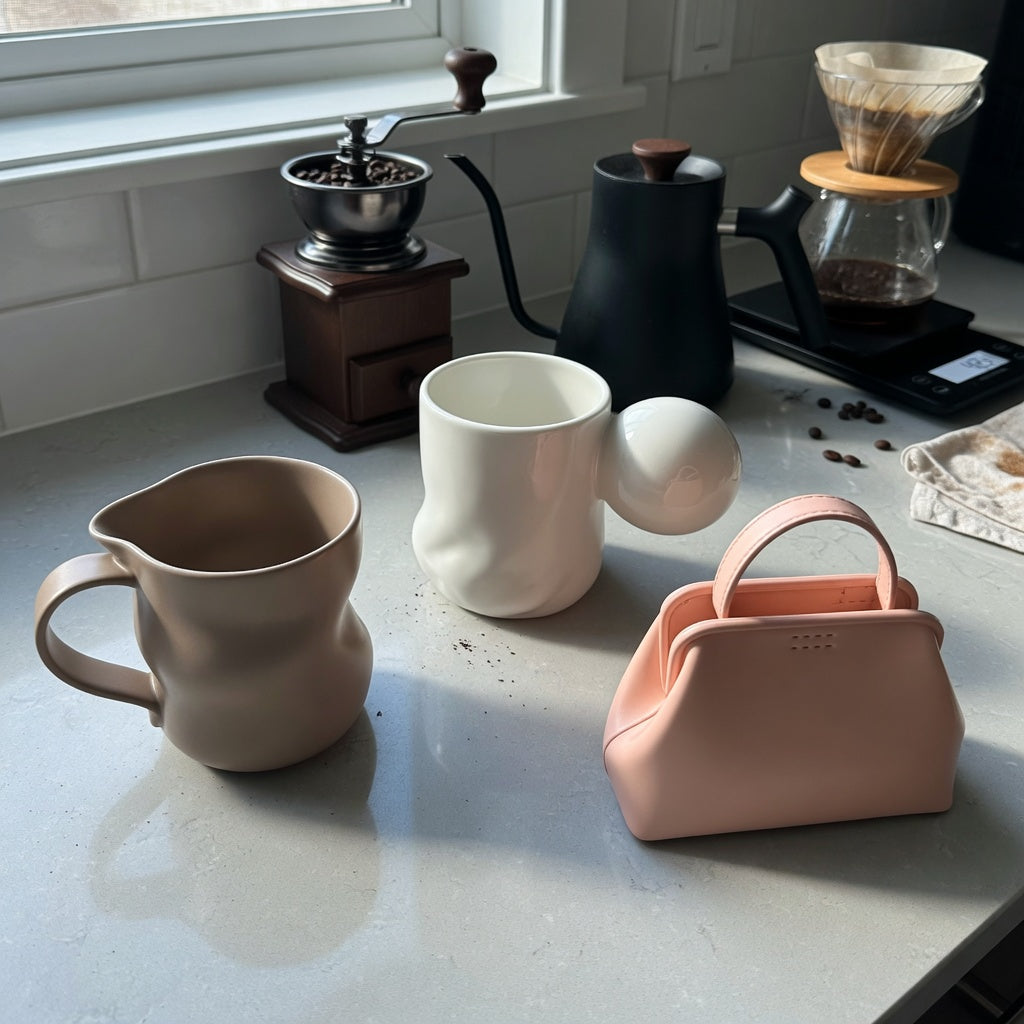
Ceramic Sculptural Mug Home Coffee Station Product Shortlist Guide
Compare three ceramic sculptural mugs using verified 250 ml, 310 ml, and 400 ml capacities, three-dimensional form, counter clearance, and care needs. Each scenario includes a specific reason to ch...
Read more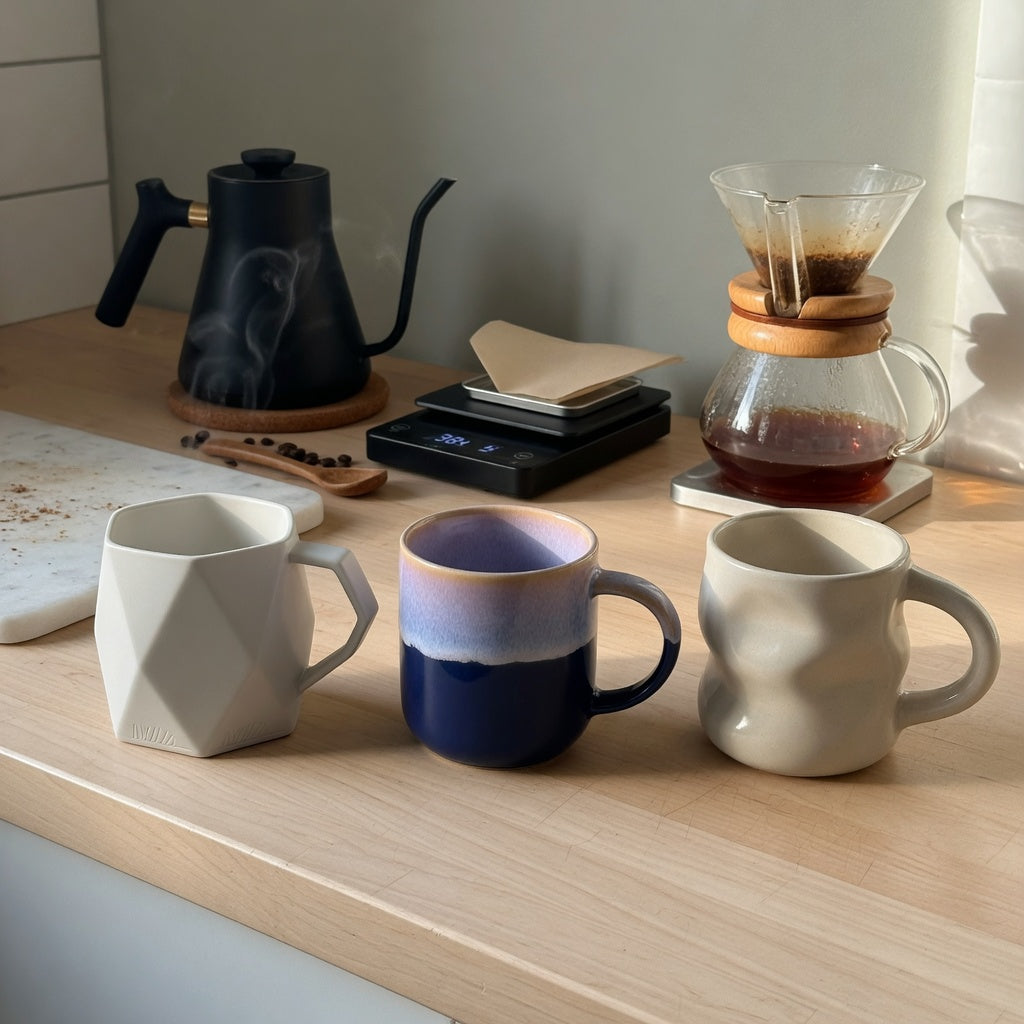
Abstract Coffee Mug Home Coffee Station Product Shortlist Guide: 3 Picks
Compare Rhombus 250 ml, Gradient 400 ml, and The Flow 400 ml by actual drink volume, counter workflow, storage, and finish. Each option includes a clear reason to choose it, skip it, or keep shopping.
Read more
Leave a comment
This site is protected by hCaptcha and the hCaptcha Privacy Policy and Terms of Service apply.