
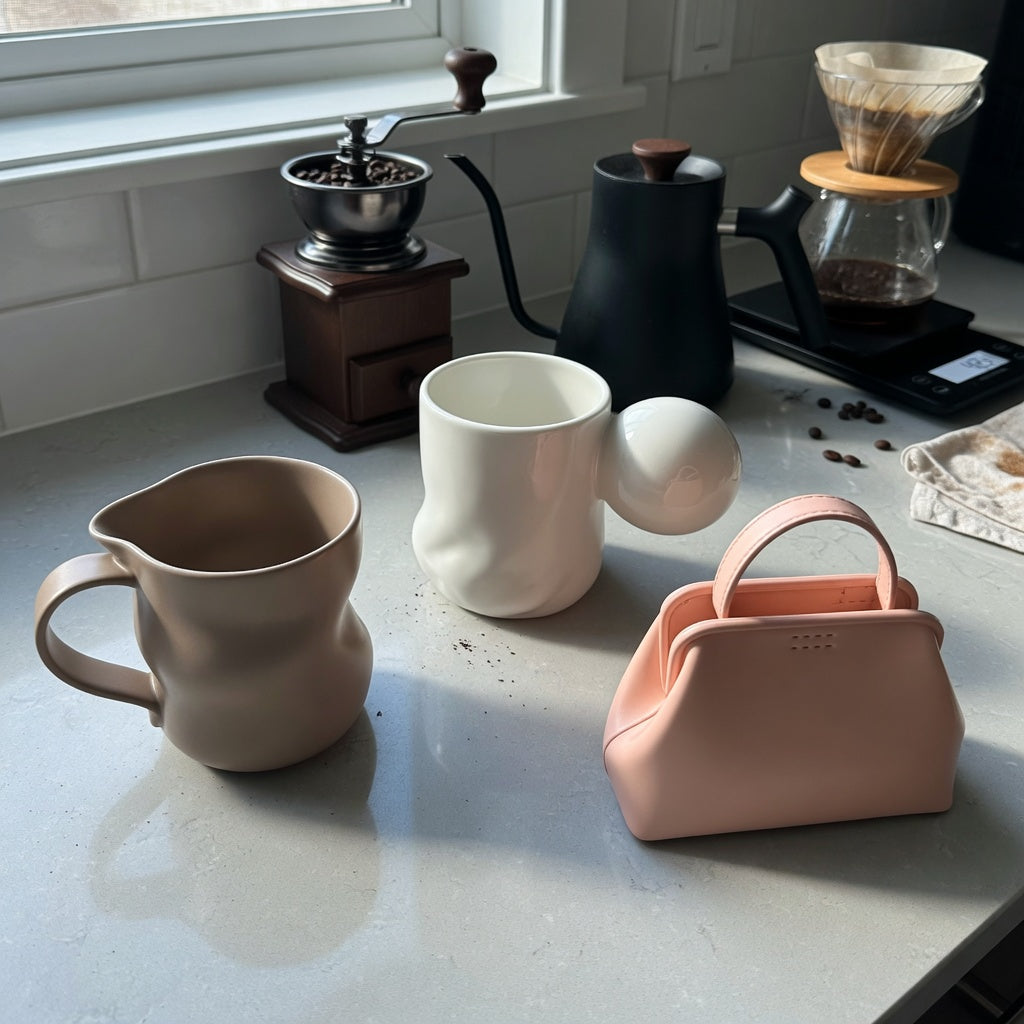
Ceramic Sculptural Mug Home Coffee Station Product Shortlist Guide
Reading time: about 9 minutes
The kettle, grinder, scale, and dripper may all fit on the counter until the mug arrives. Then a projecting form crowds the scale, a tall outline meets the shelf above, or a full serving leaves too little room below the rim. This ceramic sculptural mug home coffee station product shortlist guide compares three options by the details that affect that daily setup: listed capacity, three-dimensional form, counter clearance, and handling.
Because we sell and handle this category in our store, we keep the comparison inside the facts we can support. The Flow has sculptural curves and a 400 ml listed capacity. Handbag has a purse-shaped silhouette and a 310 ml capacity. Ball Handle has a rounded sculptural handle and a 250 ml capacity. Those facts do not establish external dimensions, appliance compatibility, dishwasher safety, production method, or provenance, so we do not use them to make those claims.
Ceramic sculptural mug home coffee station product shortlist guide by serving size
Start with the finished beverage, not the amount of dry coffee in the brewer. Water, brewed coffee, milk, and any other addition all count toward the volume that must fit in the mug. The three listed capacities create a clear first filter:
- The Flow, 400 ml: the largest listed capacity here, 90 ml above Handbag and 150 ml above Ball Handle.
- Handbag, 310 ml: the middle option, 60 ml above Ball Handle and 90 ml below The Flow.
- Ball Handle, 250 ml: the smallest listed capacity in this three-product shortlist.
A listed capacity is not the same as the amount you will comfortably carry. Filling to the lip leaves no practical headspace for walking from the kitchen to a desk or adding milk after brewing. Measure the finished yield of your usual drink in a vessel you already own, then decide how much space you prefer below the rim. A recipe close to a mug's full listed capacity deserves an extra check before ordering.
Capacity also cannot tell you the mug's maximum width, height, base diameter, or clearance under a brewer. Treat milliliters as the serving-size filter. Use separate measurements for the physical station.
Which of the three mugs matches your station routine?
Each recommendation below connects a specific routine to a verified product fact. The skip reasons matter just as much as the reasons to choose.
A larger morning serving with sculptural curves
Reader situation: Your regular drink needs more capacity than the 250 ml and 310 ml choices offer, and the mug remains visible beside the brewing tools. Why it fits: The Flow 400 ml sculptural mug has the highest listed capacity in this group, while its curves make the three-dimensional body the visual feature rather than relying on surface artwork. Choose it when 400 ml is the most suitable starting point for your recipe and you deliberately want a curved form. Skip it if you normally drink a much smaller serving, need a conventional handle shape, or cannot confirm that its external measurements fit your available space.
A moderate serving that stays on display
Reader situation: Your coffee station is part of an open kitchen, and you want a recognizable object without moving to the largest capacity in the shortlist. Why it fits: the Handbag 310 ml ceramic mug combines the middle listed capacity with a purse-shaped silhouette. Its identity comes from form, not printed decoration. Choose it when 310 ml matches your finished drink and the purse profile suits the room. Skip it if your recipe needs more volume plus headspace, if dense cabinet stacking is essential, or if you prefer conventional drinkware that visually recedes into the setup.
A shorter serving with a rounded handle
Reader situation: You prepare a smaller coffee or tea and may carry it from the kitchen to a home-office desk. Why it fits: the Ball Handled 250 ml coffee and tea mug pairs the lowest listed capacity here with a rounded sculptural handle. Choose it when 250 ml covers your finished serving and that handle form is specifically what you want to hold. Skip it if your drink regularly exceeds 250 ml, you want a traditional handle, or a protruding handle conflicts with the place where the mug will sit. We do not describe it as externally compact without dimensions; lower capacity alone does not prove a smaller footprint.
| Option | Listed capacity | Verified form | Reason to choose | Reason to skip |
|---|---|---|---|---|
| The Flow | 400 ml | Sculptural curves | Largest serving range in this shortlist | Your drink is smaller or the dimensions remain unverified |
| Handbag | 310 ml | Purse-shaped silhouette | Moderate volume with a display-focused form | You need more capacity or prioritize dense storage |
| Ball Handle | 250 ml | Rounded sculptural handle | Shorter serving with a distinct handle form | You need more volume or prefer another grip style |
If none of those three combinations matches your routine, compare other forms in our unique coffee mugs collection instead of forcing the closest option to work.
How much counter clearance should you measure before checkout?
A mug can fit on an empty counter and still interfere with the motions of brewing. We use a simple clearance check that accounts for the whole object, not just the base:
- Measure the available width at the mug's normal resting position, including room for any handle or projecting contour.
- Measure the depth from the wall or backsplash to the front edge of the counter.
- Measure vertical clearance to shelves, brewer components, or anything stored above the mug.
- Leave a clear path for lifting the filled mug without passing through a dripper, scale, kettle cord, or cabinet handle.
Set your current mug in the intended spot and mark the available boundary with removable tape. That quick mock-up reveals more than capacity alone. If the mug must sit below an automatic brewer, inside a dishwasher rack, on a cup warmer, or in a vehicle holder, compare the actual product dimensions with that equipment before buying. The verified facts in this shortlist do not establish compatibility with those appliances or accessories.
How should sculptural ceramic sit in the sink and drying rack?
Ceramic is a material description, not a complete care rating. A sculptural contour can also create extra contact points against a sink, another mug, or a rack tine. Product-specific instructions should always take priority, but these conservative steps reduce avoidable handling damage:
- Inspect the rim, base, body, and handle area before first use, then wash according to the product instructions.
- If dishwasher suitability is not explicitly stated, use a soft sponge and hand wash rather than assuming that ceramic automatically means dishwasher safe.
- If dishwasher use is approved, position the mug so it cannot knock against another item during the cycle and confirm that the spray arm clears it.
- Dry the mug with space around its projecting contours. Do not wedge a sculptural handle or raised section under the weight of other dishes.
- Avoid sudden extreme temperature changes unless the product instructions specifically support that use. Do not infer microwave suitability from the material or shape.
Ceramic can chip when it strikes a hard edge. The rim and handle-to-body area deserve particular attention because damage there affects drinking or lifting. Stop using a mug if you find a chip or crack and contact our store about the next appropriate step.
What should you inspect during an unboxing or before gifting?
A sculptural mug often makes its strongest impression as soon as the box opens, but shape should not distract from a basic inspection. Place the clean, dry mug on a level counter and check the following before adding it to the station:
- The drinking rim is smooth and free from chips.
- The body shows no visible hairline crack under good light.
- The base sits steadily on a level, dry surface.
- The rounded handle on Ball Handle and the raised contours on any sculptural form show no impact damage.
For a gift, match the recipient's normal drink volume before choosing the silhouette. The Flow is the 400 ml option, Handbag is 310 ml, and Ball Handle is 250 ml. A memorable shape does not compensate for a serving size the recipient will not use.
When is a conventional mug the better station choice?
Skip this shortlist if your first priority is tightly stacked cabinet storage, a standardized travel lid, a known machine-clearance requirement, or a plain shape that disappears visually. A conventional straight-sided mug may also be easier to shortlist when every millimeter of counter space is fixed. For tall iced drinks, select by verified interior volume, opening, height, and straw clearance rather than assuming that an exterior sculptural silhouette will suit the ice.
These limitations do not make sculptural mugs impractical. They define the buyer they serve: someone who wants three-dimensional ceramic form to remain part of the daily coffee station and is willing to confirm space, serving volume, and care before checkout.
Your five-minute product shortlist before checkout
- Record the milliliters in your normal finished drink, including milk or added water.
- Add the headspace you need for stirring and carrying.
- Measure the mug location's width, depth, height, and lifting path.
- Choose among sculptural curves, a purse-shaped silhouette, and a rounded sculptural handle.
- Read the current product details and care guidance without inferring appliance compatibility.
Use those answers to keep no more than two candidates. If 400 ml and curves match, open The Flow. If 310 ml and the purse silhouette match, open Handbag. If 250 ml and a rounded handle match, open Ball Handle. That leaves you comparing products that can plausibly serve the station rather than choosing by appearance alone.
Frequently asked questions
What capacity is best for a ceramic sculptural mug on a home coffee station?
The best capacity is your finished drink volume plus the headspace you prefer. The Flow is listed at 400 ml, Handbag at 310 ml, and Ball Handle at 250 ml. Measure a drink you already make instead of selecting the largest number by default.
Will these sculptural mugs fit under my coffee machine?
Capacity does not establish mug height, width, or clearance beneath a machine. Measure the available opening and compare it with the current product dimensions or ask our store before ordering. We do not claim compatibility with a brewer based only on the mug's volume.
Are ceramic sculptural mugs dishwasher and microwave safe?
Do not assume dishwasher or microwave suitability from the word ceramic. Follow the instructions supplied on the current product page or with the mug. If dishwasher status is unclear, hand washing with a soft sponge is the conservative choice.
Which sculptural mug should I shortlist for a small home coffee station?
The ceramic sculptural mug home coffee station product shortlist guide starts with serving size, then requires a separate clearance check. Ball Handle has the lowest listed capacity at 250 ml, but that does not prove it has the smallest external footprint. Measure the full space, including room for its rounded handle, before treating it as the small-station choice.
What should I do if none of these three forms fits my setup?
Do not compromise on a capacity or shape you already know will be inconvenient. Take your serving and clearance measurements to the unique coffee mugs collection, then compare only the alternatives that meet both limits.
More from our blog
Read more
Coffee Mugs Unique Shape Home Coffee Station: Practical Buying Checklist
A measurement-led checklist for matching handbag, rhombus, and ball-handled mugs to a home coffee station. Compare footprint, grip, listed capacity, care, storage, and gift fit without assuming bre...
Read more
Eggnog Mug Home Coffee Station Product Shortlist Guide: 170-270 ml
Compare Retro 170 ml, Pleated 200 ml, and Emerald 270 ml mugs for a home coffee station. Each option includes a measured-pour scenario, visible-shape trade-off, and a clear reason to choose or skip...
Read more
Leave a comment
This site is protected by hCaptcha and the hCaptcha Privacy Policy and Terms of Service apply.