
Abstract Coffee Mug Home Coffee Station Product Shortlist Guide: 3 Picks
Reading time: about 9 minutes
A narrow counter can look orderly with a kettle, grinder, and scale, then become awkward as soon as a mug takes the only clear landing spot. We built this abstract coffee mug home coffee station product shortlist guide around that problem: matching capacity and visual form to the drink you actually make, the equipment already on your counter, and the storage available after breakfast.
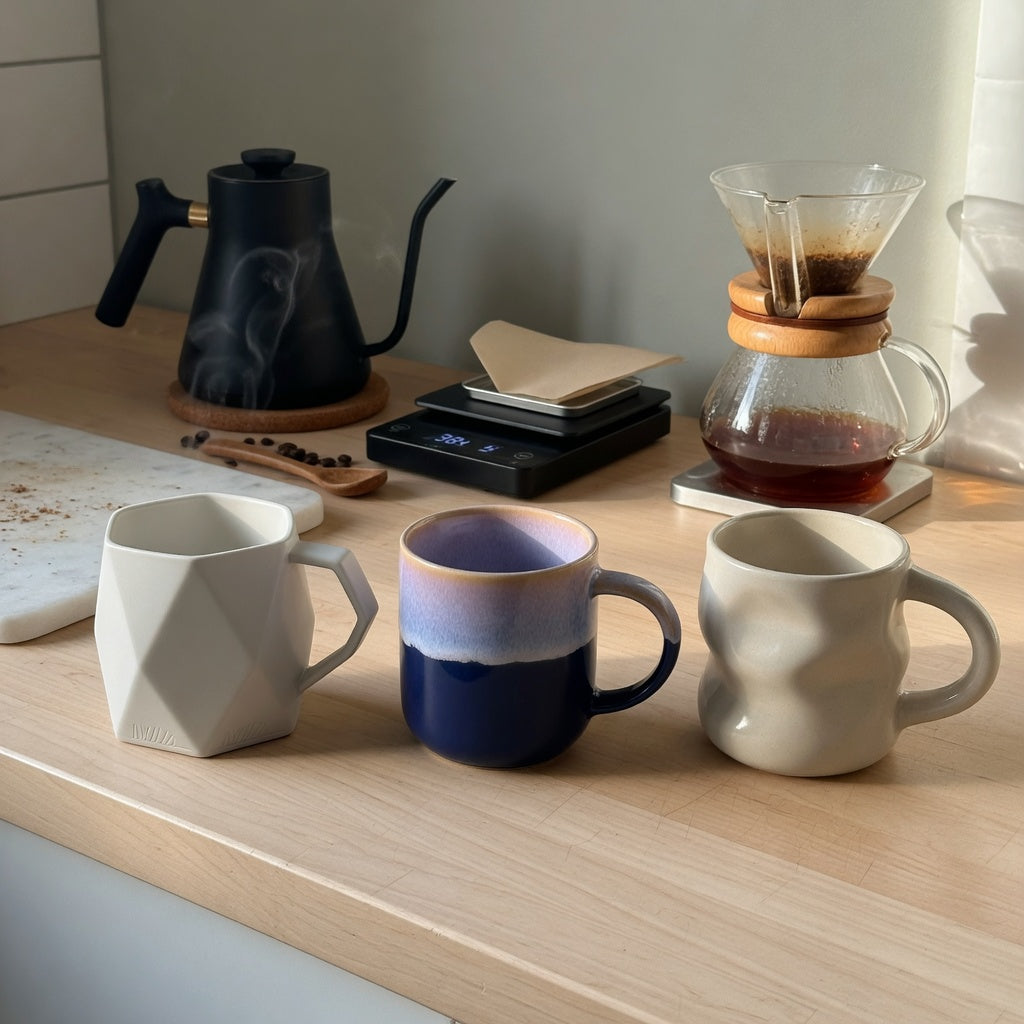
Our shortlist is deliberately narrow. The verified catalog facts are the Rhombus at 250 ml with a geometric form, the Gradient at 400 ml with a color-transition finish, and The Flow at 400 ml with sculptural curves. We use abstract as a shopper's style lens for geometry, shifting color, and curves. It is not a claim about creator attribution, design provenance, edition status, or a named art movement.
What does this abstract coffee mug home coffee station product shortlist guide compare?
In our store, we find that the most useful shortlist starts with the routine rather than the product photo. Capacity matters, but it does not prove that a mug will fit under a brewer, beside a scale, or inside a particular cabinet. Those checks require current product dimensions and measurements from your own setup.
- Usual drink volume: Is the finished serving comfortably below 250 ml, or does it need the room offered by a 400 ml mug?
- Visual role: Should the mug contribute angular geometry, a color transition, or sculptural curves?
- Working clearance: Is there enough space for the mug while the kettle, scale, and brewer are in their normal positions?
- Care routine: Do the current product instructions match the way you normally wash and store drinkware?
These variables give each mug a distinct job. They also create honest reasons to skip an option, even if its appearance initially catches your eye.
250 ml or 400 ml: start with the liquid, not the mug photo
The Rhombus capacity of 250 ml is about 8.5 US fluid ounces. The 400 ml capacities of Gradient and The Flow are about 13.5 US fluid ounces. Treat those conversions as comparison figures, not suggested fill lines; a drink that reaches the stated capacity may leave too little room below the rim for comfortable carrying.
Drink names are unreliable sizing shortcuts. One person's pour-over, Americano, or tea serving can be much larger than another's. We recommend measuring one normal serving before ordering:
- Prepare the drink exactly as you make it on an ordinary morning, including milk or added water.
- Measure the finished liquid rather than relying on the brewer's labeled batch size.
- Choose a mug with capacity above that measured amount so the drink is not sitting at the rim.
If your finished serving is clearly below 250 ml, all three remain possible on volume alone. If it approaches or exceeds 250 ml, the two 400 ml choices make more practical sense. A serving close to 400 ml calls for a larger option outside this shortlist.
Who should shortlist Rhombus at 250 ml?
The Rhombus 250 ml geometric mug is the focused choice for someone who makes smaller servings and wants angles to provide the station's main visual detail. Its verified advantage in this comparison is the lower capacity paired with a geometric form. We do not treat 250 ml as proof of a particular external footprint, so check the current dimensions before planning a tight counter fit.
- Choose it: Your measured drink is comfortably below 250 ml, and geometric form suits the surrounding kettle, trays, or shelving.
- Skip it: Your usual recipe is close to 250 ml, you add a substantial amount of milk, or frequent refills would interrupt the routine.
- Verify before ordering: Compare the current width, depth, and height with the exact landing area beside your equipment.
For a solo station built around a smaller daily drink, the Rhombus product page is the direct next step. A shopper trying to fit a larger recipe into it should move to one of the 400 ml options instead.
Who should shortlist Gradient at 400 ml?
The Gradient 400 ml color-transition mug fits a station where a larger serving and visible color are both priorities. The finish gives it a different role from a solid-color mug: it can become the color focal point without requiring a more sculptural profile.
- Choose it: Your measured serving needs more than the Rhombus offers, and a color-transition finish works with the station's surrounding colors.
- Skip it: You prefer a uniform solid-color set, need an exact shade match, or usually make a much smaller drink that does not benefit from 400 ml of capacity.
- Verify before ordering: Review the current product images and care details. Screens and kitchen lighting can affect how a color transition appears.
This is the practical next step for the shopper who wants the larger capacity and sees color as the deciding variable. If the capacity is right but the finish is not, compare The Flow before leaving the shortlist.
Who should shortlist The Flow at 400 ml?
The The Flow 400 ml sculptural mug is the form-led alternative to Gradient. Both have the same verified capacity, so the useful distinction is visual: The Flow contributes sculptural curves, while Gradient contributes a color-transition finish.
- Choose it: Your serving fits within 400 ml, and curved form matters more than a shifting exterior color.
- Skip it: You want every mug to line up like a simple straight-sided set or your cabinet arrangement depends on confirmed stacking behavior.
- Verify before ordering: Check current dimensions and storage guidance rather than assuming that sculptural curves will nest or stack in a particular way.
Curves are not automatic proof of better grip or ergonomics, so we keep the recommendation centered on capacity and style. The Flow product page is the next step for a shopper who wants a larger serving and a visibly sculptural station piece.
Three products, three reasons to choose, and three reasons to skip
| Mug | Verified capacity | Verified style cue | Shortlist it for | Skip or verify if |
|---|---|---|---|---|
| Rhombus | 250 ml | Geometric form | Smaller measured servings and angular visual detail | Your drink approaches 250 ml or you are assuming a compact footprint |
| Gradient | 400 ml | Color-transition finish | Larger servings with color as the focal point | You want a solid, exactly matched exterior color |
| The Flow | 400 ml | Sculptural curves | Larger servings with curved form as the focal point | Your storage requires confirmed straight alignment or stacking |
A useful abstract coffee mug home coffee station product shortlist guide does not force one winner for every counter. It removes the options that conflict with your serving size, storage, or visual priority. If none of these three survives that test, continue through our unique coffee mugs collection instead of accepting a poor fit.
Will it fit beside a scale and under a shelf?
Capacity is a volume measurement, not an appliance-compatibility claim. For direct brewing into a mug, the relevant number is the combined height of the scale, mug, and brewer, plus enough hand clearance to place and remove each part. Product photography cannot establish that clearance for your kitchen.
- Put the kettle, grinder, scale, and brewer in the positions used during an actual brew.
- Measure the remaining counter width and depth, then measure the vertical clearance below shelves or cabinets.
- If you brew directly into the mug, compare the full equipment stack with that vertical limit.
- Check cabinet depth and shelf height separately. A mug can work on the counter and still be inconvenient to store.
We ask shoppers to record these numbers before comparing current product dimensions. Do not plan a zero-clearance fit. A little working room matters when the counter is wet, the kettle is hot, or another person is reaching for the grinder.
What should happen at unboxing and before a dishwasher cycle?
Our first handling check happens while the mug is clean, dry, and easy to inspect. Set it on a flat, dry surface and look across the rim, base, and body under side light. This makes obvious chips, hairline cracks, transit damage, or an uneven resting base easier to spot before the first drink.
- Inspect before washing: If the mug is chipped, cracked, or rocks unexpectedly on a known-flat surface, set it aside and contact the store before use.
- Confirm the care directions: A geometric shape, color-transition finish, or sculptural profile does not establish material, dishwasher suitability, or microwave suitability.
- Use the approved cleaning method: Follow the current product page or included care information. A prompt rinse helps keep coffee or tea residue from drying before the approved wash.
- Dry the base: Wipe away water before returning the mug to a wood tray, shelf, or coffee-station mat.
For a gift, complete the same inspection before wrapping and keep the product identification and care information with the mug. The recipient then knows which cleaning instructions apply instead of guessing from appearance.
Which mug belongs in each coffee-station scenario?
- Smaller daily serving, geometry first: Start with Rhombus. It fits the volume requirement when your finished drink stays comfortably below 250 ml; skip it if added milk or water pushes the recipe near that limit.
- Larger daily serving, color first: Start with Gradient. Its 400 ml capacity and color-transition finish answer both needs; skip it if a solid, uniform exterior is part of the station plan.
- Larger daily serving, curved form first: Start with The Flow. It keeps the 400 ml capacity while making sculptural curves the deciding detail; skip it if strict alignment or verified stacking is essential.
If you need a capacity above 400 ml, precise published compatibility with a specific brewer, or a uniform straight-sided set, a different mug style may suit the station better. That is a stronger buying decision than choosing an abstract form and trying to force it into the routine.
Frequently asked questions
Which abstract coffee mug is best for a small home coffee station?
This abstract coffee mug home coffee station product shortlist guide uses Rhombus as the starting point for smaller servings because its verified capacity is 250 ml. Capacity alone does not prove a small external footprint, so compare the current product dimensions with your available counter space. Choose Gradient or The Flow if the measured drink needs more than 250 ml.
Is a 250 ml mug large enough for pour-over coffee?
It is large enough only when your finished pour-over is comfortably below 250 ml. Measure the brewed drink after adding any milk or water, and avoid choosing a mug that would place the liquid close to the rim. A larger recipe points to one of the 400 ml options.
What is the difference between Gradient and The Flow if both hold 400 ml?
The verified difference is their style treatment: Gradient has a color-transition finish, while The Flow has sculptural curves. Choose Gradient when color is the priority and The Flow when curved form is the priority.
Can I assume these abstract mugs are dishwasher or microwave safe?
No. Appearance and capacity do not establish material or appliance-care suitability. Check the current product page or included care directions before the first dishwasher cycle or microwave use, and follow those instructions.
What should I check before ordering a mug for my coffee station?
Write down your finished drink volume, available counter width and depth, vertical brewing clearance, cabinet space, and preferred care method. Then choose geometry, color transition, or sculptural curves as the visual priority. If none of the three products matches all five practical checks, return to the unique coffee mugs collection and keep the same checklist beside you.
More from our blog
Read more
Eggnog Mug Home Coffee Station Product Shortlist Guide: 170-270 ml
Compare Retro 170 ml, Pleated 200 ml, and Emerald 270 ml mugs for a home coffee station. Each option includes a measured-pour scenario, visible-shape trade-off, and a clear reason to choose or skip...
Read more
Unique Pottery Coffee Mugs Home Coffee Station Product Shortlist Guide
Compare the Rhombus, Mountain Sea, and Golden Waves Kio mugs by counter style, visual role, space, and care expectations. Each option includes a reason to choose it, a reason to skip it, and a prac...
Read more
Leave a comment
This site is protected by hCaptcha and the hCaptcha Privacy Policy and Terms of Service apply.