

Decaf Coffee Cup Shared Household Product Shortlist Guide: 3 Sizes
Reading time: about 10 minutes
At a shared kitchen counter, the cup mismatch often appears before anyone discusses color or style. One person pours a small serving into a large mug and leaves part of it behind. Another fills the same mug, takes it to a desk, and comes back for more. By the next morning, everyone's preferred cup is somewhere else. This decaf coffee cup shared household product shortlist guide narrows the decision to three verified capacities: the Retro at 170 ml, the Pleated at 200 ml, and the Emerald at 270 ml.
In our store, we approach shared-household cup selection by identifying serving habits first. We do not assume that everyone needs the same size, and this shortlist is not a recommendation to buy all three as a matching set. One household may need a single middle-size option; another may be better served by separate small and larger cups. For factual restraint, capacity is the confirmed specification used here. Check each current product page for material, external dimensions, and care instructions rather than assuming those details from appearance.
Decaf coffee cup shared household product shortlist guide: which capacity fits whom?
The useful differences are measurable. The Pleated holds 30 ml more than the Retro. The Emerald holds 70 ml more than the Pleated and 100 ml more than the Retro. Those steps are large enough to affect serving routines without requiring a sprawling list of nearly identical options.
| Household serving pattern | Likely shortlist option | Why it fits | Reason to skip it |
|---|---|---|---|
| One person consistently chooses a small serving | Retro, 170 ml | It is the smallest confirmed capacity and suits a deliberately lighter pour. | It can create immediate refill trips for someone whose normal serving is closer to 250 or 270 ml. |
| Most servings fall near the middle | Pleated, 200 ml | It provides a 30 ml step above the Retro without moving to the largest option. | It may be an unnecessary compromise if household preferences are clearly split between small and large servings. |
| One person regularly wants the largest serving in this range | Emerald, 270 ml | It holds 100 ml more than the Retro in a single fill. | It is not the practical choice for someone who normally stops near 170 ml or wants the lightest filled cup. |
Before choosing, measure three normal pours with a kitchen measuring jug. Do this during the routine you are trying to improve, not during a staged test when everyone pours differently. A three-morning record usually reveals more than asking each person which mug size they think they prefer.
Who should choose the Retro 170 ml cup?
The Retro coffee tea cup belongs on the shortlist when one household member repeatedly serves an amount close to 170 ml. This may be the person who has a quick cup at the kitchen counter or carries a modest serving to a home office and finishes it without an immediate refill.
- Reader situation: Larger cups regularly return to the sink with part of the serving untouched, or the user intentionally pours below 200 ml.
- Why it fits: At 170 ml, the Retro is the smallest verified option in this comparison. It gives that person a clearly assigned capacity instead of making them use a larger household mug by default.
- Reason to skip it: Someone who normally wants 200 to 270 ml will have to reduce the serving or refill. That defeats the point of creating an easier shared routine.
- Product next step: Open the Retro product page and compare the current handle photos, material details, and external dimensions with the user's existing favorite cup.
Do not choose the Retro solely because the intended user has smaller hands. Cup capacity does not establish handle-opening size, finger clearance, or total filled weight. A smaller-capacity cup can still have a handle shape that does not match a particular grip, so handle comfort needs its own check.
When is the Pleated 200 ml the useful middle choice?
The Pleated coffee tea cup is the most direct option when household servings cluster near 200 ml. It is only 30 ml above the Retro, so it makes sense for closely grouped preferences rather than a household with one very small pour and one much larger pour.
- Reader situation: Two people serve similar amounts, or a single shared cup tends to be filled somewhere around the 200 ml point.
- Why it fits: Its confirmed 200 ml capacity occupies the practical middle of this three-product shortlist. It can remove the debate between the smallest and largest choices when neither reflects the household's actual pours.
- Reason to skip it: A middle capacity does not solve a pronounced split. If one person consistently wants 170 ml and another wants 270 ml, both may view 200 ml as the wrong compromise.
- Product next step: Review the Pleated product listing and confirm that its current handle, material, care guidance, and outside measurements suit the shared shelf and intended users.
We often caution shoppers against selecting a middle size just because it appears broadly versatile. The strongest evidence is still what happens at the counter. If a 200 ml test pour feels right for both people, the Pleated can simplify the cupboard. If both adjust the test serving immediately, choose separate capacities instead.
Who is the Emerald 270 ml mug meant to serve?
The Emerald coffee tea mug is the largest verified option in this shortlist at 270 ml. It fits the household member who regularly serves more than the Retro or Pleated can hold and would otherwise return for a second pour.
- Reader situation: A user regularly fills a smaller cup and tops it up immediately, or their measured serving is already close to 270 ml.
- Why it fits: The Emerald holds 70 ml more than the Pleated and 100 ml more than the Retro. That extra capacity is meaningful for a person whose preferred serving already falls at the upper end of this range.
- Reason to skip it: It is not well matched to deliberately small servings. A full 270 ml cup also places more liquid in the hand than a full 170 ml cup, while the actual total weight depends on the product's material and construction.
- Product next step: Check the Emerald product page for current dimensions and handle details, especially if cabinet clearance, grip strength, or filled weight is a concern.
Do not assume the largest capacity has the roomiest or most comfortable handle. Capacity describes what the vessel holds, not how many fingers fit inside the handle or where the thumb rests. If the user carries a cup from the kitchen to a sofa or office desk, grip stability deserves as much attention as volume.
How can different hand sizes test handle comfort?
From handling cup comparisons in our store, we know an empty cup can feel comfortable and still become awkward after filling. Handle comfort is personal, so we avoid calling any one shape universally ergonomic. Instead, use a favorite cup already in the household as a grip reference.
- Fill the current cup to the person's normal serving level and note whether they use one, two, or three fingers inside the handle.
- Check whether the knuckles touch the cup body, the handle presses into a finger joint, or the thumb has to brace the rim.
- Carry the filled cup ten normal steps from the counter toward the table or desk. Notice wrist tilt and whether the user changes grip halfway.
- Measure the current handle's inside height and width in millimetres. Compare those numbers only if corresponding dimensions are provided on the product listing.
- Repeat the test with the household's least comfortable cup. The contrast helps identify a handle opening or grip position to avoid.
A decaf coffee cup shared household product shortlist guide can narrow capacity, but it cannot make every hand respond to a handle in the same way. If exact handle dimensions are not listed, acknowledge that uncertainty and use the available product photos, overall dimensions, and store policies to make a measured decision.
What should you check for storage, care, and arrival condition?
Shared kitchens expose cups to crowded shelves, busy counters, and frequent washing. Those conditions make external fit and care compatibility relevant, even though they are not verified comparison claims in this capacity-based shortlist.
- Cabinet fit: Measure the shelf height and the space between neighboring items. Capacity alone does not reveal a cup's height, rim diameter, or handle projection.
- Appliance compatibility: Look for explicit dishwasher and microwave instructions on the current product page or packaging. Do not infer compatibility from color, finish, or assumed material.
- Washing routine: If care instructions call for hand washing, decide honestly whether every household member will follow them. A different cup style is more practical if the required care will be ignored.
- Unboxing inspection: Before washing or using any rigid cup, inspect the rim and handle attachment points for chips, hairline cracks, rough edges, or movement.
- Counter stability: Set the empty cup on a clean, flat surface and check for rocking. Do not use a cup with visible structural damage or an unstable base.
These checks matter for gifts too. A visually appealing cup can still be the wrong choice if the recipient's usual serving, cabinet, or washing routine is unknown. For a shared-household gift, capacity is a better starting question than asking which design looks most decorative.
Which one-cup or two-cup shortlist matches your household?
These are separate product choices, not a required set. Start with the smallest number of options that resolves the household's actual serving mismatch.
- Everyone pours close to 170 ml: Shortlist the Retro. There is no functional reason to add a larger capacity solely for variety.
- Everyone clusters near 200 ml: Start with the Pleated and verify its handle and care details before considering another size.
- One small pour and one large pour: Compare the Retro and Emerald as two distinct personal choices. The 100 ml difference gives each person a clear default.
- One middle pour and one larger pour: Compare the Pleated and Emerald. Skip the Retro unless someone has measured a genuine need for 170 ml.
- Serving habits change from day to day: Test the Pleated first only if most measured pours remain near 200 ml. Otherwise, separate capacities will be more predictable.
Once the capacity decision is clear, browse our unique coffee mugs collection to compare available designs. Keep function ahead of appearance: record three normal pours, select the nearest capacity, check handle fit, confirm storage dimensions, and read the current care guidance before adding a cup to the cart.
Frequently asked questions
Can a decaf coffee cup shared household product shortlist guide work if everyone pours a different amount?
Yes. The method does not require everyone to use one size or to buy all three options. Measure each person's normal serving, then shortlist only the 170 ml, 200 ml, or 270 ml capacity that closely matches a recurring preference.
Is a 170 ml coffee cup too small for everyday household use?
It is too small for someone who routinely serves more than 170 ml and does not want to refill. It can be practical for a person whose measured pour already falls near that amount. The decision should come from actual serving volume, not from whether 170 ml sounds small on paper.
Is the 200 ml Pleated cup the safest choice for two people?
Only if both people's servings cluster near 200 ml. It is not automatically the safest choice when one person prefers a distinctly smaller serving and the other prefers a larger one. In that situation, choosing two individual capacities is more practical than forcing a midpoint.
Does the 270 ml Emerald automatically have a more comfortable handle?
No. The 270 ml figure confirms capacity, not handle-opening dimensions or grip comfort. Compare product details with a cup the intended user already handles comfortably, and remember that a full 270 ml vessel carries 100 ml more liquid than a full 170 ml option.
What should I do before adding a shared-household cup to the cart?
Measure three real servings, identify the nearest verified capacity, and test each user's preferred grip with an existing cup. Then confirm material, external dimensions, and care instructions on the linked product page before comparing the final style in the CoffeifyMug unique coffee mugs collection.
More from our blog
Read more

Hot Toddy Mug First Time Buyer Practical Purchase Checklist: 7 Checks
Measure your usual pour, verify handle clearance, and compare The Gradient and The Flow at 400 ml with The Rock at 480 ml. This checklist also flags ceramic care details and listing unknowns to res...
Read more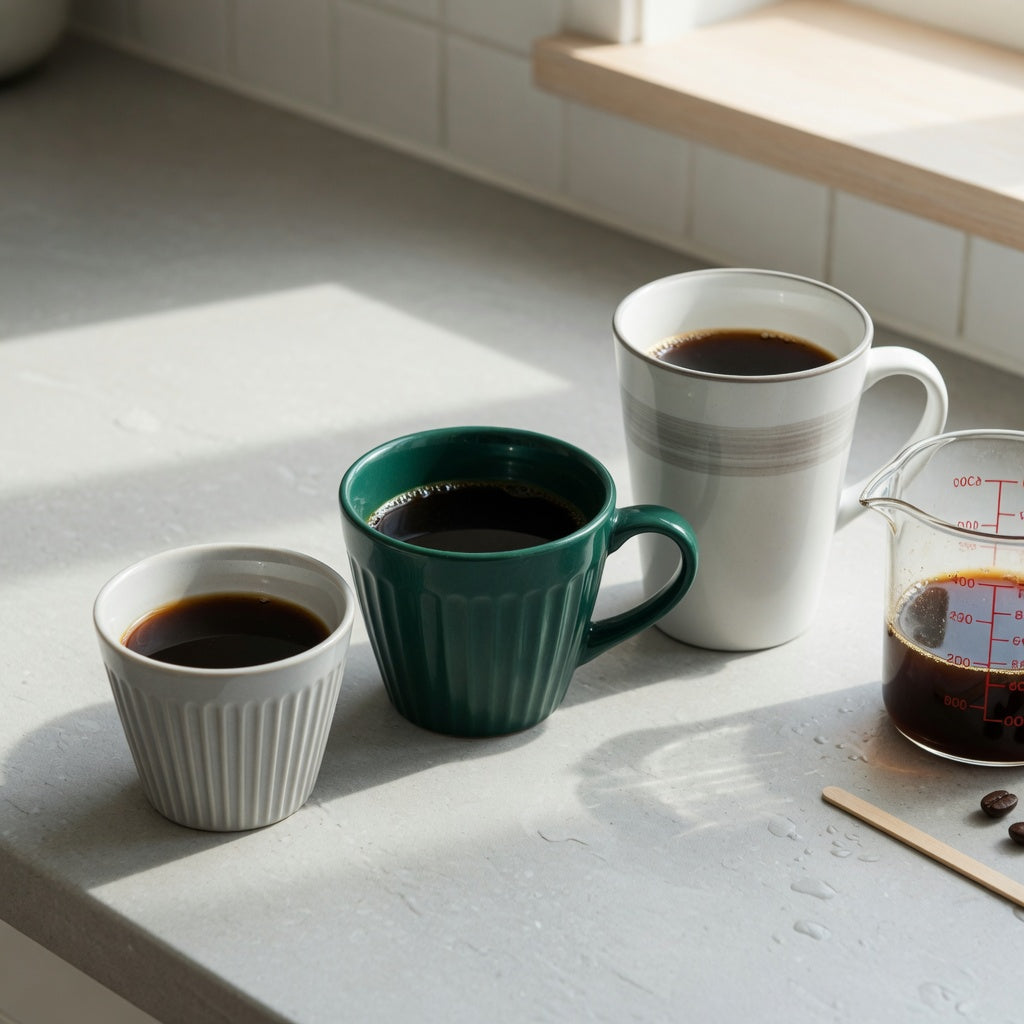
Americano Coffee Cup First Time Buyer Product Shortlist Guide
Build a practical first-cup shortlist by measuring your usual pour, comparing the verified 200 ml, 270 ml, and 350 ml capacities, and identifying material, care, and dimension details that still ne...
Read more
Leave a comment
This site is protected by hCaptcha and the hCaptcha Privacy Policy and Terms of Service apply.