



Decaf Coffee Cup Shared Household Practical Purchase Checklist
Reading time: about 9 minutes
At breakfast, one housemate fills a cup close to the rim and carries it to a desk; another pours much less and is finished before the first person sits down. Give both people the same cup and one may face extra refills while the other handles more cup than needed. Our decaf coffee cup shared household practical purchase checklist starts with that everyday mismatch. In our store, we get better buying decisions when shoppers describe the pour, grip, and storage spot before choosing a design.
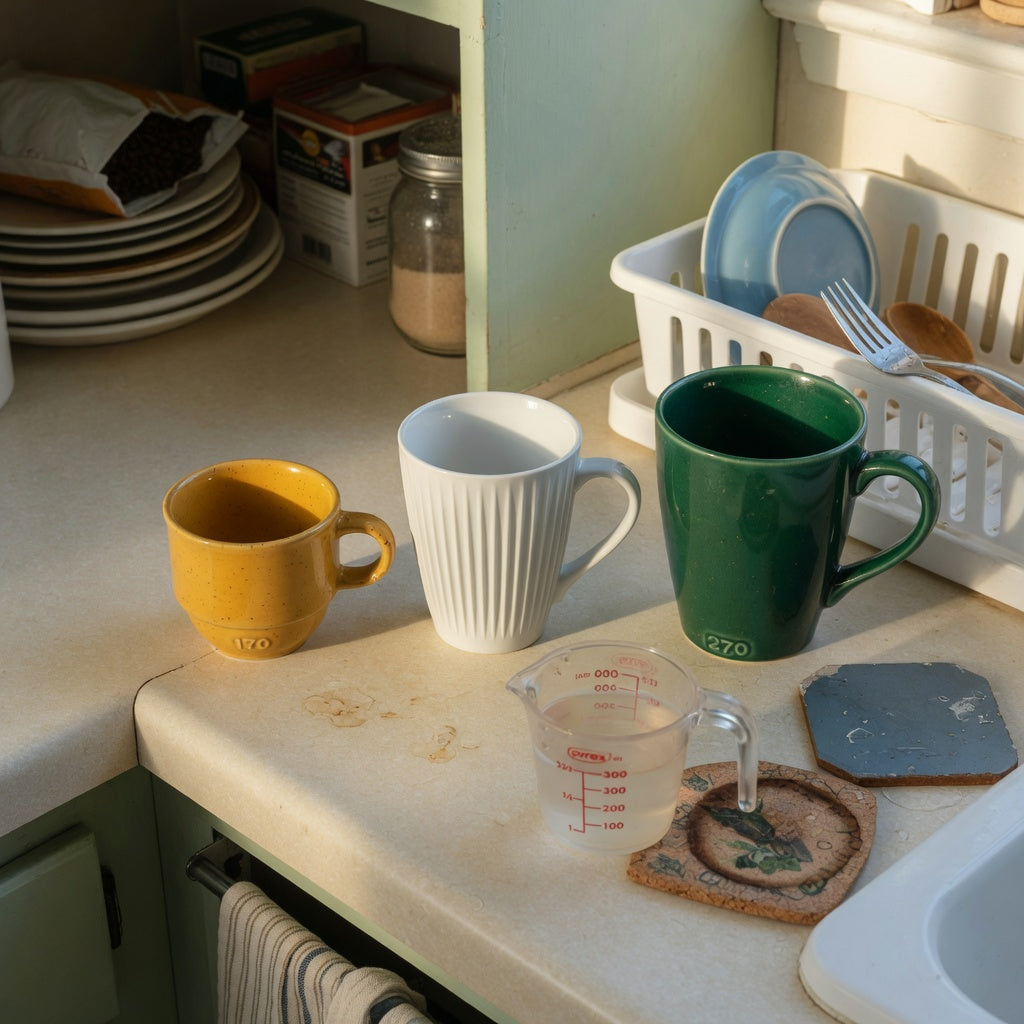
For these three options, we can stand behind three capacity figures: the Retro Coffee Tea Cup is 170 ml, the Pleated Coffee Tea Cup is 200 ml, and the Emerald Coffee Tea Mug is 270 ml. Those numbers support a useful serving comparison. They do not confirm material, exterior dimensions, empty weight, internal handle measurements, dishwasher or microwave compatibility, stackability, or included accessories, so we treat those details as pre-purchase confirmation points instead of guessing.
Which listed capacity matches each person's actual pour?
Start with the cup already being used in the household. Fill it to the usual level, then transfer that serving into a marked measuring jug. Repeat the check on a rushed morning and a slower day because serving habits can change with the setting. This five-minute exercise is more reliable than deciding that someone simply wants a small or large cup.
| Option | Verified capacity | Reader situation | Trade-off to check |
|---|---|---|---|
| Retro Coffee Tea Cup | 170 ml | The person's regular pour fits below 170 ml with comfortable space beneath the rim. | It may require more refills if that person regularly serves more than the listed capacity. |
| Pleated Coffee Tea Cup | 200 ml | One or more housemates measure a middle-size serving and do not need the full 270 ml option. | A midpoint is not automatically the best fit for someone at either end of the range. |
| Emerald Coffee Tea Mug | 270 ml | The regular serving exceeds the smaller capacities or the user wants more room below the rim. | Filling a larger volume adds more liquid to carry, so grip and balance deserve extra attention. |
Do not assume the listed number equals the most comfortable fill level. If the product page does not say whether capacity is measured to the brim, leave practical rim clearance in your calculation or ask our team for clarification. Also, a 170 ml capacity does not prove that the empty cup is lighter than another model; empty product weights have not been established by the facts used here.
Will the handle work for one-finger, two-finger, or full-hand grips?
Capacity is easy to compare because it comes with a number. Handle comfort is more personal. At our counter, we ask shoppers to notice how they hold their current favorite cup before they compare a replacement: one finger through the handle, two fingers inside, several fingers through, or a hand wrapped around the cup body.
- Finger clearance: Check whether the knuckles touch the cup body during the normal grip.
- Thumb position: Note whether the thumb rests on top of the handle or braces against the body.
- Filled balance: A grip that feels acceptable while empty can feel less secure after the cup is filled.
- Handle projection: A handle that extends farther from the body can affect cabinet spacing, drying-rack placement, and desk clearance.
Open the Retro, Pleated, and Emerald product images beside a cup that already fits the intended user. Photographs can show general proportions, but they cannot provide dependable finger clearance because perspective and image scale vary. If handle fit is decisive, request the internal handle height and width in millimeters before ordering. The largest listed capacity should not be assumed to have the largest handle opening.
How can different serving preferences share one cabinet without a set?
These products have separate product pages, so compare them person by person rather than treating them as a preconfigured household set. The right combination depends on measured servings and grip preferences, not on making every place setting identical.
- Smaller pour plus middle pour: Compare the 170 ml Retro with the 200 ml Pleated. Each person gets a capacity closer to the amount they normally serve.
- Middle pour plus fuller pour: Compare the 200 ml Pleated with the 270 ml Emerald. The relevant next check is handle comfort at each filled volume.
- Three clearly different servings: Review all three sizes, but only choose each one if the household measurements support it.
- Two similar servings: The same model may be sensible, provided both users agree on the handle and storage fit.
The 200 ml Pleated is a logical comparison point when household measurements fall near the middle, but it is not a universal compromise. A compromise that fits neither person's regular pour simply creates two dissatisfied users. Check the quantity, included pieces, and current product details on each listing because this article does not assume a saucer, spoon, lid, or gift box is supplied.
These three verified capacities also do not establish suitability for travel, insulation, rugged outdoor use, or servings above 270 ml. If someone needs a lid, a highly durable worksite cup, or substantially more capacity, a different drinkware style would be the more practical purchase.
Will the cup fit the cabinet, drying rack, and office desk?
A capacity figure describes volume, not exterior size. Without confirmed dimensions, we cannot assume that the 270 ml Emerald is the tallest or widest option, or that the 170 ml Retro occupies the least shelf space. Measure the places where the cup will actually spend time.
- Record the cabinet's usable shelf height and depth.
- Measure the space between neighboring handles if the shelf is already crowded.
- Check the opening needed to hang a cup from a mug tree or hook.
- Note the width between drying-rack posts so the handle and rim are not forced into place.
- For an office desk, measure the coaster or clear surface area, including room for the handle.
If exterior dimensions are missing from a product page, ask for height, widest body diameter, base diameter, and total width including the handle. Those four measurements answer more storage questions than capacity alone. If none of the three sizes appears to suit the available space or serving routine, browse our unique coffee mug collection and apply the same measurements to the other options.
What should you inspect at unboxing and before the first wash?
Shared kitchens put cups through frequent counter moves, sink transfers, and drying-rack cycles. We inspect high-contact areas first because a small issue at the rim, handle, or base matters more in daily use than a detail hidden underneath the cup.
- Confirm the item and quantity: Match the delivered product with the listing and do not assume unlisted accessories should be present.
- Check the drinking rim: Use side lighting to look for a chip, rough point, or hairline line before the cup enters regular use.
- Inspect both handle joins: Look for visible gaps, cracks, or an edge that feels uncomfortable against a finger.
- Test the base: Place the empty cup on a known flat, dry counter and check for noticeable rocking.
- Read the care information: Use the product page, packaging, insert, or base markings. Do not infer dishwasher or microwave compatibility from appearance.
- Avoid forced stacking: Unless the product is specifically shown or described as stackable, do not press rims together to make the cups fit a tight cabinet.
If dishwasher use is non-negotiable and the live listing does not confirm it, pause the purchase and ask before ordering. The same applies to microwave use. For a housewarming or roommate gift, keep any supplied care information with the cup so the recipient is not left to guess during the first wash.
Decaf coffee cup shared household practical purchase checklist
Run this decaf coffee cup shared household practical purchase checklist with every regular user present. It separates verified facts from details that still need confirmation.
- Measure each person's normal serving in milliliters.
- Leave space below the rim instead of matching the serving to the stated capacity exactly.
- Shortlist 170 ml, 200 ml, or 270 ml from the measured amounts.
- Record each person's normal finger and thumb position on a handle.
- Ask for internal handle measurements if hand clearance is a concern.
- Consider the added liquid weight of the fuller serving.
- Measure the cabinet, drying rack, mug tree, counter, or office desk.
- Verify material, empty weight, dimensions, care instructions, and included pieces on the live listing.
- Inspect the rim, handle joins, and base when the cup arrives.
- Choose by person and use case rather than assuming every household member needs a matching cup.
Open the 170 ml Retro page if the measured serving fits the smallest verified capacity. Use the 200 ml Pleated page for a middle-size comparison, and review the 270 ml Emerald page for the fullest listed option. Each recommendation still depends on confirming handle fit, external dimensions, care, and the current listing details.
Frequently asked questions
What does a decaf coffee cup shared household practical purchase checklist include?
It should include each person's measured serving, preferred grip, available storage space, and required care method. It should also separate verified specifications from assumptions. For the products compared here, the confirmed figures are 170 ml for Retro, 200 ml for Pleated, and 270 ml for Emerald.
Is a 200 ml cup always the safest choice for two housemates?
No. The 200 ml Pleated is a useful midpoint, but it can still be too large for one person's regular pour and too small for another's. Measure both servings before treating the middle capacity as a compromise.
Does the 270 ml Emerald have the largest handle?
Capacity alone does not confirm handle size. Review the current product images and ask for internal handle height and width if finger clearance matters. Do not choose it for a larger hand based only on the 270 ml figure.
Are the Retro, Pleated, and Emerald products confirmed as dishwasher and microwave safe?
Those care claims are not established by the verified facts used in this checklist. Check the live product page, packaging, or care markings, and contact our store if the required method is not stated. Do not place a new cup in a dishwasher or microwave based on appearance alone.
What should I buy if someone regularly needs more than 270 ml?
These three options stop at a verified 270 ml capacity, so forcing one into that use would create repeated refills or insufficient rim clearance. Use the unique coffee mug collection to look for a different capacity, then confirm its handle, exterior dimensions, and care details before purchasing.
Next step: Measure one normal serving for every regular user, note each person's grip, and check the intended shelf or desk. Then compare Retro, Pleated, and Emerald using those numbers; if none fits, return to the CoffeifyMug unique coffee mug collection with the same checklist instead of settling for a matching cup that does not suit the household.
More from our blog
Ready to pick your mug? Two ways to save on today's order:
Ordering 1–3 mugs? Get an extra 10% off your 1st order with code 10_OFF Apply 10% Off & Shop Wooden-Handle Mugs →
Gifting 4+ mugs? Buy 3, Get the 4th Free applies automatically at checkout (no code needed; offers do not stack) · Free standard shipping (Nov pre-Christmas delivery: 15–20 calendar days US) · Free replacement if chipped in transit.
Popular mug buying guides: Ceramic Tea Cups & Infuser Mugs · Ceramic Mugs with Lids Compared · Wooden-Handle Tea Infuser Mugs Compared · Christmas & Secret Santa Mugs 2026 · Espresso & Cortado Cups Guide · Cup & Saucer Gift Sets · All 25 Mugs Spec Table · Mug Size Guide · Shipping & Promo FAQ
FIRST ORDER 10% OFF (CODE: 10_OFF) · OR BUY 3, GET THE 4TH FREE


Read more

Small ceramic coffee cup shared household practical purchase checklist
Shared kitchens reveal small-cup problems quickly: mismatched pour sizes, unclear ownership, awkward grips, and preventable ceramic damage. This checklist explains how to measure real drinks, verif...
Read more
Your mocha mug first time buyer practical purchase checklist: 3 sizes
Compare The Flow 400 ml, Morning and Night 440 ml, and The Rock 480 ml using practical checks for pour volume, dimensions, material, care, storage, and unlisted details.
Read more
Leave a comment
This site is protected by hCaptcha and the hCaptcha Privacy Policy and Terms of Service apply.