
Decaf Coffee Cup Home Coffee Station Practical Purchase Checklist
Reading time: about 9 minutes
A cup can look right beside a kettle and still be awkward on the first morning: the usual serving is too small for it, the handle reaches into the grinder's space, or the shelf above the station blocks a clean lift. This decaf coffee cup home coffee station practical purchase checklist is built around the checks we use in our store: measure the serving, test the hand movement, and verify every unlisted specification before ordering. The confirmed comparison is deliberately narrow. Retro is 170 ml, Pleated is 200 ml, and Emerald is 270 ml. We do not infer external dimensions, material, care instructions, or appliance clearance from those capacities.
Which listed capacity matches the amount you normally serve?
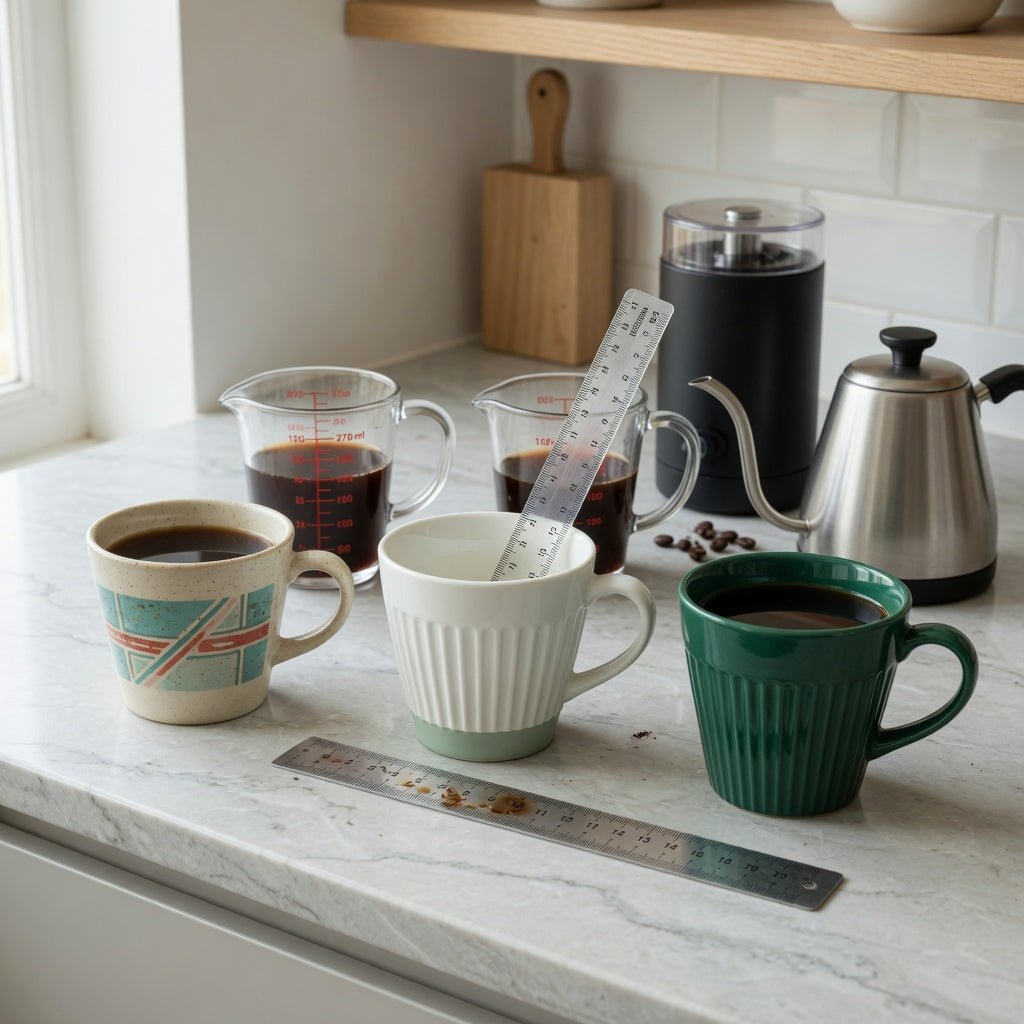
Start with a measuring vessel, not labels such as small, regular, or generous. Those words change from one household to another. We ask shoppers to reproduce their normal fill line with cool water, transfer it to a measuring jug, and record the result in millilitres. This takes less than two minutes and gives you a useful number for comparing the three verified capacities.
- Place the cup you currently use on the coffee station.
- Add cool water to the level you normally serve.
- Transfer the water to a marked measuring jug.
- Compare that amount with 170 ml, 200 ml, and 270 ml.
- Allow the headspace you prefer instead of assuming the cup should be filled to its rim.
A listed capacity is not necessarily the same as your comfortable fill line. If your result points toward the smallest capacity in this comparison, review the Retro 170 ml coffee tea cup. A serving closer to the middle option points toward the Pleated 200 ml coffee tea cup. For the largest listed capacity of the three, compare the Emerald 270 ml coffee tea mug. Use the current product-page wording to confirm how capacity is stated before making the final choice.
How much counter depth and shelf clearance should you measure?
Capacity does not establish a cup's diameter, height, base footprint, or handle projection. A tall, narrow cup and a short, wide cup can hold similar amounts while occupying very different spaces. This matters on a kitchen counter where the cup may sit between a grinder, canister, scale, or kettle.
- Resting space: Measure the clear width and depth where the cup will sit, including the area occupied by the handle.
- Vertical clearance: Measure from the counter to the shelf or cabinet above it. Include the upward movement needed to pick up the cup.
- Pickup path: Move your current cup in and out of the station from the direction your hand naturally approaches.
- Storage space: Check cabinet shelf height and depth separately from the open counter area.
Painter's tape can mark the space used by your current cup without moving the rest of the station. If exact product dimensions are not published on a listing, do not use capacity as a substitute. Product photographs can help you assess proportions, but they are not scale drawings. We are not claiming that any of these three cups will fit beneath a particular brewer, on a specific drip tray, or inside a particular cabinet.
How can you judge handle comfort from an online listing?
Handle comfort is personal, and an online photograph can only help you screen options. Look at the loop opening, the distance between the handle and cup body, and how far the handle projects outward. Then compare those details with a cup you already find comfortable. Note how many fingers you place through the loop, whether your knuckles touch the body, and whether you lift from the side or from above.
Repeat that pickup movement at the actual station with cool water in your current cup. A handle may feel fine at an open dining table but awkward when your hand must pass a canister or reach beneath a cabinet. For a gift, use the recipient's favourite cup as the reference rather than judging the grip with your own hand.
If grip strength, joint comfort, or an adaptive handle shape is a deciding factor, photographs are not enough to guarantee a fit. A cup with documented handle measurements or an in-person trial would suit that shopper better. This is one area where selecting by appearance alone can lead to a poor daily experience.
Decaf coffee cup home coffee station practical purchase checklist
Use this decaf coffee cup home coffee station practical purchase checklist beside your current setup. It separates verified product facts from the measurements and care details that still need confirmation.
- Measure your normal serving with cool water and record the result in millilitres.
- Compare that result with the verified 170 ml, 200 ml, and 270 ml capacities.
- Mark the available counter width and depth, including room for the handle.
- Measure the vertical lift path beneath any shelf or cabinet.
- Record how many fingers you normally place through a comfortable handle.
- Check the current product listing for external dimensions, material, and care directions.
- Do not infer brewer, warming-plate, or drip-tray fit from capacity alone.
- Plan where the cup will be stored when it is not on the station.
The order matters. Capacity narrows the choice, but it does not answer the physical-fit or care questions. If your station has very limited clearance, those remaining details may be more important than choosing the closest capacity.
Which CoffeifyMug cup fits your serving pattern?
Our product-selection logic starts with the measured serving, then sends the shopper to the relevant product page to verify the remaining details. It does not assume that the smallest capacity has the smallest exterior or that the largest capacity has the most comfortable handle.
| Reader situation | Why it may fit | Product next step |
|---|---|---|
| Your cool-water test points to a 170 ml listed capacity, and you prefer the smallest serving size in this comparison. | Retro is the smallest verified capacity of these three, so you are not stepping up to volume you did not measure a need for. | Review the Retro 170 ml cup, then confirm its exterior measurements, handle proportions, and care information. |
| Your measured serving is better matched to 200 ml: more than the 170 ml option but less than the 270 ml option. | Pleated occupies the middle position in the verified capacity comparison. | Open the Pleated 200 ml cup and compare its current product details with your station measurements. |
| Your normal serving points toward 270 ml, or you prefer the largest listed capacity in this group. | Emerald provides the highest verified capacity among the three products covered here. | Check the Emerald 270 ml mug, paying particular attention to the listed dimensions and handle images. |
If your measured serving falls below 170 ml or above 270 ml, do not force it into the nearest option simply to complete the station. The same applies if material, handle shape, or care requirements outweigh capacity. Browse our unique coffee mugs collection to compare other shapes, then apply the same measurement process to each listing. A collection page offers alternatives, but it does not by itself confirm a specific feature.
What should you verify about material, care, and arrival condition?
The verified product comparison supplied for this checklist covers capacity. It does not establish a material or a shared care method for all three cups. Before checkout, read the current product page for material and cleaning instructions. If dishwasher or microwave suitability is not explicitly stated, do not assume it from the cup's colour, finish, name, or photograph. That distinction matters for a home station where the cup may go through frequent washing or daily dishwasher cycles.
We also recommend a basic inspection before the first wash, especially if the cup will be wrapped as a gift. These are standard intake checks for handled cups, not claims that these products commonly arrive damaged:
- Examine the rim under side light for a chip, sharp irregularity, or rough point.
- Check both handle-to-body joins for a visible crack, gap, or movement.
- Place the cup on a clean, known-flat counter and check for unexpected rocking.
- Confirm that the received style and stated capacity match the order.
If you find a concern, stop before washing or using the cup and contact the store. For gift unboxings, inspecting the item before wrapping prevents the recipient's first use from becoming the first quality check.
When should you choose a different cup category?
These three capacities are not the right answer for every station. This guide does not present them as travel mugs, insulated vessels, spill-proof cups, or accessories guaranteed to work with a specific appliance. Choose a product explicitly designed and documented for those jobs if you need a sealed commuting cup or assured equipment clearance.
- Choose a smaller category if your measured serving is well below 170 ml.
- Choose a larger category if your usual serving exceeds 270 ml.
- Choose a purpose-built travel vessel if you need a lid, insulation, or car-cup-holder use.
- Choose an option with documented dimensions if exact brewer or cabinet clearance is essential.
- Choose a cup with verified ergonomic details if grip support is a primary requirement.
A different style is also the better purchase if a required material or care instruction cannot be confirmed. The most attractive capacity match is still a poor fit if it conflicts with the way you wash, store, or lift the cup every day.
Frequently asked questions
What capacity should I choose for a home coffee station?
Measure your normal fill line with cool water and compare the result with the listed capacities. Retro is 170 ml, Pleated is 200 ml, and Emerald is 270 ml. Leave your preferred headspace and confirm how capacity is described on the current product page.
Is a 170 ml, 200 ml, or 270 ml cup guaranteed to fit under my coffee maker?
No. Capacity alone does not provide the cup's height, diameter, base footprint, or handle projection. Compare published cup dimensions with the clearance specified for your equipment; this article makes no appliance-compatibility claim.
What does the decaf coffee cup home coffee station practical purchase checklist cover?
It covers serving capacity, available station space, handle comfort, storage clearance, and pre-use inspection. It also identifies material, exterior dimensions, care directions, and appliance clearance as details that must be verified separately.
Can I put the Retro, Pleated, or Emerald cup in the dishwasher?
Use a dishwasher only if the current product instructions explicitly allow it. This guide does not assign a blanket dishwasher rating to the three products, so follow the product page or included care directions rather than assuming they share the same requirements.
Which capacity is the safest choice for a gift?
Measure the recipient's favourite cup with cool water and note the handle style they already use comfortably. Select the closest listed capacity, then compare the product photographs and available specifications. If you cannot check those details, a different style with clearer measurements may be the better gift.
Measure two things now: your normal serving in millilitres and the clear space around your station. Open the product page matching 170 ml, 200 ml, or 270 ml, verify the remaining dimensions and care details, and order only when all three checks - capacity, handle, and station fit - point to the same cup.
More from our blog
Read more

Your Herbal Tea Mug Home Coffee Station Practical Purchase Checklist
Compare The Flow 400 ml, Morning and Night 440 ml, and The Rock 480 ml by verified capacity and personal handle comfort, without assuming volume proves counter or appliance fit.
Read more
Oversized Ceramic Coffee Mugs: Home Station Practical Purchase Checklist
Measure counter clearance, handle swing, working capacity, cleaning space, and storage before choosing an oversized ceramic mug. This checklist also shows how to compare three CoffeifyMug designs w...
Read more
Leave a comment
This site is protected by hCaptcha and the hCaptcha Privacy Policy and Terms of Service apply.