
Dandelion Ceramic Mug: 6 Things to Compare Before You Buy
Reading time: about 9 minutes
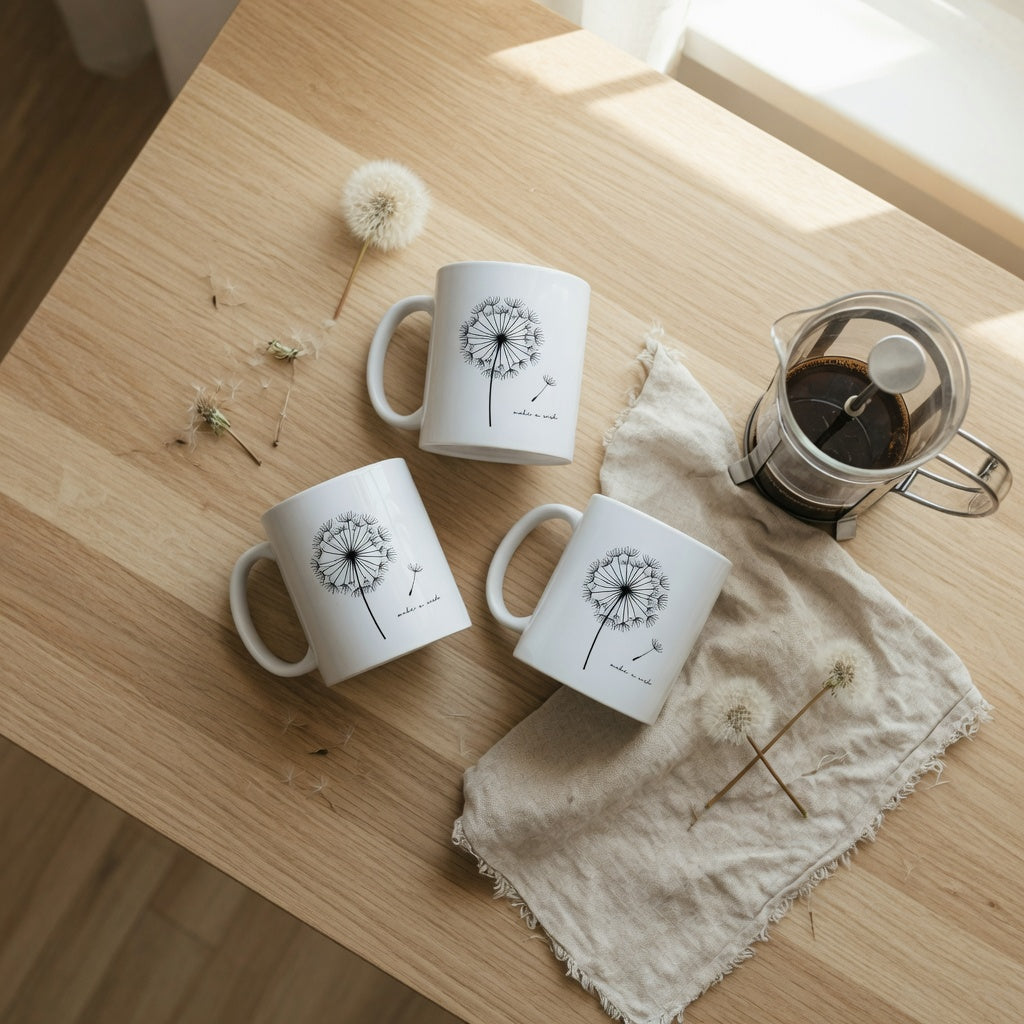
The photo arrives before the question does: a close-up of a white mug with a pale seed head on the side, and one line underneath — is this dandelion real? Some version of that message lands in our inbox nearly every week, and the honest answer depends on how the dandelion ceramic mug in question was made. Three different construction styles all get sold under the same name, they look nearly identical in a thumbnail, and they age very differently on an actual kitchen counter. This is the comparison we walk customers through at our own packing tables, rebuilt so you can run the same checks before you click buy.
Printed, painted, or pressed: which dandelion mug are you actually buying?
The decoration method drives everything else — price, care routine, lifespan, and whether the flower is botanical at all:
- Printed or sublimated designs. The artwork is transferred into an exterior coating and feels glassy-smooth under a thumb. These are usually the most affordable dandelion coffee mugs and the most forgiving in a dishwasher, though abrasive scrubbers can dull a print after years of cycles.
- Hand-painted or decal work. Brushstrokes or an applied overglaze decal create slight piece-to-piece variation, and on a well-made hand-painted dandelion mug you can often feel the artwork sitting just proud of the glaze.
- Pressed-flower construction. A real dried seed head is sealed under a clear resin or glass-like layer. The flower is genuinely botanical, which is the whole charm — but where that clear layer sits matters enormously, and not every listing explains it.
Our rule for shoppers: read the title and bullet points for the words pressed flower, hand-painted, or print, then zoom into the photos. If a description never states the method, ask the seller before ordering — the answer changes the care routine, the lifespan, and how the mug looks on the shelf next to your kettle.
Dandelion ceramic mug capacity: is 400 ml or 480 ml right for your pour?
Capacity is the spec buyers most often underestimate until the mug arrives and looks small beside the coffee machine. For reference, 400 ml is roughly 13.5 US fluid ounces — a generous mug of filter coffee or tea. 480 ml lands near 16 ounces, which is latte-and-settle-in territory.
The dandelion range in our store currently spans three shapes, and capacity is the first honest divider between them:
| Mug | Capacity | Approx. US oz | Best fit |
|---|---|---|---|
| The Gradient | 400 ml | ~13.5 oz | One-cup coffee or tea drinkers who want a straightforward daily mug |
| The Flow | 400 ml | ~13.5 oz | The same 400 ml in a different silhouette — compare the shape and handle photos on each listing |
| The Rock | 480 ml | ~16 oz | Big pours, milk-heavy lattes, and long desk sessions that run on refills |
All three live in our unique coffee mugs collection, so you can line the shapes up side by side before committing to one.
Mapping capacity to your morning: a 400 ml mug suits most people who drink one cup and move on, and its smaller footprint earns more room in a crowded cupboard. The 480 ml Rock makes sense if your morning is a two-cup affair squeezed into one pour, or if you add enough milk that a smaller mug threatens to overflow the moment you stir. One trade-off worth naming: a full 480 ml of coffee weighs roughly half a kilogram, so bigger is not automatically better for every hand. If you are weighing that size across brands too, our guide to the 480 ml ceramic coffee mug covers what the extra 80 ml changes in grip, glaze, and daily use, and our 10-point ceramic mug buying checklist lists every spec worth confirming on any listing — ours included.
Which handle fits your hand — and your cupboard shelf?
Handle comfort is subjective, which is exactly why it deserves a deliberate check instead of a glance at the product photo. Three things we watch when we hand mugs to customers in person:
- Knuckle clearance. Larger hands need a taller handle loop. If the gap between handle and mug wall looks tight in the listing photo, assume it will feel tight.
- Weight when full. Wide handles spread the load of a full mug across several fingers; narrow loops concentrate it on one point, which gets tiring over a long, slow coffee.
- Stacking and shelf height. Ornate handles are lovely until the mug will not fit under the shelf above it. Measure your cupboard clearance if you stack rather than display.
Handle dimensions vary shape by shape, even within one brand, so confirm the exact measurements on the current listing of whichever dandelion ceramic mug you are eyeing instead of assuming across a range. A tape measure against your favorite mug at home settles it faster than any review can.
Will a dandelion ceramic mug survive the dishwasher and microwave?
Care is the detail most often buried in listings, and the honest answer depends on how the artwork was applied:
- Printed exteriors generally cope with a gentle cycle, but abrasive pads and harsh detergents dull the design over time. A soft sponge over the artwork is the safer habit.
- Hand-painted and pressed-flower finishes usually reward gentler treatment. Check whether the listing specifies hand-wash only before you buy — especially for a recipient who runs everything through a busy dishwasher.
- Microwave use depends on the glaze and any resin or metallic detail. If a listing does not state microwave safety, treat that as an open question and ask before buying rather than gambling on it.
The two questions we hear most at checkout: “Is the flower real?” and “Can my dishwasher handle it?” If a store cannot answer both quickly, buy somewhere else.
One care note generic guides skip: thermal shock. Pouring boiling water into ceramic that just came in from a cold car stresses the glaze. Let any mug reach room temperature before filling it with very hot or very cold liquid, and skip the freezer-to-microwave shortcut entirely — no decoration survives that happily.
Pressed-flower mugs: what should you verify before the first pour?
Real pressed botanicals raise the most legitimate questions in this category, and we will not pretend every pressed-flower mug is automatically safe or unsafe — construction varies by maker. What we can give you is the verification list:
- Locate the flower. Ask whether the sealed botanical sits on the exterior surface or inside the drinking cavity. Exterior placement is the common approach; interior placement deserves explicit food-contact confirmation.
- Ask about the drinking surfaces. Reputable makers can tell you how the interior and rim are finished and whether those surfaces are intended for food contact.
- Inspect on arrival. Run a fingertip around the rim and look for chips, rough spots, or crazing — the fine web of cracks that can appear in glaze. Damage on a drinking edge is a stop-using-it sign, not a cosmetic footnote.
- Follow the care card. If the clear layer has heat limits, respect them. Heat and harsh washing are the usual stressors, not the flower itself.
None of this should scare you off pressed designs. It is the same due diligence we apply to any handmade ceramic with decorative layers; pressed flowers simply make the questions visible enough that buyers finally ask them.
When is a dandelion mug the wrong gift?
We sell these happily and will still talk you out of one when the fit is wrong. Skip the dandelion design if:
- The recipient owns nothing but plain white restaurant ware and has said as much. A botanical print will read as someone else's taste on their shelf.
- They drink exclusively from a lidded travel tumbler on a commute. A ceramic mug they never use is cupboard clutter, not a gift.
- You are choosing a pressed-flower style for a household that will not hand-wash anything. The design will not get the care it needs, and everyone loses.
Where the fit is genuinely strong: gardeners, new homeowners, Mother's Day, and anyone charmed by the make-a-wish symbolism of the seed head — the plant botanists call Taraxacum officinale. That blow-and-wish imagery is why these mugs keep showing up in gift guides, and it pairs naturally with the advice in our ceramic mug gifting checklist.
One last timing note for gift buyers: if the mug needs to arrive by a birthday, check the shop's made-to-order lead times and breakage-in-shipping policy before checkout. Ceramic is fragile freight, and a good seller states both plainly.
A 60-second dandelion mug checklist for checkout
Run these six checks on our listings or anyone else's:
- Decoration method: printed, hand-painted, or pressed flower — know which one you are buying.
- Capacity: 400 ml for a classic pour, 480 ml for a latte-sized one.
- Handle: knuckle clearance for the actual hands that will hold it.
- Care: dishwasher and microwave status confirmed on the listing, not assumed.
- Construction: interior and rim finished for food contact, no visible crazing or chips.
- Gift fit: will this person hand-wash it and actually use it daily?
Sixty seconds of checking saves a return window's worth of regret. Start by comparing The Gradient, The Flow, and The Rock on capacity alone, then browse the full unique coffee mugs collection to see every dandelion design in one place.
Frequently asked questions
Is the dandelion on a ceramic mug a real flower?
Sometimes. Pressed-flower mugs seal a genuine dried seed head under a clear layer, while many others use a printed or hand-painted image of one. The listing should state which construction you are buying — if it is silent on the method, ask before ordering.
How many ounces is a 400 ml dandelion ceramic mug?
400 ml is approximately 13.5 US fluid ounces, which suits a standard large coffee or a generous tea. In our range, The Gradient and The Flow hold 400 ml, while The Rock holds 480 ml — about 16 ounces — for bigger pours and milk-heavy drinks.
Can a dandelion ceramic mug go in the dishwasher?
It depends on the decoration method, so confirm the care details on the specific listing before checkout. Printed exteriors generally cope with gentle cycles, while hand-painted and pressed-flower finishes usually reward hand-washing with a longer, brighter life. A soft sponge and mild detergent are the safe default either way.
Are pressed-flower dandelion mugs safe to drink from?
They can be, but verify rather than assume: ask where the sealed flower sits, whether the interior and rim are finished for food contact, and what the care card says about heat. Any chip or crack in a drinking surface is a reason to retire the mug, no matter how much you love the design.
Do dandelion mugs make good gifts?
For gardeners, new homeowners, and Mother's Day, they are among the more reliable ceramic gift picks because of the make-a-wish symbolism. The honest caveat: the recipient needs to be someone who will actually use a ceramic mug daily and follow the care routine for the decoration type you chose.
Read more
Emerald Green Coffee Mug Gift: What to Compare Before You Buy
We pack green gift mugs all spring, and the ones that land get five comparisons right: the exact shade, the capacity the recipient actually drinks, handle fit, material, and what the listing promis...
Read more
Ceramic Mug Pair Shelf Styling Ideas: What Buyers Should Compare
Two mugs either read as a styled vignette or as clutter — height offset, spacing, and one anchor object decide which. We compare matched vs split layouts, shelf and hook safety checks, care questio...
Read more
Leave a comment
This site is protected by hCaptcha and the hCaptcha Privacy Policy and Terms of Service apply.