
Cute Ceramic Coffee Mugs: Practical Everyday Rotation Purchase Checklist
Reading time: about 10 minutes
The mug at the front of the cabinet usually wins the morning coffee, even if the prettier one is hidden behind it. A wide handle catches on neighboring cups, a tall body misses the shelf by half an inch, or a decorative shape proves awkward beside a laptop. We call the decision tool in this article our cute ceramic coffee mugs everyday mug rotation practical purchase checklist: a way to judge each mug by how often you will actually reach for it.
At CoffeifyMug, we handle ceramic pieces during product setup, inventory checks, and order packing. In our store, that experience keeps us focused on practical details such as rim finish, handle clearance, base stability, glaze surfaces, and the storage space occupied by an unusual silhouette. We also separate visible product facts from unknowns. The linked pages show each product's name and design, but dimensions, capacity, weight, stackability, and appliance compatibility should only be treated as confirmed when the specific listing states them.
How many mugs fit your coffee habit and dishwasher rhythm?
Start with the number of drinks poured between washing sessions. A shopper who drinks one morning coffee and one evening tea has a different rotation from someone who uses a single mug all day. Buying by frequency prevents a decorative collection from becoming cabinet clutter.
- Daily washing: Count one mug for each drink that normally gets a fresh cup, then consider one spare for a guest or delayed wash.
- Washing every second day: Multiply normal daily mug use by two before adding any display-only pieces.
- Home and office use: Count the mug that stays at a desk separately from the kitchen rotation.
- Several drinkers: Record each person's coffee and tea routine instead of assuming everyone reuses one cup.
- Limited storage: Treat the number of usable mug footprints as a hard limit, even if your wash-cycle calculation suggests more.
Someone using two mugs per day and running the dishwasher every other night needs four active positions in the rotation. A fifth mug may make sense for guests. A ninth mug does not solve a daily-use problem unless it has a specific role or there is enough storage to keep every piece accessible.
Cabinet fit: shelf height, handle reach, and stackability
Exterior shape matters as much as stated capacity. Two mugs that hold a similar pour can occupy very different cabinet footprints because of their handles, tapered bodies, foot rings, or decorative details. Measure the storage space before comparing colors.
- Measure from the shelf surface to the shelf or cabinet frame above it.
- Measure usable depth with the cabinet door fully closed.
- Measure a comfortable mug from the far side of its body to the outer edge of its handle.
- Record the handle opening's inside height and width if finger clearance affects your grip.
- Count how many complete body-plus-handle footprints fit without pressure from neighboring cups.
Do not infer stackability from a front-facing photograph. A raised foot ring may not nest inside another mug, and a handle can prevent two bodies from aligning securely. If your cabinet only works because the current mugs stack, an explicitly stackable design is a better candidate than a sculptural cup with unconfirmed nesting.
Storage also changes the value of a statement mug. Open shelves and dedicated coffee stations can accommodate a piece chosen partly for display. A narrow cabinet rewards straighter sides, predictable handles, and repeatable placement. Gift buyers should consider the recipient's storage too; the unboxing moment is brief, but the mug still needs somewhere convenient to live.
Handbag, pleated, or gradient: which role is missing?
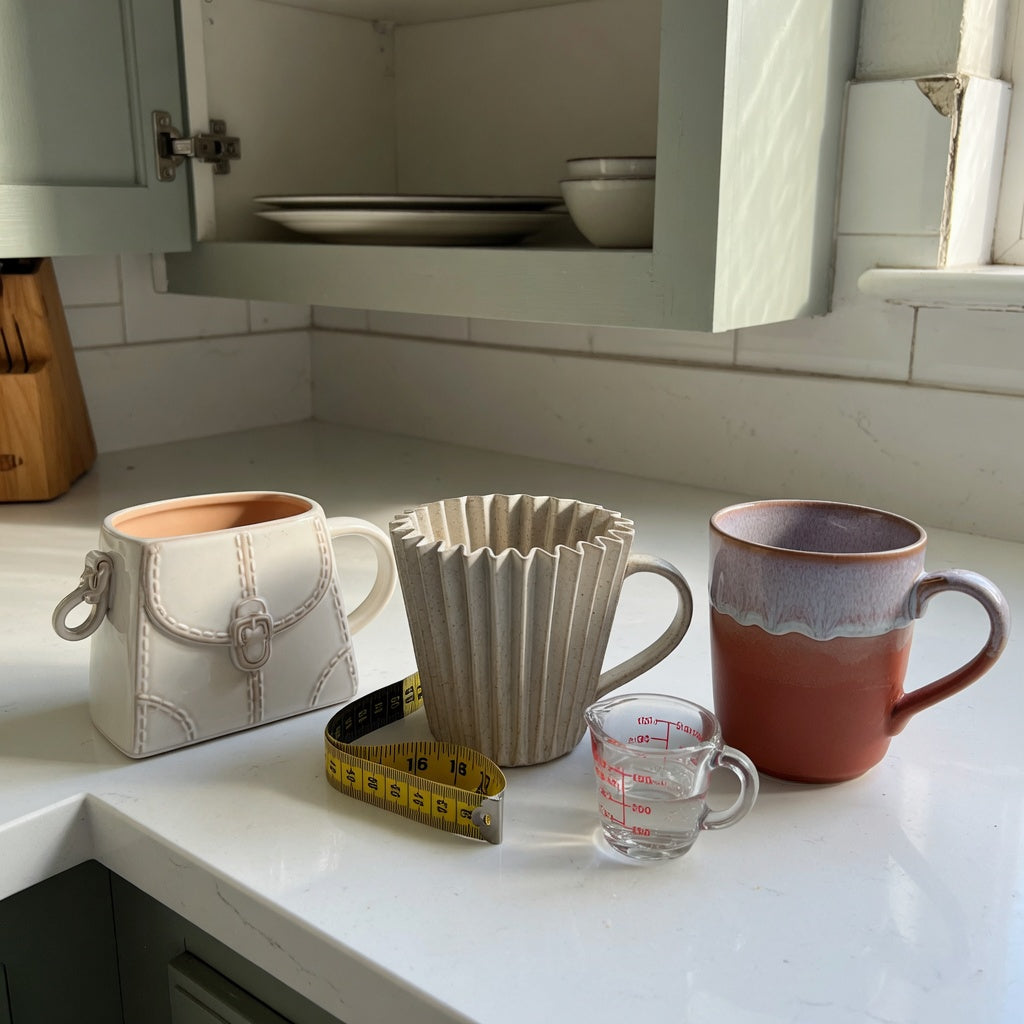
A useful rotation does not need five versions of the same visual idea. Assign the new mug a role first, then use its design to create meaningful contrast. The product-specific observations below are limited to the styling visible on the linked pages; use each listing to verify capacity, measurements, material details, and care before checkout.
| Buyer situation | Product fit to consider | Why it could earn a place | Trade-off to verify |
|---|---|---|---|
| You want one recognizable statement mug for a coffee station, desk, or gift. | Inspect the Handbag Coffee Tea Mug with its handbag-inspired silhouette. | Its visible shape gives it a distinct role beside conventional cups rather than duplicating another basic profile. | Confirm total width, handle clearance, capacity, and care. A sculptural outline is not the first choice for stack-only storage. |
| You prefer tactile-looking detail and want variety that does not depend only on color. | Compare the Pleated Coffee Tea Cup and its visible textured form. | The pleated exterior supplies a different surface treatment for a tea or coffee rotation. | Check dimensions and cleaning instructions. Exterior channels can require a more deliberate wipe when coffee, tea, or milk runs down the side. |
| You want color to identify your mug at a glance. | Review The Gradient Coffee Tea Mug and its color-led finish. | The visible gradient treatment creates contrast with solid-color drinkware without relying on printed wording. | Review every listing image and confirm the care details. Screen brightness and color settings can change how a finish appears online. |
| You have cabinet space for one new piece but have not settled on shape, texture, or color. | Open the unique ceramic coffee mugs collection and compare candidates side by side. | A collection view makes duplicated colors and silhouettes easier to spot before you buy. | Shortlist only mugs that pass your storage, pour, grip, and washing requirements. |
For a crowded kitchen, one statement piece paired with simpler workhorse mugs is usually easier to manage than several projecting silhouettes. For open shelving, visual difference may carry more weight. A gift shopper can prioritize personality, but should still check that the recipient is not limited to a tiny cabinet, a stack-only shelf, or dishwasher-only cleaning.
Does the mug match your pour, grip, and walk to the desk?
Measure your normal drink instead of estimating it from a product photo. Fill your current favorite mug to the level you actually use, transfer the liquid to a measuring jug, and record the volume. That number gives you a practical capacity target.
- Milk or foam: Include the amount normally added after brewing.
- Iced coffee: Allow for both the drink and the space occupied by ice.
- Room-to-room carrying: Leave headspace so the liquid is not sitting close to the rim.
- Desk use: Measure the clear area beside the keyboard, notebook, monitor stand, and charging cables.
If a product page does not state capacity, treat it as an unanswered purchasing question. A photograph cannot confirm volume because camera angle, hand size, and nearby props distort scale. The same restraint applies to grip. A handle may look generous while providing limited finger clearance, and a mug's empty appearance does not tell you how its filled weight will feel during a walk upstairs.
A stationary breakfast-table mug can tolerate a different balance of shape and capacity than an office mug carried past electronics. For commuting, a sealed travel vessel is the better format. An open ceramic mug is designed for a stable surface, not for a car cup holder or an unprotected place inside a bag.
Cute ceramic coffee mugs everyday mug rotation practical purchase checklist
Run every candidate through this sequence. A mug should pass the practical checks before its color or shape decides the purchase.
- Assign one job: Morning coffee, evening tea, iced drinks, desk use, guests, display, or gifting.
- Count actual use: Match the active rotation to the number of drinks poured between dishwasher or hand-washing sessions.
- Measure the shelf: Record height, closed-door depth, and the available width for the body and handle.
- Check the pour: Compare your measured drink volume with the capacity stated on the listing.
- Compare the grip: Use a mug you already hold comfortably as the reference for handle opening and balance.
- Verify care: Look for explicit dishwasher, microwave, and hand-washing guidance on the exact product page.
- Inspect the arrival: Check the rim, glaze, handle joins, and foot ring before first use.
- Create useful contrast: Add a shape, texture, or finish that gives the new mug a clear reason to be chosen.
- Reject a mismatch: Skip the mug if its storage needs, unknown capacity, or required care conflicts with your daily routine.
The Handbag design is the candidate for a shopper seeking a statement silhouette. The Pleated cup is the candidate for visible surface texture. The Gradient mug is the color-led option. Those distinctions help build a shortlist, but they do not replace checking the listing for specifications and care instructions.
Care labels and arrival checks: rim, glaze, handle joins, and base
Ceramic describes the material category; it does not automatically confirm dishwasher or microwave suitability. Decorative treatments, glaze details, and construction can affect care requirements. If the product page does not explicitly support the appliance or cleaning method you rely on, do not assume compatibility.
- Rim: Inspect under bright light for chips, rough points, or hairline lines that can be seen or felt.
- Handle joins: Look at both attachment points for cracks, gaps, or separation.
- Glazed surfaces: Check for unexpected rough areas or visible damage rather than assuming every variation is intentional.
- Foot ring: Set the empty mug on a flat counter and check for rocking or an abrasive contact point.
- After washing: Recheck the rim and handle, especially where the mug can touch a dishwasher rack or another dish.
Do this inspection before wrapping a gift. It protects the recipient's unboxing experience and gives you time to address visible transit damage. For a pleated or strongly textured exterior, also consider whether wiping liquid from surface channels fits your cleaning routine. A shopper who wants a fast rinse and no detail work may prefer a smoother exterior.
Which shoppers should choose a different mug format?
Cute ceramic mugs are not ideal for every situation. Choose a sealed travel mug for commuting or carrying a drink in a bag. Choose an insulated vessel if extended temperature retention matters more than ceramic styling. Select a straight-sided, explicitly stackable cup if a narrow cabinet depends on secure nesting.
Ceramic can chip or break after a hard impact, so it is a poor match for rough outdoor work, unstable counter edges, or settings where drinkware is frequently knocked over. A decorative open mug may also be the wrong office choice when it must sit among valuable electronics. Some shoppers simply prefer one familiar workhorse cup; adding several novelty designs will create clutter if rotation itself does not appeal to them.
Frequently asked questions
What should I check before buying cute ceramic coffee mugs for daily use?
Our cute ceramic coffee mugs everyday mug rotation practical purchase checklist covers cabinet dimensions, body-plus-handle width, measured drink volume, grip, care instructions, and use between wash cycles. Give the mug a specific role before buying it so the new piece adds useful variety instead of duplicating a cup you already avoid.
How many ceramic mugs do I need if I run the dishwasher every two days?
Multiply the number of mugs used each day by two. Add one spare only if you regularly host a guest or delay a dishwasher cycle, then check whether that total fits your cabinet without crowding handles or rims.
Can I assume the Handbag, Pleated, or Gradient mug is dishwasher safe?
No. A product name, ceramic material description, or photograph does not establish dishwasher or microwave compatibility. Follow the care information on the exact listing and treat missing appliance guidance as unknown.
Which cute mug style is best for a narrow kitchen cabinet?
A compact shape with a handle that stays close to the body is generally easier to align, but measurements decide the fit. A handbag-inspired or asymmetrical silhouette may require more side clearance, while any mug with unconfirmed stackability should be treated as a single shelf position.
Are cute ceramic mugs practical for an office desk?
They can work well on a stable desk with convenient washing access and a short carrying route. Measure the open area beside your keyboard and leave headspace in the mug. Choose a lidded vessel instead if spills near electronics or transport through a commute are major concerns.
Build a three-mug shortlist before checkout
Open the CoffeifyMug collection of unique coffee mugs, then keep no more than three candidates. Eliminate any mug that misses your cabinet measurements, lacks a confirmed detail your routine requires, or repeats a role already covered. Compare the remaining options by shape, texture, and finish, and choose the one you can picture reaching for on an ordinary weekday, not just admiring on delivery day.
More from our blog
Read more

Two Tone Ceramic Coffee Mugs: Everyday Mug Rotation Purchase Checklist
Use a seven-day mug audit, cabinet measurements, grip and care checks, and a careful unboxing inspection to choose a two-tone ceramic mug that earns regular use. We also map Gradient, Green Waves, ...
Read more
Rustic Ceramic Coffee Mugs: Everyday Mug Rotation Purchase Checklist
Use frequency, cabinet measurements, grip, care, and unboxing checks to decide which rustic ceramic mug belongs in your active rotation. Includes scenario-based comparisons for CoffeifyMug's Mounta...
Read more
Leave a comment
This site is protected by hCaptcha and the hCaptcha Privacy Policy and Terms of Service apply.