

Cute Ceramic Coffee Mugs: Buying Checklist for Home Coffee Stations
Reading time: about 9 minutes
A close product image can make a decorative mug look compact. On a real counter, the handle can collide with the grinder, the base can overhang a tray, and the rim can sit too high under a shelf. We built this cute ceramic coffee mugs home coffee station practical purchase checklist around those ordinary failures, because color only matters after the mug fits the way you brew.
The questions we answer in our store often move quickly from style to scale, grip, and cleaning. Product photography can establish a mug's design direction, but it cannot prove exact capacity, shelf clearance, or compatibility with a particular coffee machine. Set out the tools you use every morning, record the available space, and then browse our unique coffee mugs for home coffee stations. If a needed dimension or care instruction is not stated on a current listing, treat it as unknown.
Cute ceramic coffee mugs home coffee station practical purchase checklist
Mark each variable as a must-have or a preference. A failed must-have should remove a mug from consideration, even if the finish is exactly what you wanted.
- Full working width: Measure the widest point of the body plus the complete handle projection. Do not rely only on the opening diameter.
- Overall height and lift path: Check the height at rest, then confirm that the mug can be lifted vertically without hitting a shelf, cabinet trim, or light fitting.
- Base contact: The base or foot ring should sit fully inside the flat area of a tray rather than balancing on a raised edge.
- Brewing clearance: Measure the cup space on your own brewer or pour-over setup. A styled product image is not an appliance-compatibility claim.
- Usable capacity: Compare any stated capacity with your normal pour, including room for milk, foam, an infuser, or ice.
- Handle fit: Note how many fingers you use, where your thumb rests, and how secure the grip feels when your hand is damp.
- Verified care: Look for explicit dishwasher and microwave guidance on the current page or packaging. Ceramic alone does not confirm either.
- Storage method: Decide if the mug will remain on display, fit inside a cabinet, or need to stack. Do not assume a sculptural shape is stackable.
This pass-or-fail approach prevents an attractive unknown from becoming an inconvenient daily mug. Width, height, grip, and care usually deserve more weight than a close color match.
How much counter, tray, and brewer clearance is available?
Measure during a real drink routine, not after clearing the counter for a photograph. Leave the grinder, kettle, spoon rest, milk pitcher, scale, or tea supplies where they normally sit. That exposes both the resting footprint and the temporary space used while brewing.
- At rest: Place the mug where it will be displayed and turn the handle into its intended position.
- During brewing: Open grinder lids, cabinet doors, and other moving parts that pass through the same area.
- During pickup: Lift the mug without moving neighboring tools or tilting it around a low shelf.
- During shared use: Set out the number of mugs normally used at once and confirm that every handle remains reachable.
In our experience, a compact station works better with one deliberate statement mug than with several irregular shapes competing for the same tray. Two-person stations need compatible footprints, while a busy family setup may be better served by straight-sided daily mugs that store closely together. A sculptural ceramic mug is not the practical choice if every inch of counter space must support several cups, rapid unloading, and dense stacking.
Which design fits a fashion-led, textured, or color-led station?
The product-specific guidance below is limited to design cues visible in the linked names and listings: a handbag-inspired form, pleated detail, and a gradient treatment. We are not assigning dimensions, capacities, care ratings, or machine compatibility that a current product page does not state.
| Shopper situation | Why the design may fit | Verify before checkout |
|---|---|---|
| You want one bold display piece for a fashion-led coffee bar or a memorable gift. | The Handbag Coffee Tea Mug statement design uses a handbag-inspired silhouette that can serve as the station's visual focal point. | Compare the full shaped outline with your available width. Check handle comfort, cabinet storage, and any listed care guidance rather than assuming it will stack with standard mugs. |
| You prefer visible surface detail without making color the main feature. | The Pleated Coffee Tea Cup for a texture-led setup introduces pleated detailing that gives a neutral or restrained station more visual structure. | Study the side views for grip and spacing. Confirm the listed dimensions and cleaning instructions if the cup will be used every day. |
| Your counter already combines several colors and needs a softer connection between them. | The Gradient Coffee Tea Mug for a color-led coffee bar uses a visible color transition rather than one solid block. | Review all current listing images before trying to match a precise kitchen color. Screen settings and surrounding light can affect how a finish appears. |
| You have measurements but have not chosen a visual direction. | Return to the collection of unique and decorative coffee mugs and compare only the options that pass your fit and care requirements. | Keep your written must-haves beside you. A wider selection should not override a failed width, height, capacity, or cleaning check. |
This is selection logic, not a ranking. We would point a shopper toward the Handbag design for a strong focal object, the Pleated cup for quieter texture, and the Gradient mug for visible color movement. A conventional mug from another part of the collection will be the better purchase if stackability, compact storage, or simple rack loading matters more than decorative shape.
Does the capacity, rim, and handle fit your drink routine?
Use your current favorite mug as a measuring tool. Fill it to the level you normally drink from, transfer the water to a measuring cup, and record the result in fluid ounces or milliliters. That number is more useful than guessing capacity from a front-facing image.
- Hot coffee: Match the amount you actually pour, not the maximum amount the mug could hold to the rim.
- Coffee with milk or foam: Leave enough headroom to carry the drink without spilling over the edge.
- Tea: Account for the space used by a tea bag or infuser and check that the opening suits your preferred accessory.
- Iced coffee: Ice displaces liquid, so compare capacity using your finished drink rather than the coffee alone.
Side-view photos can help you assess the handle opening and rim profile, but they cannot guarantee comfort. Count how many fingers fit through a mug you already enjoy using and note where your thumb naturally rests. A small decorative handle may be acceptable for a short pour but tiring with a fuller mug, especially when carrying it with damp hands after rinsing equipment.
Ceramic is also not the best category for every situation. A lidded insulated tumbler is a more suitable choice for commuting, cup holders, spill control near a laptop, or extended temperature retention. Decorative ceramic makes more sense for a kitchen counter, dining table, or office coffee station where the mug stays close and its appearance is part of the purchase.
Will the care instructions match your dishwasher and hand-wash routine?
Ceramic describes a broad material category, not a universal care method. Glazes, decorations, and construction details can affect the instructions, so check each current listing and the packaging instead of carrying assumptions from another mug.
- Inspect the rim and interior under angled light during unboxing. Look for chips, sharp points, or visible crack lines before the first drink.
- Check both handle joints closely. Fine cracks where the handle meets the body deserve attention because that area carries the mug's weight.
- Set the mug on a flat counter and inspect the base or foot ring. A rough point can mark a painted shelf or wood tray.
- Use a nonabrasive sponge on decorative surfaces unless the supplied care directions say otherwise, then dry the base before returning it to display.
- If dishwasher use is explicitly permitted, leave space between the mug, rack tines, plates, and heavier cups. An unusual outline can load awkwardly even when machine washing is allowed.
If your household depends on a dishwasher every night and the listing leaves dishwasher suitability unknown, choose a mug with clearer care information. The same rule applies to microwave use. Buyers who will not hand-wash should give verified care directions more weight than finish, while gift buyers should inspect the rim, handle joints, glaze, and base during unboxing rather than waiting until the first use.
Which details should decide between the Handbag, Pleated, and Gradient mugs?
Use three passes so style becomes the tie-breaker instead of the only decision.
- Fit gate: Compare current stated dimensions with your maximum width, height, base area, storage space, and brewer clearance. Leave an unstated measurement marked as unknown.
- Routine gate: Compare any stated capacity and care directions with your usual coffee, tea, iced-drink, grip, and cleaning habits.
- Style tie-breaker: Among the products that pass both gates, choose Handbag for a fashion-inspired focal piece, Pleated for visible texture, or Gradient for color transition.
A mug that wins on appearance but fails a required measurement is not a close second. It is the wrong mug for that station. This ordering keeps the purchase grounded in daily use while still leaving room for a design that feels personal.
Frequently asked questions
What should I measure before buying a mug for a home coffee station?
Use the cute ceramic coffee mugs home coffee station practical purchase checklist to record full width including the handle, overall height, base contact area, lift clearance, and the cup space under your own brewer. Measure with your everyday tools on the counter so the numbers reflect the working station.
Can I assume every ceramic coffee mug is dishwasher and microwave safe?
No. Ceramic is a material category, while dishwasher and microwave suitability can depend on the glaze, decoration, and construction. Follow the current product listing and packaging; if a use is not stated, treat it as unconfirmed.
Which cute ceramic mug is best for a small coffee station?
No linked style is automatically best without current dimensions. The Handbag design may suit a shopper seeking one bold focal piece, while Pleated or Gradient may suit texture-led or color-led displays. Whichever style you prefer still needs to pass the width, height, base, and lift-path checks.
Are cute ceramic mugs practical for iced coffee and tea?
They can be if the stated capacity leaves room for ice, milk, or a tea infuser. Build your usual drink in a mug you own and measure that volume before comparing listings. Choose a lidded insulated vessel instead if spill resistance or prolonged cold retention is the main requirement.
What should I inspect during a ceramic mug gift unboxing?
Check the rim for chips, both handle joints for fine cracks, the interior and exterior glaze for visible damage, and the base for sharp or rough points. Compare the received color and design with the current listing before the mug is used.
Your next step: write down your maximum mug width including the handle, maximum height, normal-pour capacity, preferred grip, and acceptable care method. Compare the three linked product pages against those five requirements, then compare more unique coffee mugs by shape and finish if none passes every must-have.
More from our blog
Read more

Vintage Pottery Coffee Mugs: Home Coffee Station Checklist
Measure shelf clearance, brewing space, drink volume, and care needs before choosing a pottery mug. This checklist also maps three CoffeifyMug designs to specific coffee station styles.
Read more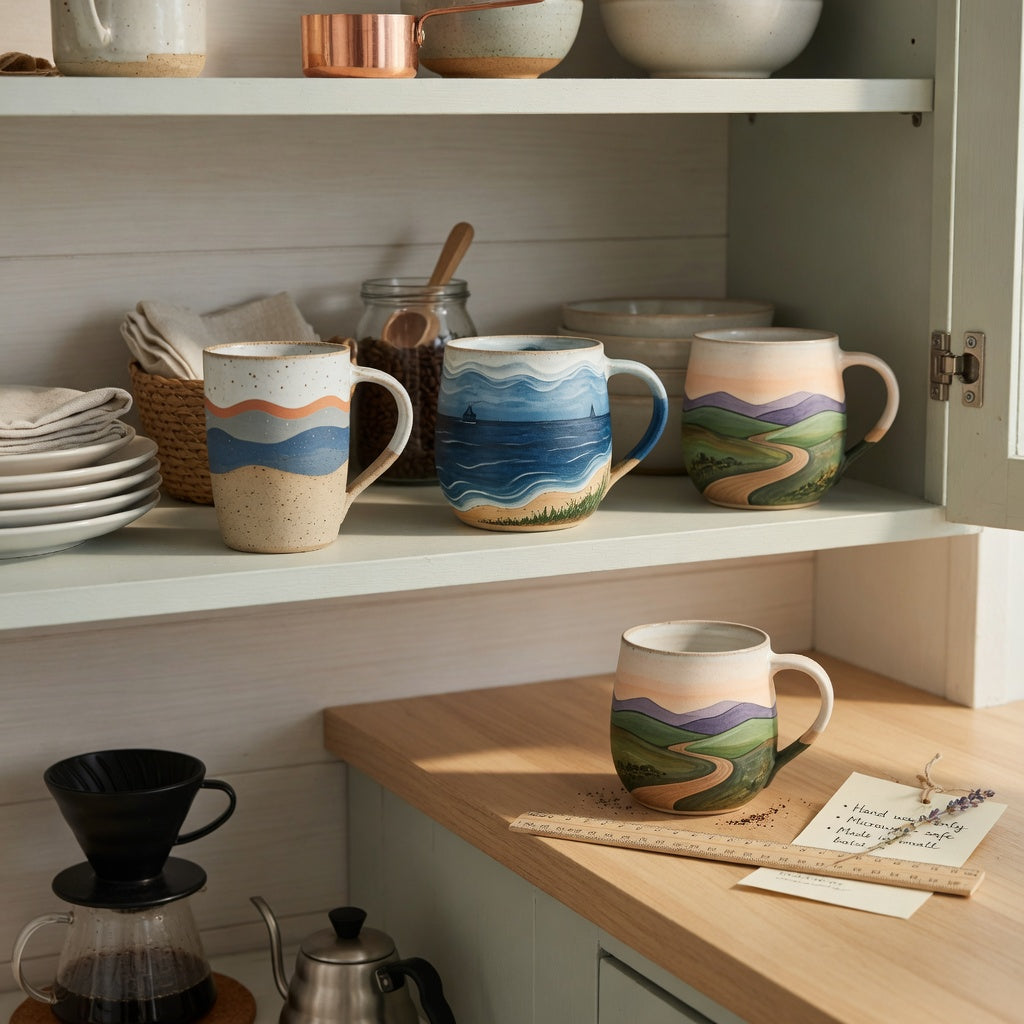
Clay Pottery Coffee Mugs: Everyday Rotation Practical Purchase Checklist
Use wash frequency, cabinet measurements, handle clearance, rim feel, base stability, and care instructions to build a practical clay pottery mug rotation. We also map three CoffeifyMug designs to ...
Read more
Leave a comment
This site is protected by hCaptcha and the hCaptcha Privacy Policy and Terms of Service apply.