



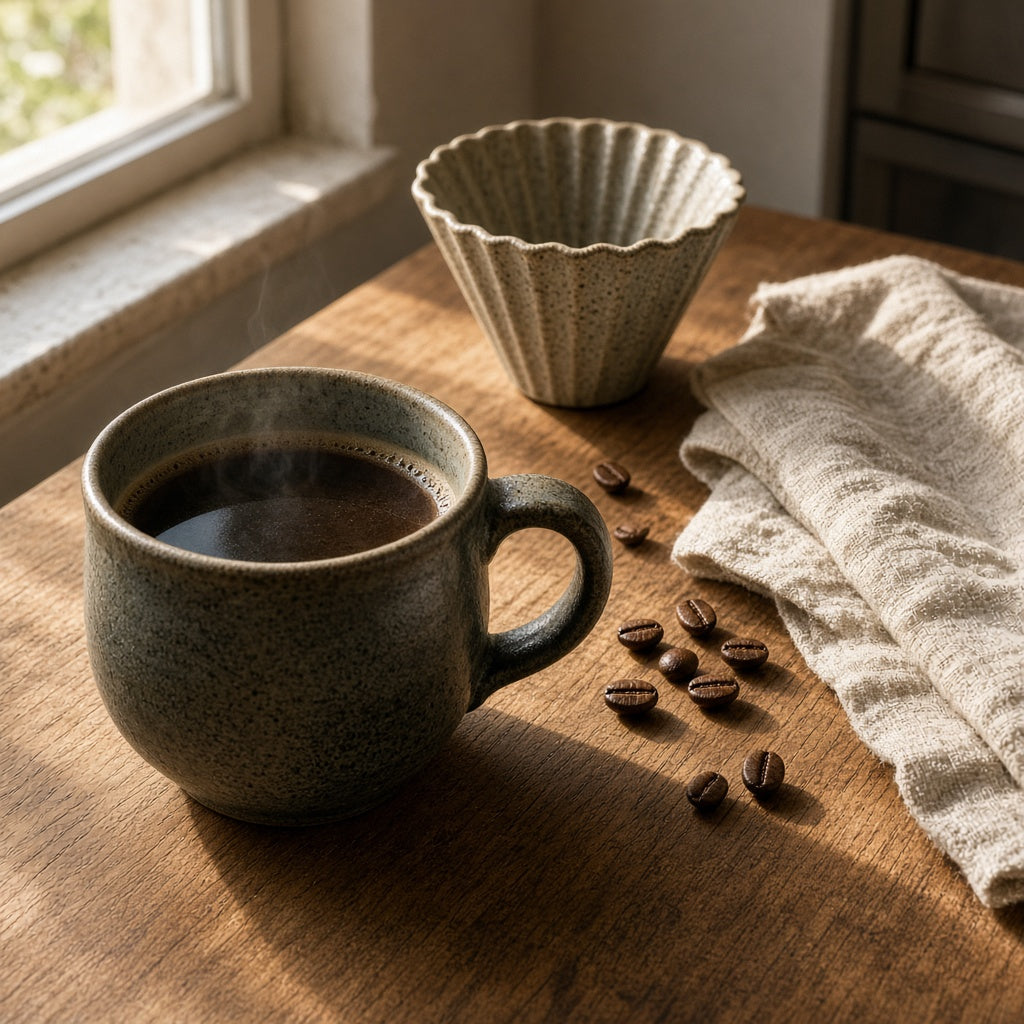
Counter Coffee Routine Ceramic Mug: What to Compare Before Buying
Reading time: about 11 minutes
The mug that lives on your counter takes more abuse than anything else in the cupboard. It gets grabbed one-handed while the kettle finishes, set down hard on tile or butcher block, refilled, forgotten, then rinsed in a hurry. A counter coffee routine ceramic mug has to survive that cycle hundreds of times, and the details that decide whether it does are rarely the ones in the product photo.
We pack, unpack, and field questions about these mugs in our store every week. The pattern in what comes back is consistent: pieces bought on looks alone, never checked against a real pour or a real wash cycle. This is the comparison order our team uses before recommending one.
Why does a counter coffee routine ceramic mug fail faster than a display mug?
A shelf mug fails by falling. A working mug fails at four wear points, and all four are mechanical rather than cosmetic.
- The rim. It meets teeth, a spoon, and the edge of a sink. A thin, sharply finished rim chips first, and a rim chip ends the mug as a drinking vessel — it is not a cosmetic flaw.
- The glaze at the lip and the interior floor. That is the food-contact surface. Worn glaze at the lip is also where coffee film sets in and staining becomes permanent.
- The foot ring. An unglazed or rough foot traps water against the counter, can mark wood, and on a porous body wicks stains up into the base.
- The handle junction. Look at where the handle meets the wall. A thick blob of glaze there can hide a thin join, and heavy mugs with sloppy joins are the ones that let go when full.
Then add thermal shock. Hot ceramic hit with cold water is the classic crack setup, and a mug already carrying a hairline is far likelier to finish the job in the sink than on the counter.
What capacity actually fits a counter pour, not a stated ounce?
Stated ounces are a maximum. Leave a finger-width below the rim — which you should — and most mugs hold noticeably less than the number on the box. The useful question is how much you pour at once, and how many times.
- Cortado, flat white, small cappuccino. A smaller vessel with a narrower opening keeps the drink in a better temperature range and makes pouring milk less frustrating.
- Standard drip or filter pour. Enough headroom that you are not carrying a brim-full mug across the kitchen. Wide, shallow bowls hold less than they appear to.
- Slow second cup at the counter or desk. A smaller pour you refill beats one oversized pour that goes lukewarm. Bernie Deitrick, the test expert behind Consumer Reports' mug testing, notes that smaller servings help retain heat and flavor and that a narrower liquid surface slows evaporative cooling.
Measure your usual pour once with a measuring cup. Two minutes, and it settles more arguments than any spec sheet.
If you already know you want a taller silhouette with a full-hand grip, the landscape tall coffee and tea mug is the first listing to check. If you want a rounder profile you can cup with both hands, compare the round coffee and tea mug. We deliberately do not quote numbers here — listings get updated and a spec frozen in a blog post ages badly. Confirm capacity and dimensions on the live product pages, and see both silhouettes side by side in our unique coffee mugs collection.
Stoneware, porcelain, or earthenware: what does the word ceramic actually promise?
Ceramic is a material family, not a safety rating. Stoneware, porcelain, and earthenware all sit under it, and they behave differently on a counter.
- Stoneware is dense and heavy. It holds heat well once warmed and shrugs off knocks better than thin earthenware, but lifting a full stoneware mug one-handed every morning is a genuine weight consideration.
- Porcelain can be thinner and lighter at the same capacity, with a tighter, smoother body. Chip risk depends more on rim thickness and how the lip is finished than on the label.
- Earthenware is typically more porous unless fully glazed. A bare interior or an unglazed foot on a daily hot-coffee mug is a fair question to put to the seller.
None of those three words tells you the piece is food-safe, microwave-safe, or dishwasher-safe. Those are three separate claims, and a listing making one is not making the others. Our guide to what coffee mugs are made of goes deeper on bodies, glazes, and finishes.
Does microwave-safe mean the glaze is lead-free?
No, and this is the assumption we correct most often. Food-contact safety and appliance convenience are unrelated questions.
The FDA sets an action level for lead in ceramic cups and mugs at 0.5 µg/mL of leaching solution, measured on the food-contact surface. Its own working description of a cup or mug is small hollowware, often around 8 fl oz, usually with a handle. Cadmium has a parallel action level for small hollowware. These are leach limits applied to the drinking surface, and no microwave label establishes them.
The FDA also explains that properly fired pottery largely binds lead in the glaze, while poorly fired pottery can let lead migrate into food or drink — and washing or boiling will not remove it. Its higher-concern list is specific: handmade pieces with a crude or irregular look, antiques, damaged or heavily worn pieces, flea-market and street-vendor finds, unknown makers, and bright orange, red, or yellow decoration. Commercially made everyday pottery is far less likely to be a problem.
A 2017 pilot study is worth knowing about because it tests the exact use case: five commercial mugs already known to contain lead were filled with coffee and tea, and lead migrated into the drinks at 0.2 to 8.6 µg/L, varying by cup rather than by beverage. The authors are explicit that this was preliminary work on lead-containing mugs, not a survey of typical mugs. Read it as a reason to ask questions, not a reason to distrust everything in your cupboard.
What that means at the counter:
- Look at the interior and the rim first — the surfaces coffee actually touches.
- Ask what testing stands behind a “lead free” claim. A claim is not a leach result; the FDA notes that some traditional pottery labeled lead-free has still shown extractable lead.
- Retire vintage, unknown-maker, and heavily worn pieces from daily hot coffee. Display is a fine second career.
- If a home lead swab reacts, stop using the piece for drinks. The FDA's guidance is that pottery showing leachable lead should not hold food or drink.
Should you preheat the mug, or just pour less and refill?
Both work, for different reasons, and neither changes what is in the cup.
Deitrick's guidance is the clearest plain-English version we have found: for a non-insulated mug, a preheated heavy mug plus a cover is the best combination for warmth. If you do not preheat, a lighter mug actually cools the coffee less, because the coffee is spending heat on warming the mug itself. Smaller surface area reduces evaporative cooling, which is why a narrower opening holds temperature longer. At equal size, weight, and shape, glass and ceramic should perform about the same.
Two habits cost nothing:
- Fill the mug with hot tap water while the coffee brews, then dump it. Thirty seconds turns heavy stoneware from heat sink into heat holder.
- Pour two-thirds and refill. Two smaller pours usually drink better than one large one that sits and stews.
Keep brew temperature separate from drinking temperature. Brew water is a recipe variable. The IARC classification of drinking very hot beverages — above 65 °C — as probably carcinogenic to humans concerns beverage temperature at the lip, not the material it is served in. Give a fresh pour a minute before the first sip.
Which appliance labels hold up on a counter coffee routine ceramic mug?
Treat each appliance claim as specific to the exact piece in front of you, and verify it on the listing you are buying.
Microwave. The USDA says only cookware manufactured for microwave use belongs in a microwave, and that microwave-safe glass and ceramic are usually labeled for it. China with metallic paint or trim is listed as not safe. For an unlabeled piece, the USDA describes a check: microwave it for one minute beside — not touching — a cup of water, and if the vessel becomes warm or hot, it is not microwave safe. Use that as a screening test, never as a substitute for the manufacturer's label.
Dishwasher. “Dishwasher safe” is a manufacturer claim about that product. In our experience, the failures customers describe are rarely detergent alone. They are collisions against other items, glaze already worn at the rim, and thermal shock from cold rinse water on a hot mug. Let it cool, load it so the handle is not taking the impact, and do not stack rims against each other.
Neither. A handmade or vintage piece with no appliance labeling is best treated as hand-wash only and kept out of the microwave entirely.
What does a weekday wash cycle do to the foot ring and the rim?
Short version: soft sponge, no cold shock, dry the foot.
- Cool before rinsing. Let the mug come down in temperature before it meets water. A hairline in the body will find the sink eventually.
- Skip abrasives on decoration and trim. A paste of baking soda and water left a few minutes on a glazed interior lifts most coffee film without dulling the surface.
- Dry the foot ring. Water trapped under the base is what produces the musty smell and, on a porous body, a stained foot.
- Stop storing damp and stacked. Rims knocking in a closed cabinet chip quietly. Leave room, or stack with a cloth between.
Our ceramic coffee mug gift and care notes cover storage and gifting handling in more detail, including what to check before wrapping one as a present.
When should a mug leave the counter for good?
- A chip on the drinking rim. Retire it. Rim chips do not improve, and they are unpleasant to drink from.
- Crazing you can feel. Fine surface crackle can be cosmetic; a network deep enough to feel, or one that darkens over time, is not something to keep filling with hot acidic coffee — especially on unglazed or older pieces.
- A crack through the body. Even a weeping hairline is done as a vessel.
- Unknown vintage or handmade with bright orange, red, or yellow interior decoration. Display only unless the maker can document leach testing.
- A reacting home lead swab. Off the counter permanently.
And be honest about the job. A counter mug is not a commuting mug: it is not built for cupholders, a bag, or holding a seal. Ceramic-lined steel travel mugs are a different product with a different body, lid, and care schedule. If your coffee leaves the kitchen, buy for that separately rather than pressing heavy stoneware into duty.
Which counter setup are you actually buying for?
Match the mug to the morning you have, not the morning you plan to have.
- Fast weekday drip, drunk standing up. Prioritize handle comfort, moderate capacity, and a rim thick enough to meet a sink. Lighter is better here, because you are not going to preheat anything.
- Slow weekend cup with a refill. A heavier stoneware body you are willing to preheat, with a narrower opening to slow cooling.
- Desk-adjacent counter with a laptop in reach. A stable footprint that does not need two hands. If you walk away mid-cup, our morning coffee mug comparison covers the walk-away scenario.
- Two people, one counter, one shelf. Stackability and matching footprints beat any single mug's charm.
Narrow the field by capacity first, then handle, then glaze and care. Both shapes we carry sit in the unique coffee mugs collection, and the live listings are the place to confirm capacity, dimensions, and appliance labeling before you commit.
Frequently asked questions
Is a counter coffee routine ceramic mug safe in the microwave if it has metallic trim?
No. The USDA lists china with metallic paint or trim as not safe for microwave use, and metal trim can arc. If the listing does not clearly state microwave-safe, treat the mug as not microwave-safe.
Can I remove coffee stains without scratching the glaze?
Yes. A baking soda and water paste left on the stained interior for a few minutes and lifted with a soft sponge handles most coffee film. Skip scouring pads, especially over printed decoration or metallic trim.
Should I preheat a heavy stoneware mug before pouring?
If the mug is heavy, yes — rinse it with hot water and dump it first, so the coffee is not spending its heat on warming the vessel. With a thin, light mug and no preheat, the coffee cools more slowly, because less heat goes into the ceramic.
How do I know a handmade or vintage mug is safe for daily hot coffee?
Often you cannot tell from appearance. The FDA flags crude or irregular handmade finishes, antiques, heavily worn pieces, unknown makers, and bright orange, red, or yellow decoration as higher concern, and notes that some pottery labeled lead-free has still shown extractable lead. Without documented leach testing from the maker, keep it as decor.
Will a 16 oz mug keep coffee hot longer than a 12 oz one?
Not automatically. More liquid holds more heat, but more surface area loses it and a larger cold body absorbs more. A preheated heavy mug with a narrower opening and a smaller pour generally holds drinking temperature better than one big pour in a wide, unheated mug.
Ready to pick your mug? Two ways to save on today's order:
Ordering 1–3 mugs? Get an extra 10% off your 1st order with code 10_OFF Apply 10% Off & Shop Wooden-Handle Mugs →
Gifting 4+ mugs? Buy 3, Get the 4th Free applies automatically at checkout (no code needed; offers do not stack) · Free standard shipping (Nov pre-Christmas delivery: 15–20 calendar days US) · Free replacement if chipped in transit.
Popular mug buying guides: Wooden-Handle Tea Infuser Mugs Compared · Christmas & Secret Santa Mugs 2026 · Espresso & Cortado Cups Guide · Cup & Saucer Gift Sets · All 25 Mugs Spec Table · Mug Size Guide · Shipping & Promo FAQ
FIRST ORDER 10% OFF (CODE: 10_OFF) · OR BUY 3, GET THE 4TH FREE


Read more
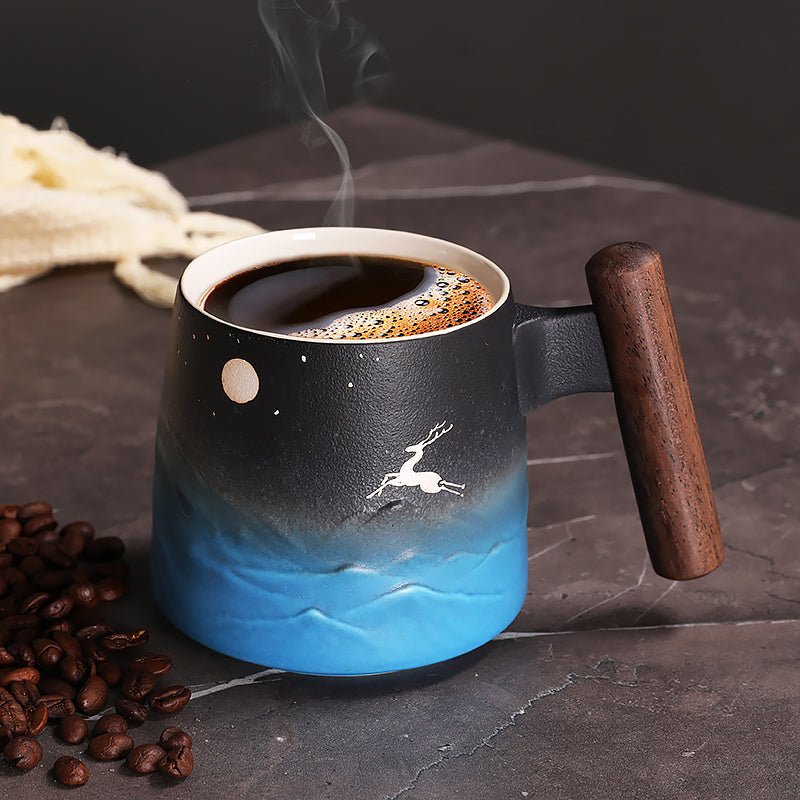
Unique Nature Coffee Mug Elk Moon: What Buyers Should Compare
A working comparison guide to the elk and moon mug: how the motif holds up in the hand, honest gift-fit trade-offs, handle and cabinet measurements, care questions, and the listing details to confi...
Read more
Landscape Mug Gift Checklist: What to Compare Before You Buy
A landscape mug gift checklist from a store that ships these every week: what a labeled capacity actually means, which finishes survive a dishwasher, why a gold rim changes the microwave rules, and...
Read more
Leave a comment
This site is protected by hCaptcha and the hCaptcha Privacy Policy and Terms of Service apply.