
Coffee Mugs With Big Handles Capacity Guide: 250, 400 & 480 ml
Reading time: about 11 minutes
Slide your fingers through the handle of the mug already in your cupboard. On most 11 oz mugs, two fingers fit, the thumb does the stabilising, and the ring finger hangs outside the loop doing nothing useful. That shortfall is what sends shoppers hunting for coffee mugs with big handles — and it is also where the decision usually goes sideways, because the handle gets all the scrutiny while capacity quietly decides whether you can lift the mug comfortably once it is full.
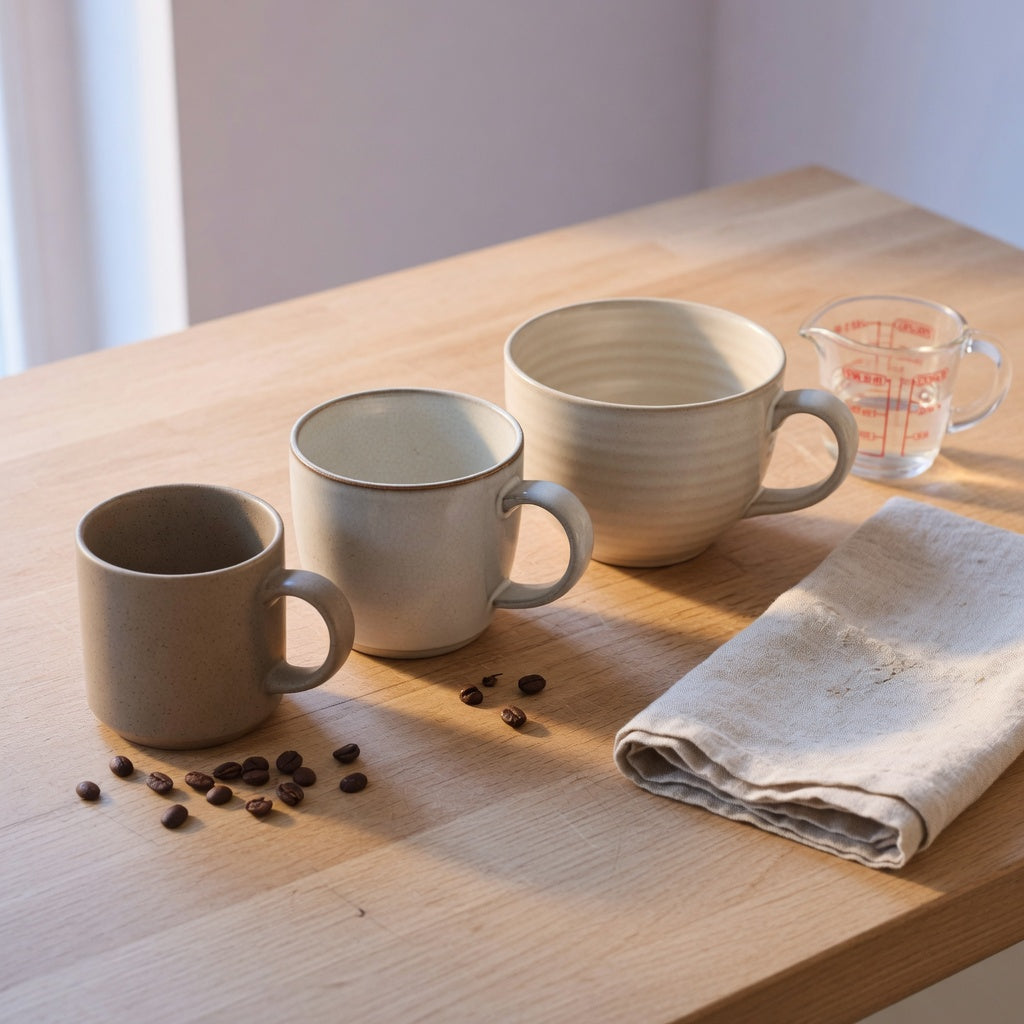
This coffee mugs with big handles capacity guide sticks to what we can state plainly about the three handled mugs we sell: the Ball Handle at 250 ml, The Flow at 400 ml, and The Rock at 480 ml. No ranking, no single winner — just listed capacity, refill pattern, and the serving routine each mug actually matches. All three sit together in our unique coffee mugs collection if you want to see the shapes side by side before reading further.
Our coffee mugs with big handles capacity guide: 250, 400 and 480 ml compared
Capacity is the number that changes the buying decision. Handle opening is the number almost nobody publishes. Here is the straight comparison of what is listed, plus the question we would want answered before ordering each one.
| Mug | Listed capacity | Handle as shown on the listing | Routine it suits | Confirm before ordering |
|---|---|---|---|---|
| Ball Handle | 250 ml (about 8.5 fl oz) | Rounded ball-style loop | Tea, short coffees, frequent top-ups | Interior opening height and width of the loop |
| The Flow | 400 ml (about 13.5 fl oz) | Curved loop handle | The default one-mug morning | Overall height if you brew single-serve |
| The Rock | 480 ml (about 16.2 fl oz) | Broad grip handle | Long desk sessions, iced coffee, slow sipping | Empty and filled weight, plus base diameter for a warmer |
Read the last column carefully. We are not going to invent an empty weight or a handle clearance in millimetres, because those figures are not part of what we can verify on the current listings, and a fabricated number is worse than no number. What the table does give you is a clear size ladder and a short list of things to go and confirm.
How to judge a handle when large is the only word on the listing
The word large is a photo caption, not a measurement. Four things decide whether a loop actually works in your hand:
- Finger count. Can two, three or four fingers pass through the clear opening? Two is the minimum most adults need to feel secure, three is comfortable, four is what large hands are usually chasing.
- Interior clearance, not exterior width. A thick handle can look enormous from across the kitchen and still leave a narrow slot inside. Measure the clear gap between the handle and the mug wall, not the outside profile.
- Distance from the hot wall. A loop set close to the body pushes heat into your knuckles faster than one set further out, even when the two loops are identical in size.
- Wrist angle when lifted. A mug you can only carry with the wrist cocked sideways will feel worse after 200 ml than a smaller mug that keeps your forearm neutral.
Do this before you order anything: measure the clear opening height and width inside your current mug's loop with a ruler, multiply the two figures, and write the result down. For context, hand-clearance work cited in cup-design research puts a minimum mean cross-section of roughly 650 mm² for two fingers to pass and about 950 mm² for three. A mug that clears 950 mm² is a genuinely different object from one that scrapes past 650 — and no product photo will tell you which you are looking at.
How much of each listed capacity actually reaches your mouth?
Listed capacity is measured to the brim, and nobody drinks to the brim. Leave the 1–2 cm of headroom that keeps coffee off your knuckles while you walk across a room, and the practical pour drops by roughly 30–50 ml:
- 250 ml (8.5 fl oz) — about 200–220 ml of drinkable liquid. One proper cup of coffee, or a full mug of tea with room to spare. Not two cups.
- 400 ml (13.5 fl oz) — about 350–370 ml usable. The size most people reach for when they make one coffee and expect it to survive an inbox session.
- 480 ml (16.2 fl oz) — about 430–450 ml usable. A single refill carries you through to lunch.
Iced drinks bend the maths. Ice displaces volume, so a 480 ml mug filled two-thirds with cold brew and topped with ice lands close to the same drinkable amount as a full 400 ml hot coffee. If iced coffee is the main job rather than an occasional one, the bigger body is not overkill — it is the only one of the three that leaves room for ice and still pours a real drink.
Does a bigger loop still help once the mug is full?
Not automatically, and this is where most large-handle roundups stop short. A 2023 study of cups for care-home residents found that participants preferred cups that were light and had a large handle, and identified cup mass, cup diameter, handle length and handle orifice area as the dimensions that matter for people with reduced strength or dexterity. The strongest performers were lower-mass cups whose opening took at least two fingers while still letting the thumb and ring finger support the cup and keeping wrist strain low.
Translated for a shopper: an oversized loop on a heavy mug is not a comfort upgrade, it is a longer lever. That is why, in our store, we would rather sell you a 400 ml mug you can lift cleanly than a 480 ml mug you carry with two hands and set down hard on the counter.
Grip thickness has its own ceiling. A biomechanics study of people with rheumatoid arthritis using spoons found that larger handle diameters were associated with less finger-joint flexion than a standard slender handle, and most participants chose a 1.50-inch built-up handle over a 1.00-inch option. Wider helps — up to the point your hand can comfortably open. Past that, the grip is simply farther to reach.
This is also the honest limit of what we can tell you here. We do not publish empty or filled weights for the Ball Handle, The Flow or The Rock in this article, because those numbers are not part of our verified listing data. If hand strength is the deciding factor for you, ask us before ordering and we will confirm what we can rather than guess on your behalf.
Which of the three fits your refill pattern?
The right mug is the one that matches how often you get up from your chair.
Small, frequent top-ups — tea through the afternoon. The Ball Handle 250 ml mug is sized for that rhythm: a fresh pour every hour rather than one that goes lukewarm by 10 a.m. It is a poor choice if your first coffee of the day is a 16 oz tumbler; you will refill it twice before you sit down.
One coffee, carried to a desk. The Flow 400 ml mug is the middle of the range and the one we would hand a first-time buyer. It holds a real mugful without becoming a two-handed object. If you routinely drink 250–300 ml at a time and dislike tipping coffee away, it is still generous — this is the mug that asks the fewest compromises of the three.
One pour across a whole meeting block, or iced coffee. The Rock 480 ml mug covers that. Be honest about the trade-off: a full 480 ml mug is the heaviest object on this page to hold one-handed at an angle, and a wider body loses heat across a larger surface. If grip strength is why you are shopping, start at 400 ml and size up only if you already carry mugs with two hands.
Where a big-handle mug will not fit: brewer, warmer, dishwasher rack, cup holder
A handle adds width in one direction and nothing in the other, which is why a mug can clear your brewer and still fight your cupboard shelf. Run four checks before ordering:
- Height under the spout. Single-serve brewers and many drip machines have a fixed dispense height. Measure from the counter to the spout, then compare with the mug height on the product page. Height, not handle size, is what usually blocks a tall mug.
- Base diameter on a mug warmer. Warmer plates are roughly saucer-sized. An oversized base overhangs the plate, heats unevenly and sits less stably than you expect.
- Dishwasher rack spacing. Big loops eat the gap between tines. On a tight rack the handle, not the body, decides where the mug goes — and a mug wedged in at an angle is exactly how handles get chipped over a year of cycles.
- Car cup holders. Handled ceramic mugs generally do not sit in cup holders, and we would not claim ours do. Treat these as desk, kitchen and bedside mugs rather than travel mugs.
Glaze, metallic coatings and hot liquid: what to check before a jumbo mug meets the microwave
Large ceramic mugs come out of a lot of different workshops, and safety performance is not uniform across them.
On 21 March 2024 the U.S. Consumer Product Safety Commission announced a recall of about 440,500 Starbucks-branded holiday gift-set mugs with a metallic coating, after reports that they could overheat or break when microwaved or filled with extremely hot liquid. The agency recorded 12 incidents and 10 injuries, including burns, blisters and one cut. A metallic finish is not automatically a problem — but a metallic-coated mug is not the one to experiment with in a microwave.
The FDA notes that lead in glazes and decorations on some traditional pottery can leach into food and drink if a piece is not manufactured and fired properly, and that washing or boiling will not remove it. Factory-made commercial ware is described as far less likely to be affected than handmade, antique, damaged, or brightly orange, red and yellow pieces of uncertain origin. When a seller claims a mug is lead free, the useful follow-up is what testing stands behind that, because the phrase carries a regulatory threshold with it.
For our own mugs, we deliberately do not print microwave or dishwasher instructions in this article. Those limits belong on each product page where they can be kept current — check the listing before you assume, and ask us if a line is missing. Body thickness also changes how a big mug behaves: a thick wall holds heat longer but takes more energy to warm through, and a handle that stays cool on a thin-walled mug can get noticeably warm on a heavy one after a long spell in the microwave.
Frequently asked questions
Is a 480 ml mug too big for one person?
For hot coffee, many people find it is more than they finish while it is still hot. It works well for iced coffee, for long desk sessions, or for anyone who wants one refill to cover a morning. If you usually drink 250–300 ml at a time, the 400 ml Flow is the better fit.
Does a 250 ml mug with a big handle still fit a large hand?
Capacity and handle opening are separate measurements, so a small mug can have a generous loop and a large mug can have a tight one. For the Ball Handle, ask us for the interior opening height and width before ordering and compare it with a mug you already own. As a reference point, published hand-clearance work puts two-finger clearance at roughly 650 mm² of opening area.
What does this coffee mugs with big handles capacity guide leave out?
Three things you should still verify: interior handle clearance in millimetres, empty and filled weight, and any third-party lead or cadmium test report. We do not publish those figures here because they are not part of our verified listing data, and independent testing of handle-joint strength and thermal shock is rare across the whole category, not just our store.
Will these mugs fit under a single-serve brewer?
Measure the clearance from your counter to the dispense spout and compare it with the height listed on the product page. Height is the constraint, not the handle — the loop sits to the side and does not affect brewer clearance. The same applies to cupboard shelves, where a tall body runs out of room before the handle does.
Which of the three should a tea drinker buy?
The 250 ml Ball Handle suits anyone who tops up often and wants each cup hot. The 400 ml Flow suits a single large tea left to cool slowly at a desk. If you brew loose leaf in volume, the extra room in the 480 ml Rock helps, but check whether you want that much liquid cooling in one go.
Still deciding? Fill your current mug with water, pour it into a measuring jug, and see what you genuinely drink in one sitting. That number, not the mug you wish you used, tells you whether to start at 250 ml, 400 ml or 480 ml. Then open the CoffeifyMug unique coffee mugs collection with the capacity already chosen, and confirm the handle clearance on the listing before you commit.
More from our blog
Read more
Coffee Mug Gifts Ideas Capacity Guide: 200, 400, or 440 ml
This coffee mug gifts ideas capacity guide compares our 200 ml, 400 ml, and 440 ml ceramic mugs by refill pattern, drink routine, and daily fit, so a gifted mug gets used instead of shelved. It als...
Read more
Large Round Coffee Mugs Capacity Guide: 400, 440 or 480 ml
Compare CoffeifyMug’s 400 ml, 440 ml and 480 ml round mugs by serving routine, refill habits and practical fit. See which size works for black coffee, milk drinks, tea, desk use and gifting.
Read more
Leave a comment
This site is protected by hCaptcha and the hCaptcha Privacy Policy and Terms of Service apply.