
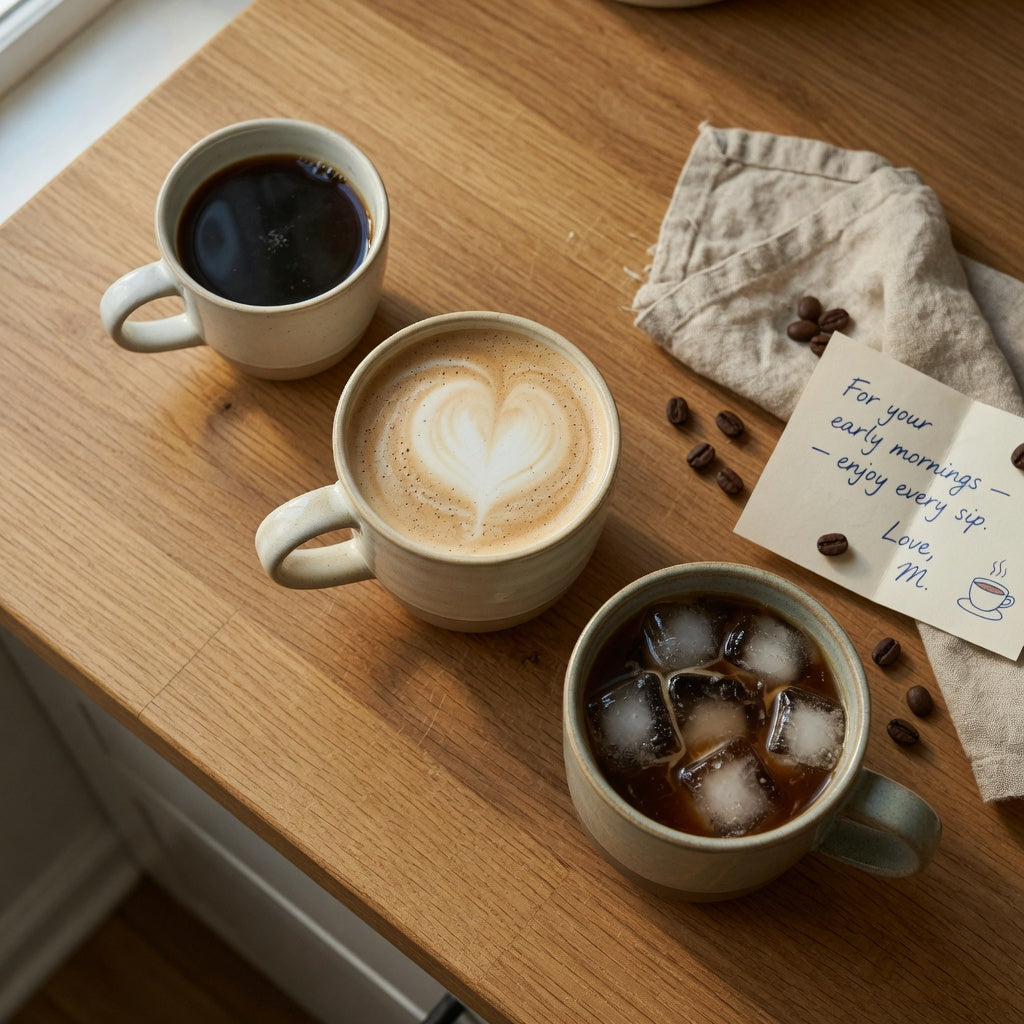
Coffee Mug Gifts Ideas Capacity Guide: 200, 400, or 440 ml
Reading time: about 10 minutes
A colleague once unwrapped four mugs at a single birthday lunch. Three went into a cupboard and never came out again. The one that survived held roughly the amount of coffee she drinks before her first meeting, so it earned a permanent spot next to her keyboard. That is the filter this coffee mug gifts ideas capacity guide uses: not design first, but how much the recipient actually pours.
Design gets a mug opened. Capacity decides whether it gets used on a Tuesday in February, six months later. Below we compare only the three ceramic sizes we currently stock — 200 ml, 400 ml, and 440 ml — against the things a recipient notices after the wrapping paper is gone: working fill level, refill pattern, and where the mug lives during the day. In our store, the most common size question is not which mug looks best; it is which one will not end up at the back of the cupboard.
What does the listed capacity actually pour once coffee is in the mug?
Treat the number as the ceiling, not the pour. Nobody fills a mug to the rim and then carries it across a kitchen. You fill to a working level, usually a centimeter or two below the edge, so the drink does not slosh and there is still room for milk, foam, or a spoon. A 200 ml mug does not serve 200 ml in practice — it serves a short drink comfortably. A 440 ml mug is the one that takes a long pour plus a generous splash of milk without threatening the rim.
That headspace rule is why two mugs 40 ml apart can feel more different than the numbers suggest. So instead of asking shoppers to think in milliliters alone, we ask them to think in refill patterns:
- Sippers take a small hot drink, often twice, and rarely finish a large one.
- Loop drinkers pour one big mug, drink it over an hour, and top up once.
- Desk drinkers treat the mug as furniture — it needs to hold a long drink through a meeting block without running dry.
200 ml, 400 ml, and 440 ml side by side
| Listed capacity | Drinks it suits | Refill pattern | Skip it if |
|---|---|---|---|
| 200 ml — Pleated | Cortado, flat white, short americano, small pot of tea | Two short pours rather than one big one | They drink drip by the pint, or commute with a large travel mug |
| 400 ml — The Flow | Home drip, americano, builder's tea, one splash of milk | One pour, occasional top-up | They drink espresso only, or keep a tight cupboard |
| 440 ml — Morning and Night | Latte, iced coffee with ice, all-morning desk mug | One long pour, rarely refilled | They drink tea in small cups, or prefer a compact mug in hand |
If you would rather browse by finish than by number, our collection of unique coffee mugs groups the current range in one place.
Which one fits an espresso habit, a drip loop, or an all-morning desk session?
Small, strong, and repeated: the 200 ml Pleated cup
The Pleated coffee and tea cup is our 200 ml option, and it is the right gift for someone whose coffee is a ritual rather than a volume — a cortado before the school run, a flat white mid-afternoon, a small pot of tea after dinner. It also suits a guest cup or a bedside table, where a full 400 ml would go cold half-drunk.
What it is not good for: anyone who fills a mug once and expects it to last an hour of back-to-back calls. They will be walking to the kettle twice as often, and they will resent it. If that sounds like your recipient, move up. For a wider look at ceramic mug gifts, our guide to unique ceramic mugs for coffee lovers covers what buyers should compare beyond size.
One big pour, one top-up: the 400 ml Flow mug
The Flow coffee and tea mug at 400 ml lands in the range most people picture when they hear the word mug. It carries a full drip pour with room left for milk, which makes it the safest gift when you do not know the recipient's exact habit but do know they drink coffee at a desk or kitchen table every morning. When in doubt, this is the size we point people toward.
Its limits are real, though. If your recipient drinks espresso only, 400 ml is a lot of empty surface and a drink that cools before they finish it. If their cupboard is tight or they simply prefer a small cup in hand, the 200 ml serves them better.
Long drinks and milk-heavy orders: the 440 ml Morning and Night
The Morning and Night coffee and tea mug is the 440 ml option, and it is the one we recommend for latte drinkers, iced-coffee drinkers, and anyone who measures a good morning by how long the mug stays full. Ice is the argument people forget: cubes displace liquid, so a mug holding iced coffee plus ice delivers noticeably less drink than the printed number suggests. The extra volume buys some of that back.
It is not the right gift for someone who drinks tea in small cups, or who has said out loud that they own too many mugs. A big mug that never gets filled is clutter with a handle. If they commute with coffee, none of these ceramic mugs is a travel mug; choose a lidded insulated model instead.
Does 40 ml between the 400 and the 440 actually change anything?
It changes three things, and none of them is dramatic in isolation.
- Milk allowance. 40 ml is roughly two and a half tablespoons — about the gap between a modest splash and a proper pour in a homemade latte.
- Ice displacement. Fill either mug with ice and usable drink shrinks. The larger mug keeps an iced coffee from tasting like a half portion.
- Cooling behavior. A slow drinker gets more usable minutes from the bigger volume; a fast drinker who likes their coffee hot loses nothing by choosing the smaller one.
For black-coffee drinkers, 400 ml is plenty and 440 ml is simply more to carry from the kettle. For milk-heavy or iced orders, the 440 earns its keep.
Handle, rim, and glaze: what a capacity figure cannot tell you
Capacity is the only hard number we compare here, deliberately. A milliliter figure is verifiable; a comfortable handle is not. On our packing table, we check the details the number leaves out.
- Handle opening. Can two fingers fit, or three? A chunky loop suits a large mug; a slim one suits a small cup. Side-on photos are far more useful than front-on shots.
- Rim thickness. A thin rim reads as delicate and suits tea and espresso; a thicker rim feels sturdier against the lip.
- Finish. All three of our mugs are finished in visible ceramic, and the glaze is part of the look. Glaze is visual and tactile — it is not a durability guarantee, and on its own it tells you nothing about dishwasher or microwave behavior.
If dishwasher and microwave safety matter to your recipient — and for a mug used daily, they usually do — read the care section on the individual product page rather than assuming. Dishwasher safe and microwave safe are separate claims, and metallic rims or surface decals are the usual reason a mug passes one test and fails the other.
Should you worry about glaze safety on handmade or imported mugs?
Most gift round-ups skip this. We do not, because a mug is food-contact ware and shoppers ask us about it.
The FDA sets an action level of 0.5 µg/ml of leaching solution for lead in ceramicware cups and mugs, referenced to Compliance Policy Guide 545.450. Its guidance notes that lead can be present in glazes or decorations on some traditional pottery, that washing or boiling will not remove it, and that lead-free labeling has limits — FDA guidance states ceramicware with extractable lead should not carry that label at all. Commercially made everyday ceramic is described as much less likely to be a problem than crude, antique, damaged, or uncertain-origin handmade pieces, and brightly orange, red, or yellow decoration is flagged as higher concern.
The practical version: for a daily-use gift, buy from a seller who states the piece is intended for food use, and avoid anything sold purely as decoration or marked not for food use. That is a safety rule, not a knock on handmade work — plenty of studio pottery is made to food-contact standards.
What if the person already owns too many mugs?
This is the real objection, and it is fair. People who say they do not want mugs usually mean they do not want a fourth mug that duplicates what they already have. Two moves fix that.
- Give a capacity they do not already own. Most households have one mid-size mug and nothing smaller or larger. A 200 ml cup for after-dinner tea, or a 440 ml mug for the long Sunday coffee, adds a role rather than another body in the cupboard.
- Make it specific, or make it a set. A mug that is clearly for one person — a name, an in-joke, a color that matches their kitchen — gets kept. A generic printed mug is the one that gets re-gifted.
Filling the mug helps as well: a bag of coffee that fits inside, a box of tea, a chocolate, a handwritten note. An empty mug reads as an afterthought; a filled one reads as a gift.
Coffee mug gifts ideas capacity guide: the 60-second pre-checkout list
- Name the drink: espresso-based, drip, tea, or iced.
- Name the refill pattern: small and repeated, one big pour, or all-morning.
- Pick the closest listed capacity: 200 ml, 400 ml, or 440 ml.
- Check the product page for the care details that matter to them — dishwasher, microwave, metallic trim.
- Confirm the handle and rim look right in a side-on photo.
- Add something that fits inside the mug so it arrives as a gift, not a vessel, and write the care details on a card.
Frequently asked questions
How do I use this coffee mug gifts ideas capacity guide to pick a size?
Start with the drink, then the refill pattern. A short espresso-based drink points to 200 ml, a standard drip or desk coffee to 400 ml, and a milk-heavy or iced routine to 440 ml. Confirm care details on the listing before you buy.
Is 400 ml enough for a large coffee?
For most home drip pours, yes — 400 ml holds a full mug with room for a splash of milk. If your recipient drinks milk-heavy lattes or iced coffee with ice, step up to 440 ml, because ice and foam both take up space the listed capacity does not account for.
What size mug should I give someone who already has mugs?
Go smaller or larger than the standard. A 200 ml cup covers after-dinner tea and short espresso drinks; a 440 ml mug covers long milk drinks and desk sessions. Either one adds a job the existing mugs do not do.
Can I put these ceramic mugs in the dishwasher or microwave?
Read the care section on the individual product page before you buy. Capacity and finish are the only specs we compare here, and dishwasher and microwave claims are separate from both. Metallic rims and surface decals are the usual reasons a mug is fine in one appliance and not the other.
How do I know a handmade or imported mug is safe for daily use?
Buy from a seller who states the piece is made for food use, and avoid anything sold as decorative or marked not for food use. The FDA guidance on lead in traditional pottery is worth reading if you are considering antique, damaged, or uncertain-origin ceramics.
Still deciding? Start from the drink rather than the design: a short espresso habit points to the 200 ml Pleated cup, a single big morning pour to the 400 ml Flow mug, and a milk-heavy or iced routine to the 440 ml Morning and Night mug. Compare the three listings, confirm the care details for the person receiving it, and you will have picked a mug that survives past the first week on the shelf.
More from our blog
Read more
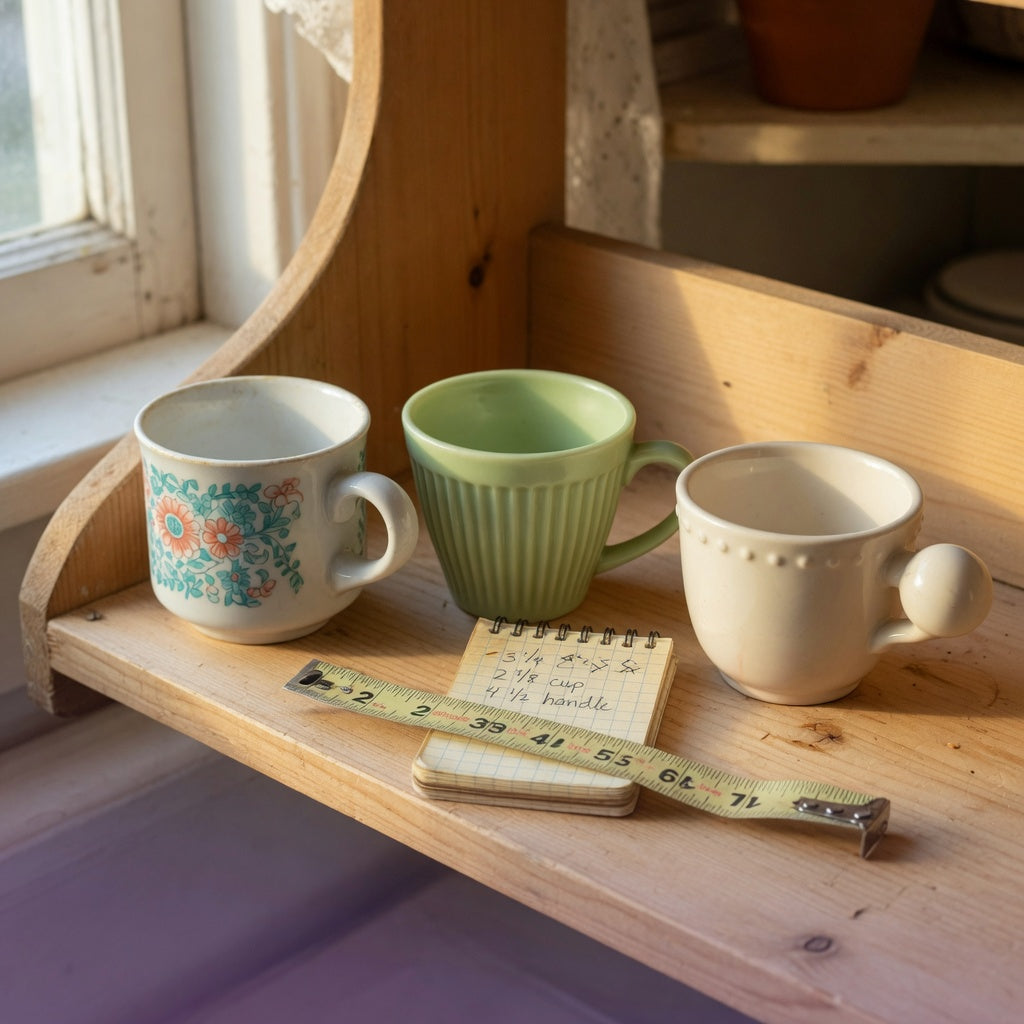
Unique Espresso Cups Storage Fit Guide: Shapes and Shelf Needs
Handle projection, base diameter, and listed capacity decide whether a distinctive cup actually fits your shelf and your machine. Here is how to measure before you buy.
Read more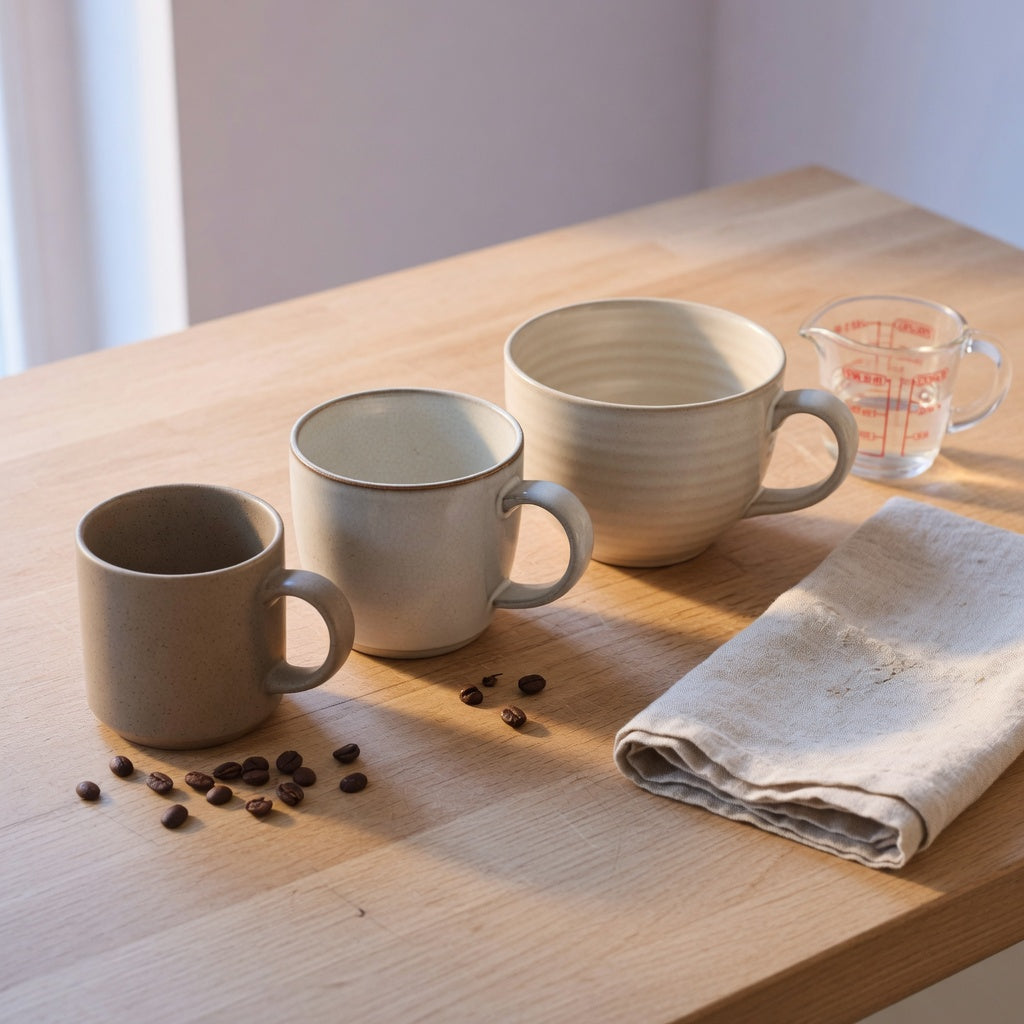
Coffee Mugs With Big Handles Capacity Guide: 250, 400 & 480 ml
A capacity-first comparison of the three handled mugs we sell — 250 ml Ball Handle, 400 ml Flow, 480 ml Rock — covering what each really pours, how a big loop behaves once the mug is full, and whic...
Read more
Leave a comment
This site is protected by hCaptcha and the hCaptcha Privacy Policy and Terms of Service apply.