
Coffee Mug for Home Decor Enthusiasts: What to Compare
Reading time: about 15 minutes
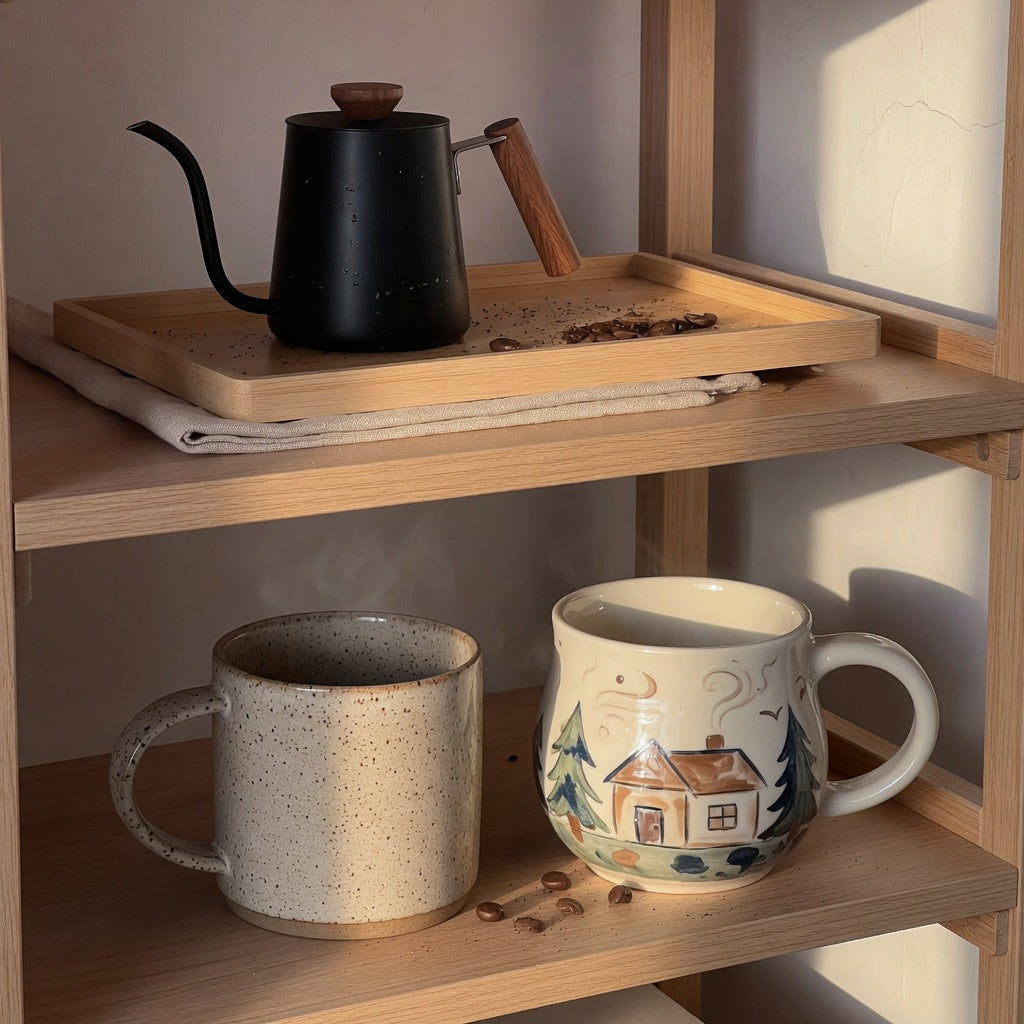
The mug that looks right on the rail above the coffee maker is often the one that comes back with a chipped foot, or with the picture half gone, after a month of real mornings. In our store that shows up at unboxing: the color works against the backsplash, then a small card says hand wash. A coffee mug for home decor enthusiasts is being asked to do two jobs. It has to hold a place in the room, and, if you drink from it, survive heat, detergent, and a lip that meets your mouth.
Styled photos hide a narrow handle and a gold line. If the Planet Coffee Tea Mug is the piece you keep circling, open the current listing and read it as a listing, not a finished decision. Confirm the material, the stated capacity, how the handle is built, and every care line on that page. The name does not tell you whether the art is fired into the glaze, printed on the surface, or trimmed in metal. We will not guess those facts from a similarly named mug or from the photograph.
What should a coffee mug for home decor enthusiasts survive besides a styled photo?
On an open coffee bar the mug is part of the room. At breakfast it is a tool. Shoppers who only score the first job end up with a shelf object they resent washing.
For the room, we compare three things with customers at the counter:
- Color against what is already there: oak, stone, white tile, black hardware. A glaze that looked calm on a white background can fight a warm kitchen.
- Shape from across the room. Straight walls, a wide foot, or a tall handle read as a collection. A tiny souvenir cup disappears between canisters.
- Finish. Gloss throws under-cabinet light. Matte, speckled, and reactive glazes look softer, show fingerprints faster, and will not match piece to piece the way a solid gloss can.
For the hand, compare the lip, the handle, and the sink. A thick decorative rim looks substantial and can dribble. Finger room matters when the mug is full of hot coffee, not empty on a styled table. Be honest about the household. Hand wash is a fair plan for a guest cup. It is a bad plan if every mug goes into the machine after dinner.
A piece sold only as ornament is not a starter mug for a weekday coffee setup. Liking the illustration does not make the interior food-safe.
Stoneware, porcelain, earthenware, or glass on a coffee-bar shelf
The body is what you lift, and what chips when two mugs knock in the rack. One maker’s care card does not transfer to the next piece, even when both are called ceramic. Use the table as a filter, then confirm the row against the listing in front of you.
| Body | How it usually sits on a shelf | What to verify before daily use |
|---|---|---|
| Stoneware | Heavier visual weight; matte and speckled glazes sit naturally on a casual coffee bar | Rim and foot chips, glaze fit, and whether dishwasher or microwave language covers this exact piece |
| Porcelain | Brighter, often thinner walls; easier to blend into a quiet, pale kitchen | Whether color is under the glaze or a surface decal; a thin rim chips against a steel sink |
| Earthenware | Warmer and more collected; often the rustic mug people want in a group | That it is sold as foodware, not ornament; lower-fired clay needs a glaze meant for hot drinks |
| Glass | Shows the coffee and reads modern on a bar | Thermal-shock wording, any metal paint, and the glass type named on the page—do not infer it from a clear photo |
Stoneware is what many of our decor-minded shoppers reach for first, because the silhouette has presence on an open shelf. The trade-off is weight once it is full, and a foot that chips when it taps a steel sink. Porcelain suits a kitchen that wants less visual noise: thinner walls, a brighter white, easier next to pale tile. Earthenware can be the most beautiful object on the rail and still be the wrong daily driver if the seller never calls it dinnerware. Glass shows the drink, with a shock problem. A refrigerator-cold glass mug and a boiling pour are a bad pair unless the maker says otherwise.
None of these bodies is microwave safe just because it is not plastic. Two handmade mugs from the same shelf can need opposite care if only one carries metallic luster. When you want several characters rather than one clay type, compare care blocks across our unique coffee mugs before the glaze makes the decision for you.
Fired-in color versus prints, decals, and metal trim
The clay can be tough and the picture can still fail. Customers tell us the same story: the logo faded, bubbled, or lifted even though the mug was described as dishwasher safe. Separate the body from the decoration.
- In-glaze or underglaze color is fired with the ceramic. It is the decoration most likely to tolerate washing, but only that maker’s care line covers that mug.
- On-glaze decals and surface prints sit at or on the glaze. This is the group that peels when detergent, heat, and rack abrasion hit it. “Dishwasher safe” sometimes describes the ceramic, not the artwork. Look for a sentence about the design.
- Sublimation and vinyl show up on gift and novelty mugs. They can look sharp on day one and scuff under a sponge. If the page says hand wash, a “gentle” cycle is still a gamble.
- Metallic luster—gold, silver, or platinum on the rim or in the illustration—is a style choice and a use limit. Do not skip it because the rest of the mug is ceramic.
Matte, reactive, and speckled glazes are popular on open shelving because they read as texture, not as a flat logo. We do not have measured stain, fingerprint, or chip numbers for those finishes, so we will not call one stain-proof. Expect matte surfaces to show water spots more readily than a high gloss. Crazing, the fine crackle in a glaze, can be an intended crackle finish or a fault. If you see it on a food-contact surface and the seller did not describe it, ask before you drink from that mug.
What this kind of mug is not good for: a household that needs every cup to look identical after a year in the dishwasher. A one-off surface print will show wear before a plain gloss stoneware cup does. Buy the print if you will hand wash it, or if you are willing to let it age. Do not buy it as the indestructible everyday mug.
Lead limits, cadmium limits, and display-only ware
A pretty exterior is not a food-safety test. FDA guidance on lead in pottery and ceramics sets an action level of 0.5 micrograms of lead per milliliter of leaching solution for cups and mugs, judged on any one of six units tested. That guide explains that some ceramic foodware can leach significant lead from surfaces that touch food, that food can pull the metal out, and that continued food use can cause harm, including chronic lead poisoning.
In the same guide, cups and mugs are small ceramic hollowware commonly used for coffee or tea served above room temperature. They normally, though not always, hold about 240 milliliters (8 fluid ounces) and are made with a handle. The guide treats a cup as having curved sides and a mug as having straighter, cylindrical sides. That 8-ounce figure is how the agency classifies the ware. It is not a rule that your coffee-bar mug must be 8 ounces, and it is not the brim-full number you should expect on a modern product page.
Cadmium has a separate FDA action level: 0.5 micrograms per milliliter for small hollowware and 0.25 micrograms per milliliter for large hollowware, again on any one of six units. Small hollowware in that guide means a capacity under 1.1 liters. The guide states that acid foods can extract cadmium from ceramic ware and that continued food use could lead to chronic cadmium poisoning.
Those checks point to laboratory methods, including the current edition of ASTM C738, which extracts lead and cadmium from glazed ceramic surfaces with acetic acid. The extraction is described as a severe test, harsher than ordinary home use. A drugstore swab is not that test. A wipe on the outside does not clear the interior glaze, and a mark on an unglazed foot is not the same as a failure where your drink sits. If you are uneasy, buy ware the seller intends for food, and skip pieces that read as souvenirs.
Under 21 CFR 109.16, lead in glazes and decorative decals on ornamental ceramicware can move into food if you prepare, serve, or hold food in the piece. Ceramic that looks fit for food is treated as foodware unless it is clearly taken out of that use. Display-only ware needs a conspicuous “Not for Food Use” statement the buyer can see—a stick-on label—and a permanent statement on the base. The other route is a hole bored through the surface that would have held food. The word “decorative” in a product title is not that marking.
Do not treat “lead free” as a comfort blanket. FDA guidance says ware that still releases lead under the test in the lead guide should not be labeled lead free. Using that phrase on ware with extractable lead can be treated as misleading. Even when a listing makes the claim, you still want the piece sold for food contact, not as a shelf souvenir.
Skip drinking from cracked vintage ware, unlabeled imports that only look like cups, and anything bored or marked not for food. Artwork at the lip matters more than artwork on the foot, because your mouth and the drink both meet that band. If the current page never says the mug is for drinks, keep it on the shelf.
Dishwasher damage, microwave sparks, and a cold mug with a hot pour
USDA food-safety guidance describes microwave arcing as sparks inside the oven when microwaves meet gold paint on dishes, twist ties, and other metal. Prolonged arcing can damage the oven, the utensil, or both. A gold rim, a silver line on the handle, or metallic ink in an illustration is a reason to keep that mug out of the microwave even when the clay itself would be fine. There is no tilt that makes metal microwave-safe.
Dishwashers fail decoration differently: hot water, alkaline detergent, and mugs tapping the rack. If the listing says dishwasher safe, find out whether that sentence includes the print. Top rack only means do not park it beside a heating element. Hand wash only means the design was not built for the machine. We would rather a customer be slightly annoyed by a care card than send us a photo of a peeled decal.
Thermal shock is the quieter break. A refrigerator-cold mug and a boiling fill, or a hot mug dropped into a cold rinse, stress ceramic and glass. Let a decorative piece come toward room temperature before a very hot pour. Skip the microwave entirely when any metal is present. We will not quote a number of minutes a mug keeps coffee hot. Those figures wander from guide to guide, and our team has not run a timed heat test on every shape we sell.
Handmade pottery gets the same rule. A reactive glaze is not a dishwasher certification. Blistering after a machine wash is one way a glaze fails when it was never meant for that detergent and heat. If the maker is silent, hand wash it and keep it out of the microwave until you have a clear answer. An artisan mug can be the right object for a collected shelf and the wrong mug for a shared office kitchen where nobody reads the card.
Handle clearance, usable fill, and shelf depth
The FDA classification size, about 8 fluid ounces, collides with how people drink at home. Many shoppers want coffee plus milk without filling to the brim. Brim capacity is the number on the page. A practical fill sits lower, so you can walk to the table without sloshing and so milk has somewhere to go. A modern listing may state a size well above that classification figure. Read the number on the page you are buying, then leave headspace. Do not copy a capacity from a similarly named mug and assume it matches.
Measure the spot, not the mood:
- Shelf depth. A deep foot or a handle that sticks out can overhang a narrow rail and get clipped every time someone walks by.
- Handle direction. On a coffee and tea bar, turning handles the same way looks deliberate and lets you lift one mug without snagging the next.
- Cabinet height. A tall statement mug that shines on an open shelf may not clear the shelf above a closed cupboard.
- Stacking. Most decorative shapes do not nest. In a small kitchen, one sculptural mug eats more space than a simple cylinder.
- Lip and handle in the hand. A tiny handle looks neat in a photo and hurts once the mug is full of hot liquid.
Dust is the dull part of open display. Matte glaze shows fingerprints, and a rail above the stove collects a grease film. A mug you love but will not wash often belongs behind glass. Awkward, sentimental, or not-for-food pieces belong there too. Everyday drinkers can stay on the rail, where you can reach them with one hand.
Gift buys add one more fork. Will the recipient drink from it on weekday mornings, or only style it next to the kettle? If the answer is styling, a hand-wash piece is a success. If the answer is daily drinking in a busy kitchen, the care line matters more than the illustration.
One statement mug versus a quiet set for the same station
One illustrated mug is a focal point. It works when the rest of the bar is quiet: plain canisters, one wood tray, a simple kettle. It works poorly when every object is already loud. A matching set of quieter stoneware reads as dinnerware and is easier to drink from every day. The trade-off is personality. Sets rarely carry the odd illustration people fall for, and a unique one-off is a poor choice when you need eight identical cups for a table.
In our experience selling this category, the coffee mug for home decor enthusiasts that still gets used months later is the one whose care matched the household, not the one with the strongest first photo. A hand-wash piece is a success if it lives on the shelf and comes down for guests. It is a miss if it was bought to survive a family dishwasher.
If you are set on that planet design, go back to the Planet Coffee Tea Mug page and confirm where the decoration sits, whether the listing calls the mug drinkware, whether the art is included in any dishwasher claim, and whether any metal is called out before microwave use. Missing lines mean treat it as display-only until the page answers. If you want a range of characters instead of one hero mug, stay inside unique coffee mugs and compare care the same way. Neither path replaces a plain matching set when the table needs identical cups.
Cart checks before a styled mug leaves the shelf
- Use: weekday drink, guest cup, or display only.
- Body: stoneware, porcelain, earthenware, or glass, and whether that weight and color belong in the room.
- Decoration: in the glaze, on the surface, or metallic.
- Care: dishwasher, and whether the art is included; hand wash; microwave; any metal warning.
- Food contact: sold as drinkware, or truly marked not for food use with a visible label and a permanent base statement—or a hole.
- Capacity: the stated size versus the pour you make, including milk, with room below the brim.
- Fit: height, foot, and handle projection against your shelf and cabinet.
- Feel: lip and finger room. If you cannot hold a sample, read comments for a sharp rim, a tiny handle, or unexpected weight, and discount reviews that only say the mug is cute.
If the listing leaves material or care blank, do not fill the blanks from another product. Wait until the page answers, or choose a different mug in the collection whose care you can read in full.
Frequently asked questions
Will a printed design wash off even if the mug says dishwasher safe?
It can. Shoppers often find that the sentence applied to the ceramic body, not the decal, print, or vinyl. Check whether the listing mentions the artwork specifically. If it says hand wash, or stays silent about the design, do not put that mug through the machine and hope the detergent will be gentle.
Can I microwave a coffee mug for home decor enthusiasts if it has gold or silver trim?
No. USDA guidance describes sparks when microwaves meet gold paint and other metal, and says prolonged arcing can damage the oven and the utensil. A decorative rim or metallic illustration belongs out of the microwave even if the rest of the mug is ceramic. Reheat the drink in a plain, metal-free cup instead.
How can I tell a drinkable mug from a display-only piece?
Ware that looks like a cup is treated as foodware unless it is clearly removed from that use. Display-only ceramic needs a conspicuous “Not for Food Use” stick-on label plus a permanent statement on the base, or a hole through the surface that would hold food. A decorative title, a home test swab, or the phrase “lead free” is not a substitute for that status. If the listing never says you can drink from it, do not.
Are handmade pottery mugs dishwasher safe and microwave safe by default?
No. Handmade does not certify either appliance. Metallic luster, an untested glaze, or a surface that blisters in detergent can take a beautiful mug out of daily machine use. Follow the maker’s care line. If there is no line, hand wash it and keep it out of the microwave until you know.
What capacity should I compare if I add milk?
Use the capacity printed on the listing you are buying, not a number borrowed from another mug. That figure is usually brim-full. Leave room below the rim for milk and for carrying, so the styled mug does not spill on the way to the table. The FDA’s roughly 8-fluid-ounce description of cups and mugs is a classification note, not your required size.
More from our blog
Read more

Mountain Ceramic Mug for Coffee and Tea: What to Compare
Usable fill, glaze safety, handle comfort, and how the mountain is fired matter more than the photo. We walk through what to verify on a mountain ceramic mug for coffee and tea before it becomes a ...
Read more
Eggnog Gift Mug: Capacity, Shape, and Care Checks
Shoppers searching for an eggnog gift mug are choosing among slogan mugs, moose-shaped glasses, and compact cups. We compare 170 ml, 200 ml, and 270 ml by pour size and visible shape, then flag car...
Read more
Leave a comment
This site is protected by hCaptcha and the hCaptcha Privacy Policy and Terms of Service apply.