

Coffee and Tea Mountain Mug for Home Decor: What to Check
Reading time: about 13 minutes
A customer will hold up a phone photo of a pine shelf, then ask whether that same cup can take a 6 a.m. pour without the ridgeline coming off in the sink. We hear that split constantly in our store. They want a coffee and tea mountain mug for home decor: cabin or trail art that still behaves like drinkware. The photo hides the failures. A landscape print can dull or peel after one hot wash. A heavy handmade cup can feel like a display object once it is full. Glass with a mountain sitting in the base looks sharp on a counter and gets fussy when boiling water hits a cold wall.
Start with the current mountain coffee and tea mug listing, not a lookalike title from another shop. Capacity, body material, care icons, and any food-use wording have to be on that page. In our experience, copying those details from a similar name is how a cabin-shelf plan turns into the wrong cup.
A coffee and tea mountain mug for home decor has two jobs
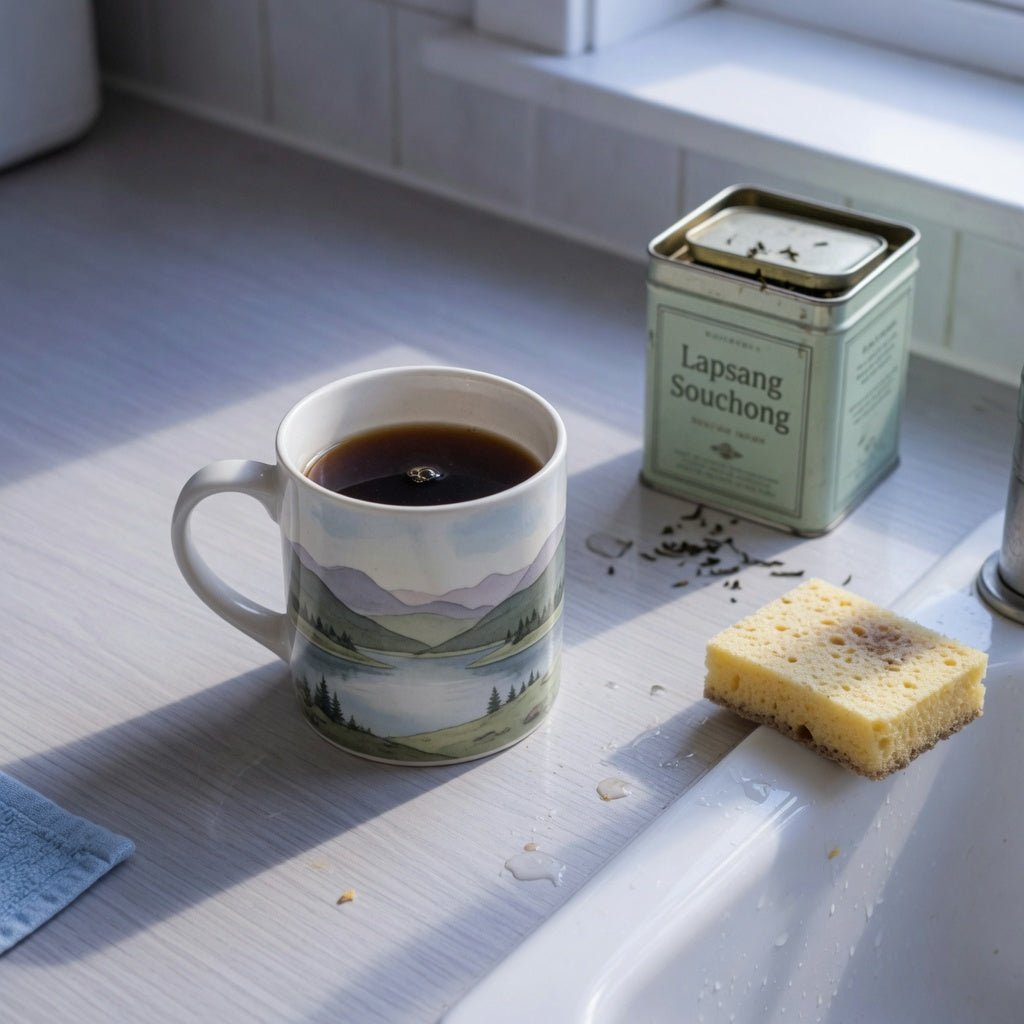
One job is the drink. Hot coffee, a black tea, or a shorter pour you finish before it cools on a stone counter. The other job is the room: an open shelf, a coffee bar, a cabin kitchen, a desk that already holds a folded map. From a few feet away the scene has to read as mountains. In the hand it still has to feel like a mug, not a souvenir you are afraid to use.
Those jobs pull against each other. A full-wrap print looks finished on a shelf because no blank side faces the room. In the hand, half the artwork sits against your palm. Carved or hand-painted stoneware often reads more like a lodge piece, and it is usually heavier than a thin printed cup. Glass with a sculpted base photographs well and stores badly in a crowded cabinet, where the base form can catch on neighboring rims.
Pick the primary job before you buy. Daily cup that also decorates, or decor that might hold a guest pour. If the listing never says the piece is for beverages, keep it on the shelf until you can confirm otherwise. A pretty ridgeline is not a care instruction.
Printed ceramic, carved stoneware, or a mountain in the glass?
Shoppers keep landing on the same four constructions. They are not interchangeable, even when the ridgeline in the photo looks similar.
| Style | What you are usually buying | Where it struggles |
|---|---|---|
| Printed landscape ceramic | A ceramic body with mountains, pines, or a cabin applied as a print, decal, or dyed coating | Surface designs can fade, scratch, or peel if they were never meant for daily heat and detergent |
| Carved or hand-painted stoneware | Clay where the scene is relief or glaze, not only ink on the outside | Heavier in the hand, more variation from the photo, chips on raised ridges |
| Stained-glass-style print | A graphic that mimics leaded glass, usually on a standard ceramic mug | Strong from across the room; durability still depends on whether color sits under glaze or on the surface |
| Mountain-in-the-base glass | Clear or tinted glass with a mountain form in the bottom, sometimes with a wood handle | Heat, microwave, and dishwasher limits, plus how the handle is attached |
Ask how the mountain is made before the styling wins. Is it a print, a glaze, a carve, or a separate piece inside the glass? Is the rustic wood real, or a wood-grain print on ceramic? A printed plank pattern will not give you texture under a fingertip on a cabin shelf. Real wood usually changes the wash rules. If there is a wooden handle, find out whether it is part of the form or attached with a fastener or glue, and whether the page restricts the microwave or dishwasher.
When this motif is only one option among several, browse our unique coffee mugs and keep those construction questions beside the tab. For a closer pass from the daily-drinker side, our mountain coffee tea mug buyer guide stays on the drink-versus-display problem.
Does 11 oz, 15 oz, or about 8 fl oz match the pour?
Capacity complaints on mountain mugs are usually a mismatch, not a mystery defect. People picture a cafe mug and unbox something closer to a tea cup.
For lead testing, U.S. regulators describe cups and mugs as small ceramic hollowware commonly used for coffee or tea served above room temperature. They normally, though not always, hold about 240 mL, which is 8 fl oz, and they normally have a handle. That picture is smaller than a lot of home coffee habits. An 11 oz mug is a modest pour with a little room under the rim. Listings in the 14, 15, and 16 oz range are what many shoppers mean by a full cup. Someone who brews one tea steep often prefers the smaller end. A wide bowl cools fast and can look bulky on a narrow shelf.
Do not trust the silhouette. A tall narrow mug and a short wide one can share an ounce rating and take very different shelf space. Read the capacity on the current page. If ounces are missing, pause. A rating measured to the rim is not a comfortable hot pour. You need space so you are not walking a full lip across the kitchen. Milk-heavy drinks, a large iced pour, or a travel-cup habit may push you off scenic ceramic. Many mountain shapes are built around hot coffee and tea, not a tumbler of ice, and a decorative rim gets awkward when the mug is filled to the top.
If the ounces on the mountain listing do not match the pour you actually drink, do not force the scene. Compare the listed capacity on each page in the unique mug collection instead of guessing from the photo.
Can you drink from the scene, or is it shelf-only?
A pretty mug is not automatically a food-contact mug. This is the check we wish more product titles spelled out.
Ornamental ceramic that looks usable for food is treated as food-use ware unless it is clearly kept out of that category. A warning only on the box, or only a sticker you can peel off, is not enough. The piece needs both a conspicuous temporary warning and a permanent statement on the exterior base. The permanent line to look for is a not-for-food warning in the spirit of "Not for Food Use. May Poison Food." A hole through the potential food-contact surface is another way a decorative object is kept out of the cupboard.
Turn the mug over when it arrives, and read any base wording on the listing before you order. If you find a permanent not-for-food statement, do not put coffee or tea in it, no matter how well the mountains suit the shelf. Washing does not convert decorative ware into drinkware.
If the base says the piece is not for food, the mountains can stay on the shelf. They do not go in the drink rotation.
Lead is why the base mark matters. Some glazes and decorative decals contain lead. Lead that moves into food is tied to harm from ongoing exposure, including effects associated with chronic lead poisoning when that use continues. For cups and mugs, the FDA action level is 0.5 micrograms of lead per milliliter of leaching solution, on any one of six units. Cited methods include ASTM C738 and specified AOAC and FDA laboratory methods. Ware above that level can be treated as adulterated because it may contain an unsafe food additive. If a tested piece still releases lead, a "lead free" label can be false or misleading. We would not treat a badge on a product page as proof by itself.
On traditional pottery, lead may sit in the glaze or the decoration. Earthenware is porous and needs a glaze to hold liquid. Proper firing binds lead into that glaze. Poor firing can leave it free to move into a drink. Everyday commercial factory pottery is much less likely to have this problem than crude handmade work, antiques, damaged pieces, flea-market finds, or pottery decorated in bright orange, red, or yellow. No amount of washing, boiling, or other home process removes lead once it is in the ware.
Mountain artwork often puts strong color near the rim, which is where a lip rests. For handmade, brightly glazed, antique, or traditional imported pottery, ask whether it was fired for food. If the seller cannot answer, leave it on the shelf. The same order of checks belongs in any coffee and tea mug home decor checklist: how it looks never outranks whether you can drink from it.
Will one hot wash fade, peel, or chip the mountain?
Care follows construction. One dishwasher icon is not a full instruction. We would rather you assume nothing and read the icons on the listing you are about to order. Shoppers regularly describe landscape graphics that look tired after a single hot cycle.
- Glazed stoneware. A mature glaze fired onto the clay usually handles daily hot drinks better than surface ink. It can still craze, take a tea stain, or chip if you stack rim to rim. Paint sitting on top of the glaze is not the same as color sealed under it.
- Sublimation or coated prints. Dye set into a coating can look sharp on day one. Harsh detergent, a heated dry cycle, or a mug that was never a proper print blank is how designs ghost or peel. If the page says hand wash only, believe it.
- Vinyl or stick-on graphics. These lift at the edges. Fine for a desk you never wash hot. A poor bet for every morning.
- Metallic accents. Gold, silver, or copper on a ridge or rim is a common reason a mug is not microwave safe, and that paint scratches in a crowded rack.
- Wood handles and wood panels. Wood swells, stains, and loosens at glue joints in a dishwasher. Microwave heat is a separate question for fasteners and glue. If the page is silent, hand wash and keep it out of the microwave until the seller says otherwise.
- Glass with an interior mountain. Ask whether the mountain is fused or a loose insert, whether the glass is clear or tinted, and whether very hot water is allowed. Glass and a sudden temperature jump do not always agree, especially straight from a cold cabinet.
On display, fading is slower but real. A window shelf in afternoon sun will dull some inks long before a closed cabinet will. If the mug is mostly decor, light matters as much as the dishwasher. Resin on the outside raises the same unanswered heat question: if the page does not say the resin can take a hot drink, do not guess.
This category is not a camp mug, and it is not what we would send through an unattended office dishwasher. It is also a weak choice if you reheat a drink every afternoon and the listing is silent or marked no. Those buyers are better with a plainly rated ceramic cup and a separate decorative object.
Where the scene faces, and who should receive it
On an open shelf, only the camera side of the design works. Put the ridgeline near eye level. On a top shelf you mostly see the rim ellipse and lose the landscape. One mountain mug between books, a small bowl, or a neutral canister reads as cabin or lodge decor. A row of competing full-color prints starts to look like a souvenir rack.
Handle direction is a buying detail, not a styling afterthought. A right-handed drinker may see the main scene only when the handle sits on the right, or the reverse, depending on how the art was wrapped. Left-handed drinkers get the mirror problem. Full-wrap art removes the blank back and creates a new choice: there is no single front, so you turn whichever trees you want facing the room. A dark interior hides tea stains and looks deeper on a coffee bar. It also hides the liquid level, which some people dislike when they are topping up.
Weight and variation matter at the unboxing, especially for gifts. Handmade mountain stoneware can outweigh a standard printed mug, and two pieces from the same design can differ where the glaze pools. That is a good match for someone who likes made-by-hand cabin objects. It disappoints someone who wanted the exact photo and a light cup for a small hand. Chips on a raised mountain show faster than chips on a smooth print, because the high points take the hit in a box or a stacked cupboard. Read any packing note the listing gives you. Ceramic and glass need real protection around the handle and the base form.
Match the person, not a generic outdoors label. A hiker often wants a ridgeline they recognize, not an anonymous peak. A cabin or farmhouse housewarming can use one statement mug more easily than a full matching set on a short shelf. If one person drinks coffee and the other drinks tea, different capacities beat forcing one scenic piece to do every pour. We use a similar screen in our gift mug checks for coffee lovers.
Skip this style for a child's everyday cup, a shared office washer, routine microwaving when the page does not allow it, or any case where food-use status is unclear. Buy a plainly rated ceramic mug and keep the mountain scene as art.
Ten lines to read before it hits the cart
Run this on the live product page. If a line is blank, ask the seller or pick a different mug. Do not fill the blank from a similar title.
- Primary job: everyday coffee or tea, guest use, or shelf decor only.
- Listed capacity in ounces, and whether that measure goes to the rim.
- Material: ceramic, stoneware, glass, or a mixed piece with wood or resin.
- How the mountain is made: print, underglaze, carve, stained-glass-style graphic, or a form in the base.
- Food-use status. No permanent not-for-food base statement if you plan to drink from it.
- Any lead or food-safe wording, read as a claim to verify, not as a certificate.
- Dishwasher and microwave icons, especially with metal, wood, resin, or a surface print.
- Handle comfort, and which way the main scene faces for the drinker's dominant hand.
- Both-side or full-wrap artwork, plus what an eye-level shelf will actually show.
- Breakage in shipping. Look for a packing note before you trust a scenic ceramic or glass piece in transit.
When that list matches a mountain scene you also want on the shelf, open the mountain coffee and tea mug and check those same lines on the current listing before you order. If you are still comparing motifs, start from the unique mug collection and keep the checklist beside the tab.
Frequently asked questions
Is a coffee and tea mountain mug for home decor safe to drink from?
Only if it is sold as food-use ware and the base does not carry a permanent not-for-food warning. Decorative ceramic that looks like a mug can still release lead from glaze or decals if it was not made for food. A sticker on the box does not settle this. Read the base and the current listing before the first pour.
Will the mountain print survive the dishwasher?
Sometimes, and sometimes it fails on the first hot cycle. Kiln-fired glaze decoration generally holds up better than vinyl or a loosely applied surface print. If the page says hand wash only, do not test that warning to save time. Sun on an open shelf can fade some inks even when you never use a dishwasher.
How many ounces should a mountain coffee or tea mug hold?
Match the listed capacity to the drink, not to the photo. About 8 fl oz is the size regulators often picture for a cup or mug, while many home coffee pours are compared in the 11 to 16 oz listings shoppers actually see. Tea often suits the smaller end. Confirm the ounce rating on the page, and leave room below the rim for a hot drink.
Are wood-handle mountain glass mugs microwave and dishwasher safe?
Do not assume either one. Wood and glue joints dislike dishwasher heat and standing water, and microwave use depends on fasteners and the glass itself. Also confirm whether very hot water is allowed, whether the mountain is a separate piece, and whether the glass is clear or tinted. If the listing is silent, treat those as unanswered, not as a yes.
Is a handmade mountain scene a good gift if it might not match the photo?
It is a good gift for someone who likes handmade cabin or trail objects and can accept glaze variation and extra weight. It is a weak gift if they wanted a light, identical-to-the-photo cup for every morning in a shared dishwasher. Name the job you are buying for, and keep display-only pottery out of the drink cupboard.
Read more
How to choose landscape mug ceramic coffee tea cup buying guide
A landscape mug has to work as a hot coffee or tea cup before the scene matters. We cover glaze contact, FDA lead and cadmium checks, appliance labels, handle clearance, and the listing lines to ve...
Read more
Gradient Ceramic Coffee Mug Buying Checklist: What to Compare
A counter-level gradient ceramic coffee mug buying checklist: glaze versus print, lip paperwork, dishwasher and microwave wording, real fill size, and when color shift is not a defect.
Read more
Leave a comment
This site is protected by hCaptcha and the hCaptcha Privacy Policy and Terms of Service apply.