
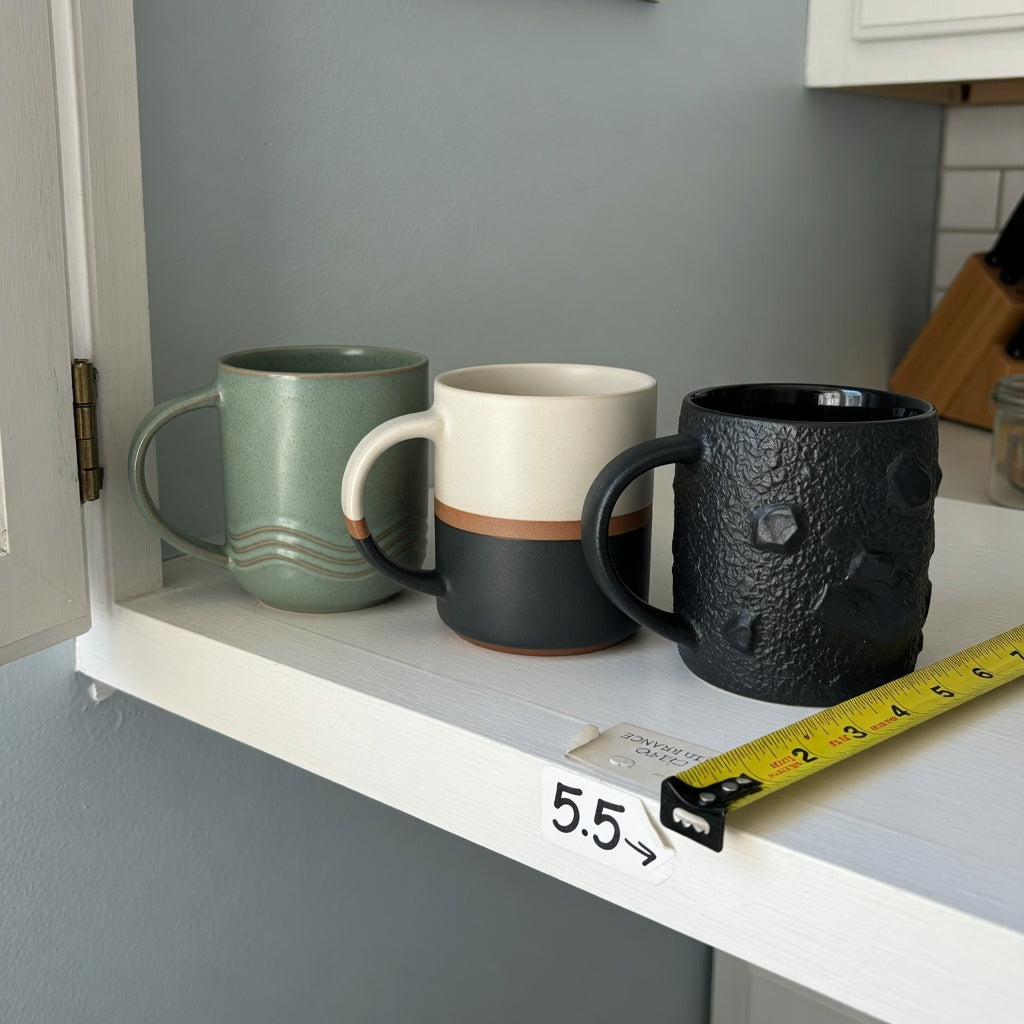
Chai Tea Mug Storage Fit Guide: 400-480 ml Shelf Comparison
Reading time: about 9 minutes
A cabinet door can clear a mug's body and still strike the outer edge of its handle. The same mug may fit while standing alone but become awkward once neighboring handles overlap or the shelf above blocks a comfortable lift. This chai tea mug storage fit guide focuses on those everyday problems: usable shelf depth, handle projection, vertical clearance, and the room required to remove a larger mug without knocking the one beside it.
We sell and handle these mugs, so we separate verified product facts from visual estimates. The current tea-friendly options are The Flow at 400 ml, Morning and Night at 440 ml, and The Rock at 480 ml. Their catalog descriptions support tea use. The verified information supplied for this comparison does not include a complete set of external height, body width, base width, or handle-projection measurements, so we will not turn capacity into invented dimensions. Use any current measurements shown on the live product pages, then compare other shapes in our unique coffee mugs collection if your shelf needs a different profile.
What does the chai tea mug storage fit guide reveal about capacity?
Capacity describes how much the mug holds, not how much cabinet space it occupies. A 480 ml interior can be created through added height, a fuller body, or a combination of both. Handle geometry adds another variable. In storage terms, handle projection is the distance from the mug body to the handle's outermost edge, while usable shelf depth is the space from the back of the cabinet to the inside of the closed door.
| Current mug | Verified capacity | Visible form cue | Best starting scenario |
|---|---|---|---|
| The Flow | 400 ml | A flowing, less block-like visual profile in the current presentation | A buyer starting with the lowest-capacity option because shelf space is limited |
| Morning and Night | 440 ml | A balanced middle-ground presence | A buyer who wants more capacity than 400 ml without moving directly to the largest option |
| The Rock | 480 ml | The most substantial visual presence of the three | A buyer with a dedicated shelf, open tea station, or roomy desk area |
These visual cues help with shortlisting, but they are not dimension claims. The Flow's lower capacity does not prove that every external measurement is smaller, and The Rock's higher capacity does not tell us exactly how many centimeters its handle needs. Actual fit depends on the complete exterior shape and the direction in which you store the handle.
How do you measure cabinet depth and handle projection at home?
You do not need specialist tools. A ruler or tape measure, a removable piece of painter's tape, and one mug that already fits can reveal the restrictions that matter.
- Mark the safe depth line. Put your existing mug fully against the cabinet's back panel and close the door slowly. Mark the furthest safe position on the shelf. Account for a raised inner door panel rather than measuring only to the cabinet's front frame.
- Check vertical clearance. Measure from the shelf surface to the underside of the shelf above. Include any front lip that could catch the rim while you lift the mug out.
- Test the stored handle direction. A handle facing forward uses depth. A handle turned sideways uses row width. Try both orientations with your current mug and note which leaves a clean path around hinges and neighboring pieces.
- Measure the complete width. If a product page lists overall width, confirm that it includes the handle. Body diameter alone will not tell you whether two mugs can sit beside each other.
- Leave retrieval room. Fit is not just a mug sitting motionless. Your fingers need space around the handle or body, especially on a high shelf where sliding a full mug sideways is inconvenient.
If your current mugs already touch the door, shelf lip, or each other, a larger-capacity mug deserves a cautious fit check. Do not rely on a shelf measurement taken from the front trim alone. The door, hinges, and the angle of your hand can all reduce usable space.
Which current shape matches your shelf and serving size?
The Flow 400 ml for the most cautious starting point
The Flow is the first product we would compare for a buyer who wants a larger chai serving but has limited spare cabinet room. Its 400 ml capacity is the lowest of the three verified options, and its current presentation reads as less visually block-like. That combination makes it a sensible starting point, not a guaranteed smallest footprint.
This option fits the shopper whose current mug feels undersized but whose cabinet cannot absorb a major change. Check The Flow product page for current photos and any listed measurements before ordering. It is not the right choice if 400 ml is already below your preferred serving size.
Morning and Night 440 ml for a capacity compromise
Morning and Night sits 40 ml above The Flow and 40 ml below The Rock. That makes its 440 ml capacity the straightforward middle choice for someone who wants more room for tea but does not automatically need the largest mug in the group. Its visible form also reads as the middle ground rather than an extreme at either end.
We would point a shopper here when a 400 ml mug sounds limiting, the shelf has some free space, and a dedicated large-mug area is not available. The trade-off is that middle capacity does not guarantee middle exterior dimensions. Inspect the handle position and compare any live measurements with your marked safe depth line.
The Rock 480 ml for dedicated storage space
The Rock has the largest verified capacity at 480 ml and the most substantial visual presence of these three products. It makes sense for a buyer who values the biggest serving in the current group and already has a roomy shelf, counter-based tea station, or office desk area. The capacity also means more liquid can be carried when filled, which is worth considering if the mug will be stored on a high shelf.
This is not the option we would choose blindly for a shallow, crowded upper cabinet. Open The Rock product page, inspect the body and handle from the available angles, and confirm your storage route before checkout. Its extra capacity is useful only if the mug remains easy to store and retrieve.
Where will the mug live: closed cabinet, open shelf, or desk?
The same shape behaves differently depending on its permanent location. We ask shoppers to decide where the mug will live before settling on capacity.
- Closed upper cabinet: Door clearance and hinge intrusion matter most. The Flow is the cautious first comparison, while Morning and Night may suit a shelf with a little more breathing room.
- Open floating shelf: There is no door to strike the handle, but excessive overhang leaves the mug exposed to bumps. Turn the handle sideways if the shelf is shallow and wide enough for that orientation.
- Counter tea station: Vertical clearance is usually less restrictive, but the mug still needs a stable resting area away from the counter edge. The Rock becomes more practical in this setting.
- Office desk: Check the handle against your mouse hand, notebook, monitor stand, and charging cables. A 480 ml mug may suit a long desk session, but it also claims more working space.
- Gift purchase: Storage is difficult to judge without seeing the recipient's kitchen. The lowest-capacity option is a more cautious starting point, but asking about cabinet space is more reliable than assuming universal fit.
How do handle spacing and care affect long-term storage?
A mug can fit on day one and still be frustrating during daily use. In our experience, the vulnerable moments are removal, replacement, drying, and contact with neighboring pieces. The rim and handle edges are common impact points across the mug category, and repeated collisions can cause marks, scuffs, or chips depending on the product's material and finish.
- Leave enough space to grip the handle without pulling the next mug forward.
- Avoid interlocking handles in a crowded row. They save little room and can make two mugs move at once.
- Let the mug dry fully before placing it in an enclosed cabinet.
- Do not plan on vertical stacking or nesting unless the current product information explicitly supports it.
- Check the live material and care instructions before a dishwasher cycle. Cabinet fit does not establish dishwasher suitability or rack clearance.
Product photography can show shape, but it should not be used to guess material, weight, dishwasher compatibility, or special temperature performance. Those details need to come from the current product listing. This guide covers storage fit and serving capacity only.
When is a smaller or different mug style the better buy?
These larger-capacity mugs are not good choices for every kitchen. A very shallow cupboard, a narrow camper cabinet, or a shelf already packed with overlapping handles may work better with a smaller, straighter-sided mug. A handleless cup can reduce projection, although it also changes grip and may not suit someone who strongly prefers a handle.
A different product category is also better for sealed commuting or compact travel storage. The verified facts here do not support claims about included lids, leak resistance, chai ingredients, brewing tools, or other accessories. If your main requirement is nesting, spill control, or fitting inside a bag, choose a purpose-built travel vessel instead of forcing a larger open mug into that role.
Frequently asked questions
Which option in the chai tea mug storage fit guide should I check first for a shallow cabinet?
Start by inspecting The Flow because its 400 ml capacity is the lowest of the three current options and its visible profile appears less block-like. That is a shortlisting reason, not proof that it has the smallest external dimensions. Compare current product measurements and photos with your cabinet's safe depth line.
Does 400 ml mean The Flow has the smallest outside dimensions?
No. Capacity measures internal volume, while exterior fit depends on height, body width, base shape, wall construction, and handle projection. The Flow is the lower-capacity starting point, but only complete external measurements can confirm which mug occupies the least shelf space.
How much extra cabinet room should I allow for a mug handle?
Allow enough room for the handle's outer edge plus a practical margin for your fingers and the cabinet door. We do not provide an invented clearance number because the verified information does not include exact handle projection. Use listed overall width where available and test the same handle orientation with a mug you already own.
Can I stack these mugs to save shelf space?
Do not plan your cabinet around stacking unless the current product page specifically confirms that the shape is designed for it. An unsupported stack can put pressure on rims, handles, and interior surfaces. Side-by-side storage is the more cautious plan when stackability is not stated.
Which capacity is the safest gift choice when I cannot measure the recipient's shelf?
There is no universal fit, but The Flow at 400 ml is the cautious first comparison because it has the lowest verified capacity. Morning and Night at 440 ml suits someone who prefers a middle serving, while The Rock at 480 ml is better reserved for a recipient known to have generous storage. For more visual options, compare the current mug shapes in our collection.
Next step: choose your preferred capacity, inspect the live product photos and listed dimensions, mark your cabinet's safe depth and height, then test the handle direction with a mug you already own. If any one of those checks fails, move down in capacity or compare a different profile in the collection before ordering.
More from our blog
Read more
Two Tone Ceramic Coffee Mugs Storage Fit Guide: Shelf Needs
Compare the visible profiles of the Gradient, Green Waves, and White Golden Waves Tall mugs, then measure cabinet height, handle clearance, and shelf depth. This guide separates product-page facts ...
Read more
Ceramic Mug With Wooden Handle Size Decision Guide: 400 or 480 ml
Compare The Cloud at 400 ml with Mountain Sea II at 480 ml using your measured pour, preferred vessel profile, and visible handle shape. This guide also explains what capacity cannot tell you about...
Read more
Leave a comment
This site is protected by hCaptcha and the hCaptcha Privacy Policy and Terms of Service apply.