
Two Tone Ceramic Coffee Mugs Storage Fit Guide: Shelf Needs
Reading time: about 8 minutes
A mug can sit comfortably on a shelf and still be difficult to put away. The rim catches the shelf above, the handle clips the cabinet face frame, or the closed door presses against the handle. This two tone ceramic coffee mugs storage fit guide starts with those practical failure points because capacity alone does not describe how a mug occupies a cabinet.
In our store, we evaluate storage fit through four separate variables: body height, overall width including the handle, usable shelf depth, and the path your hand needs to remove the mug. We also keep product facts separate from general storage advice. Where a linked product page does not provide a measurement, we will not estimate one from a photograph.
Why can a mug fit the shelf but fail at the cabinet opening?
The inside of a cabinet is often larger than its usable opening. Face frames reduce width, shelf lips reduce height, and concealed hinge arms can occupy the exact space where a handle needs to pass. Under-shelf baskets and lighting create similar problems.
Handle projection deserves particular attention. The body diameter does not represent the mug's total width; you need the distance from the side opposite the handle to the handle's outermost point. A comfortable loop can fit inside the cabinet yet catch the frame every time you pull the mug forward.
- Clear opening height: Measure from the shelf surface to the lowest frame, shelf, light, or rack above it.
- Usable shelf depth: Measure from the back panel to the inside surface of the closed door, accounting for hinges.
- Overall mug width: Include the full handle rather than measuring only the ceramic body.
- Retrieval space: Allow enough room to grip and lift the mug without striking another rim or handle.
Two tone ceramic coffee mugs storage fit guide: which shape needs more room?
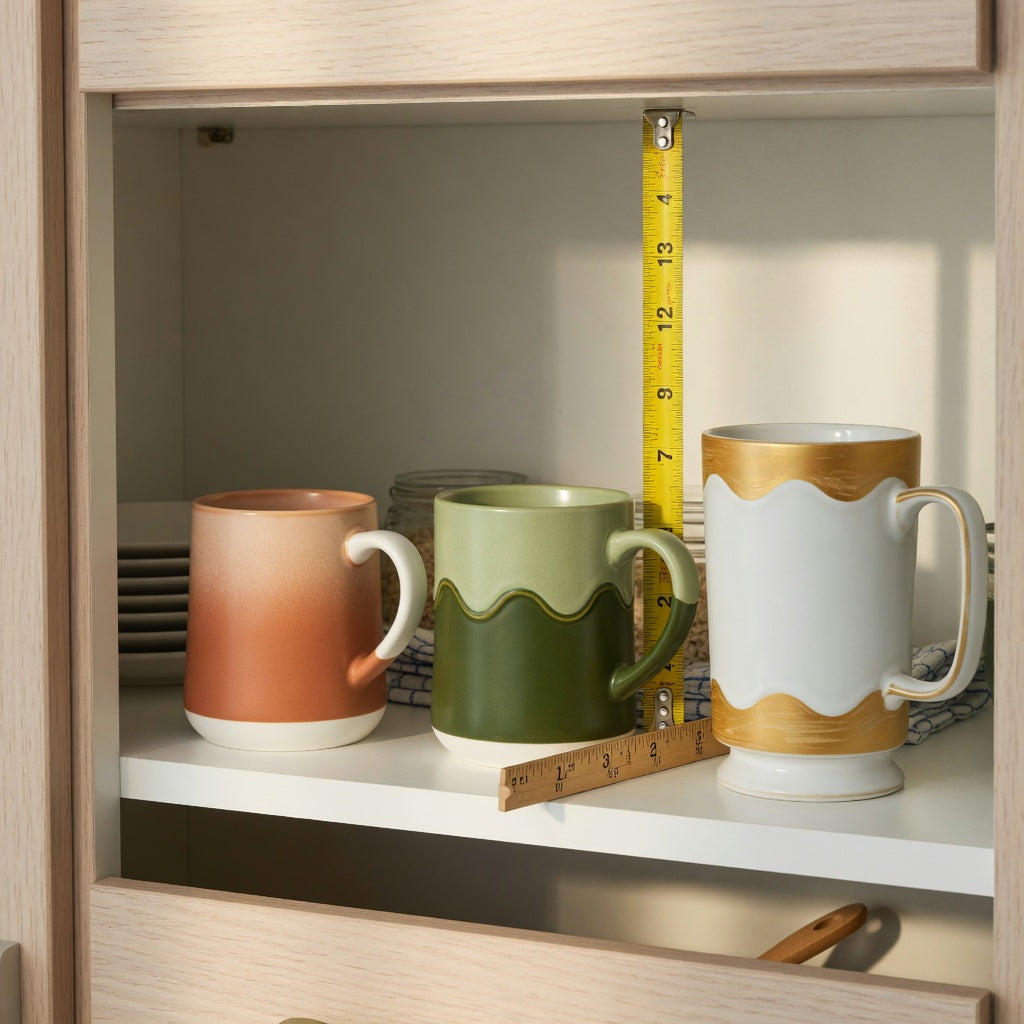
The three linked CoffeifyMug options have visibly different profiles. Listing images are useful for identifying form and finish, but photographs on separate pages may use different crops or camera distances. Treat them as visual references, not as a shared measurement scale.
| Current mug | Visible form | Best storage situation to investigate | Trade-off to check |
|---|---|---|---|
| The Gradient Coffee Tea Mug | A rounded ceramic body with a smooth two-tone gradient finish. | Start here if you have a fixed cabinet and prefer a more conventional mug silhouette. | Its visual profile does not guarantee a particular clearance. Confirm any dimensions shown on the live page before ordering several. |
| Green Waves Coffee Tea Mug | A green two-tone design with visible wave detail across the exterior. | A good page to consider for an office shelf or open kitchen shelf where the patterned surface remains visible. | If the wave treatment projects from the surface, tightly packed mugs may touch at those high points. Review close-up and side images rather than assuming the detail is flat. |
| White Golden Waves Tall Coffee Tea Mug | A visibly elongated white ceramic profile with golden-colored wave styling; the product name explicitly identifies it as Tall. | Consider it when you prefer a taller vessel and have an open shelf, desk, or measured cabinet with sufficient headroom. | It is the first of these three shapes to rule out for a low fixed shelf. The word Tall is useful guidance, but it is not a substitute for a listed measurement. |
If cabinet space is uncertain, compare the two non-Tall profiles first. If you know the mug will live on an open shelf or counter, the tall silhouette becomes easier to accommodate. Shoppers who want to compare these finishes with other shapes can also browse our unique coffee mugs collection after measuring their available space.
How should you measure body width, handle projection, and shelf depth?
Measure the space the mug must travel through, not only the place where it will sit. We see avoidable fit problems when a shopper records the wide interior shelf but overlooks a narrower cabinet opening.
- Remove the mug currently stored in the intended position so you can reach the back panel and door.
- Measure the clear vertical gap at the front of the cabinet and again farther inside. The lower of the two values controls fit.
- Measure usable depth with the door closed. Include any rear rail, front lip, hinge, or door-mounted rack that reduces the space.
- For a mug, use the overall width from the body edge to the outside of the handle. Do not substitute body diameter.
- Test the removal path with a mug you already own. Confirm that your fingers can enter the handle and that the rim can clear the shelf above without tilting sharply.
We do not prescribe a universal extra allowance because grip size, cabinet construction, and neighboring dishes differ. If exact product dimensions are listed, compare them with your smallest clear measurement. If they are not listed, do not infer them from a front-facing photo or buy a full cabinet set solely on visual scale.
Which profile suits a small kitchen, office shelf, or gift?
- Small apartment cabinet: Inspect the Gradient mug first because its visible form is closer to a conventional rounded profile than the explicitly Tall option. It is still necessary to verify the current listing and your cabinet opening.
- Open office shelf: The Green Waves mug suits a display-oriented setting because the wave finish remains visible and open sides make handle projection less restrictive. Leave enough lateral room to prevent the detailed surfaces from rubbing.
- Tall-drink preference with open storage: The White Golden Waves Tall mug is the relevant next step. Its elongated profile makes sense where vertical clearance has already been confirmed or no shelf sits directly above it.
- Gift for an unknown kitchen: Begin with one of the non-Tall options. A conventional profile creates less obvious vertical risk than a mug explicitly labeled Tall, although no shape is guaranteed to fit an unmeasured cabinet.
- Very shallow cupboards, campers, or tightly stacked storage: These decorative ceramic profiles may not be the right choice. A narrower mug specifically described as stackable will suit that situation better.
The same logic applies to mug trees. Check the hook length, spacing, and stated load capacity rather than assuming every ceramic handle will seat securely. A tall mug can also make a lightweight stand less stable if the hooks are crowded on one side.
How does glazed ceramic change the way mugs should be stored?
General ceramic care is mainly about preventing impact and abrasive contact. The common storage damage points are the rim, the handle joint, and raised or decorated areas that touch neighboring mugs. A small piece of grit trapped on a shelf liner can also scuff a glazed base as the mug is repeatedly slid forward.
- Store mugs side by side unless the product page explicitly describes them as stackable or nesting.
- Leave enough room to lift each mug without knocking its rim against the shelf above.
- Keep shelf liners clean and use a nonabrasive surface under glazed ceramic.
- Let the base dry before placing the mug in a closed cabinet.
- Follow the live product page for dishwasher and microwave guidance. Gold-toned decoration should never be assumed microwave safe based on color or name alone.
A mug is not automatically stackable because one base fits loosely inside another rim. Purpose-built stacking shapes control contact points; decorative ceramic mugs may place weight directly on a finished edge. If dense vertical stacking is essential, choose a different style designed for that job.
What should you verify on the product page before checkout?
Use this storage checklist while reviewing the live listing:
- Look for exact height, body diameter, and overall width, and check whether the stated width includes the handle.
- Inspect side-view images for handle projection and base shape.
- Check the material, finish, and current care instructions rather than relying on assumptions about ceramic.
- Compare the measurement with the cabinet opening, not only the interior shelf.
- Order one mug before committing to multiples if dimensions are unavailable or your storage space is unusually tight.
Once those checks are complete, use the CoffeifyMug unique coffee mugs collection to compare color and finish without losing sight of the shape that fits your shelf.
Frequently asked questions
Does this two tone ceramic coffee mugs storage fit guide include exact dimensions?
It does not substitute estimated measurements for details missing from a product page. Check each live listing for current dimensions, then confirm whether the published width includes the handle. Product photographs should not be treated as a measuring scale.
How do I measure mug handle projection for a cabinet?
Measure the mug's complete width from the body edge opposite the handle to the handle's outermost point. Then compare that figure with the cabinet opening and hinge clearance, not just the open shelf width.
Will the White Golden Waves Tall mug fit under a fixed cabinet shelf?
Only a measurement can confirm that. Because the product is explicitly labeled Tall, check the lowest clear height at the cabinet opening and inside the shelf before ordering. Choose a non-Tall profile or open storage if the clearance is uncertain.
Can two-tone ceramic coffee mugs be stacked?
Do not assume they can be stacked unless the product listing specifically describes a stackable or nesting design. Rim-to-base contact can chip edges or mark decorative glaze. Side-by-side storage is the lower-risk arrangement for decorative ceramic mugs.
What is the safest next step if I am buying several mugs?
Measure clear height, overall width, handle clearance, and closed-door depth, then compare those figures with the live product details. For a tight cabinet, start with one non-Tall mug before ordering a set. For open storage, compare all three linked shapes in the collection and select the finish that suits the space.
More from our blog
Read more
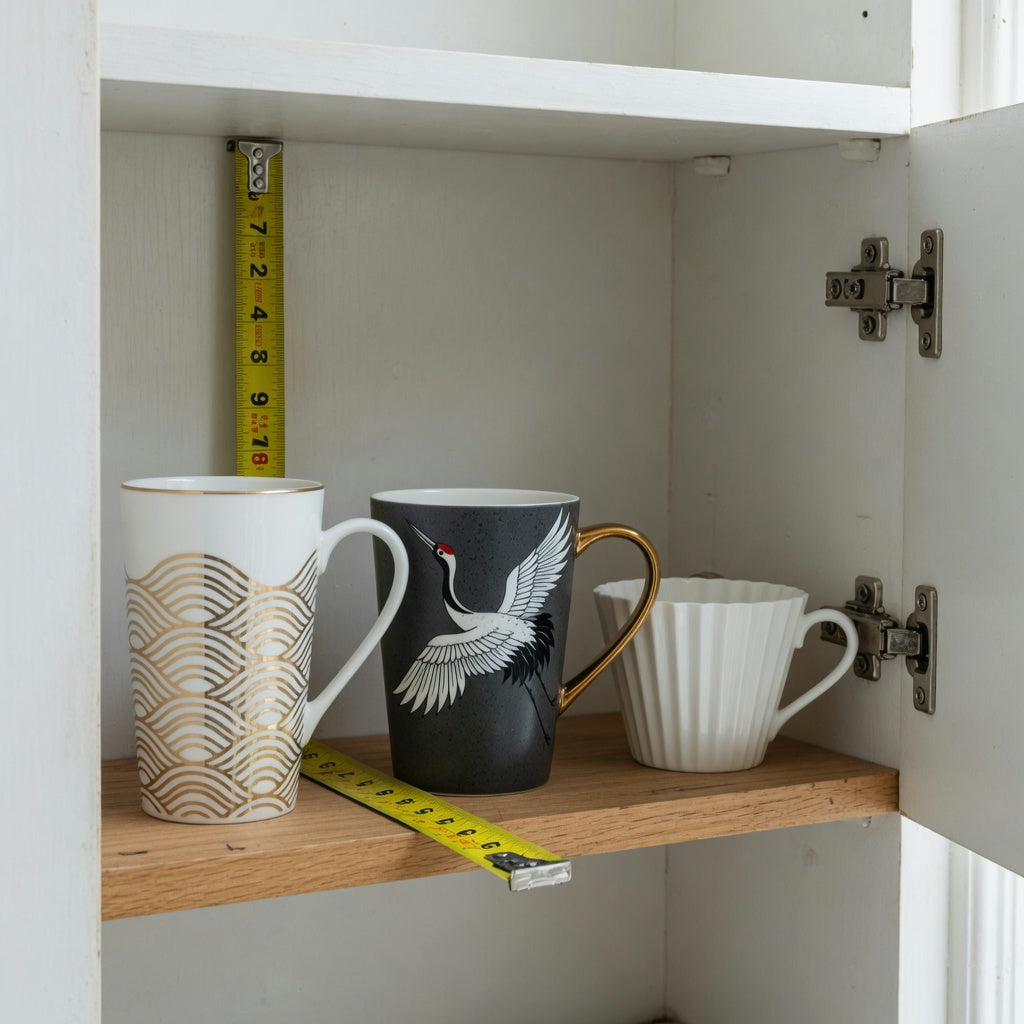
Coffee Mug Wedding Gift Storage Fit Guide: Shelf Fit by Shape
Compare the visible forms of the White Golden Waves Tall, The Crane, and Pleated cup, then measure clear height, handle projection, shelf depth, and lift-out space. Product facts remain separate fr...
Read more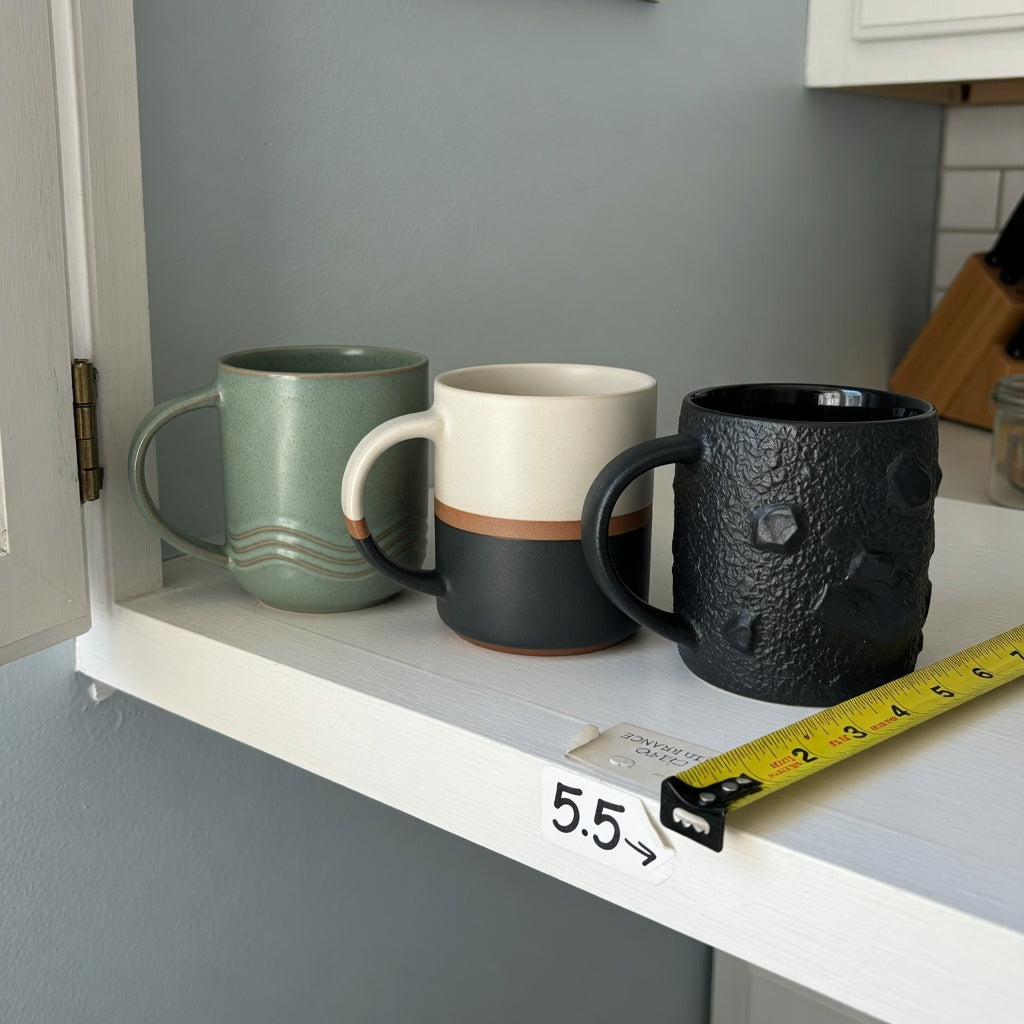
Chai Tea Mug Storage Fit Guide: 400-480 ml Shelf Comparison
Compare The Flow 400 ml, Morning and Night 440 ml, and The Rock 480 ml by capacity, visible form, handle clearance, and realistic shelf use. Learn how to measure a cabinet without treating capacity...
Read more
Leave a comment
This site is protected by hCaptcha and the hCaptcha Privacy Policy and Terms of Service apply.