
Ceramic Sculptural Mug Shared Household Practical Purchase Checklist
Reading time: about 9 minutes
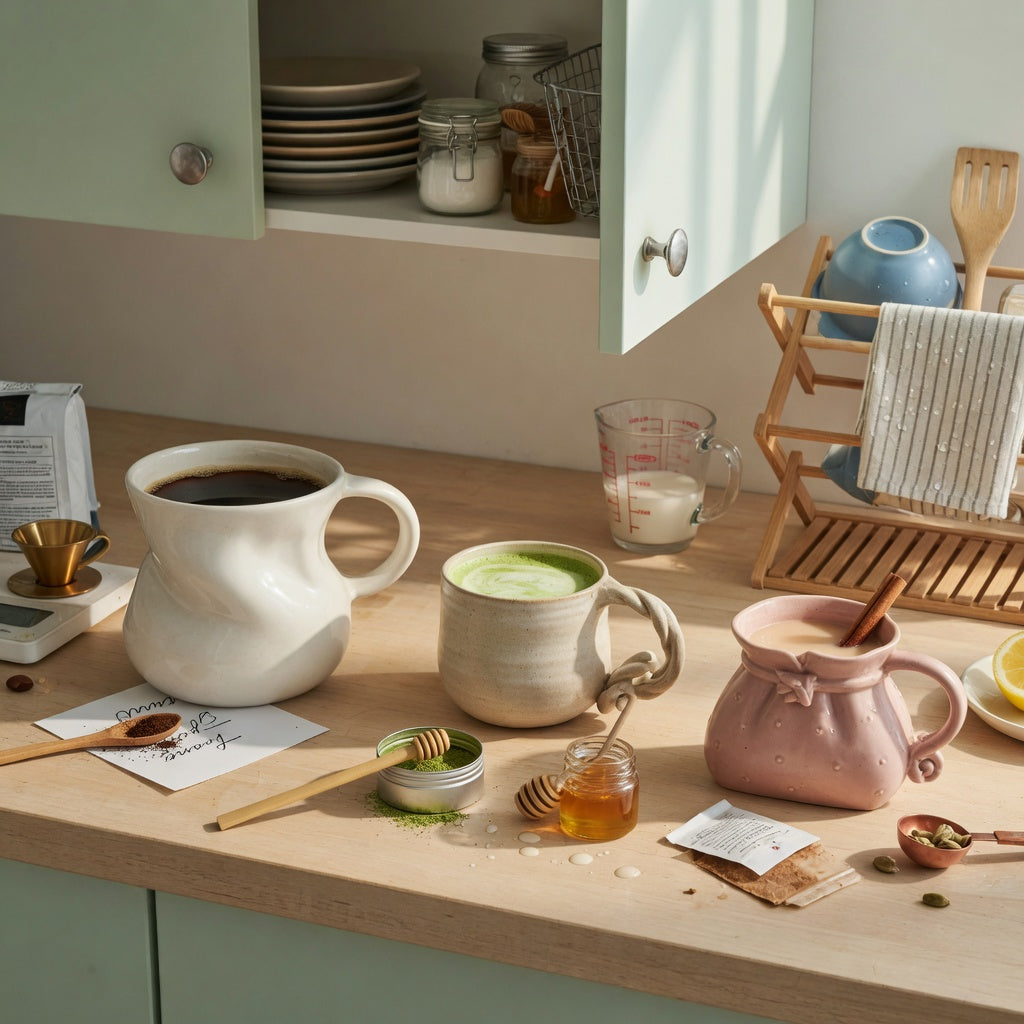
Three people can share the same cupboard and still need very different mugs. One pours a long coffee before work, another stops after a short tea, and a third wants a shape that is immediately recognizable as theirs. A ceramic sculptural mug shared household practical purchase checklist turns those preferences into a concrete decision about capacity, three-dimensional form, storage, grip, and care.
At CoffeifyMug, we handle these pieces as individual product choices rather than treating them as a matching set. The verified differences are specific: the Flow has a 400 ml capacity and sculptural curves, the Ball Handle holds 250 ml and has a rounded sculptural handle, and the Handbag holds 310 ml with a purse-shaped silhouette. The source facts used for this comparison do not establish exact outer dimensions, empty weight, finger clearance, or dishwasher and microwave suitability. Those details should be confirmed on the current product page or with our store before purchase.
Which listed capacity matches each person's usual pour?
Capacity is the most reliable place to begin because it can be tested in your own kitchen. Pour each person's normal drink into a measuring jug, including milk or creamer, and record the result. For iced coffee, add the usual amount of ice first because ice reduces the space available for liquid. In our experience, this simple test is more useful than asking which mug size sounds standard.
| Product | Verified capacity and form | Shared-household situation | Trade-off to check |
|---|---|---|---|
| Ball Handle coffee and tea mug | 250 ml with a rounded sculptural handle | A housemate whose measured serving is close to 250 ml or who prefers a smaller drink and an earlier refill | The 250 ml capacity may be limiting for long coffees or drinks containing plenty of ice. Confirm that the rounded handle suits the intended grip. |
| Handbag coffee and tea mug | 310 ml with a purse-shaped silhouette | A housemate whose coffee or tea falls between the smaller and larger options and who specifically likes an object-like form | The silhouette may occupy shelf space differently from a conventional cylinder. Verify its external measurements if cupboard clearance is tight. |
| The Flow coffee and tea mug | 400 ml with sculptural curves | A housemate who regularly pours a larger drink or needs more capacity for milk, creamer, or ice | It has the largest listed capacity of the three. Check its overall footprint, empty weight, and storage clearance rather than estimating those details from volume alone. |
Do not treat listed capacity as a comfortable fill line. A drink carried from the kitchen to a desk needs headspace, especially if the route includes stairs, pets, or a crowded breakfast table. Someone who normally pours 300 ml may be better served by a 400 ml mug than by filling a 310 ml mug close to the rim.
If household preferences are still unclear, compare the available forms in our unique ceramic coffee mug collection. Look at capacity and silhouette together instead of choosing only by appearance.
Will the silhouette fit the cupboard, drying rack, and office desk?
Sculptural design is different from surface artwork. A printed design leaves the basic mug profile largely unchanged, while a rounded handle, flowing curve, or purse-shaped body changes the three-dimensional space the mug occupies. Capacity cannot tell you the maximum width, height, or depth of that form.
- Measure the actual storage slot. Record clear width, height, and depth, including any shelf lip, cupboard hinge, or door hardware that reduces usable space.
- Confirm the product's outer dimensions. If a required measurement is not shown or is unclear, ask before ordering. Do not calculate it from the listed milliliter capacity.
- Do not assume stackability. A sculptural mug may not align with the base or rim of the mugs already in your cupboard. Plan a separate shelf position unless stacking is explicitly confirmed.
- Reserve washing and drying clearance. Handles and projecting curves can contact plates, rack prongs, or neighboring cups if everything is packed tightly.
Only plan to use a dishwasher if the current care instructions explicitly allow it. If dishwasher use is approved, position the mug so its rim, handle, and sculptural transitions cannot knock against other ceramics during the cycle. If suitability is not stated, a conservative approach is to hand wash until the correct care guidance is confirmed.
Desk space matters too. A sculptural mug placed beside a keyboard, charging cable, or notebook needs clearance beyond the base. Shared-household buyers who also carry their mugs to a home office should measure both locations, not just the kitchen shelf.
How should mixed hand sizes compare the three forms?
Product photos can show silhouette, but they cannot prove ergonomic comfort. Finger clearance, center of gravity, surface feel, and empty weight are separate variables. The Ball Handle is defined by its rounded sculptural handle, while the Flow emphasizes curved form and the Handbag uses a purse-shaped silhouette. None of those verified descriptions guarantees that every hand will prefer the result.
- Ask each person how they normally hold a mug: fingers through a handle, hand around the body, or two hands around the cup.
- Fill an existing mug to 250 ml, 310 ml, and 400 ml on separate trials. Carry it from the kitchen to the usual seat or desk to compare the liquid load.
- Review product images from more than one angle. Look at where the handle or sculptural body projects outward and how that relates to the intended holding style.
- If grip strength, dexterity, or hand mobility is a concern, require confirmed weight and handle measurements. A familiar conventional mug may be the more practical option if those specifications are unavailable.
The product choice should follow the person. A housemate who likes a defined rounded handle and pours close to 250 ml has a clear reason to open the Ball Handle page first. Someone near 310 ml who wants the purse-shaped form should start with the Handbag. The Flow is the relevant first look for the person who needs around 400 ml and prefers prominent sculptural curves. These are scenario-based starting points, not promises of universal grip comfort.
Ceramic sculptural mug shared household practical purchase checklist
Use this checklist with every regular drinker in the household. Do not average everyone's preferences into one supposedly universal mug.
- Write down each person's usual drink, including coffee, tea, milk-based drinks, or iced servings.
- Measure the normal pour in milliliters using a jug or another marked container.
- Add enough unused capacity for comfortable carrying and any milk, creamer, foam, or ice.
- Match the measured serving to the 250 ml Ball Handle, 310 ml Handbag, or 400 ml Flow.
- Record the preferred holding style and identify whether a rounded handle, flowing body, or purse-shaped silhouette is the better starting point.
- Measure the cupboard slot, drying area, and desk space where the mug will actually be used.
- Verify unknowns that affect the decision, including outer dimensions, empty weight, finger clearance, and stackability.
- Confirm dishwasher, microwave, and other care instructions instead of assuming all ceramic mugs have identical requirements.
- Treat each mug as an individual product choice. Do not assume the three designs are supplied together or need to match.
- Review the store's current return and damage-reporting terms before washing, filling, or discarding the packaging.
The ceramic sculptural mug shared household practical purchase checklist works because it keeps unknowns visible. If a specification is not established on the product page, mark it for confirmation. Filling that gap with a guess can turn an attractive mug into one that is too large for the shelf, too small for the drink, or uncomfortable for its intended user.
What should you inspect at unboxing and during early use?
We recommend inspecting ceramic pieces before the first wash, particularly during gift unboxings when packaging is often cleared away quickly. Sculptural transitions and handle attachment areas deserve the same attention as the rim and base.
- Run a careful visual check around the rim for shipping chips, cracks, or unexpectedly rough points.
- Inspect the handle-to-body area and changes in the sculptural form for visible hairline cracks.
- Set the empty mug on a clean, dry, level counter and check for unexpected rocking.
- Compare the delivered silhouette and condition with the product page. Photograph suspected shipping damage before use.
Once the mug has been accepted, follow the stated product care instructions. If dishwasher or microwave guidance is not provided, do not infer suitability from the word ceramic alone. A cautious hand-washing routine uses mild dish soap and a soft, non-abrasive sponge. Avoid abrupt temperature changes, and place the mug in a drying position that allows water to drain instead of collecting around curves or handle junctions.
Who should choose a simpler ceramic mug instead?
Sculptural mugs are not the best answer for every shared kitchen. A more conventional form is likely to create less daily friction in these situations:
- The cupboard depends on tightly stacked or nested mugs.
- Everyone needs the same capacity and familiar grip for uniform serving.
- A user requires a verified lightweight mug or specific handle clearance for comfortable, reliable handling.
- The mug will live in a crowded communal office dishwasher where projecting forms are more likely to contact other dishes.
- The shopper wants surface artwork but prefers the footprint and grip of a plain cylindrical mug.
A sculptural mug also makes a poor impulse purchase if nobody can identify who will use its particular capacity and form. In that case, choose a familiar everyday mug first and add a sculptural piece only after the household has a clear use for it.
Frequently asked questions
How do I use the ceramic sculptural mug shared household practical purchase checklist?
Measure each person's normal pour, note their preferred grip, and measure the mug's intended storage space. Match those results to the verified 250 ml, 310 ml, or 400 ml option, then confirm any missing dimensions, weight, and care details before ordering.
Is 250 ml, 310 ml, or 400 ml the most practical shared-kitchen capacity?
There is no single best capacity for every household. The 310 ml Handbag sits numerically between the 250 ml Ball Handle and 400 ml Flow, but it is only a sensible middle option for someone whose measured serving fits it. Assign capacities to people instead of choosing one household average.
Can I assume these sculptural ceramic mugs are dishwasher and microwave safe?
No. Ceramic material alone does not establish dishwasher or microwave suitability for a specific product. Check the current care instructions on the relevant product page and ask our store if the guidance needed for your routine is not shown.
Do the Flow, Ball Handle, and Handbag mugs come as a set?
This comparison treats the Flow, Ball Handle, and Handbag as individual product choices and does not present them as a set. Check each product page for the exact purchase contents before ordering.
Which sculptural mug should I consider for iced coffee?
By listed capacity alone, the 400 ml Flow provides more total room than the 310 ml Handbag or 250 ml Ball Handle. Ice displaces liquid, so test your usual combination of ice and coffee in a measured container. Confirm the opening, external dimensions, and applicable care guidance before deciding.
Measure one current pour and one cupboard slot, then open the CoffeifyMug unique mug collection beside your notes. Start with one individual mug matched to the clearest household use case, and repeat the process for the next person instead of forcing one sculptural form to suit everyone.
More from our blog
Read more
Ceramic Glazed Coffee Mugs Shared Household Practical Purchase Checklist
Use this practical checklist to compare grip, cabinet clearance, glaze condition, care instructions, and easy-to-identify mug designs for a shared kitchen. It also explains when ceramic is the wron...
Read more
Vintage Pottery Coffee Mug Shared Household Practical Purchase Checklist
Measure practical capacity, handle clearance, filled weight, cabinet fit, and care needs for each person. Then compare CoffeifyMug's Retro, Mountain Sea, and Great Mountain designs as individual mu...
Read more
Leave a comment
This site is protected by hCaptcha and the hCaptcha Privacy Policy and Terms of Service apply.