
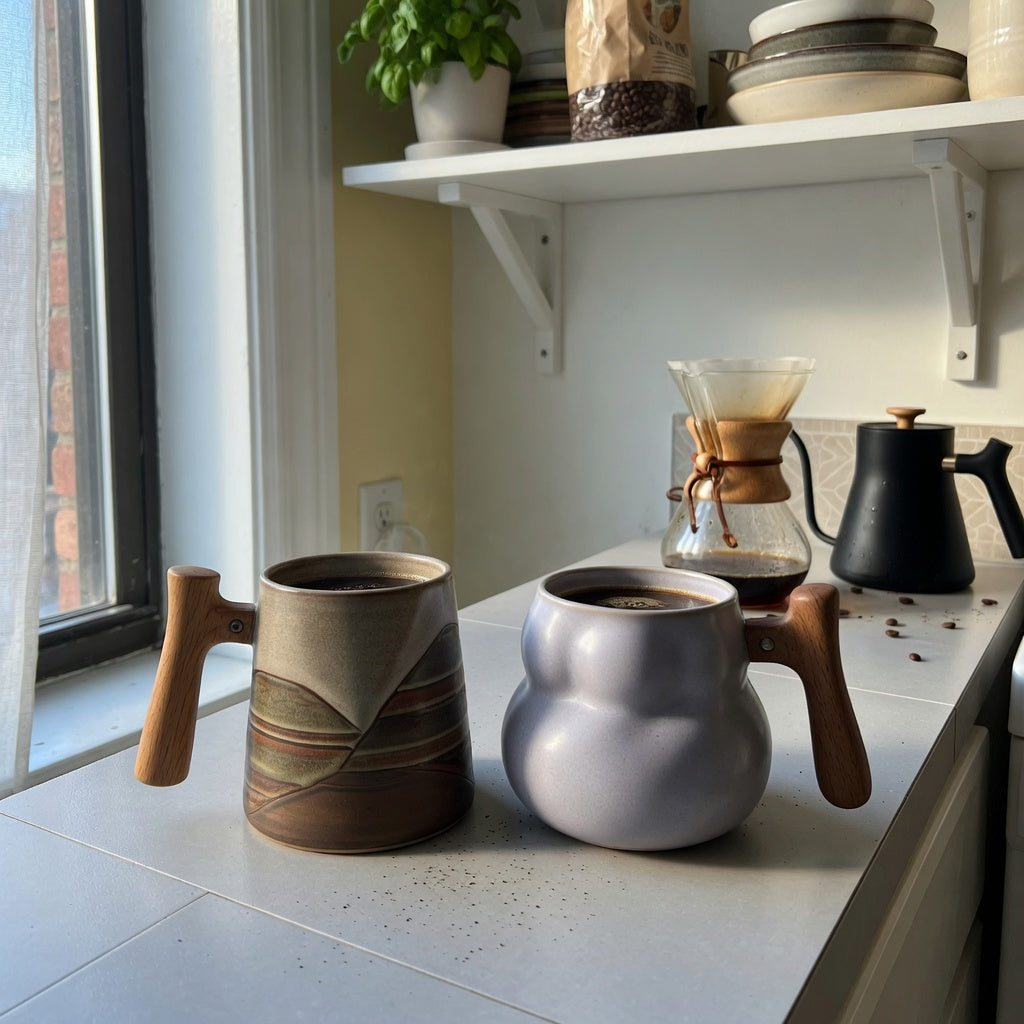
Ceramic mug with wooden handle for small coffee setup: Fit guide
Reading time: about 9 minutes
A narrow counter can make a good-looking mug feel oversized before the first pour. The ceramic body may fit beside the kettle, but the handle reaches into the only open strip left for a spoon, scale, or phone. For anyone searching for ceramic mug with wooden handle for small coffee setup, the useful measurement is the whole occupied area, not the body shown alone in a product image.
At CoffeifyMug, we sell and handle this category, and the questions we hear are practical: How much does it hold? Will the vessel fit beneath a shelf? Where will the handle sit beside a keyboard or brewer? We keep our answers within details a shopper can verify: listed capacity, visible ceramic vessel form, and visible wooden-handle shape. We do not identify a wood species or assume a coating, detachable construction, water resistance, care method, or heat performance from appearance.
How much counter space does the handle really use?
Start with the space rather than the mug. Measure the usable rectangle where the mug will rest: clear width between nearby objects, clear depth from the backsplash to the counter edge, and vertical clearance beneath any shelf or cabinet. On a desk, include the area temporarily occupied by a notebook, mouse, charging cable, or pulled-out keyboard tray.
The listed capacity is not an exterior measurement. Two mugs can hold a similar amount while using space differently because their bodies and handles have different forms. A styled photograph can show relative shape, but a photo without a known scale should not be converted into inches.
- For a kitchen counter: measure the gap beside the brewer or kettle, then reserve room for the handle and the tool you use to stir or measure coffee.
- For an office desk: rotate your current mug through a full circle and note where its handle meets a keyboard, mouse area, notebook, or cable.
- For cabinet storage: check width, depth, and vertical clearance. Do not assume the mug will nest or stack unless the product information explicitly shows or states that it does.
- For a gift: consider the recipient's storage, not just the mug's appearance during unboxing. A distinctive handle can be a poor fit for a cabinet already packed two mugs deep.
If external dimensions are provided, mark them on a piece of paper and place that template in the intended spot. If they are not provided, use the product images to compare silhouettes only and leave extra clearance. In our experience, the missed measurement is usually the working area around the mug, not the ceramic body itself.
Three checks for a ceramic mug with wooden handle for small coffee setup
Capacity, vessel form, and handle shape answer different buying questions. Keeping them separate prevents a rounded mug from being labeled compact without measurements or a larger-capacity mug from being dismissed before its exterior form is checked.
| Buyer variable | What it helps you compare | What it does not prove |
|---|---|---|
| Listed capacity | How the stated volume relates to your normal coffee or tea serving | Exterior height, base width, or the amount you personally pour below the rim |
| Visible vessel form | Whether the ceramic body appears rounded, straight-sided, tapered, flared, or more structured | Exact counter footprint without stated measurements |
| Visible handle shape | Relative projection, grip opening, attachment position, and overall outline | Hand comfort, wood species, finish, detachability, water resistance, or care requirements |
That distinction matters in a small setup. A softer form may look less imposing while still occupying substantial space, and a structured form may fit neatly even though it appears visually bolder. Use appearance to compare appearance, then use stated specifications for physical fit.
How should listed capacity change a small-space decision?
The most useful capacity is the one that matches your normal serving. A smaller listed number may mean more trips back to the kitchen. A larger number may suit a long desk session, but it does not automatically tell you how much shelf or counter space the mug uses.
You can establish your preferred serving volume without guessing:
- Fill your current mug with cool water to the level you normally use for coffee or tea.
- Pour that water into a marked measuring cup and record the amount.
- Repeat the test with the space you normally leave for milk, foam, or ice.
- Compare that result with the capacity stated on each product page.
If a page does not explain how its capacity was measured, treat the number as a comparison point rather than a promise about your exact fill line. The practical goal is enough room for your routine drink without buying volume you rarely use. For iced coffee, remember that ice occupies part of the stated volume.
Mountain Sea II or The Cloud: which visible form suits the space?
These two CoffeifyMug options support the same core material description in their product titles: a ceramic mug with a wooden handle. Their visible vessel forms offer different reasons to shortlist them.
- A small display shelf with room to see the full profile: The Mountain Sea II coffee and tea mug with wooden handle has a more structured, landscape-inspired visible form. It makes sense for a shopper who wants the mug to act as a defined visual object. Check its listed capacity and the handle outline shown on the page before deciding that it fits physically.
- A shared desk or counter where a softer outline suits the surrounding objects: The Cloud coffee and tea mug with wooden handle presents a more rounded, cloud-like vessel. That softer form may suit a setup filled with curved containers or compact accessories, but rounded does not automatically mean smaller. Compare its listed capacity and visible maximum width with your available area.
- A setup that fits neither profile: Browse our unique coffee mug collection to compare other vessel and handle silhouettes. This is the better next step if your shelf is especially shallow, your storage requires a different handle position, or neither current form matches the room.
We would not rank Mountain Sea II or The Cloud as the more compact choice without supporting exterior measurements. The defensible difference is visual: one reads as more structured and scene-led, while the other reads as softer and more rounded.
Which handle details matter beside a keyboard or kettle?
A handle can determine whether the mug coexists with the rest of a small setup. Look at how far it appears to project relative to the ceramic body, the shape of the opening, and where it joins the vessel. Those details help you plan orientation, but photographs cannot confirm comfort for every hand.
- Side projection: A handle that extends farther from the body may need more clear counter width.
- Grip opening: Compare the visible opening with the way you hold your current mug. A photograph can suggest room, but only dimensions or direct handling can confirm fit.
- Attachment position: Note whether the handle sits higher, centrally, or lower on the visible body. Use this to compare shape, not to make unsupported claims about balance or heat.
- Storage orientation: Check whether the mug can sit beside another item with its handle turned toward an open side. Do not assume it will stack or nest.
Claims the photos cannot settle
Ceramic and wood are visible material categories, but appearance alone does not establish the product details below:
- Wood color and grain do not reliably identify the species.
- A smooth or glossy appearance does not prove a coating or water-resistant finish.
- The handle's join does not show whether it is detachable.
- The material combination does not establish dishwasher, soaking, or microwave instructions.
- A wooden handle does not by itself guarantee any level of heat performance.
If one of those details is essential to your routine, rely only on explicit product information or ask our team before ordering. This is especially relevant for shoppers who depend on a dishwasher cycle or need confirmed microwave compatibility every day.
Who should choose a different mug profile?
A wooden-handle ceramic mug is a mixed-material style choice, not a universal space-saving solution. Another mug profile is more practical in several situations:
- You need confirmed nesting or stable stacking in a single narrow cabinet.
- Your shelf clearance is extremely tight and no exact exterior measurements are available.
- Your usual serving is larger than the capacity stated on the product page.
- Your routine requires a specific dishwasher, soaking, or microwave instruction that has not been confirmed.
- Your desk leaves no safe side clearance for a projecting handle.
In those cases, a handleless vessel or a mug with a more conventional all-ceramic loop may be easier to place, provided its listed specifications match your routine. We would rather point a shopper toward a different profile than sell a distinctive mug that spends most of its time at the back of a cabinet.
Frequently asked questions
Is a ceramic mug with wooden handle for small coffee setup a practical desk choice?
It can be if the full vessel and handle fit within the clear area beside your keyboard, mouse, and notebook. Measure that working area with the desk in normal use, not after everything has been cleared away. Leave enough room to pick up and return the mug without moving cables or office tools.
How do I compare capacity without knowing my usual coffee volume?
Use cool water to recreate the fill level in your current mug, then transfer it to a marked measuring cup. Include the space you normally reserve for milk, foam, or ice. Compare that result with the capacity listed on the product page.
Do ceramic mugs with wooden handles stack in a small cabinet?
Do not assume they do. A projecting handle can affect nesting and side-by-side storage, but actual stackability depends on the complete vessel geometry. Treat stacking as unconfirmed unless the product information specifically demonstrates or states it.
Which is better for a small-space gift, Mountain Sea II or The Cloud?
Choose Mountain Sea II for a recipient who prefers a more structured, landscape-inspired visible form and has room to display the profile. Choose The Cloud for someone who prefers a softer, rounded visual shape. For either gift, verify the listed capacity and consider the recipient's cabinet or desk space before ordering.
Can I assume the wooden handle is dishwasher-safe or stays cool?
No. A wooden appearance does not establish care requirements, water resistance, or heat performance. Follow only the instructions explicitly supplied with the product or confirmed by the store.
Use this side-by-side check before adding one to cart
- Photograph the setup in normal use, including the brewer, kettle, keyboard, or other nearby items.
- Measure the clear width, depth, and overhead clearance available for the complete mug.
- Measure your normal serving with cool water and compare it with each listed capacity.
- Compare the visible vessel form and handle outline without estimating unsupported dimensions from a styled photo.
- Stop if a must-have detail, such as stacking or a specific care method, is not confirmed.
Start with Mountain Sea II if a structured visible form is your priority, or The Cloud if a softer rounded silhouette better suits the space. If neither profile clears every item on the checklist, return to CoffeifyMug's collection of distinctive coffee mugs and compare a different vessel or handle shape against the same measurements.
More from our blog
Read more

Ceramic Tea Mug for Small Coffee Setup: Shape and Capacity
Compare ceramic mug form, handle projection, listed capacity, and storage needs for a compact counter, shelf, or desk. We match three current CoffeifyMug options to specific small-space situations ...
Read more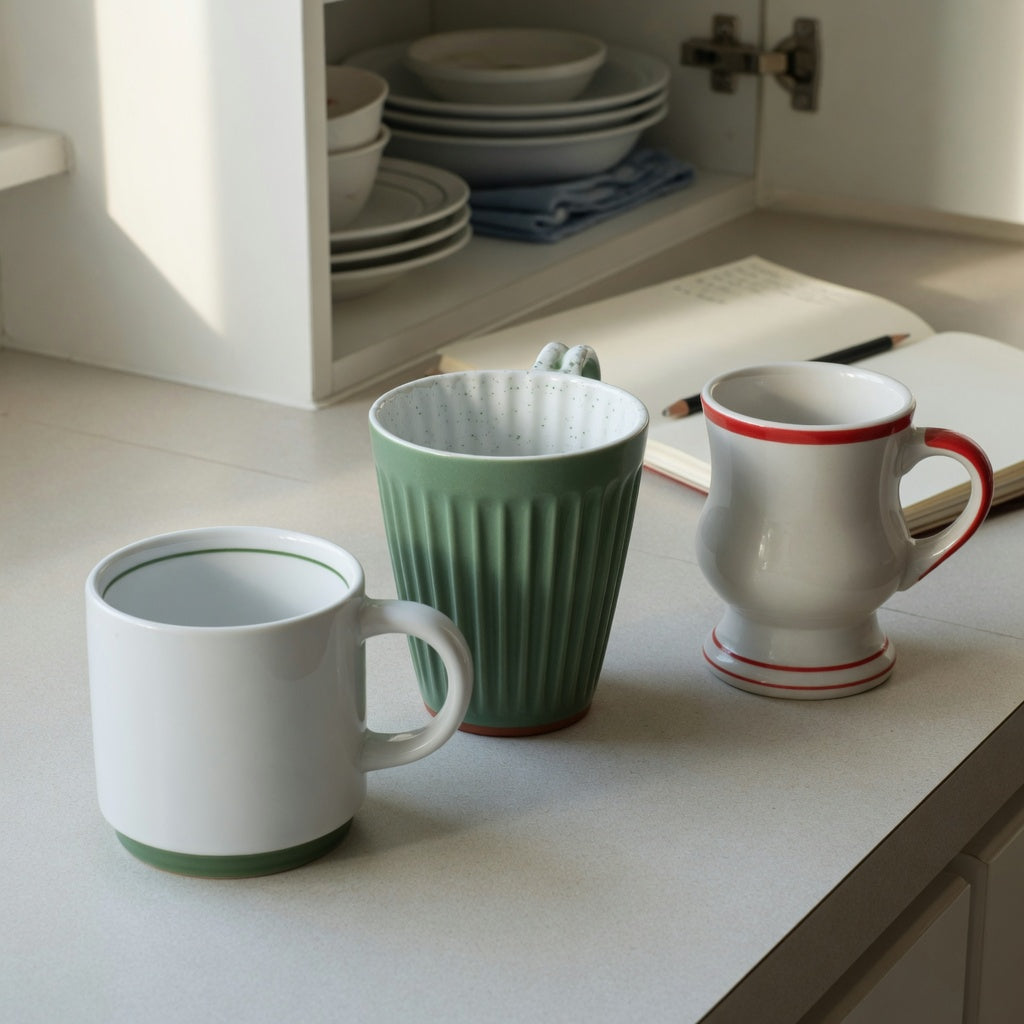
Minimalist Ceramic Mug Daily Use Guide: Practical Fit Checks
Compare round, pleated, and retro ceramic mug forms through practical routines: pour volume, handle clearance, desk use, washing, and cabinet storage. This guide maps each option to a clear buyer s...
Read more
Leave a comment
This site is protected by hCaptcha and the hCaptcha Privacy Policy and Terms of Service apply.