
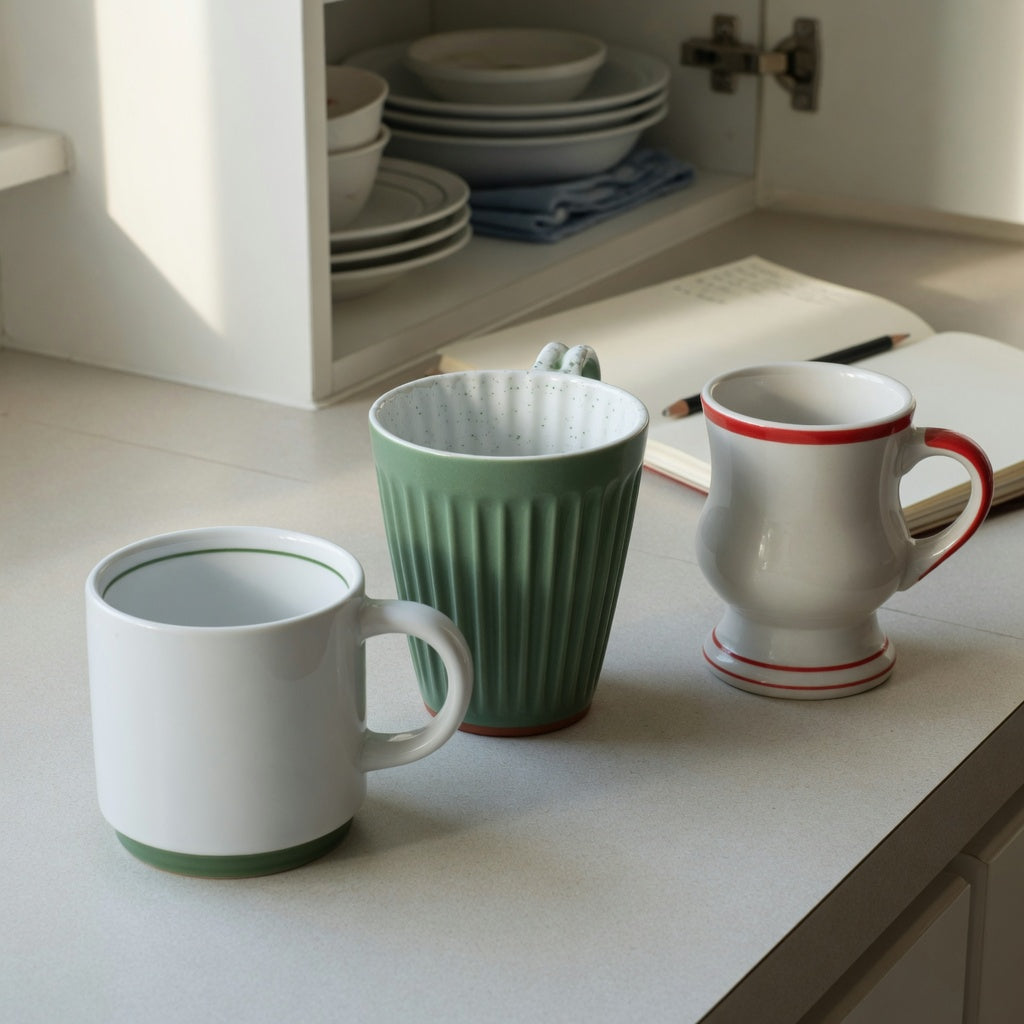
Minimalist Ceramic Mug Daily Use Guide: Practical Fit Checks
Reading time: about 9 minutes
A mug can look calm in a product photo and still become the awkward one in the cabinet. The handle presses against the cup beside it, the stated capacity leaves no working room for milk, or the body has more visual texture than you wanted beside a clean keyboard. Our minimalist ceramic mug daily use guide starts with those ordinary points of friction. In our store, we handle and compare this category by looking at the details shoppers live with after unboxing: listed capacity, ceramic material, body shape, handle geometry, base contact, and the care information stated on the current product page.
We use minimalist as a shopper-facing style lens, not a formal design classification. A round profile, pleated exterior, or retro silhouette can each work in a visually restrained setting, but they do not offer the same appearance or handling. We also do not infer quality, durability, microwave compatibility, or dishwasher safety from style alone.
Minimalist ceramic mug daily use guide: start with pour volume
Capacity should match the finished drink, not just the first pour. A routine of 8 ounces of coffee plus 2 ounces of milk already requires 10 ounces before you allow any space below the rim. Tea drinkers may need room for an infuser or spoon, while iced coffee takes up more cup volume because the ice shares the interior with the drink.
- Black coffee: compare your normal measured pour with the capacity stated for the selected product or variant, then allow enough headspace to lift the mug comfortably.
- Coffee with milk or foam: add every part of the drink before comparing capacities. Do not treat the coffee portion as the total.
- Tea: account for a tea bag, infuser, lemon slice, or spoon if those stay in the cup while you drink.
- Iced drinks: test your usual recipe in a measuring cup, including ice, rather than assuming a familiar hot-coffee size will work.
Exterior height is not a dependable shortcut for capacity. Wall thickness, base shape, and rim width all affect interior volume. Use the listed capacity on each product page, and confirm the selected option if the listing contains variants.
Round, pleated, or retro: which shape fits your visual routine?
The Round Coffee Tea Mug is the first option to inspect if your idea of minimalism centers on a straightforward round silhouette. It can suit a quiet desk or an uncluttered kitchen shelf because the form does not depend on pronounced surface decoration. It is not automatically the best mug for a narrow workspace, though. Check the current overall dimensions, including the handle, rather than assuming a round body has a small footprint.
The Pleated Coffee Tea Cup makes sense for a shopper who wants a restrained shape with visible surface texture. Pleating gives the exterior a repeated pattern and a more tactile appearance than a plain wall. The trade-off is equally visible: grooves create more contours to inspect while washing. Skip this direction if your version of minimalism means the least possible surface detail or if you want the quickest exterior wipe-down.
The Retro Coffee Tea Cup is the better starting point if your table already includes traditional dinnerware, older wood tones, or vintage-inspired accessories. Its styling cue is warmer and less strictly contemporary than the other two names suggest. It is not the strongest fit for someone building a sharply modern, uniform mug row. As with the other options, confirm the listed capacity and study the handle proportions before deciding from the silhouette alone.
Handle opening and mug balance: what should you test first?
Handle comfort depends on usable inner space, not the handle's outside size. The practical variables are the height and width of the opening, the distance between the handle and mug body, the handle thickness, and the positions of the upper and lower joints. A larger loop may give more finger room but occupy more cabinet and desk space. A compact loop reduces overall width but may concentrate the load on fewer fingers.
We use a cool-water check before judging everyday fit. It separates handle geometry from the distraction of a hot drink:
- Inspect the rim, handle joints, and base in bright light for chips, rough contact points, or visible hairline cracks.
- Place the empty mug on a dry, level counter. Touch the rim lightly at several points to check for rocking rather than assuming the word round guarantees stable base contact.
- Fill it with cool water to your usual drink level. Hold it for 30 seconds and note whether your knuckles press against the body or the mug rotates in your grip.
- Set it in the intended cabinet space and measure the real width with the handle included. Body width alone does not determine storage fit.
These checks do not predict long-term durability. They simply reveal an arrival issue or a poor hand fit before the mug becomes part of your daily routine.
Office desk, kitchen counter, or commute: where does ceramic fit?
A fixed desk is a sensible use case for an open ceramic mug when there is a clear, level place away from cables and papers. Measure the available surface from the mug body to the outer edge of its handle, especially if the cup will sit beside a keyboard, monitor stand, or notebook. A coaster can define the placement area, but it cannot compensate for a mug that is too wide for the space.
Kitchen use shifts the priorities toward cabinet clearance, sink access, and the types of drinks you prepare. A pleated exterior may be worth the extra surface detail if you enjoy its look. A round form may suit a shelf where you want fewer visual interruptions. A retro profile may coordinate better with existing tableware. Those are style and routine choices, not performance rankings.
None of these product names should be read as a promise of a lid, insulation, leak resistance, or car cup-holder compatibility. If your drink travels inside a bag, sits in a moving vehicle, or needs to remain covered, an open ceramic coffee or tea cup is not the best category unless the listing explicitly provides the required features.
Dishwasher cycles and cabinet storage: what can you safely assume?
Ceramic material alone does not establish dishwasher or microwave compatibility. Finish, decoration, and construction can affect the stated care guidance, so check the current product page before the first dishwasher cycle or microwave use. If that information is not shown, contact the store rather than filling in the gap from experience with a different ceramic mug.
Shape still affects the cleaning routine. A visibly smooth exterior has fewer grooves to trace with a sponge. A pleated surface has additional channels that should be checked after drinks containing milk, foam, sugar, or syrup. This does not make pleating unsuitable for daily use; it means the texture should be an intentional trade-off rather than a surprise at the sink.
For cabinet planning, record three measurements from the current listing when available: total height, maximum body width, and total width including the handle. Do not assume a mug is stackable because it is round. Actual stacking depends on the relationship between the rim and the base or foot ring, and the linked products are not presented here as nesting sets.
Which mug makes sense for a gift recipient?
Gift unboxings often put appearance first, but the recipient still has to use the mug. Match the visible form to something you know about the person's routine: a quiet office setup, a preference for textured objects, or a kitchen with retro tableware. If they commute with every drink, require an exact capacity, or only use dishwasher-safe items, confirm those requirements before choosing.
Before wrapping any ceramic mug, inspect the drinking rim, handle joints, and base under good light. Set it on a level counter to check for rocking. This short inspection is more useful than making an unsupported assumption about quality from the style name or product photo.
Daily scenarios matched to the three CoffeifyMug forms
| Reader situation | Option to inspect first | Why it may fit | Reason to choose another form |
|---|---|---|---|
| You want the least visually detailed silhouette for a desk or open shelf | Round Coffee Tea Mug | The round styling provides a straightforward starting point | You prefer visible texture or a more traditional design cue |
| You want surface detail without a heavily decorated graphic | Pleated Coffee Tea Cup | The pleated exterior makes texture part of the form | You want fewer exterior contours to inspect during washing |
| Your tableware leans traditional or vintage-inspired | Retro Coffee Tea Cup | The retro styling can coordinate with that setting | You want a strictly plain, contemporary mug row |
This table narrows the style decision, but it does not replace the product listing. Before ordering, compare the current material description, stated capacity, overall dimensions, handle photos, included components, and care instructions for the exact option selected.
Frequently asked questions
What does a minimalist ceramic mug daily use guide help me compare?
It helps you compare the practical variables hidden behind a clean product photo: finished drink volume, body profile, handle clearance, desk footprint, washing effort, and cabinet fit. It also identifies situations where an open ceramic mug is the wrong category, such as leak-sensitive commuting.
Is the Round Coffee Tea Mug automatically best for a small desk?
No. A round profile may look visually simple, but desk fit depends on the current total width, including the handle, and the amount of stable surface available. Compare the listing dimensions with the actual space beside your keyboard or notebook before ordering.
Does a pleated ceramic cup take more effort to clean?
A pleated exterior has more surface transitions than a plain wall, so the channels deserve a visual check during washing, especially after milk or sweetened drinks. Follow the care instructions on the product page and do not assume dishwasher compatibility unless it is stated.
Can I put these ceramic mugs in a dishwasher or microwave?
Use the care guidance on the current product listing for the selected item or variant. The word ceramic by itself is not enough to confirm dishwasher or microwave use, and this guide does not add an unlisted compatibility claim.
What capacity should I choose for coffee with milk or iced coffee?
Measure the complete drink rather than the coffee alone. For example, 8 ounces of coffee plus 2 ounces of milk already totals 10 ounces before headspace; iced coffee also needs room for ice. Compare that full volume with the capacity stated on the product page.
Your 60-second pre-purchase check
- Write down the volume of your finished drink, including milk, foam, or ice.
- Confirm the selected product's listed material, capacity, and dimensions.
- Check handle opening and total width against your hand, desk, and cabinet needs.
- Choose deliberately between a round profile, pleated texture, and retro styling.
- Verify care instructions and any required lid, insulation, or travel features.
Open the unique coffee mugs collection with that checklist beside you. Compare only the forms that fit your measured pour and storage space, then use style as the deciding factor.
More from our blog
Read more
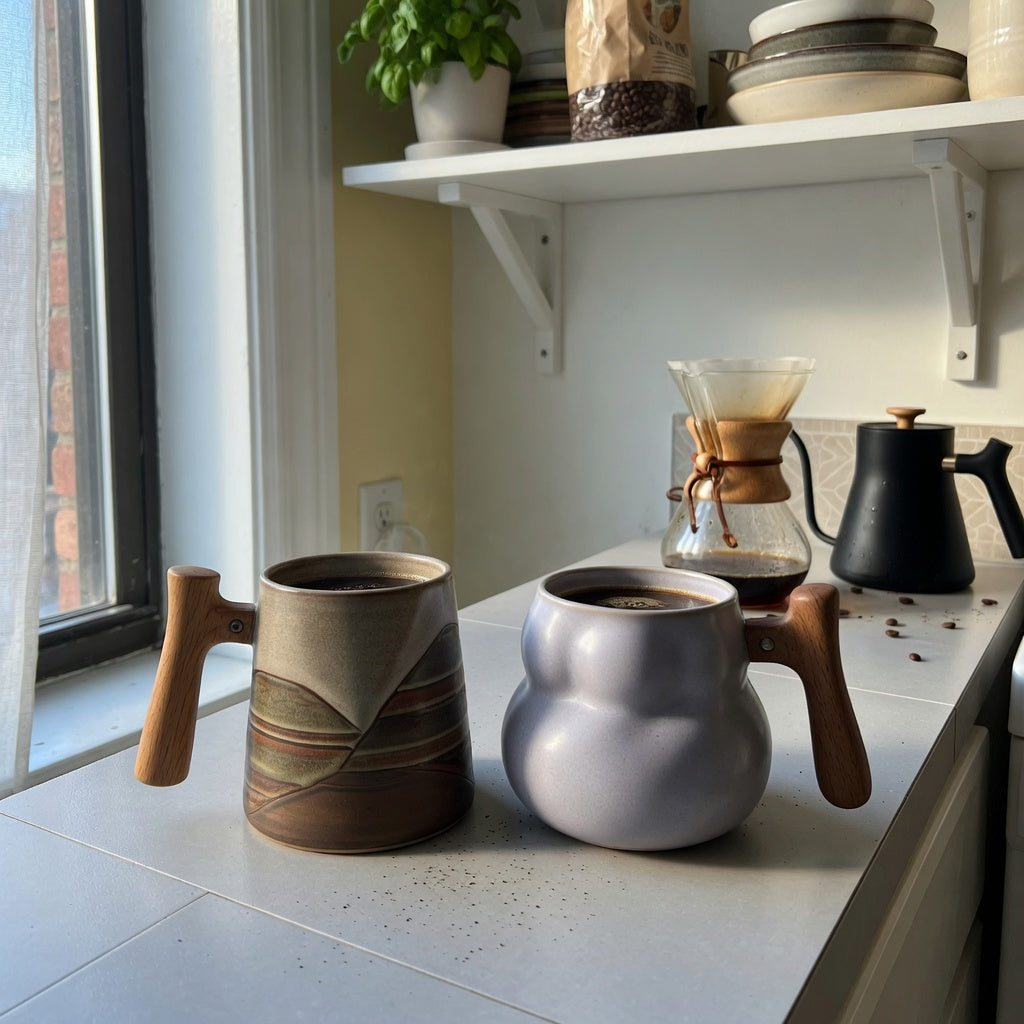
Ceramic mug with wooden handle for small coffee setup: Fit guide
Compare listed capacity, visible ceramic vessel form, and wooden-handle shape against a tight counter, shelf, or desk. We map Mountain Sea II and The Cloud to real small-space buying situations wit...
Read more
Ceramic Tea Mug Morning Routine Practical Purchase Checklist
Match a ceramic mug to the minutes you have, the amount you actually pour, and your tolerance for refills. Compare current CoffeifyMug listings by ceramic material, listed capacity, visible form, a...
Read more
Leave a comment
This site is protected by hCaptcha and the hCaptcha Privacy Policy and Terms of Service apply.