

Ceramic Tea Mug for Small Coffee Setup: Shape and Capacity
Reading time: about 8 minutes
A mug can fit on a bare counter and still become awkward once the coffee station is in use. The body clears the kettle, but the handle catches a canister; it sits neatly beside the serving area, then occupies more shelf width than expected. The search for a ceramic tea mug for small coffee setup use should start with the space occupied by the whole vessel, not just the body shown in a front-facing photo.
In our store, we handle these comparisons for shoppers working with narrow apartment counters, shared office desks, and compact cabinet shelves. Four details do most of the decision work: ceramic material, the capacity stated on the live listing, the visible body form, and the handle shape. We keep those boundaries clear. Product images can help you compare silhouettes, but they cannot guarantee an exact fit when precise dimensions are not stated.
Ceramic tea mug for small coffee setup: what space should you measure?
Start with the mug's working footprint. This is the full rectangle occupied by the body and handle while the mug is resting where you intend to use it. It is different from base size alone. A compact-looking body can still need considerable side clearance if its handle projects outward.
- Arrange the counter or desk as you normally use it, then measure the open width and depth instead of measuring an empty surface.
- Include the handle envelope: the distance from the far side of the body to the handle's outermost edge.
- Check shelf depth and height separately. Counter fit does not prove that the same mug will store comfortably in a cabinet.
- Leave enough space to place, grip, and lift the mug without shifting the neighboring vessel, canister, or desk item.
We often see shoppers account for the body but forget the hand approaching the handle. That final clearance matters on a desk beside a mouse or notebook and on a counter where several items share one narrow strip. If your available space is exact to a fraction of an inch, use stated product dimensions when available rather than estimating from photography.
How should listed capacity affect a compact counter decision?
Capacity and exterior shape answer different questions. Capacity tells you how much the vessel is listed to hold; form shows how that volume is distributed. Two mugs can appear similar from the front while using their space differently, so visual size is not a reliable substitute for the capacity stated on the product page.
- Your usual serving already feels sufficient: compare options close to that familiar capacity instead of buying extra volume that you may not use.
- You want fewer refills: consider a larger listed capacity, but inspect whether the visible body or handle requires more of your limited counter area.
- You are buying a gift: avoid assuming that the largest capacity is the most useful. The recipient may value an easier-to-place mug more than additional volume.
For a ceramic tea mug for small coffee setup use, the best capacity is the amount that serves your normal drink without forcing a poor storage arrangement. Check the current capacity on each linked listing before ordering. We do not infer volume from a rounded, tall, or flowing appearance because those visual cues do not establish the actual listed amount.
Which current mug form belongs in each small-space scenario?
The three current CoffeifyMug choices are listed as ceramic coffee and tea mugs, but their visible forms and handles give shoppers different starting points. The recommendations below are comparison priorities, not promises of exact fit.
| Reader situation | Why the visible form is worth comparing | Product next step |
|---|---|---|
| Items sit close to both sides of the mug | An elongated, flowing silhouette and a curved handle that appears to follow the body more closely may suit a narrow lateral opening. | Review The Flow Coffee Tea Mug, then confirm its current listed capacity against your usual serving. |
| You have a modest open area and want a middle-profile form | The visible body and moderate handle projection provide a middle comparison between a close-flowing shape and a fuller round mug. | Inspect the angles and listed capacity of the Morning Night Coffee Tea Mug. |
| You have more side clearance and prefer a classic open handle | A fuller circular body and open-loop handle make grip opening and lateral space the main variables to check. | Compare the Round Coffee Tea Mug with the width available at your station. |
These comparisons are based on the visible forms presented in the current listings. We would not call one mug definitively narrower, taller, or easier to store without supporting measurements. If none of these three shapes suits the opening you measured, browse the unique coffee mugs collection and compare another ceramic form before compromising on clearance.
How should handle shape change a desk or shelf decision?
Handle projection is easy to overlook because most product photographs center the mug body. In daily use, however, the handle determines how close the vessel can sit to another object and how much room your fingers need to approach it. We compare three handle details before recommending a shape for a tight station:
- Outer projection: how far the handle appears to extend beyond the body and into neighboring space.
- Grip opening: the visible room inside the loop, especially relevant for shoppers who prefer more finger clearance.
- Resting orientation: whether the handle can face an open side of the counter or must point toward another item or cabinet wall.
A body-following curve may reduce visible side projection, but it can also present a tighter-looking grip area. A classic open loop can provide more apparent finger room while increasing the mug's working footprint. Neither shape is universally better. Hand size, preferred grip, and available side clearance decide the trade-off.
A useful real-world check is to place your current mug in the intended spot and note where its outer handle edge lands. Compare that relationship with the new product images. This does not produce an exact measurement, but it is more informative than judging the new mug against an empty background.
Why can a mug suit the counter but not the shelf?
A counter allows you to rotate a handle toward open space. A cabinet may not. Shelf depth, vertical clearance, the position of neighboring handles, and the path of the cabinet door all affect storage even when the mug works well during serving.
- Open counter: prioritize the working footprint and the room required for your hand to reach the handle.
- Closed cabinet: check whether the body and handle can sit in the available orientation without pressing against another mug or the cabinet wall.
- Office desk: include the space needed for papers, a keyboard, or a mouse rather than measuring only the bare desktop.
- Small-kitchen gift: favor a form whose capacity and handle style match what you know about the recipient instead of guessing that a larger vessel will be more useful.
Do not assume that a round body means a mug is designed to stack. The facts used for this comparison do not establish stackability for these products, so plan to store each mug in its own shelf position unless the live listing says otherwise.
These ceramic mugs are intended for ordinary sit-down coffee or tea serving. This category is not the best match if you need a travel-specific vessel, a guaranteed car cup-holder fit, the lightest possible material, or a serving amount beyond the listed capacity. A purpose-built travel mug or a differently sized vessel would suit those situations better.
What should you confirm on each live listing before ordering?
The product page should be your source of record because listing details can change. Use the same short check for every mug you compare:
- Material: confirm that the current listing identifies the vessel as ceramic.
- Capacity: compare the stated amount with the serving you actually prepare most often.
- Visible form: inspect every available angle for body fullness and the way the profile uses horizontal space.
- Handle shape: note the apparent projection and grip opening rather than evaluating the body alone.
- Fit evidence: use stated dimensions if provided. If they are not provided, treat visual comparisons as directional and avoid promising yourself an exact fit.
That final point matters most in very tight cabinets. A product image can help you choose which mug to investigate first, but it is not a scale drawing.
Frequently asked questions
How do I choose the capacity of a ceramic tea mug for small coffee setup use?
Start with the amount you normally serve, then compare it with the capacity stated on each live product page. Choose additional capacity only if it solves a real need and the visible form still works with your available counter and shelf space.
Which mug should I compare first for a narrow counter?
The Flow Coffee Tea Mug is the first comparison for a narrow lateral opening because its visible silhouette is elongated and its curved handle appears to stay closer to the body. Check the linked listing for current capacity and any available measurements before treating it as an exact fit.
Is the Round Coffee Tea Mug a poor choice for a small kitchen?
No. Its fuller visible body and classic open-loop handle can work if your setup has sufficient side clearance and you prefer that handle style. It is less suitable when the mug must occupy a very narrow gap between fixed objects.
Can I tell whether a ceramic mug will fit my shelf from capacity alone?
No. Capacity does not establish exterior width, height, handle projection, or stackability. Compare the listed capacity with the visible form, then use product dimensions if the listing provides them.
Where can I compare more ceramic coffee and tea mug shapes?
Use CoffeifyMug's unique coffee mugs collection to compare additional body forms and handle styles. Keep the same four variables in view: ceramic material, listed capacity, visible silhouette, and the complete handle envelope.
Before buying, write down your available counter width, shelf depth, usual serving amount, and preferred handle clearance. Compare those notes with The Flow, Morning Night, and Round listings, then choose the mug that leaves the station practical after the cup is in place.
More from our blog
Read more

Ceramic Tea Mug Daily Use Guide: Match Form to Your Routine
Compare ceramic mug capacity, body form, and handle shape against real desk, kitchen, bedside, and gifting routines. We map the Flow, Morning Night, and Round mugs to situations where each fits, pl...
Read more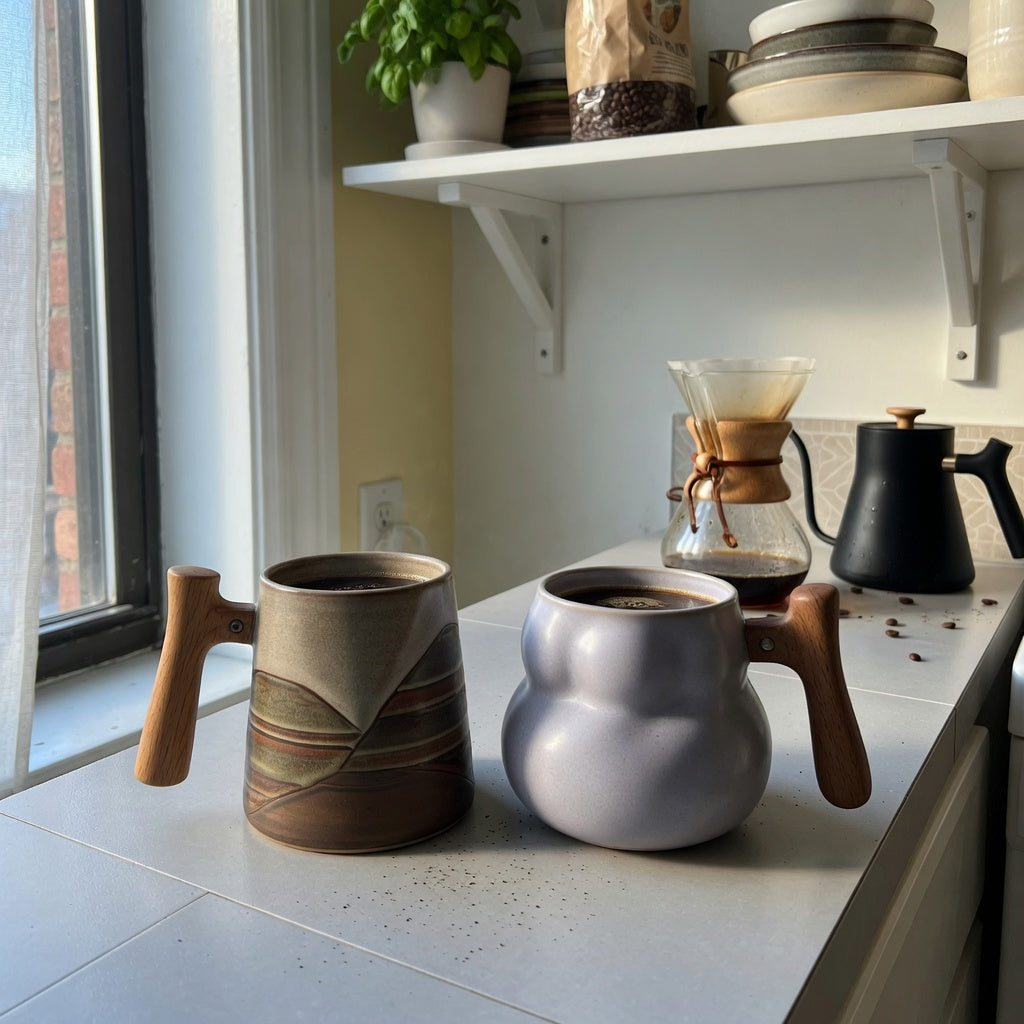
Ceramic mug with wooden handle for small coffee setup: Fit guide
Compare listed capacity, visible ceramic vessel form, and wooden-handle shape against a tight counter, shelf, or desk. We map Mountain Sea II and The Cloud to real small-space buying situations wit...
Read more
Leave a comment
This site is protected by hCaptcha and the hCaptcha Privacy Policy and Terms of Service apply.