




Ceramic Latte Cups Gift Choice Product Shortlist Guide for Routines
Reading time: about 11 minutes
Last week a customer emailed us a photo of three cups lined up on her kitchen counter and asked which one her sister would actually use. Two were labeled latte cups. One was 250 ml, the second was 400 ml, and the third was 440 ml. Her problem was not a lack of options. It was that none of the labels said 'small flat white before a desk shift' or 'one big latte on a slow Sunday.' That is where a ceramic latte cups gift choice product shortlist guide earns its keep: it turns capacity into a routine, then gives you a reason to skip the two cups that do not fit it.
Which recipient routine are you actually shopping for?
Before you compare product pages, name the drink. Almost every latte-cup gift question we answer lands in one of three routines.
- The small milk-coffee drinker. A double shot and a modest pour of steamed milk, finished in five or ten minutes at a desk. They want a cup that feels full, not a bucket with an inch of coffee at the bottom.
- The one-full-latte drinker. A 12 to 14 fl oz latte most mornings, often with a foam cap they care about. This is the person who notices when a cup is too narrow to pour into.
- The long-drink drinker. A big milky coffee, or someone who makes coffee in the morning and tea in the afternoon and does not want two cups on the desk.
If you cannot pick one, you are not ready to choose a cup. Ask the recipient what they order, or look at the cup they already use most often. The answer is usually visible on the shelf.
Why the listed milliliters are not the same as a comfortable fill
We tell customers to assume a listed capacity is a brim measurement unless the listing says otherwise. A latte needs headspace: foam, a little clearance, and room to walk the cup from the kitchen to the desk without a wave going over the rim.
This is why a cup described as 10 oz can feel closer to 8 oz in daily use. The number on the page is not a lie. It is just not the same number as the pour you can carry.
The vocabulary does not help. The FDA defines ceramic cups and mugs as small hollowware normally holding about 240 ml, usually with a handle. A modern latte is often larger than that, so 'cup' and 'mug' no longer tell you much on their own.
- Work backward from the finished drink, then add roughly two centimeters of headroom before you compare it to a capacity figure.
- Assume any number on a listing is brim-full unless the listing says fill capacity or shows a marked fill line.
- If the recipient drinks 300 ml lattes, a 400 ml cup is the sensible minimum, not a generous upgrade.
The ceramic latte cups gift choice product shortlist guide: three cups, three routines
All three of the cups we get asked about most sit in our unique coffee mugs collection, so you can compare them side by side. We will keep the product facts to what we list: 250 ml, 400 ml, and 440 ml. For handle clearance, base diameter, and silhouette, use the product photos and ask us to confirm anything the listing does not show.
Scenario 1: one small milk coffee at a desk, the Ball Handle at 250 ml
250 ml is about 8.5 fl oz by conversion. That is a large flat white or a modest single latte, not a bucket. The point is that the drink fills the cup instead of leaving a shallow pool at the bottom.
- Choose it if the recipient orders small milk drinks, drinks standing up, or has complained that a big mug makes a latte feel like a bowl of milk.
- Skip it if they default to a 12 to 14 fl oz cafe latte. A 250 ml cup will read as an espresso cup to them, and it will sit at the back of the cupboard.
The Ball Handle 250 ml cup names its handle style, but the name does not tell you finger clearance. Check the gap between handle and body in the photos, and confirm the base diameter if the cup has to fit a narrow coaster or a crowded desk.
Scenario 2: one full latte with foam to work with, The Flow at 400 ml
400 ml is about 13.5 fl oz. It is the middle capacity here, and it is the one we would call the safer blind guess for a one-latte-a-day recipient.
- Choose it if they drink one proper latte most mornings, care how the foam sits, or have started practicing latte art and want more surface to pour into.
- Skip it if they drink cortados or espressos, or pull a single shot and like it strong. Four hundred milliliters of milk to one shot is a lot of dilution.
The The Flow 400 ml cup is not a universal cup. It is a one-latte cup. If the recipient regularly orders the largest size on a cafe menu, go up rather than hoping the 400 ml will stretch.
Scenario 3: a long drink that doubles as tea, Morning and Night at 440 ml
440 ml is about 15 fl oz, the largest of the three. It suits a big milky coffee, a work-from-home refill, or a household where the same cup gets coffee in the morning and tea in the afternoon.
- Choose it if they drink large lattes, refill once before lunch, or already own a smaller cup and complain it is never enough.
- Skip it if they are precise about espresso-to-milk ratios or mainly drink short milk drinks. A 440 ml cup half-filled is a worse gift than a 250 ml cup filled properly.
The Morning and Night 440 ml cup is the one to look at when the recipient wants one cup to do two jobs. Check the product photos for the silhouette and handle, and measure the spot where the cup will live before you assume a bigger cup will fit.
Handle geometry and base diameter: what product photos can and cannot tell you
Capacity gets the attention. The handle decides whether the cup gets picked up on a tired morning.
- Finger clearance. A handle that fits two fingers when empty can pinch when the cup is full. Look for visible open space between the handle and the body.
- Attachment point. Handles set high on the body change the balance point on a full cup. Mid-body handles often feel steadier once the cup is heavy, but the photos are your evidence, not a spec sheet.
- Weight when full. A 440 ml cup is meaningfully heavier full than a 250 ml cup. If the recipient has wrist or grip issues, size down.
- Base diameter. Measure the coaster or the patch of desk the cup will sit on. A wide base on a narrow side table is a cupboard cup.
We cannot tell you which handle suits someone else's hand. Anyone who claims otherwise is guessing. What we can say is that handle discomfort is one of the most common reasons a gifted cup stops being used, so spend thirty seconds on the photos before you commit.
Does a 'lead-free' label settle glaze safety?
This is the part of gifting ceramicware that deserves more attention than it gets. The FDA sets an action level for leachable lead in ceramic cups and mugs at 0.5 micrograms per milliliter of leaching solution, applied to any one of six units tested. Cadmium has its own limits: 0.5 micrograms per milliliter for small hollowware and 0.25 micrograms per milliliter for large hollowware.
The test behind those numbers uses acetic-acid extraction, ASTM C738. The FDA describes it as a severe test that is unlikely to be matched in ordinary use. That does not make the label meaningless. It makes the method worth understanding.
A 'lead free' label on its own is not proof. The FDA has reported traditional pottery sold as lead free that still released extractable lead at or above action levels, and notes that such labeling can be treated as false or misleading. If a glaze was not fired properly, lead may not fuse into the glaze at all. Washing, boiling, or scrubbing will not remove it.
- Buy factory-made commercial ceramicware from a seller who answers questions. The FDA describes everyday commercial factory pottery as much less likely to have a lead problem than handmade, antique, flea-market, damaged, or brightly orange, red, or yellow decorated pieces.
- Ask for leachable lead and cadmium results from the production batch. Many listings do not publish them, so treat food safe as a starting point rather than a certificate. If the listing is silent, email the seller.
- Avoid decorative ceramicware that looks like a mug but carries a 'Not for Food Use' warning. Under 21 CFR 109.16, that warning has to be conspicuous on the piece and permanently marked on the base, or the item is treated as food-use ware.
Will it survive a microwave reheat or a dishwasher cycle?
Ceramic generally lets microwaves pass through rather than reflecting them, which is why it works as a container. That does not make every ceramic cup microwave safe. Metal trim, gold rims, and metallic lusters reflect microwaves, and the FDA says reflected microwaves can cook unevenly and may damage the oven.
In a dishwasher, the slow failure we watch for is glaze wear. Repeated hot cycles and strong detergents dull a glossy surface over years and can open fine crazing lines. A cup with visible crazing or a chip on the rim should be retired, not gifted on.
For the cups on this shortlist, check the individual product listing for microwave and dishwasher wording. We do not claim either suitability unless the listing says so. If the page is silent, ask before you wrap it. It is a two-line email and it saves an awkward conversation later.
When one of these three cups is the wrong gift
Three cases where we would point you somewhere else:
- They drink cortados or piccolos. Even the 250 ml cup is likely too large. Look for a smaller cortado-specific cup rather than sizing down from this shortlist.
- They are a tea drinker first. Coffee proportions and tea proportions are different conversations. A wide latte cup may not suit an infuser or a teabag routine, so check the interior and capacity before you buy.
- They want one plain, big mug and nothing sculptural. That is a different brief. Browse the unique coffee mugs collection for silhouettes, but be honest that these three are latte-oriented capacities.
Worth saying plainly: we do not list gift boxes or personalization on these cups. If the gift needs a name on it or a presentation box, confirm that before you promise either to the recipient.
Frequently asked questions
Is a 250 ml ceramic latte cup big enough for a normal latte?
For a small latte or a flat white, yes. It holds about 8.5 fl oz by conversion, which is a single shot with a modest amount of milk. For a standard 12 to 14 fl oz cafe latte, no. The drink plus its foam cap will not fit at a comfortable fill level.
How do I narrow three ceramic latte cups down to one gift?
Use a ceramic latte cups gift choice product shortlist guide as a filter, not a catalog. Start with the recipient's drink, cut any cup whose capacity does not leave room for that drink plus foam, then check handle clearance and base diameter in the photos. If two cups still fit, choose the smaller one for a desk and the larger one for a refill habit.
Does cup shape really matter for latte art?
Baristas generally say it does, and the practical reason is flow. A rounded interior bottom gives milk somewhere to move instead of hitting a hard corner, and a wider surface gives foam room to spread. A narrow, straight-sided mug is harder to pour into at the same volume.
Can these cups go in the microwave or dishwasher?
Check the individual listing rather than assuming. Plain ceramic with no metallic trim is the usual microwave case, but gold rims and lusters are not, and dishwasher tolerance varies by glaze. If the page does not say, ask before you buy.
How can I check that a ceramic cup's glaze is food safe before gifting it?
Ask the seller for leachable lead and cadmium results from the production batch. The FDA action level is 0.5 micrograms per milliliter for lead in cups and mugs, and 0.5 micrograms per milliliter for cadmium in small hollowware. A lead-free label alone is not proof, since the FDA has found pottery sold under that label that still released extractable lead.
A 60-second check before you add to cart
- Name the recipient's drink and its rough volume.
- Add roughly two centimeters of headroom, then compare that to the listed capacity.
- Look at the handle gap and the base diameter in the product photos.
- Check the listing for microwave and dishwasher wording.
- Ask for lead and cadmium test data if the cup is for a daily drinker or a household with young children.
If you land on one of the three cups here, compare them at full size in the unique coffee mugs collection. Pick the capacity that matches the drink the recipient actually makes, not the one that looks best in a photograph. That is the whole shortlist.
More from our blog
Ready to pick your mug? Two ways to save on today's order:
Ordering 1–3 mugs? Get an extra 10% off your 1st order with code 10_OFF Apply 10% Off & Shop Wooden-Handle Mugs →
Gifting 4+ mugs? Buy 3, Get the 4th Free applies automatically at checkout (no code needed; offers do not stack) · Free standard shipping (Nov pre-Christmas delivery: 15–20 calendar days US) · Free replacement if chipped in transit.
Popular mug buying guides: Wooden-Handle Tea Infuser Mugs Compared · Christmas & Secret Santa Mugs 2026 · Espresso & Cortado Cups Guide · Cup & Saucer Gift Sets · All 25 Mugs Spec Table · Mug Size Guide · Shipping & Promo FAQ
FIRST ORDER 10% OFF (CODE: 10_OFF) · OR BUY 3, GET THE 4TH FREE


Read more

Ceramic Latte Cups Gift Choice Practical Purchase Checklist
A capacity-first gift checklist for ceramic latte cups: how 250, 400 and 440 ml change the drink, the handle fit and the desk footprint, plus the glaze, lead and care questions to settle before you...
Read more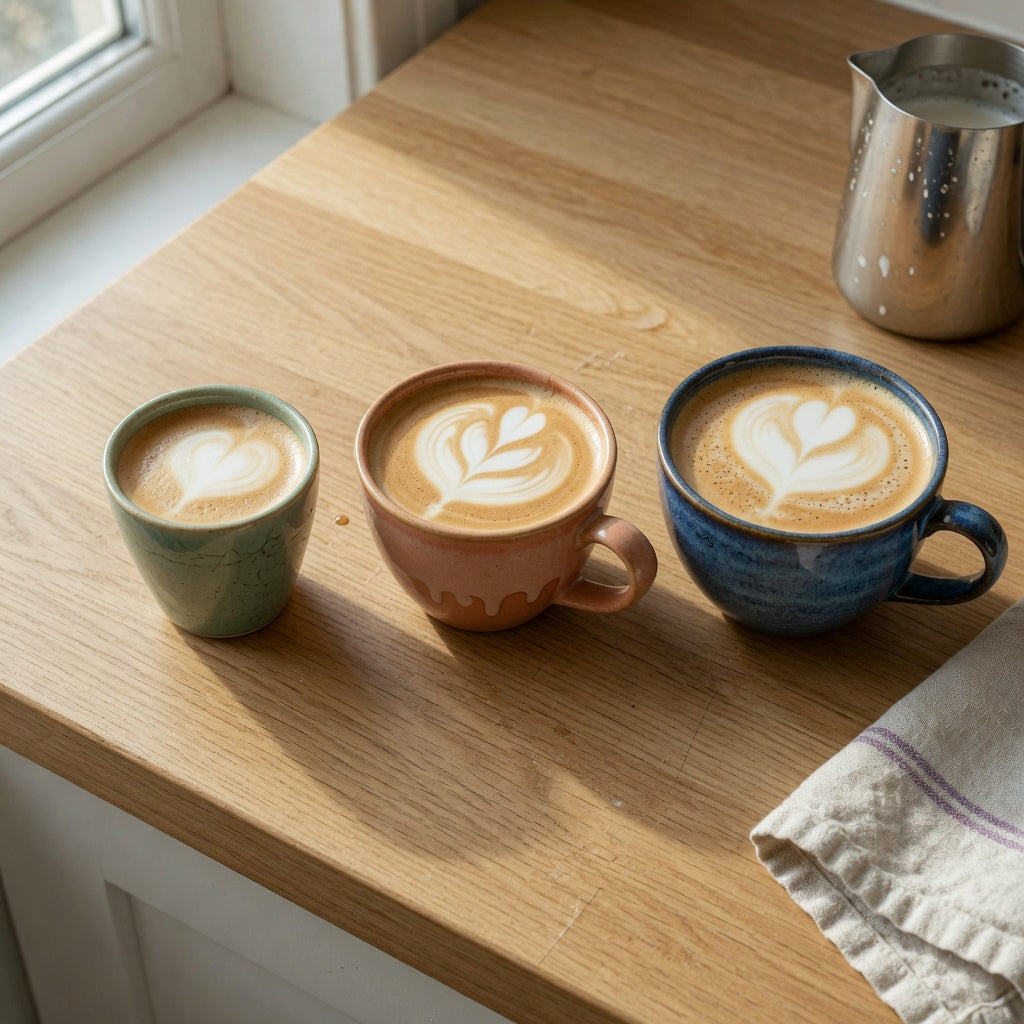
Ceramic Latte Cups First Time Buyer Practical Purchase Checklist
A working checklist for your first ceramic latte cups: how listed millilitres translate to real pours, what shape and handle geometry change, and which glaze, microwave, and dishwasher details you ...
Read more
Leave a comment
This site is protected by hCaptcha and the hCaptcha Privacy Policy and Terms of Service apply.