



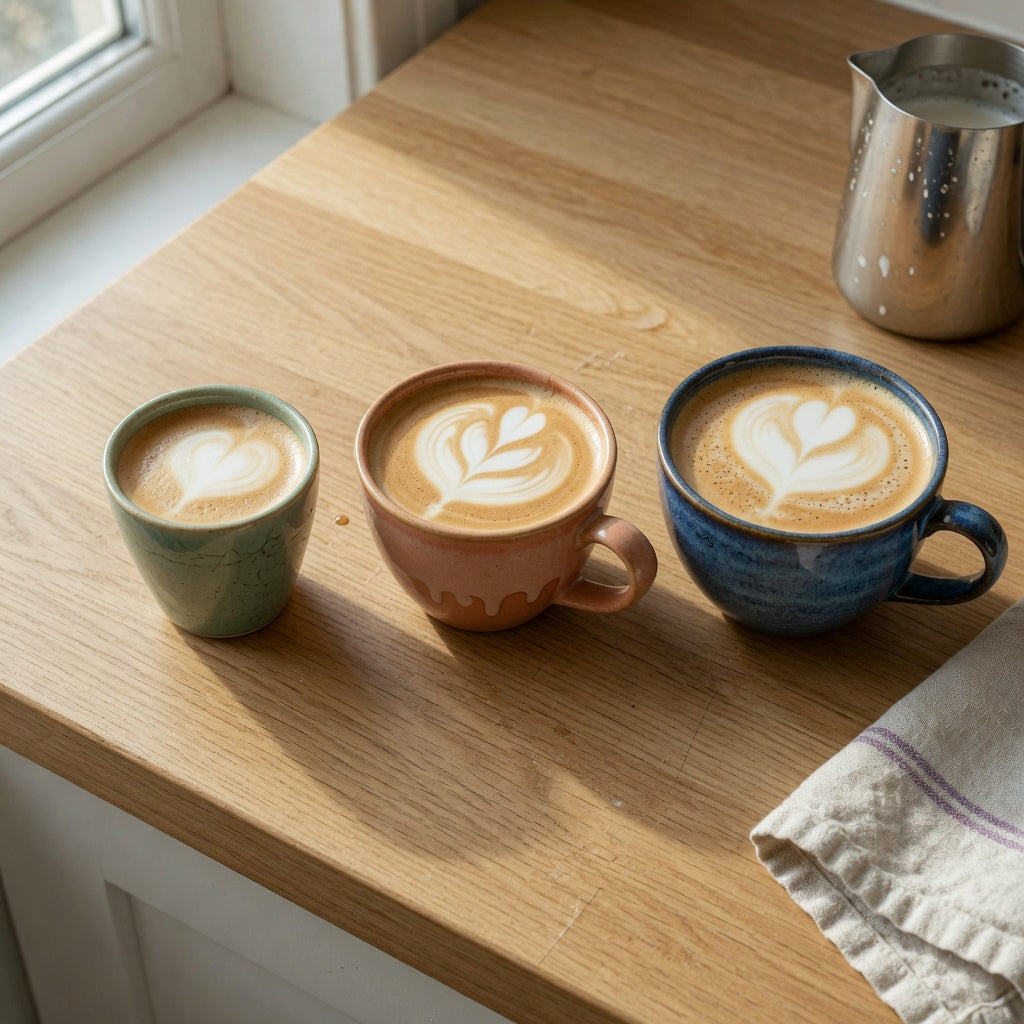
Ceramic Latte Cups First Time Buyer Practical Purchase Checklist
Reading time: about 9 minutes
Ten ounces is printed on the box. You pull the shot, steam the milk, pour, and the finished latte stops a full centimetre below the rim. Nothing is defective — the number on the label and the number in the cup were never measuring the same thing. That gap is exactly what this ceramic latte cups first time buyer practical purchase checklist is for: the details you can verify before checkout, and the ones you have to accept as unknown.
We sell these cups daily and we handle the returns, so the questions below come from real order notes and conversations in our store rather than a spec sheet. We will show you how listed capacity actually behaves, how vessel shape and handle geometry change the drinking experience, what a glaze claim does and does not prove, and where our own listings stop short.
Why a cup labeled 10 oz can drink like an 8 oz cup
Capacity figures on ceramic latte cups describe different things depending on who wrote the listing. In our experience, three versions circulate, and sellers rarely say which one they used.
- Brim-full capacity — volume to the absolute lip, filled with water, no foam. Largest number, least useful.
- Comfort fill — the level you actually pour to, comfortably below the rim so the cup survives being carried across a room.
- Working capacity with foam — comfort fill minus the headspace a latte or cappuccino needs. This is what most drinkers mean when they say a cup "holds" something.
That is why reviews on the same listing swing between "perfect size" and "smaller than I expected." They are measuring against different reference points. If a product page gives one number and does not state which of the three it is, treat it as brim-full and assume you will drink less than that.
Metric listings reduce some of the ambiguity, because millilitres are usually quoted to the rim and convert cleanly. 250 ml is roughly 8.5 fl oz. 400 ml is about 13.5 fl oz. 440 ml lands near 15 fl oz. That is arithmetic, not a fill-line claim — you still subtract for foam and a safe carry line.
Which listed capacity matches the latte you actually make?
Our catalog is deliberately small, so each cup maps onto a drink style rather than a vague size band. You can see the whole range in the unique coffee mugs collection. These are the listed capacities, and only the listed capacities:
| Cup | Listed capacity | Approximate | Drink it tends to suit |
|---|---|---|---|
| Ball Handle | 250 ml | ~8.5 fl oz | Single-shot latte, flat white, tea |
| The Flow | 400 ml | ~13.5 fl oz | Double-shot latte, tall cappuccino |
| Morning and Night | 440 ml | ~15 fl oz | Large latte, milk-forward drinks, long tea sessions |
Here is the trade-off nobody puts on a product page. A 250 ml cup is genuinely wrong for a big morning latte — you will refill it twice. It is excellent for a single shot with a modest milk pour, where the crema-to-milk ratio stays tight. A 440 ml cup does the opposite: it swallows a small flat white and makes it look lost, and it pushes the milk proportion up on every drink. The 400 ml sits in the middle and is the safer default if you make one latte a day and do not want to think about it again.
If you are also comparing across the wider mug range, our breakdown of 12 oz ceramic coffee mugs for first-time buyers uses the same capacity logic and is worth reading before you commit to a size.
Bowl-shaped, rounded-bottom, or straight-sided — does the interior actually matter?
It matters more than the exterior glaze does. Café practice and buyer guides commonly point to a rounded or bowl-like interior because it gives the milk somewhere to swirl and settle — that is the profile baristas reach for when pouring latte art. A straight-sided mug gives the milk less room to move and a narrower rim to draw through. If latte art is the reason you are buying, prioritise rim width and interior curve over handle decoration.
Two things buyers routinely overlook:
- Handle clearance under load. A handle that feels fine on an empty cup can pinch once it is full. Look at the product photos and judge the gap between handle and body against your own fingers. If grip is your deciding factor, open the listing photos on the Ball Handle cup and check the loop against your hand before ordering — handle feel is the one spec we cannot solve for you remotely.
- Desk footprint. Listed capacity usually correlates with a wider body, but it is not a guarantee. If counter or keyboard space is tight, find the actual dimensions in the listing rather than inferring them from millilitres.
For a deeper look at how handle construction affects day-to-day carrying comfort, our ceramic coffee mug with handle checklist covers the grip side in more detail.
Glaze, lead, and what a "lead free" label actually proves
This is the section where buyers get the least help from listings, so here is what is verifiable. The FDA sets an action level of 0.5 micrograms per millilitre of leaching solution for leachable lead in ceramic cups and mugs, applied to any one of six units tested. For cadmium, the action levels are 0.5 micrograms per millilitre for flatware, averaged across six units, and for small hollowware as any one of six units; large hollowware carries a lower 0.25 figure.
Three things worth knowing before you trust a badge:
- The test behind those numbers uses acetic-acid extraction — ASTM C738 — and the method is described as a deliberately severe test unlikely to be matched in ordinary use. It is a stress test, not a simulation of your morning coffee.
- FDA has reported traditional pottery labelled "lead free" that still contained extractable lead at or above its action levels. A label is a claim; a batch test result is evidence. Most listings publish neither.
- Washing, boiling, or scrubbing will not remove lead from pottery. If a cup leaches, no kitchen routine fixes it.
Practical risk screening, per FDA guidance, puts handmade, antique, damaged, flea-market, and brightly orange-, red-, or yellow-decorated pieces in a higher-concern group, while everyday commercial factory pottery is described as much less likely to carry a lead problem. Decorative-only ceramicware is also a trap: under 21 CFR 109.16, a piece that looks food-appropriate is treated as foodware unless it carries both a conspicuous "Not for Food Use" warning and a permanent version on the base, or has a hole bored through the food-contact surface. If it is glazed, decorative, and sold as a trinket, do not drink from it. Our glazed ceramic mug checklist goes through the finish questions worth asking a seller.
Microwave, dishwasher, and metallic trim — reading the care line properly
Microwave claims are piece-specific, not category-wide. The FDA explains that microwaves pass through glass, paper, ceramic, and plastic, and are reflected by metal — which is why a metal pan or foil should stay out of the oven. Ceramic itself lets microwaves pass through. What is not safe is a decorative metallic glaze or lustre trim on the rim or handle, because that decoration behaves like metal. A cup with gold detailing is not the same buying decision as a plain glazed cup, even from the same collection.
Two more rules we give customers:
- Chips and crazing — the fine hairline cracking in a glaze — end the relationship. Retire the cup. Cracked glaze is a food-contact surface you can no longer reason about.
- Dishwasher cycles and detergents are harder on decorative finishes than a hand wash; plain glazes generally tolerate the machine better. If a listing does not state dishwasher suitability explicitly, assume hand wash.
The ceramic latte cups first time buyer practical purchase checklist we use in-store
Run this before you add anything to a cart. Every line is something you can check, question, or knowingly accept as unknown.
- Confirm which capacity definition the listing uses. If it is unstated, assume brim-full and plan your drink size down accordingly.
- Convert millilitres to ounces yourself. Do not trust a converted figure in the copy; it is often rounded in the seller's favour.
- Match interior shape to your goal. Latte art and milk-forward drinks want a rounded interior and a generous rim. Straight-sided mugs do not.
- Check handle clearance and actual dimensions in the photos. Capacity is not a proxy for body diameter or desk footprint.
- Look for a stated food-contact claim and, ideally, a batch test result. A "lead free" badge alone does not tell you which limit it was measured against.
- Read the microwave line for metallic trim. Plain glaze and gold decoration are different risk profiles.
- Decide whether you want a single cup or a set before you compare prices. Sets change the per-cup maths but lock you into one size.
- Accept the unknowns out loud. Heat retention, chipping resistance, and breakage in transit are not published for most ceramic latte cups, ours included. If a seller ranks them confidently, that ranking is not backed by a standard test you can inspect.
If you want the short version: start with the 400 ml The Flow if you make standard lattes, the 440 ml Morning and Night if your drinks run large, and the 250 ml Ball Handle if you are chasing a tighter espresso-to-milk ratio. Then verify the listing details you care about before you pay.
Frequently asked questions
What belongs on a ceramic latte cups first time buyer practical purchase checklist?
Capacity definition, interior shape, handle clearance, actual dimensions, food-contact claims, microwave and dishwasher guidance, and a written note of what the listing does not tell you. If you can answer those seven items, you know enough to buy.
Why doesn't a 400 ml cup hold 400 ml of latte?
Because the listed figure usually describes brim-full volume with no foam. Once you subtract a comfort fill line and the headspace a latte needs, the usable pour is smaller — often noticeably so. That is normal, not a defect.
Do thicker-walled ceramic latte cups keep coffee hotter?
We cannot give you a number, and we would be sceptical of any listing that does. Wall thickness and overall mass are the practical clues buyers use, but independent comparisons of stoneware, porcelain, and double-wall ceramic at realistic drink volumes are scarce and they disagree with each other.
Can I microwave a ceramic latte cup with a gold handle or metallic trim?
No — treat metallic trim as metal. The FDA notes microwaves are reflected by metal, which can cook unevenly and damage the appliance. A plain glazed ceramic cup without decoration is a different situation, but confirm the specific listing's care line rather than assuming.
Are double-wall ceramic latte cups worth it?
It depends on the seal, not the concept. Buyer reports of double-wall cups leaking or behaving oddly are common enough that we would want a clear statement about how the cavity is sealed before buying. Double-wall construction is not something we can confirm on our current listings, so if that is your priority, look for a seller who states how the cavity is sealed.
Ready to pick your mug? Two ways to save on today's order:
Ordering 1–3 mugs? Get an extra 10% off your 1st order with code 10_OFF Apply 10% Off & Shop Wooden-Handle Mugs →
Gifting 4+ mugs? Buy 3, Get the 4th Free applies automatically at checkout (no code needed; offers do not stack) · Free standard shipping (Nov pre-Christmas delivery: 15–20 calendar days US) · Free replacement if chipped in transit.
Popular mug buying guides: Wooden-Handle Tea Infuser Mugs Compared · Christmas & Secret Santa Mugs 2026 · Espresso & Cortado Cups Guide · Cup & Saucer Gift Sets · All 25 Mugs Spec Table · Mug Size Guide · Shipping & Promo FAQ
FIRST ORDER 10% OFF (CODE: 10_OFF) · OR BUY 3, GET THE 4TH FREE


Read more

Ceramic Latte Cups Gift Choice Product Shortlist Guide for Routines
Buying ceramic latte cups as a gift gets easier when you match capacity to a routine. This shortlist compares the 250 ml, 400 ml and 440 ml cups, with clear reasons to choose or skip each one and t...
Read more
Ceramic Latte Cups Replacement Purchase Practical Purchase Checklist
A replacement cup should fix the flaw that retired the last one, not repeat it in a new colour. This is the ceramic latte cups replacement purchase practical purchase checklist our team uses before...
Read more
Leave a comment
This site is protected by hCaptcha and the hCaptcha Privacy Policy and Terms of Service apply.