



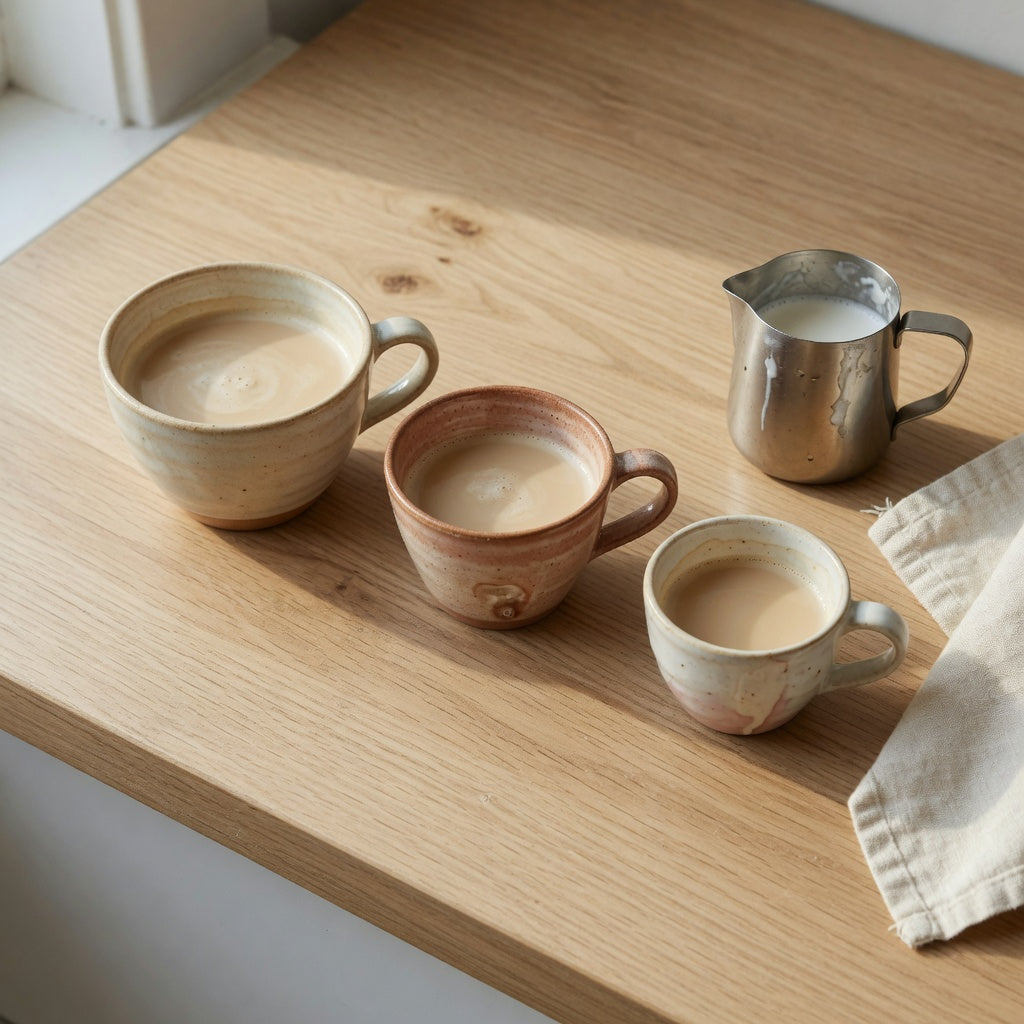
Ceramic Latte Cups Buying Priorities: Capacity, Shape, and Space
Reading time: about 10 minutes
We get the same note most weeks: someone bought a ceramic latte cup listed at 10 oz, pulled a double shot, steamed milk close to the rim, and ended up with a drink that wanted to spill before it reached the handle. Nothing on the listing was false. The number was measured to the brim, and a latte needs headroom. That gap between the printed capacity and the drink you actually pour is the first of the ceramic latte cups buying priorities we walk shoppers through in our store. The others are interior shape, rim width, handle clearance, footprint, and glaze. Get those in the right order and you buy once.
Which ceramic latte cups buying priorities actually decide whether you keep the cup?
Most latte cup advice collapses into a materials argument. Material matters, but it is rarely the reason a cup gets returned. In our experience the returns and the wish-I-had-bought-the-other-one emails trace back to fit, not clay body. Here is the order we suggest:
- Usable capacity — how much drink fits while leaving room for a foam head, not the brim-full figure.
- Interior shape — whether the bottom is rounded enough to let milk and espresso combine and settle evenly.
- Rim width and lip — a thin, wide rim pours art more comfortably than a thick rolled lip.
- Handle clearance — can your fingers pass through when the cup is full and heavy?
- Footprint and height — base diameter on the desk, total height under the cabinet shelf.
- Glaze and care — food-contact safety, microwave and dishwasher reality.
Notice that heat retention is not on the list. Wall thickness and mass do affect how quickly a drink cools, but the honest version is that pre-warming the cup does more for your latte than swapping one ceramic for another. We would rather you pick the right size than chase a material ranking nobody has tested properly.
How do our three listed capacities compare?
We list capacities plainly because guessing is what causes the problem. Here is what is confirmed on our range, plus the details worth confirming on the product page before you commit.
| Cup | Listed capacity | Confirm on the current listing | Routine it tends to suit |
|---|---|---|---|
| Ball Handle | 250 ml | Interior base curve, handle opening width, base diameter | A single small milk drink, a cortado-plus, small hands, a crowded desk |
| The Flow | 400 ml | Rim width, interior base shape, handle clearance when full | A standard latte, daily latte-art practice, one drink per morning |
| Morning and Night | 440 ml | Total height against your cabinet shelf, handle clearance, full-cup weight | A long morning latte, a second cup that has to last through a meeting |
Those three capacities are the only volume figures we can state with confidence. Anything else — exact diameter, wall thickness, glaze finish, whether a specific cup is microwave safe — should be read off the live listing rather than inferred from a photo or a sibling product.
If you want to see all three side by side, the full unique coffee mugs collection is the fastest place to compare shapes and listed capacities.
Does a 400 ml cup actually pour a 400 ml latte?
Rarely. Fill a cup to the absolute rim and you cannot carry it. Add a foam head and you have spent another centimetre or two of depth. Our working rule of thumb: assume 30–60 ml disappears into headroom and foam, so a 400 ml cup delivers something closer to a 340–370 ml drink, and a 250 ml cup lands nearer 200–220 ml.
Two more things eat into that figure. A double espresso contributes roughly 50–60 ml of liquid before any milk goes in, and milk volume grows when it is steamed. If you are weighing a 10 oz cup against your usual order, do the arithmetic on the drink you actually make, not the drink you aspire to make. We covered the numbers from the 12 oz angle in our 12 oz ceramic coffee mugs buying priorities guide, and the same logic applies one size down.
Which interior shape gives you room to pour?
Straight-sided vessels and rounded-bottom vessels behave differently with the same volume of milk. A rounded interior lets the milk pool and fold instead of hitting a hard wall, which is why baristas reach for bowl-ish cups when they are practising. A straight-sided mug is fine for drinking; it is simply less forgiving when you are trying to draw.
The FDA’s own ceramics guidance draws a distinction worth knowing: it describes cups as having a base and curved sides, while mugs are described as having cylindrical sides. That is a labelling convention rather than a rule about latte art, but it explains why the two words are not interchangeable on a spec sheet.
Rim matters as much as the bowl. A wide rim gives the milk somewhere to land and spread; a thick rolled lip pushes the surface tension around and makes a clean pour harder. If latte art is the point of the purchase, prioritise interior curve and rim width over handle styling.
Does the clay body change how the cup feels in hand?
We do not rank stoneware, porcelain, bone china, or earthenware by heat retention. Independent tests at realistic drink volumes are scarce, and the ones that exist conflict. What you can check before buying is more practical: listed weight, wall thickness at the rim, whether the glaze looks even in the product photos, and the manufacturer’s care marks.
Thicker walls add mass. Some drinkers like that solid feel; others find a heavy cup clumsy after a full pour, especially when they are carrying it one-handed. Porcelain can be thinner and lighter, while stoneware often feels heavier in the hand. Neither is automatically better for latte art. The cup that suits you is the one you can hold comfortably when it is full, not the one with the longest material name.
Where does handle geometry decide comfort?
A handle is not decoration. It is the part of the cup that has to work when the cup is at its heaviest — full, hot, and being carried one-handed from kitchen to desk. Two failure modes show up repeatedly: an opening too narrow for anything but fingertips, and a handle positioned so high that the cup tips forward as you lift it.
The Ball Handle name suggests a rounded handle form; check the actual opening measurement on the listing before assuming it suits a larger hand. If handle comfort is your deciding factor, we go deeper into grip and knuckle clearance in our guide to ceramic coffee mugs with large handles.
How much counter, desk, or shelf space does each one take?
Footprint is the priority shoppers forget until the cup is home. Three practical measurements decide it:
- Base diameter — does it sit securely on a narrow desk edge or a saucer you already own?
- Total height — the 440 ml cup holds the most of the three, and larger vessels often run taller — check the listed height against your shelf gap.
- Handle projection — a wide handle adds real width, which matters if the cup lives beside a monitor or under a low shelf.
If you keep cups in a cabinet rather than on open shelving, measure the clear space between shelves before choosing the largest size. It is a two-minute check that prevents a permanently sideways cup.
What does a lead-free glaze claim actually guarantee?
This is where we stop being relaxed. Ceramic is a fired material with a glaze that contacts your drink, and the safety question is about what leaches out of that surface, not about the word on the sticker.
The FDA sets an action level for leachable lead in ceramic cups and mugs of 0.5 micrograms per millilitre of leaching solution, applied to any one of six units tested. Its cadmium action level for small hollowware is 0.5 micrograms per millilitre, again on any one of six units. Testing typically follows an acetic-acid extraction method, ASTM C738, which the FDA describes as a deliberately severe test — harsher than ordinary use.
The bit shoppers miss: the FDA has reported traditional pottery labelled lead free that still contained extractable lead at or above those levels, and it treats that labelling as potentially false or misleading. It also states plainly that washing or boiling cannot remove lead from pottery. Higher-risk categories the agency flags include handmade, antique, damaged, and brightly orange-, red-, or yellow-decorated pieces, while everyday commercial factory pottery is described as much less likely to have a problem.
Practical translation for a buyer: a lead-free badge is a starting point, not a guarantee. Buy from a seller who will tell you where a piece is made and who stands behind the glaze. If a cup arrives with a chipped or crazed glaze — fine hairline cracks in the surface — retire it rather than keep using it. We touch on glaze behaviour more broadly in our guide to ceramic glazed coffee mugs buying priorities.
Microwave and dishwasher: what the label has to say
Ceramic as a material passes microwaves rather than reflecting them, which is why plain glazed cups are commonly used in them. Metal is the exception — microwaves reflect off metal, so any metallic trim, gold rim, or lustre decoration is metal and should stay out of the microwave entirely. If a listing does not explicitly say microwave safe, treat it as unconfirmed and check with the seller.
Dishwasher guidance is piece-specific too. In our experience, detergent and high heat are hard on glazes over years, and a cup that survives many cycles may not survive years of them. Hand-washing a favourite cup is not snobbery; it is cheap insurance. Never put a cracked or crazed cup in the dishwasher and assume it is fine — cracks give liquid a path into the body of the piece.
Matching each cup to a real routine
The fastest way to decide is to describe your morning out loud, then pick the cup that matches the description.
- You drink one small, milk-forward coffee and hate waste. The Ball Handle at 250 ml is the honest fit — a small drink in a small cup looks and pours better than a small drink in a big one.
- You make a standard latte most mornings and want to improve your pour. The Flow at 400 ml gives you enough surface to work with without pushing you into a bucket.
- You want one large cup that carries you from breakfast to a mid-morning call. The Morning and Night at 440 ml is the largest we list, so measure your shelf clearance first.
None of these is a good fit if you drink iced coffee by the litre, if you need a sealed lid for a commute, or if you want an insulated vessel that keeps a drink hot for hours. Those are different products with different jobs. For everything else, compare the full range in our unique coffee mugs collection before you commit.
Frequently asked questions
Is a 400 ml ceramic latte cup too big for a single latte?
For most home setups it is about right. A double shot plus steamed milk lands comfortably inside a 400 ml cup with headroom left for foam. If you usually make a smaller, stronger drink, the 250 ml Ball Handle will feel better proportioned and you will not be pouring a half-full cup.
Why does my 10 oz cup only hold about 8 oz?
Because capacity is usually measured to the rim. Leave the centimetre or two of headroom any carried drink needs, add the foam head, and a cup listed at one figure delivers noticeably less. Always compare listed capacity against the drink volume you actually pour, not against the number alone.
Do ceramic latte cups buying priorities change if I only drink tea?
Partly. Capacity and handle clearance still lead, but interior curve and rim width matter far less without milk to pour. For tea you can weight footprint and glaze care more heavily, and a wider rim simply helps the drink cool to a drinkable temperature sooner.
How can I tell if a ceramic cup is genuinely food safe?
You cannot verify it from a photo. Ask the seller where the piece is made and whether the glaze has been tested against FDA leachable lead and cadmium action levels. Avoid damaged, crazed, or antique pieces for daily drinking, and treat brightly decorated handmade ware with more caution than plain commercial pottery.
Will a thicker-walled cup keep my latte hot longer?
Mass helps a little, but it is not the lever most buyers think it is. Pre-warming the cup with hot water for thirty seconds before you pour does more for drink temperature than choosing between two ceramic bodies. We would not let wall thickness override capacity and handle fit.
Ready to pick your mug? Two ways to save on today's order:
Ordering 1–3 mugs? Get an extra 10% off your 1st order with code 10_OFF Apply 10% Off & Shop Wooden-Handle Mugs →
Gifting 4+ mugs? Buy 3, Get the 4th Free applies automatically at checkout (no code needed; offers do not stack) · Free standard shipping (Nov pre-Christmas delivery: 15–20 calendar days US) · Free replacement if chipped in transit.
Popular mug buying guides: Ceramic Tea Cups & Infuser Mugs · Ceramic Mugs with Lids Compared · Wooden-Handle Tea Infuser Mugs Compared · Christmas & Secret Santa Mugs 2026 · Espresso & Cortado Cups Guide · Cup & Saucer Gift Sets · All 25 Mugs Spec Table · Mug Size Guide · Shipping & Promo FAQ
FIRST ORDER 10% OFF (CODE: 10_OFF) · OR BUY 3, GET THE 4TH FREE


Read more

Ceramic Latte Cups Storage Fit Guide: 250 ml vs 400 ml vs 440 ml
Three ceramic latte cups, one crowded shelf, and a cabinet door that won't close. We compare our 250 ml, 400 ml and 440 ml cups by listed capacity, handle geometry and realistic shelf footprint — p...
Read more
Ceramic Latte Cups Current Product Facts: 250–440 ml Compared
We compare the three ceramic latte cups in our current catalog by listed capacity, then separate what the listings prove from what they leave blank: rim shape, handle opening, wall thickness, footp...
Read more
Leave a comment
This site is protected by hCaptcha and the hCaptcha Privacy Policy and Terms of Service apply.