
Ceramic Coffee Mugs With Large Handles Buying Priorities
Reading time: about 8 minutes
A mug can clear your fingers and still fail on the first Monday morning. The handle hits the monitor stand, the filled mug feels heavier than expected, or the shape will not fit between two cabinet shelves. We hear those concerns from shoppers, and our team checks the same details while handling, packing, and displaying mugs in our store. The most useful ceramic coffee mugs with large handles buying priorities are usable capacity, handle geometry, overall footprint, and care routine.
This comparison separates general buying guidance from product-specific facts. Capacities, dimensions, materials, and care information should always be confirmed on the linked product page because listings and available options can change.
Ceramic coffee mugs with large handles buying priorities: what comes first?
Start with the part of your routine that creates the most friction. Style matters, especially for a mug that stays on an office desk or is being given as a gift, but appearance will not correct a poor grip or an awkward cabinet fit.
- One long pour: compare listed capacity and the weight you are comfortable lifting.
- Frequent carrying: prioritize the handle aperture, grip surface, and balance in the hand.
- Desk-based drinking: check the base, total width, and handle projection.
- Automatic cleaning: verify the care instructions before choosing ceramic or mixed materials.
The linked mugs in this comparison sit in the listed 400-480 ml capacity band. Treat that as a useful starting range, then confirm the current figure for the individual mug rather than estimating volume from a product photo.
How much capacity fits one pour without becoming too heavy?
A 400 ml mug holds roughly 13.5 US fluid ounces, while 480 ml is about 16.2 US fluid ounces. That difference can remove a refill, but it also affects handling. A 480 ml serving adds close to 480 grams, or a little over one pound, of liquid before accounting for the weight of the ceramic body.
- For a compact coffee serving: favor the lower end of the listed range, particularly if you refill often or prefer a lighter lift.
- For a meeting-length drink: the higher end gives more room for coffee, tea, milk, or ice without filling to the rim.
- For limited wrist strength: do not assume a larger handle cancels the added weight of a larger ceramic body and a full pour.
Listed capacity may refer to maximum volume rather than a comfortable walking fill unless the page says otherwise. Leave practical headroom if you add milk, stir vigorously, carry the mug between rooms, or use ice.
Will the handle shape and total width fit your hand and shelf?
Handle size is more than the outside silhouette. The useful measurement is the aperture, meaning the internal opening available to your fingers. Storage depends on handle projection, the distance the handle extends from the mug body, plus the body diameter. Those details explain why two mugs with similar capacities can occupy very different amounts of desk or cabinet space.
- Mark the maximum mug area beside your keyboard with a sheet of paper or removable tape.
- Check cabinet height and depth, then allow for the handle rather than measuring the mug body alone.
- Think about your actual grip, including rings, wider knuckles, and whether you use two, three, or four fingers.
If complete dimensions are listed, compare overall width, height, and base diameter. If only capacity is shown, do not treat photos as precise scale references. A dramatic handle can be comfortable, but it may also prevent close side-by-side storage or stacking.
Which CoffeifyMug shape fits your grip and workspace?
These three designs solve different visual and practical priorities. We do not rank one as universally best. Each recommendation begins with a shopper situation, explains the relevant fit, and identifies the trade-off to verify before checkout.
Ball-handled mug for shoppers avoiding thin grip points
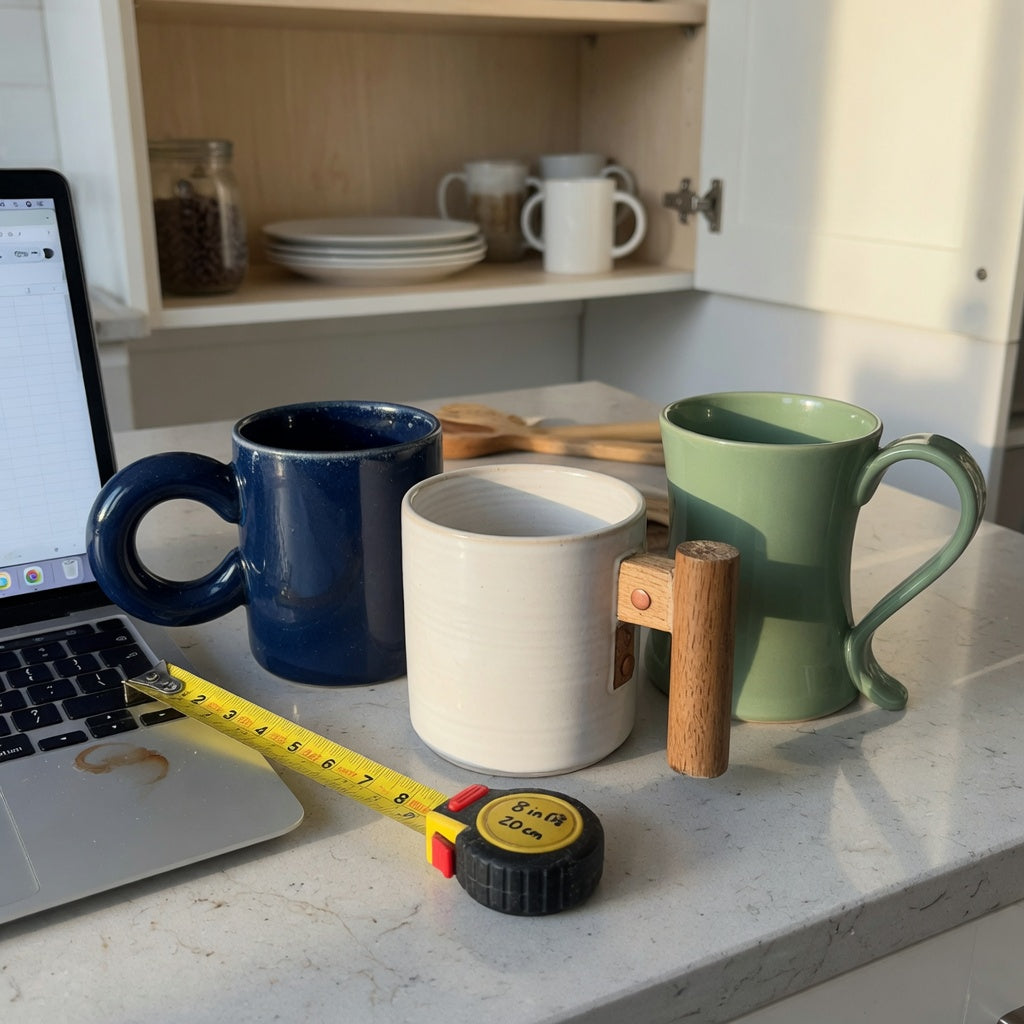
If narrow C-shaped handles press into your fingers and you prefer a substantial grip surface, start with the Ball Handled Coffee Tea Mug. Its defining feature is the prominent ball-handle form, making it the clearest candidate for shoppers who put handle character first. The trade-off is space: that distinctive silhouette can require more horizontal clearance, so confirm the current listed capacity and dimensions against your desk or shelf. It is not the safest choice for tightly packed mug racks.
Mountain Sea II for a mixed ceramic and wood design
The Mountain Sea II Coffee Tea Mug With Wooden Handle fits shoppers who specifically want a wooden contact surface and a mixed-material presentation. That combination can feel more gift-oriented than a plain office mug, and the wood is the practical distinction to weigh. It is a weaker fit for anyone who automatically puts every mug through heated dishwasher cycles. Read the current care directions instead of assuming the ceramic body makes the entire mug dishwasher or microwave compatible.
The Flow for shoppers prioritizing a sculptural profile
If the mug will remain visible on a desk and the curved handle profile is part of the appeal, compare The Flow Coffee Tea Mug. Its flowing form offers a different hand position and visual footprint from the ball-handled and wooden-handle designs. The limitation is grip predictability: a contoured opening may suit one hand and feel restrictive to another. Shoppers with wide knuckles should give the opening and listed dimensions more weight than the styled photographs.
If none of those three situations describes your routine, compare other silhouettes in our unique coffee mugs collection. Filter mentally by capacity, grip shape, and storage space before using color or decoration as the deciding factor.
How should ceramic, wood, and cleaning habits affect the choice?
Material affects care, but product-page instructions take priority over broad category advice. A ceramic body is not automatic proof of dishwasher or microwave compatibility because glazes, decoration, handle materials, and construction can differ.
- Check the listing for explicit dishwasher and microwave guidance before the first use.
- If a wooden-handle listing does not approve machine washing, hand wash it and avoid prolonged soaking or heated drying.
- Avoid sudden temperature extremes unless the product instructions state that the mug is suitable for them.
- Do not use an abrasive pad on decorated or glazed surfaces unless the care guidance permits it.
In our experience, the best mug is often the one whose care requirements already match the household routine. A design that needs special treatment is a poor everyday purchase for someone who relies entirely on the dishwasher, even if its handle feels ideal.
What should you inspect during unboxing and the first wash?
Ceramic damage is easiest to spot under side light before the mug enters daily use. This is especially useful for gift orders, where discovering a problem after wrapping creates unnecessary hassle.
- Run a finger carefully around the rim and grip area for unexpected rough spots.
- Inspect the handle-to-body joins for hairline cracks or glaze separation.
- Place the empty mug on a flat counter and check whether the foot ring rocks.
- After the first approved wash, recheck mixed-material joins and decorated surfaces.
Minor visual variation can occur in ceramic finishes, but sharp edges, structural cracks, or an unstable base are functional concerns. Keep that distinction clear when assessing an unboxed mug.
When is a large-handle ceramic mug the wrong choice?
These mugs are not substitutes for sealed travel drinkware. They may not fit a car cup holder, they do not provide a lid unless one is specifically listed, and the protruding handle is awkward in a backpack. A smaller straight-sided mug may suit a shallow cabinet, while an insulated tumbler is more practical for commuting or long outdoor use.
Large-handled ceramic is also not automatically lightweight. Buyers with reduced grip or wrist strength should consider the combined weight of the mug and liquid. For a household that needs effortless stacking and automatic washing, a simpler fully ceramic form may be a better match than a sculptural or wooden-handle design.
Frequently asked questions
What are the ceramic coffee mugs with large handles buying priorities for a small desk?
Check total width first, including the handle projection, followed by base diameter and listed capacity. A generous handle can improve finger clearance while occupying the space needed for a mouse, notebook, or monitor stand. Use the product dimensions when available rather than judging scale from photos.
Is a 400 ml or 480 ml ceramic mug better for desk use?
A 400 ml mug is generally the lighter choice for frequent lifting and refilling. A 480 ml mug gives more room for a longer drink, milk, or ice, but a full serving adds close to 480 grams of liquid before the mug's own weight. Choose according to refill frequency and comfortable lifting weight.
Does a large mug handle always fit four fingers?
No. A handle can look large because it projects far from the body while still having a narrow internal aperture. Check the opening shown in the listing, compare any dimensions provided, and account for knuckle width or rings before assuming a four-finger grip.
Can the Mountain Sea II wooden-handle mug go in the dishwasher?
Use the current product page's care instructions as the source of truth. Do not infer dishwasher compatibility from the ceramic body because the wooden handle has different care considerations. If machine washing is not explicitly approved, hand washing is the more cautious routine.
Which handle style makes the most practical gift?
Match the gift to the recipient's habits. The ball-handled mug suits someone who dislikes thin handles, the Mountain Sea II emphasizes mixed materials, and The Flow prioritizes a sculptural profile. For a recipient who uses a dishwasher for everything, verify care requirements before choosing a wooden-handle design.
Use this checkout checklist:
- Confirm the current listed capacity.
- Compare the handle aperture and overall width.
- Measure the available desk and cabinet space.
- Read the material-specific care instructions.
- Choose the product whose trade-offs fit the routine.
Open the linked product pages side by side, record those five details, and then use the unique coffee mugs collection to compare any remaining shapes. The right next step is the mug that fits the real pour, hand, shelf, and cleaning routine, not simply the one that looks largest in a photograph.
More from our blog
Read more

Matcha Latte Mug Current Product Facts: 250, 390, or 400 ml
A fact-bounded comparison of the 250 ml Ball Handle, 390 ml Round, and 400 ml Spittoon mugs, including the listed 11.2 cm diameter, visible opening shapes, and specifications shoppers still need to...
Read more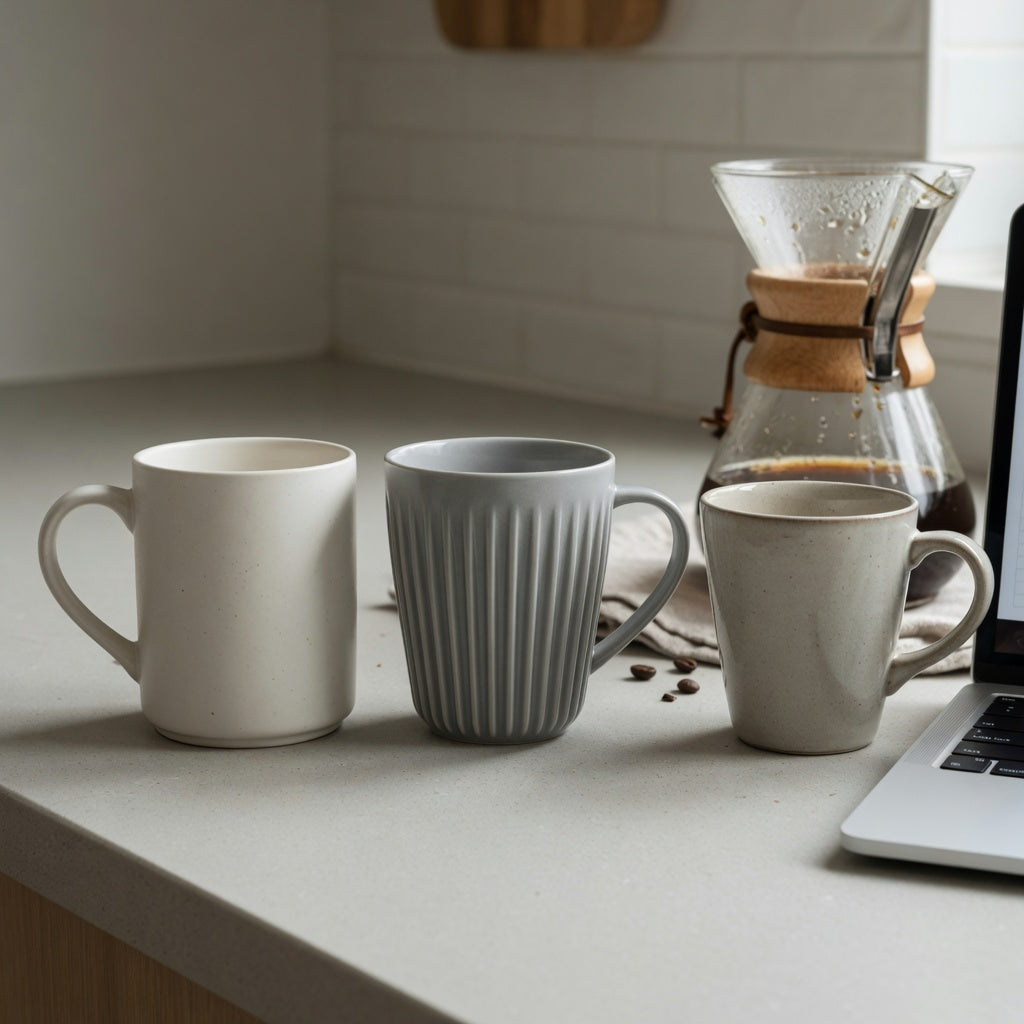
Minimalist Ceramic Mug Current Product Facts: 3 Styles Compared
Compare three current listings by capacity, ceramic material, body form, and handle: 400 ml round, 310 ml pleated, and 250 ml retro. We also flag missing dimensions, care details, and performance c...
Read more
Leave a comment
This site is protected by hCaptcha and the hCaptcha Privacy Policy and Terms of Service apply.