
Ceramic Glazed Coffee Mugs Buying Priorities: Size, Shape, Space
Reading time: about 9 minutes
A mug can clear a cabinet shelf yet still be wrong for the routine: its handle may crowd the laptop, its listed capacity may leave no room for milk, or its tall body may feel exposed near the edge of a desk. Those are the details shoppers tend to discover after the first full pour. Ceramic glazed coffee mugs buying priorities are easier to rank before ordering: start with usable capacity, then assess the visible shape and full footprint, and only then use glaze color as the deciding factor.
In our experience selling this category, photographs are useful for comparing finish and proportions, but they are not measuring tools. We check the live product page for capacity and dimensions when those details are listed, and we avoid estimating volume from a styled image. The same restraint helps shoppers: match confirmed facts to the place and drink you already have rather than asking a new mug to change your routine.
Ceramic glazed coffee mugs buying priorities: which variable wins?
The first priority should be the one that can make the mug unusable. On a compact office desk, that is usually the total footprint. For a measured morning brew, it is capacity. On an open kitchen shelf where several sizes would work, visible shape and glaze can carry more weight.
- Eliminate physical mismatches. Check the listed height, body width, and total width including the handle when those measurements are provided.
- Match the drink. Compare the listed capacity with the amount you actually pour, including milk, foam, or ice.
- Inspect the visible shape. Look at the base, body taper, rim, and handle opening from more than one product image.
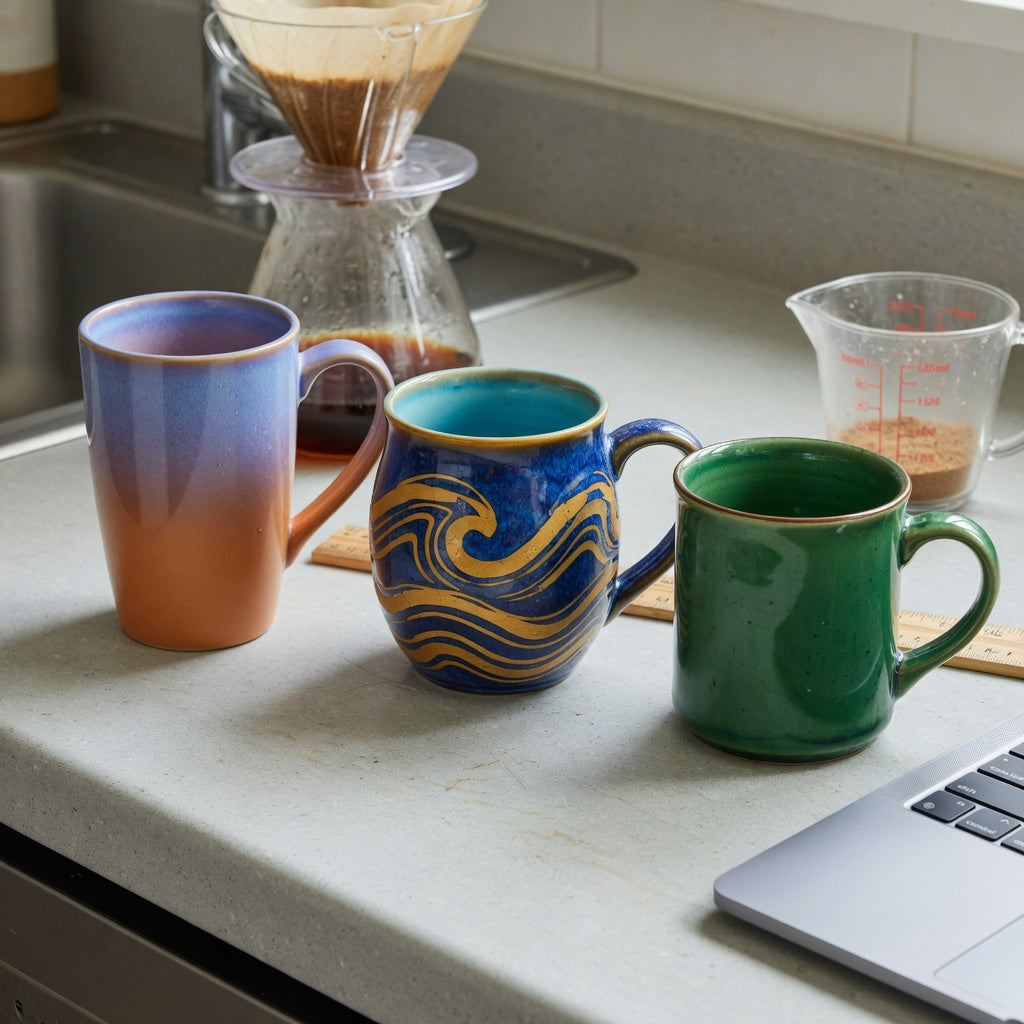
- Choose the finish. Use the gradient, wave-led, or emerald appearance as the tie-breaker once the practical checks pass.
This order is deliberately unglamorous. A beautiful glaze cannot create shelf clearance or extra room beside a keyboard. If a listing does not provide a measurement that your setup makes essential, do not substitute a visual guess.
Which listed capacity matches coffee, milk, tea, or ice?
Start by measuring the drink you already make. Pour your normal coffee or tea into a marked measuring cup, then add the milk, foam, or other additions you use most days. That total is more useful than choosing a mug around a vague label such as small or generous.
Listed capacity also needs context. Some sellers describe volume close to the rim, while comfortable carrying capacity leaves headspace. A mug filled to its absolute limit is difficult to move from a kitchen counter to a desk without spilling. We generally look for enough unused space at the top to walk at a normal pace and set the mug down without coffee reaching the rim.
- Measured drip coffee: match the normal brewed amount first and preserve headspace.
- Coffee with milk or foam: include the finished drink, not only the espresso or coffee base.
- Loose-leaf tea: allow room for an infuser if it sits inside the mug.
- Iced drinks: remember that ice occupies volume; also follow the product page's temperature and care guidance.
- Short, repeated pours: a smaller capacity can keep each serving from sitting too long, but it requires more refills.
A larger mug is not automatically more practical. More liquid means more filled weight, and a deep vessel may be awkward under a compact coffee machine. If capacity is not shown on a current listing, treat that as unknown rather than inferring it from the mug's apparent height.
How do body shape, handle clearance, and the foot affect daily use?
Shape is more than the outline seen from the front. The useful comparison includes the rim, handle opening, handle projection, body taper, and foot ring. The foot ring is the part of the ceramic base that contacts the table; a product image showing the mug from below or at a low angle can reveal more about that contact area than a straight-on lifestyle image.
For desk use, inspect the relationship between height and the visible base. A tall silhouette can use vertical space efficiently, but height also gives a bump at the rim more leverage. A broader-looking body may occupy more counter area. Neither profile is universally better, and photographs alone cannot confirm balance or filled weight.
Handle fit is equally personal. A compact loop may suit a two-finger hold but feel restrictive to someone who wants more fingers inside the handle. A large projecting handle can be comfortable while increasing the mug's total width beyond the ceramic body measurement. We recommend comparing the full side profile and looking for a listed handle-to-opposite-edge dimension when desk or cabinet space is tight.
Rim thickness and the handle joint are also worth inspecting in close product images. During gift preparation or routine cleaning, those are sensible places to check for chips or damage. Glaze variations that belong to a finish are different from a sharp chip at the drinking edge or a crack extending from the handle attachment.
Will the mug fit your shelf, coffee machine, and desk?
Measure the destination, not just the mug. Cabinet height is only one limit. A mug may fit vertically but collide with the shelf frame as the handle turns, or it may take up more width than expected once placed beside other cups.
- Cabinet: record clear height, usable shelf depth, and the width available with the handle facing outward.
- Coffee machine: measure from the drip tray to the dispenser and check the opening width around the mug.
- Desk: mark a paper rectangle using the listed overall dimensions, then place it beside the keyboard, notebook, and mouse.
- Microwave: only consider this placement if the current product page explicitly permits microwave use; then verify door and turntable clearance.
- Open shelf: allow enough room to lift the mug without scraping its rim against the shelf above.
The paper-template check catches a common oversight: the handle occupies space even though it holds no coffee. It also shows whether the mug would sit too close to a desk edge or block a frequently used drawer. If dimensions are not listed, the physical fit remains uncertain, and a different design with confirmed measurements may be the better purchase.
How do the Gradient, Golden Waves Kio, and Emerald mugs fit different shoppers?
These three pages offer distinct visible finishes, but their live listings should remain the source for current capacity, dimensions, care information, and availability. We do not assign a size, dishwasher status, or heat-use claim unless it appears on the relevant product page. That keeps the style comparison separate from facts that determine physical fit.
| Reader situation | Why the design may fit | What to verify before ordering |
|---|---|---|
| You want a visibly changing color treatment to stand out on an open shelf or in a gift box. | The Gradient Coffee Tea Mug makes its gradient finish the main visual feature. | Check the current listed capacity and any available height, body-width, and care details against your routine. |
| You prefer a more graphic surface treatment and the wave design is the feature drawing your attention. | The Golden Waves Kio Coffee Tea Mug is the relevant design to inspect rather than choosing by a generic color label. | Confirm physical measurements when listed and follow the page's exact care guidance, particularly for any decorative finish. |
| You want an emerald-colored mug that can coordinate with an existing kitchen or gift theme. | The Emerald Coffee Tea Mug gives you a specific color direction without requiring an inferred size claim. | Compare its listed capacity and dimensions with your measured drink and storage space. |
The practical mapping is simple: choose Gradient for the visible transition, Golden Waves Kio for the wave-led design, or Emerald for the named green color, but only after its current specifications pass your capacity and space checks. If none of the three clears those checks, compare additional finishes and silhouettes in our unique coffee mugs collection. A broader comparison is more useful than forcing the closest-looking option into the wrong routine.
What care does a glazed ceramic mug require?
Ceramic glaze is a fired, glass-like surface over the ceramic body. It can make routine cleaning straightforward, but it does not make the mug immune to impact, abrasion, or sudden temperature changes. The care statement on each product page takes priority over general category advice.
If a listing does not explicitly state that a mug is dishwasher-safe, hand washing with a soft sponge and ordinary dish soap is the cautious choice. Avoid abrasive pads around decorative surfaces. For a product whose page permits dishwasher use, place it so the rim and handle cannot knock against another hard item during the cycle.
Inspect three areas as the mug ages: the drinking rim for chips, the handle joints for cracks, and the glazed surface for crazing, which appears as a network of fine lines. Do not keep using a mug with a sharp rim chip or a structural crack. Thermal shock is another avoidable risk, so do not move a very cold ceramic mug directly into an extreme heat change unless the maker's instructions expressly support that use.
Who should choose a different mug style?
An open ceramic mug is a poor match for a commute that requires a sealed lid, a work area with frequent impacts, or a setting where drops onto hard flooring are likely. Ceramic can chip or break. An insulated travel mug may also suit someone who values prolonged heat retention and one-handed transport more than the feel and appearance of glazed ceramic.
These designs may also miss the mark if you need confirmed stacking, a specific machine clearance, or a care feature that is not stated on the live page. Missing information is not proof that a feature is present. Choose an option with specifications you can verify.
Frequently asked questions
Which ceramic glazed coffee mugs buying priorities matter most for a small desk?
Start with the total footprint, including the handle, followed by stability, usable capacity, and clearance from electronics. Mark the listed dimensions on paper and place the template in the intended spot. If the page does not give the measurements you need, do not estimate them from a close-up photograph.
Should I choose mug capacity from my coffee maker's serving label?
Measure the finished drink instead. Coffee-maker serving labels do not always correspond to the amount you pour after adding milk, foam, or ice, and you still need headspace for carrying. A marked measuring cup gives you a routine-specific target.
Can I assume a glazed ceramic mug is dishwasher- and microwave-safe?
No. Glazed ceramic describes the material and finish, not every care or appliance-use permission. Follow the exact instructions on the current product page; if dishwasher or microwave use is not stated, do not treat it as confirmed.
Which CoffeifyMug design should I choose as a gift?
Use the recipient's known color preference as the style filter: Gradient for a color transition, Golden Waves Kio for a wave-led design, or Emerald for an emerald color direction. Then verify capacity and dimensions for the recipient's usual drink and storage space. A visually suitable mug can still be inconvenient if it does not fit the routine.
What should I check immediately before ordering a ceramic glazed mug?
Write down your finished drink volume, maximum storage height, and available width including the handle. Open the relevant product pages side by side and compare only the specifications currently shown. If no featured design meets all three limits, use the unique coffee mugs collection to find a better physical match before choosing the glaze.
More from our blog
Read more

Small Ceramic Coffee Cup Buying Priorities: Capacity, Shape, Space
Match your usual pour, grip preferences, brewer clearance, and storage space before choosing a small ceramic cup. We compare the Pleated, Emerald, and Retro options without guessing beyond their vi...
Read more
Wassail Mug Buying Priorities: Capacity, Shape, and Space
Compare The Flow 400 ml, Morning and Night 440 ml, and The Rock 480 ml by serving size, filled-mug handling, and available space. This practical review also explains what listed capacity cannot tel...
Read more
Leave a comment
This site is protected by hCaptcha and the hCaptcha Privacy Policy and Terms of Service apply.