
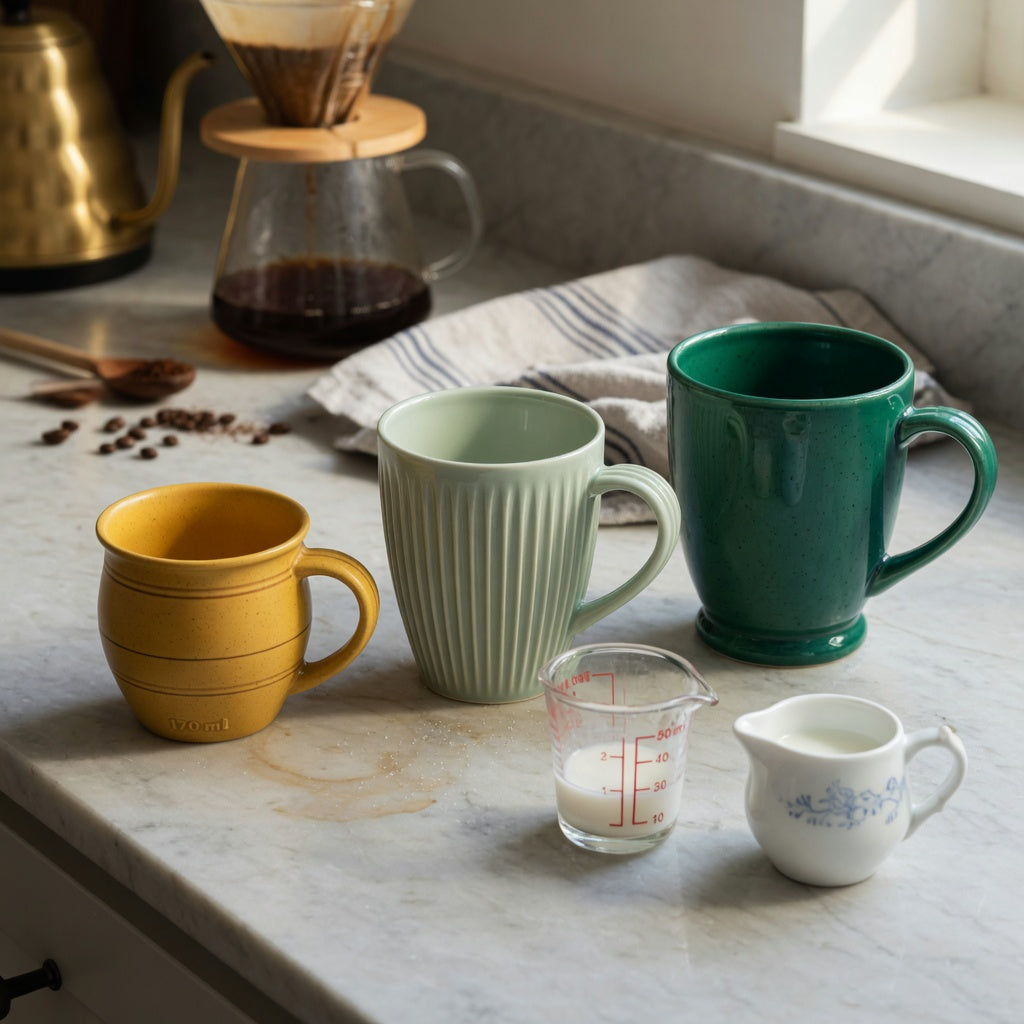
Ceramic Cortado Cup Home Coffee Station Product Shortlist Guide
Reading time: about 10 minutes
A cup can look correctly proportioned beside your coffee equipment and still feel wrong after the first pour. Put a 150 ml drink into a 270 ml vessel and, on paper, 120 ml of capacity remains above it; choose a cup too close to your finished volume and a small variation in milk can bring the drink uncomfortably near the rim. That is why our ceramic cortado cup home coffee station product shortlist guide begins with a measured pour rather than a styled product photo.
In our store, we use three verified catalog facts for this comparison: the Retro is 170 ml, the Pleated is 200 ml, and the Emerald is 270 ml. Those listed capacities help estimate practical headroom. They do not establish external dimensions, usable fill lines, appliance clearance, extraction performance, heat retention, or care compatibility. We also do not represent any of these ceramic options as purpose-built, tested, or certified for cortado service.
Which listed capacity leaves useful headroom?
The name of a drink is not a reliable volume measurement. Two people can both call their drink a cortado while using different espresso yields, milk quantities, and amounts of foam. Measure the version made at your station, including the variation that occurs on a rushed morning.
- Use your current cup for two or three normal drinks and identify the highest fill level you regularly reach.
- Once the cup is empty and cool, place a small strip of removable tape on the outside at that level.
- Fill the cup to the mark with cool water, then transfer the water to a graduated measuring jug.
- Use the highest normal reading, not the smallest, when comparing it with 170 ml, 200 ml, and 270 ml.
The basic planning calculation is listed capacity minus measured drink volume. A positive result represents nominal room, but it is not a promise of usable freeboard because the catalog facts do not specify cup geometry or how each listed capacity was measured.
| Measured finished drink | Retro 170 ml | Pleated 200 ml | Emerald 270 ml |
|---|---|---|---|
| 120 ml | 50 ml nominal room | 80 ml nominal room | 150 ml nominal room |
| 150 ml | 20 ml nominal room | 50 ml nominal room | 120 ml nominal room |
| 180 ml | 10 ml over listed capacity | 20 ml nominal room | 90 ml nominal room |
This table is capacity arithmetic, not a product-performance test. Do not plan to fill a cup to its maximum listed volume. The useful margin depends on how steadily you pour, how far you carry the drink, and how much your milk volume changes from one preparation to the next.
Our ceramic cortado cup home coffee station product shortlist guide: three measured pour scenarios
Each option earns a place on the shortlist only when its capacity matches a specific routine. Start with the highest normal volume you measured, then use these scenarios to decide which product page deserves a closer look.
Retro ceramic cup, 170 ml
Choose it for: a dedicated short drink that regularly measures near 120 ml and does not vary much. That example leaves 50 ml of nominal capacity, and the Retro has the least unused volume of the three verified options. It is the most direct shortlist choice for someone who dislikes seeing a small drink low inside a larger vessel.
Skip it when: your higher pours approach 150 ml, you frequently add more milk than planned, or you need one cup for longer drinks too. At 150 ml, only 20 ml separates the drink from the listed capacity before cup geometry is considered. The Retro should not be selected solely because 170 ml sounds like a cortado size.
Pleated ceramic cup, 200 ml
Choose it for: a station where a typical drink is around 140 to 150 ml but the milk pour changes slightly from day to day. A measured 150 ml drink leaves 50 ml of nominal room, giving it a middle position between the tighter Retro and the larger Emerald. For many mixed routines, that middle capacity is easier to justify than buying both extremes.
Skip it when: your drink is consistently close to 180 ml and you want more than a narrow planning margin. The arithmetic leaves only 20 ml at that volume. It can also be more capacity than you need if your usual pour stays well below 120 ml and close visual proportion is your priority.
Emerald ceramic mug, 270 ml
Choose it for: longer milk drinks, larger measured pours, or a shared station where finished volumes vary. A 180 ml drink leaves 90 ml of nominal room, so the Emerald gives the widest capacity buffer in this three-product shortlist. It is also the logical candidate if you want the same vessel for drinks that regularly exceed the smaller cups' listed capacities.
Skip it when: you make a tightly measured 120 ml drink most mornings and dislike substantial empty space. That pour leaves 150 ml of nominal unused capacity. The Emerald offers flexibility, but it is not the most proportionate choice for the shortest routine, and 270 ml still will not suit a drink whose measured volume plus desired margin exceeds that figure.
Will the cup fit beside your brewer, scale, and milk pitcher?
Capacity cannot answer this question. A 170 ml cup is not automatically shorter or narrower than every 200 ml cup, and a product name does not establish clearance under a particular appliance. We do not infer machine compatibility from the three capacity figures.
Check the physical station before ordering:
- Brewing clearance: measure from the surface where the cup rests to the lowest fixed part above it. If a scale normally sits underneath, include its height.
- Working width: measure the space left after the pitcher, scale, spoon rest, or other tools are in their normal positions.
- Storage clearance: record shelf height, depth, and usable width rather than assuming the cup will stack with pieces you already own.
- Overall product dimensions: verify current measurements on the product page or with our store before relying on photographs. Include any handle in the required width if the selected item has one.
A useful counter test is to leave your current cup in its working position for a full morning. Make the drink, wipe the counter, move the pitcher, and carry the cup to the kitchen table or office desk. Note where your hand or equipment runs out of room. That workflow reveals more than empty-counter measurements, but the selected product's actual dimensions still need to be confirmed before purchase.
What should you inspect when a ceramic cup arrives?
Ceramic drinkware should be checked before it becomes part of a daily station or gets wrapped as a gift. Rim chips, hairline cracks, rough contact points, and a base that rocks on a level surface are the practical condition issues our team looks for when handling this category. Decorative glaze variation may be intentional; structural damage is a different matter.
- Confirm that the model and listed capacity match the order information.
- Rotate the empty cup under bright side lighting and inspect the rim, interior, exterior, and foot for chips or visible cracks.
- If the item has a handle, look closely at both attachment points. Do not press or flex a joint that appears damaged.
- Place the empty cup on a clean, dry, level counter. Wipe the foot ring first so a crumb is not mistaken for persistent rocking.
- Photograph suspected damage before using the cup and contact the seller. Do not run a finger across an area that may be sharp.
Wash the cup before its first drink using the current instructions supplied with the product. The verified facts for this shortlist do not establish microwave or dishwasher safety, so we do not make either claim. If the product page or packaging does not answer that question, ask our store before putting the cup through a dishwasher cycle or into a microwave. A cautious manual-cleaning routine uses mild dish soap, lukewarm water, and a nonabrasive sponge, but product-specific directions take priority.
For a gift unboxing, ask the recipient to inspect the piece promptly and keep the order information until its condition and capacity are confirmed. A good-looking cup is still the wrong gift if its 170 ml, 200 ml, or 270 ml capacity does not match the recipient's normal drink.
When should you skip all three ceramic options?
A useful shortlist also identifies the point where none of the candidates fits. These cups cover three verified capacities, not every coffee-station job.
- If your finished drink plus a comfortable carrying margin exceeds 270 ml, select a larger vessel.
- If you drink only a small straight espresso and want very little empty capacity, a dedicated demitasse may suit the routine better.
- If ice is part of the drink, measure the liquid and ice together. Ice occupies capacity, so a larger mug or tumbler may be more practical.
- If you walk from the kitchen to an office desk and require a lid or travel seal, choose a product whose listing explicitly includes one. This shortlist makes no lid claim.
- If microwave use, dishwasher cleaning, or fit beneath a specific appliance is mandatory, wait until those details are confirmed for the exact product.
Shoppers whose measured routine falls outside this 170 to 270 ml range can compare other formats in our collection of unique coffee mugs. Filter by the job the vessel must do, then verify capacity, dimensions, and care information on the current listing. A different style is a better purchase than forcing a cortado-scale option into iced coffee, commuting, or high-volume tea service.
Frequently asked questions
Which ceramic cortado cup should I shortlist for a home coffee station?
Our ceramic cortado cup home coffee station product shortlist guide uses your highest normal finished volume as the starting point. Compare that measurement with the Retro 170 ml, Pleated 200 ml, and Emerald 270 ml, then allow additional room rather than planning to fill to the listed capacity. Confirm external dimensions and care requirements separately because capacity does not establish either one.
Is a 170 ml ceramic cup large enough for my cortado?
It can be, but the drink name alone cannot answer the question. A measured 120 ml drink leaves 50 ml of nominal capacity in the Retro, while a 150 ml drink leaves only 20 ml before geometry is considered. Choose the 170 ml option only if your normal high-end pour leaves a margin you are comfortable carrying.
Is the 200 ml Pleated cup a safer middle choice than 270 ml?
The Pleated is the middle listed capacity, but it is not automatically the best choice. It makes sense when your measured drink needs more room than the Retro offers and would leave more empty space than you want in the Emerald. Select 270 ml instead if longer drinks or variable household pours regularly use the extra capacity.
Are these ceramic cups microwave and dishwasher safe?
We do not make that claim from the verified information available for this shortlist. Check the current product page, packaging, or care insert for the exact item, and contact our store if the instruction is missing. Do not treat ceramic material alone as proof of microwave or dishwasher suitability.
How much headroom should a cortado cup have?
There is no single margin that fits every home routine. Someone carrying a drink across the house may want more room than someone sipping beside the machine, and variable foam can change the highest fill level. Measure your largest normal pour and treat capacity minus drink volume as an estimate, not guaranteed usable freeboard.
Your next step: complete this check before opening the product pages.
- Measure your highest normal finished drink volume.
- Compare the nominal room left at 170 ml, 200 ml, and 270 ml.
- Eliminate any option that is too tight or leaves more empty capacity than you want.
- Verify external dimensions, condition checks, and current care instructions.
- Choose one product for the routine you actually have instead of buying every size for a hypothetical one.
Start with the Retro for the shortest measured pours, the Pleated for a middle-capacity buffer, or the Emerald for greater volume variation. If none survives the checklist, return to the broader mug collection and select a format that fits the station without forcing the numbers.
More from our blog
Read more
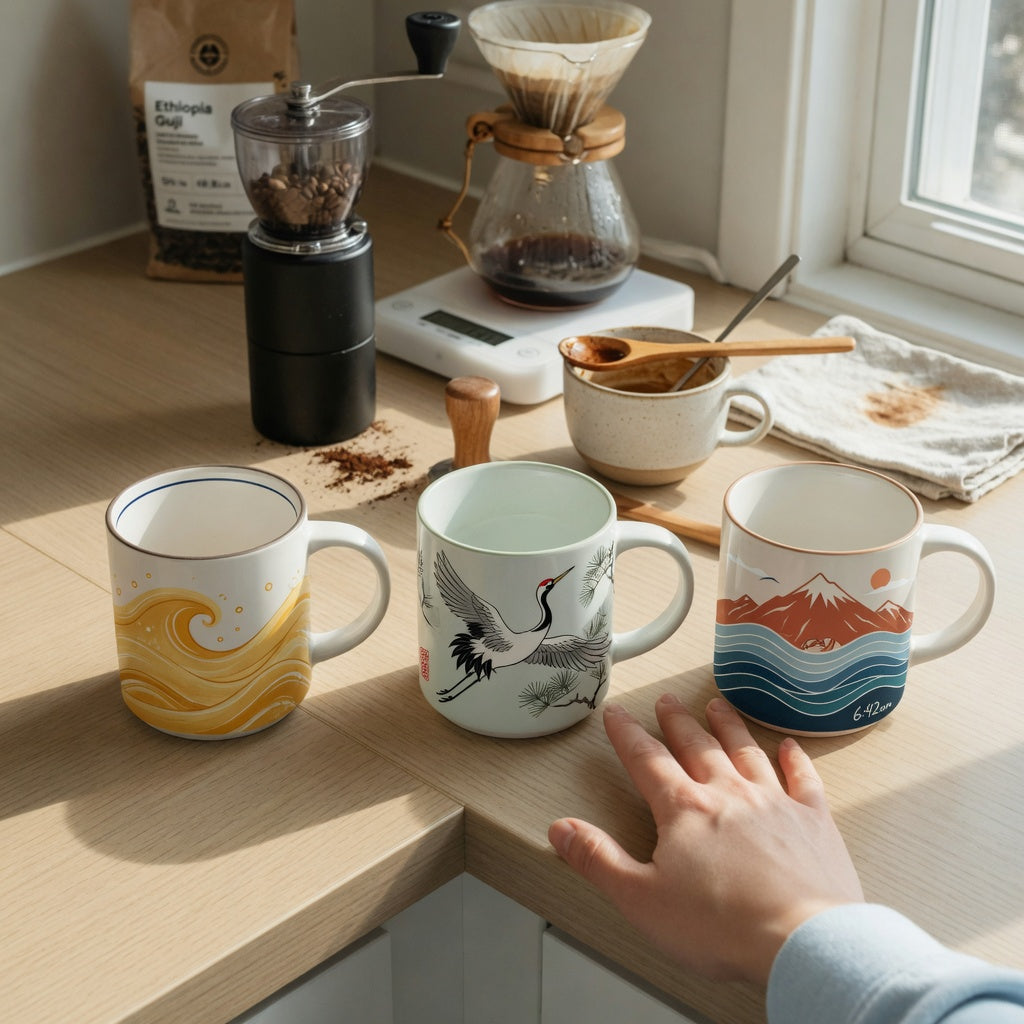
Coffee Mug Gift Idea Home Coffee Station Product Shortlist Guide
Use counter clearance, workflow, design fit, and verified care details to compare three CoffeifyMug options. Each recommendation explains who it suits, why it earns a place on the station, and when...
Read more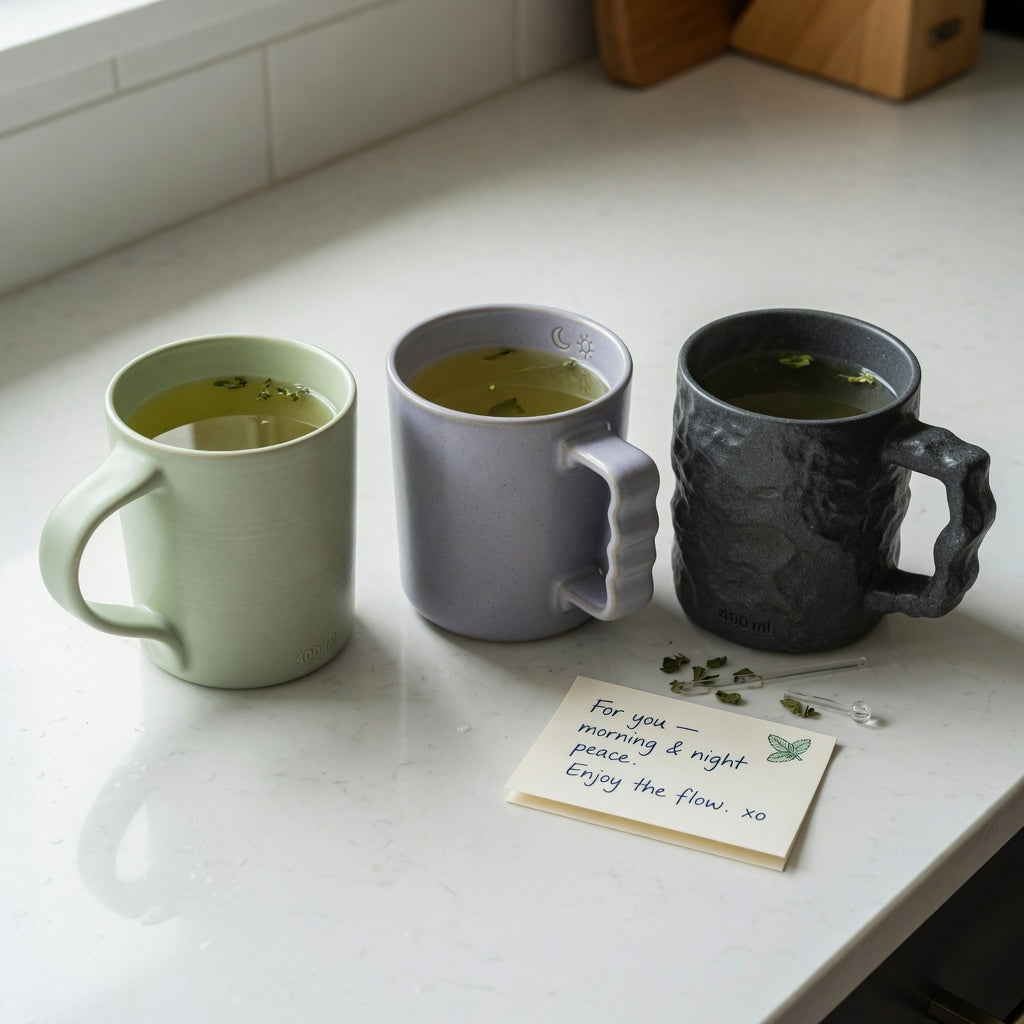
Peppermint Tea Mug Gift Choice Product Shortlist Guide
Compare three tea-ready mugs by 400, 440, and 480 ml capacities, recipient routines, and real handle feel. Each option includes a clear reason to choose it or remove it from your gift shortlist.
Read more
Leave a comment
This site is protected by hCaptcha and the hCaptcha Privacy Policy and Terms of Service apply.