
Ceramic Cortado Cup Buying Priorities: Capacity, Shape, Space
Reading time: about 9 minutes
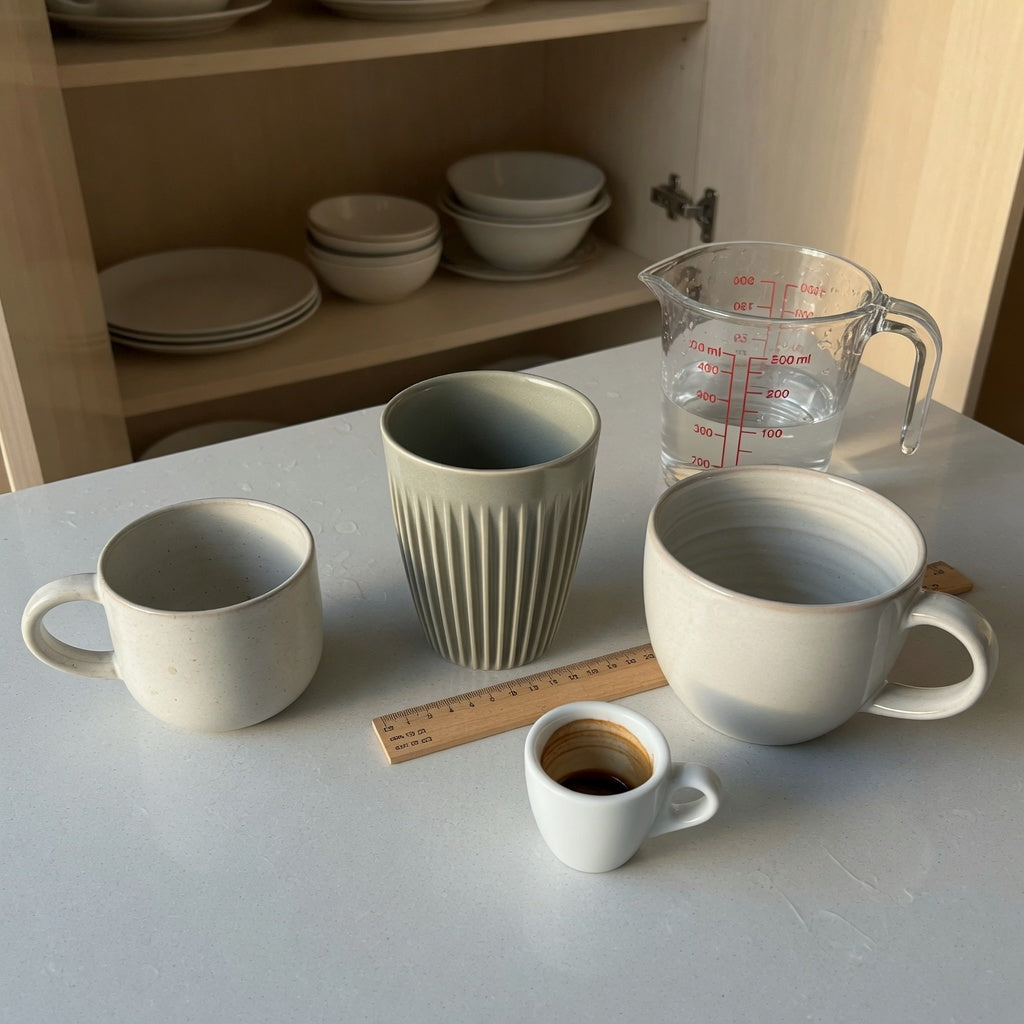
Fill your current cup with water to the same line as your usual cortado-style drink, then pour that water into a measuring jug. That 30-second check puts ceramic cortado cup buying priorities in the right order: your measured serving first, the visible shape second, and the space available on your counter, desk, or shelf third. Without that number, it is easy to buy a cup that leaves no comfortable rim clearance or makes a short drink look lost.
In our store, we treat listed capacity as the hard comparison point and everything else as a routine-fit question. For this comparison, the verified capacities are 170 ml for Retro, 200 ml for Pleated, and 270 ml for Emerald. We do not claim that any of these ceramic cups was purpose-built, tested, or certified for cortado service, and we do not infer heat retention, extraction performance, microwave compatibility, dishwasher safety, or commercial cafe suitability.
Ceramic cortado cup buying priorities: which number comes first?
Start with the amount you actually pour, including the milk you normally add. Do not rely on a generic cortado recipe if your home routine produces a different serving. Your own fill line is more useful than a nominal drink name.
- Fill your existing cup with water to your normal finished-drink level.
- Transfer the water to a graduated measuring jug and record the volume in milliliters.
- Decide how much extra room you want for foam, a variable milk pour, and movement from the kitchen to your desk.
- Compare that total requirement with the listed 170 ml, 200 ml, and 270 ml capacities.
A listed capacity may describe the vessel filled close to its maximum rather than a comfortable everyday line. Treat the difference between your measured pour and listed capacity as a screening estimate, not guaranteed usable headroom. If your drink nearly equals the stated capacity, move up unless you deliberately prefer a near-full cup and pour consistently.
170 ml, 200 ml, or 270 ml: how much nominal headroom are you buying?
A hypothetical 140 ml serving makes the capacity differences easy to see. This is an arithmetic example, not a prescribed cortado size. Substitute your own measured volume before choosing.
| Current option | Verified capacity | Capacity minus a 140 ml example | Relevant shopper situation |
|---|---|---|---|
| Retro Coffee Tea Cup | 170 ml | 30 ml nominal difference | A fixed, smaller pour where visual fullness matters more than extra buffer |
| Pleated Coffee Tea Cup | 200 ml | 60 ml nominal difference | A pour that changes slightly with milk or foam from one day to the next |
| Emerald Coffee Tea Mug | 270 ml | 130 ml nominal difference | A larger serving, more buffer, or occasional coffee and tea use beyond a short drink |
The Pleated adds 30 ml of listed capacity over the Retro. The Emerald adds another 70 ml over the Pleated and 100 ml over the Retro. Those differences are factual; the comfortable fill line still depends on your pour, foam height, and preferred distance below the rim.
What can visible shape tell you about grip and daily placement?
The product images provide useful shape information, but they cannot prove hand comfort or exact fit. The Retro shows a rounded, conventional cup silhouette. The Pleated has a visibly textured exterior with vertical contours. The Emerald presents a fuller, more mug-like form. Those distinctions affect appearance and may affect how each surface feels in your hand, but we do not treat visible texture as ergonomic testing.
Shoppers who prefer a plain profile may lean toward the Retro. Someone who likes a more tactile exterior and a design that stands out on an open shelf may prefer the Pleated. The Emerald makes more sense when a larger-looking vessel suits the rest of the drinkware on the counter and a lower liquid line does not bother you.
Shape also changes the cleaning conversation. A pleated exterior has more contours to inspect and wipe than a plain outer wall. That does not establish dishwasher compatibility or make it difficult to care for; it simply gives you more surface detail than a smooth-looking profile. Follow the current product instructions rather than assuming all ceramic drinkware has the same care requirements.
How should desk, cabinet, and brewer space affect the decision?
Capacity is not an exterior dimension. A 170 ml cup is not automatically the shortest or narrowest option, and a 270 ml mug is not automatically the widest at every point. Because verified exterior dimensions were not supplied for this comparison, we will not assign an exact footprint ranking based only on volume.
Measure the places that can reject an otherwise suitable cup:
- Cabinet: Record clear shelf height, usable depth, and side-by-side width.
- Brewing area: Check vertical clearance if you intend to brew directly into the cup.
- Office desk: Mark a spill-safe zone away from the keyboard, mouse, papers, and charging cables.
- Handle clearance: If a handle is part of the visible design, account for the widest overall point rather than measuring only the body.
Use any dimensions shown on the current product page to compare against those measurements. If an exact dimension is not listed, the honest answer is that fit remains unconfirmed. Product photography can indicate proportion, but perspective and lens choice make it a poor substitute for a ruler.
Which current cup fits a fixed, flexible, or larger pour?
- Fixed smaller pour: If your measured drink sits comfortably below 170 ml with the rim clearance you want, the Retro is the closest capacity match. Choose it because you value a fuller-looking cup and do not need much variation. Avoid it if your serving regularly approaches the listed capacity.
- Variable milk ratio: If some mornings include a little more milk or foam, the 200 ml Pleated provides 30 ml more listed capacity than the Retro. Its visible pleated exterior also suits shoppers who want texture rather than a plain profile. It is less suitable if you strongly prefer smooth external surfaces.
- Larger or mixed-use serving: If your measured drink needs more room than the 200 ml option can comfortably provide, the 270 ml Emerald is the logical next comparison. It also suits someone who wants to use the same vessel for larger coffee or tea servings. A short pour will sit lower, so it is not the best fit for shoppers who want the cup to look nearly full.
This situation-to-product mapping is how we apply our ceramic cortado cup buying priorities without turning an aesthetic preference into an unsupported performance claim. Capacity tells you what may fit. Visible shape tells you what you may enjoy handling and seeing. Measurements, where listed, tell you where the cup can physically live.
What should you inspect before first use or gifting?
From handling ceramic drinkware, we pay particular attention to the rim, base, surface, and any attachment points. These checks are useful when a cup arrives for your own kitchen and even more useful before gift wrapping, when the recipient will be the first person to use it.
- Inspect the rim under direct light for chips, sharp irregularities, or a line that appears to continue into the ceramic body.
- Set the empty cup on a clean, flat counter and check that the base sits steadily without material rocking.
- Look around the base and any handle attachment points for visible hairline cracks.
- Check textured areas, including pleats or grooves, for packing residue before washing.
- Read the current care instructions before using a dishwasher or microwave. Ceramic material alone does not confirm compatibility with either appliance.
If a new cup arrives chipped or visibly cracked, pause before using it and contact our store. A cosmetic preference is one thing; damage at the rim or through the body is a different issue and should be reviewed.
Which trade-off can rule out each option?
The 170 ml Retro is not a forgiving choice for a drink that already measures close to 170 ml. Foam and comfortable rim clearance need space, so a near-capacity serving can make pouring inconvenient. The 200 ml Pleated is not ideal for someone who dislikes external grooves or wants the plainest possible silhouette. Its middle capacity may also be unnecessary if your serving is consistently small.
The 270 ml Emerald is not the strongest match for a shopper who wants a short drink to fill most of the visible interior. Its extra 100 ml over the Retro creates more nominal buffer, but that same difference leaves a lower liquid line for an identical pour. It also deserves a careful dimension check if cabinet or brewer clearance is tight.
None of these compact options is a logical choice for a large iced drink that needs substantial room for both liquid and ice. They are also poor matches if you require a sealed lid, confirmed stacking geometry, or verified commercial cafe specifications. For other shapes and capacities, browse our unique coffee mug collection and confirm each listing against the same measurements rather than assuming every style solves those needs.
What can you confirm in three minutes before ordering?
- Write down your measured finished-drink volume.
- Add the amount of rim clearance you prefer rather than choosing by drink name alone.
- Decide whether a rounded, pleated, or fuller mug-like silhouette suits your routine.
- Measure cabinet height, brewer clearance, and the clear area on your desk or counter.
- Open the relevant product page and verify current dimensions and care details where provided.
If capacity is the deciding factor, compare 170 ml, 200 ml, and 270 ml first. If two options both clear that requirement, let visible shape and confirmed exterior fit break the tie.
Frequently asked questions
Which ceramic cortado cup buying priorities matter most in a small kitchen?
Measure your pour first, then confirm the cup's exterior dimensions against your cabinet and brewing area. Do not assume the lowest-capacity cup has the smallest outside footprint. Shape, handle projection, and height can matter more than the milliliter figure for storage.
Is a 170 ml ceramic cup too small for a cortado-style drink?
It depends on your measured finished drink and the clearance you want below the rim. If your serving sits comfortably below 170 ml, the Retro may provide the visually full result you prefer. If the drink approaches 170 ml after milk or foam, compare the 200 ml Pleated instead.
Does a 200 ml cup guarantee enough room for foam?
No. The 200 ml figure is listed capacity, not a guaranteed comfortable fill line. Subtract your own measured drink volume and leave a margin that reflects how much foam you add and how steadily you pour.
Can I use the 270 ml Emerald for a short cortado-style drink?
Yes, provided you are comfortable with the drink sitting lower in the vessel. The larger listed capacity gives more nominal room than the 170 ml and 200 ml options, but it will not create a near-full visual presentation for the same short pour.
Are these ceramic cups dishwasher or microwave safe?
That cannot be confirmed from capacity or ceramic material alone. Check the current care information on the individual product page before using either appliance. We do not infer dishwasher or microwave compatibility where it is not explicitly stated.
Write down three things before you buy: your serving volume in milliliters, your preferred buffer below the rim, and the maximum exterior space available. Then open the matching product listing or compare other designs in the collection with those numbers beside you. That keeps the decision tied to your actual routine rather than an assumed cortado size.
More from our blog
Read more

Ceramic Wide Bottom Coffee Mugs Buying Priorities: Capacity and Fit
Compare listed capacity, visible silhouette, base footprint, handle reach, and care notes against the drink and space the mug will serve. We map three CoffeifyMug shapes to practical desk, kitchen,...
Read more
Thick Ceramic Coffee Mugs Current Product Facts Compared
Compare the listed capacities, shapes, material, and care statements for The Rock, The Flow, and Spittoon. We also flag missing weights and dimensions so you know which purchase decisions the pages...
Read more
Leave a comment
This site is protected by hCaptcha and the hCaptcha Privacy Policy and Terms of Service apply.